
Even experienced coaches encounter difficult clients, ethical dilemmas, emotional exhaustion, and situations where their usual techniques stop working. Coach supervision provides structured professional reflection that helps practitioners recognize blind spots, strengthen judgment, and improve the quality of their work. As demand grows for ethical coaching practices, effective behavior change, and professional accountability, supervision offers a valuable development pathway. Understanding how it works, when to seek it, and how to evaluate its outcomes can help coaches build more sustainable, confident practices.

1. What Is Coach Supervision, and Why Does It Matter for Coaching Mastery?
Coach supervision is a structured process in which a practicing coach works with a qualified supervisor to examine their coaching relationships, professional decisions, emotional responses, and ethical responsibilities.
The International Coaching Federation (ICF) describes supervision as a collaborative reflective process supporting coaches' personal, professional, and ethical development. The European Mentoring and Coaching Council (EMCC Global) similarly emphasizes professional standards, practitioner development, and well-being.
These frameworks position supervision as part of continuing professional development, particularly for coaches handling complex relationships and professional responsibilities.
The distinction becomes clearer when considering what actually happens during difficult coaching sessions.
A client repeatedly misses agreed commitments. The coach becomes frustrated and starts delivering increasingly direct advice. Although the client initially responds positively, their engagement gradually declines.
The coach might assume that the client lacks motivation. During supervision, however, the supervisor could ask what the coach feels when commitments are missed, whether frustration influences their questioning, and how the relationship changes when the coach becomes directive.
That reflection may uncover a problem in the coach's approach: an unspoken need to produce visible results is interfering with the client's autonomy.
The resulting improvements could involve collaborative SMART goal setting, more effective accountability conversations, and a stronger understanding of behavior change resistance.
The three functions of professional coach supervision
Developmental supervision examines how coaches think, listen, intervene, and make decisions. It helps practitioners recognize patterns that may remain invisible during everyday sessions.
A coach using the CLEAR coaching model may discover that they routinely move toward action planning before clients fully understand their underlying concerns. Supervision can help them practice more deliberate listening and inquiry.
Restorative supervision provides space to process the emotional demands of coaching. Practitioners supporting clients through stressful life transitions can experience frustration, self-doubt, or excessive responsibility.
Reflective support complements appropriate self-care practices, resilience-building strategies, and awareness of career burnout.
Normative supervision addresses ethical practice, quality standards, client protection, and professional accountability.
This becomes particularly important when coaches encounter potential conflicts involving therapist-versus-coach boundaries, nutrition coaching limitations, or duty-of-care responsibilities.
These three functions often overlap. A supervision conversation about a difficult client may uncover a technical weakness, an emotional reaction, and an ethical concern simultaneously.
Coach supervision vs. mentor coaching vs. therapy
The distinctions matter when deciding what type of professional support to purchase.
Mentor coaching typically concentrates on developing observable coaching competencies. It may involve reviewing recorded sessions, evaluating questioning techniques, and improving performance against recognized standards.
Coach supervision explores the coach's wider professional functioning, including their assumptions, relationships, ethical maturity, and awareness of organizational or cultural influences.
Personal therapy addresses an individual's psychological needs through a clinical or therapeutic relationship. Coaches experiencing personal mental health difficulties may benefit from therapy alongside professional supervision.
The ICF distinguishes supervision from mentor coaching, particularly in credentialing and professional development.
For coaches building a health coaching career, pursuing professional certification, or strengthening client trust, understanding these differences prevents confusion about the purpose and value of each service.
| Coaching Challenge | Hidden Supervision Issue | Supervisor's Key Question | Practical Improvement |
|---|---|---|---|
| 1. Client repeatedly misses goals | Coach interprets setbacks as resistance | What assumptions are shaping your response? | Explore barriers before adjusting commitments |
| 2. Coach gives excessive advice | Need to demonstrate expertise | Whose agenda drives the session? | Increase reflective questions and client choice |
| 3. Client becomes dependent | Unclear autonomy and support boundaries | How is the client developing independence? | Introduce self-management milestones |
| 4. Coach feels responsible for results | Overidentification with client outcomes | Which responsibilities genuinely belong to you? | Revisit shared accountability agreements |
| 5. Difficult client triggers frustration | Unexamined emotional reactions | What does this interaction activate in you? | Identify triggers and rehearse neutral responses |
| 6. Client discloses psychological distress | Risk of exceeding coaching competence | What referral or safety action is indicated? | Use an appropriate professional referral pathway |
| 7. Client requests medical advice | Clinical scope boundaries unclear | Where does coaching end and treatment begin? | Clarify scope and involve qualified clinicians |
| 8. Repeated session cancellations | Weak contracting and accountability | What expectations were agreed upon? | Review attendance and cancellation terms |
| 9. Coach avoids challenging clients | Fear of damaging the relationship | What makes respectful challenge uncomfortable? | Practice permission-based challenge |
| 10. Coach dominates conversation | Overreliance on teaching | How much space does the client receive? | Review recordings with consent |
| 11. Client demands guaranteed results | Pressure to make unrealistic promises | What outcomes can you responsibly control? | Clarify service and outcome expectations |
| 12. Client becomes emotionally attached | Professional relationship boundaries blur | Which interactions may reinforce dependency? | Review communication and availability limits |
| 13. Coach experiences compassion fatigue | Emotional workload exceeds available recovery | What signs indicate depleted capacity? | Adjust workload and seek suitable support |
| 14. Confidentiality concerns emerge | Client information handled inconsistently | What data needs protection or consent? | Strengthen privacy and records procedures |
| 15. Employer requests private client details | Conflict between sponsor and client expectations | What disclosure was agreed at contracting? | Reconfirm consent and reporting limits |
| 16. Coach feels intimidated by executives | Status differences influence coaching behavior | How does perceived authority affect your questions? | Practice equitable professional positioning |
| 17. Client resists behavior change | Coach moves toward solutions prematurely | What competing commitment remains unexplored? | Investigate ambivalence and readiness |
| 18. Coach overlooks cultural context | Personal assumptions shape recommendations | Whose definition of success is being applied? | Invite client-defined goals and context |
| 19. Client discusses traumatic experiences | Risk of practicing beyond professional scope | How can you maintain safety and boundaries? | Refer appropriately without attempting therapy |
| 20. Group members disclose private issues | Group confidentiality is insufficiently defined | What safeguards were agreed by participants? | Strengthen group contracting procedures |
| 21. Coach favors certain clients | Unconscious bias and personal identification | Which client characteristics influence your attention? | Review patterns and equitable practice |
| 22. Sessions produce insights but no action | Reflection is disconnected from implementation | What commitment emerges from each session? | Link insights with client-owned next steps |
| 23. Coach uses AI for session summaries | Privacy and accuracy risks are overlooked | What consent and safeguards govern AI use? | Review tools, disclosure, and human oversight |
| 24. Coach fears losing clients | Financial anxiety influences professional judgment | Are business concerns changing your boundaries? | Separate commercial decisions from client care |
| 25. Client reports no meaningful progress | Outcome measures and expectations are unclear | How was success originally defined? | Reassess goals and observable indicators |
| 26. Coach becomes overly directive | Discomfort with ambiguity | What happens when you allow uncertainty? | Practice curiosity and collaborative exploration |
| 27. Coach struggles with client silence | Belief that constant talking creates value | What might silence allow the client to process? | Experiment with intentional pauses |
| 28. Organizational coaching creates conflicts | Multiple stakeholders hold competing goals | Whose interests are influencing your decisions? | Clarify sponsor, coach, and client agreements |
| 29. Coach repeats the same approach | Habitual methods limit professional growth | What alternative interpretation have you missed? | Test different questions and interventions |
| 30. Coach doubts professional competence | Self-criticism interferes with reflective learning | What evidence supports or challenges your concern? | Develop a targeted competency improvement plan |
2. How Coach Supervision Works: From Difficult Client Cases to Better Coaching Decisions
Effective supervision begins before the meeting. Coaches bring a genuine professional dilemma, examine their role in the situation, consider alternative interpretations, and translate new insights into changes they can test.
The process typically involves preparation, reflection, collaborative exploration, and follow-up.
Step 1: Identify a specific supervision question
An effective starting question focuses on the coach's professional practice rather than attempting to obtain a diagnosis or explanation of the client.
For example, a coach working with someone struggling to establish healthier routines might ask:
“Why do I become increasingly directive whenever this client misses a commitment, and how might my response be affecting their autonomy?”
This provides a stronger basis for reflection than simply asking how to make the client more motivated.
The supervisor can then explore the coach's use of behavior change techniques, habit-stacking methods, and collaborative goal setting.
A useful preparation note includes the agreed coaching objective, what occurred, what the coach noticed internally, and the decision they are currently struggling with.
Step 2: Reconstruct the session without rewriting events to protect your ego
Coaches naturally remember conversations through their own interpretations. Supervision helps distinguish observable events from assumptions.
Suppose a client becomes quiet after being challenged.
The observable event is that the client stopped speaking for approximately 30 seconds. The interpretation might be that the client felt criticized, became defensive, or disengaged.
Each interpretation suggests a different response.
A supervisor might ask what evidence supports the interpretation, what alternatives deserve consideration, and how the coach could explore the silence collaboratively.
Practitioners familiar with the CLEAR coaching model, transactional analysis, and emotional agility can use supervision to examine how their preferred frameworks influence interpretation.
Step 3: Examine emotional reactions and relationship dynamics
Some of the most valuable supervision discoveries concern the coach's response to the client.
A coach might feel compelled to rescue someone who appears overwhelmed. Another might become unusually passive when coaching a senior executive.
These reactions can influence the quality of questions, the pace of sessions, and the balance of responsibility.
Supervision encourages awareness of such patterns without turning the meeting into personal therapy.
The practical objective is to identify how emotional responses affect professional behavior and what adjustments would improve the relationship.
This becomes especially relevant in career burnout coaching, couples coaching, and leadership coaching, where interpersonal expectations and competing interests can become complicated.
Step 4: Develop alternative approaches and test them
A useful supervision session concludes with a practical experiment.
The coach might agree to use fewer directive questions, revisit the coaching agreement, ask permission before challenging an assumption, or introduce a clearer referral boundary.
For instance, a coach supporting someone through persistent setbacks could explore immunity-to-change techniques instead of repeatedly revising the client's action plan.
Another coach might apply strengths-based approaches to reduce excessive attention to failures.
The key is to define an observable change in coaching behavior.
Rather than promising to listen better, the coach might commit to asking one additional exploratory question before proposing any intervention.
Step 5: Review what changed at the next session
Follow-up converts reflection into professional learning.
A simple record can capture the original concern, the hypothesis explored, the practice change attempted, and the result observed.
For example, a coach can review whether clients increasingly generate their own solutions, whether session agreements become clearer, and whether difficult conversations feel more collaborative.
These observations can complement accountability coaching practices, the OSCAR coaching model, and effective professional contracting.
A valuable supervision session produces a clearer professional decision and a specific opportunity to improve practice. Repeating supportive conversations without identifying learning or action can limit the usefulness of the investment.
3. Individual vs. Group Coach Supervision: Which Format Builds Better Coaching Skills?
Individual and group supervision offer different forms of professional learning. The appropriate choice depends on the coach's experience, the complexity of their work, confidentiality requirements, and the type of reflection needed.
Individual supervision: Best for sensitive or recurring professional challenges
One-to-one supervision provides dedicated time to examine a coach's distinctive patterns and difficult professional decisions.
It is particularly useful when a practitioner is struggling with boundaries, feeling emotionally affected by clients, managing confidential situations, or repeatedly encountering similar coaching difficulties.
Consider a life coach building an independent practice who feels anxious whenever clients consider ending their contracts.
That anxiety may lead to excessive availability, premature discounts, or avoidance of necessary challenges.
A supervisor can help examine how commercial pressure influences coaching decisions, while encouraging clearer professional contracting, healthier client retention practices, and appropriate ethical boundaries.
Individual supervision also offers continuity. A supervisor who follows the same practitioner over several months can notice recurring themes that may be overlooked in isolated discussions.
Best suited for: Sensitive ethical questions, emotionally demanding cases, recurring relationship patterns, and focused professional development.
Group supervision: Best for multiple perspectives and professional isolation
Group supervision involves structured reflection with a supervisor and other practitioners.
The central benefit is exposure to different interpretations of similar coaching situations.
A coach might describe a client as unmotivated. Another group member could identify unrealistic goals. A third might notice cultural expectations influencing the client's behavior.
These perspectives help practitioners challenge their assumptions and expand their professional judgment.
Group supervision can be especially valuable for coaches learning cultural competence, applying holistic coaching methods, or working across unfamiliar health coaching specializations.
However, group participation requires clear confidentiality agreements, respectful discussion rules, and careful handling of case information.
The EMCC Global supervision guidance explicitly recognizes structured group reflection as a professional development approach.
Best suited for: Learning from diverse experiences, developing systemic awareness, reducing professional isolation, and exploring common practice challenges.
How often should coaches attend supervision?
Frequency should reflect professional responsibilities and the risks associated with the coaching environment.
A new coach might begin with monthly sessions while establishing consistent reflective habits. An experienced practitioner handling complicated organizational relationships may need more frequent support during demanding engagements.
These are practical starting points, rather than universal professional requirements.
The distinction matters because some workplaces and credentialing systems establish specific standards.
For example, the NHS England health and wellbeing coach workforce development framework, published in August 2026, specifies at least monthly supervision for full-time health and wellbeing coaches operating under that framework.
By comparison, ICF generally treats supervision as professional development rather than a requirement for initial ACC, PCC, or MCC credentials. Its Advanced Certification in Team Coaching (ACTC) includes specific supervision requirements.
Coaches considering corporate health coaching roles, remote health coaching jobs, or board certification pathways should verify the standards applicable to their particular role.
A practical schedule might combine monthly group supervision with individual sessions when a sensitive dilemma arises.
What evidence shows that coach supervision improves results?
Professional bodies strongly support supervision, and practitioner experience suggests benefits for reflective capacity, ethical awareness, and professional confidence.
However, direct experimental evidence establishing that supervision consistently improves client outcomes remains limited.
It would therefore be misleading to promise that supervision automatically increases client retention, produces faster behavior change, or raises coaching revenue.
A more defensible approach is to measure changes in observable coaching competence, decision-making, boundary management, and client feedback.
These indicators help practitioners determine whether their investment is generating meaningful professional development.
Submit Your Vote Change Your Vote
Please select an option above to see your recommendation.
Your Personalized Supervision Recommendation
Here's a practical next step based on your biggest professional concern:
Ethical decision-making: Arrange focused individual supervision. Bring an anonymized case, identify the competing responsibilities, review your professional code of ethics, and agree on a documented next step. Use urgent safeguarding procedures immediately where a situation requires them.
Clients who feel stuck: Bring a specific coaching interaction to supervision. Explore your assumptions, the client's competing commitments, and whether your interventions have become overly directive. Test one alternative approach during the next suitable session.
Professional confidence: Request competency-focused reflection alongside supervision. With appropriate client consent, review recorded sessions and identify two observable skills to develop. Consider mentor coaching for targeted technical feedback.
Emotional exhaustion: Use restorative supervision to examine emotional boundaries, workload, and patterns of over-responsibility. Develop a recovery plan and seek additional professional support when needed.
Supervision value: Begin with a defined three-session development experiment. Establish two specific objectives, record insights and practice changes, and evaluate the results before committing to a longer package.
Finding a supervisor: Shortlist practitioners with recognized supervision training and relevant experience. Ask about their approach, confidentiality, ethical framework, professional supervision, fees, and references before scheduling an introductory conversation.
Interactive on-page selection with personalized feedback. This HTML/CSS-only poll does not store or tally votes.
4. How to Find a Qualified Coach Supervisor: Credentials, Red Flags & Questions to Ask
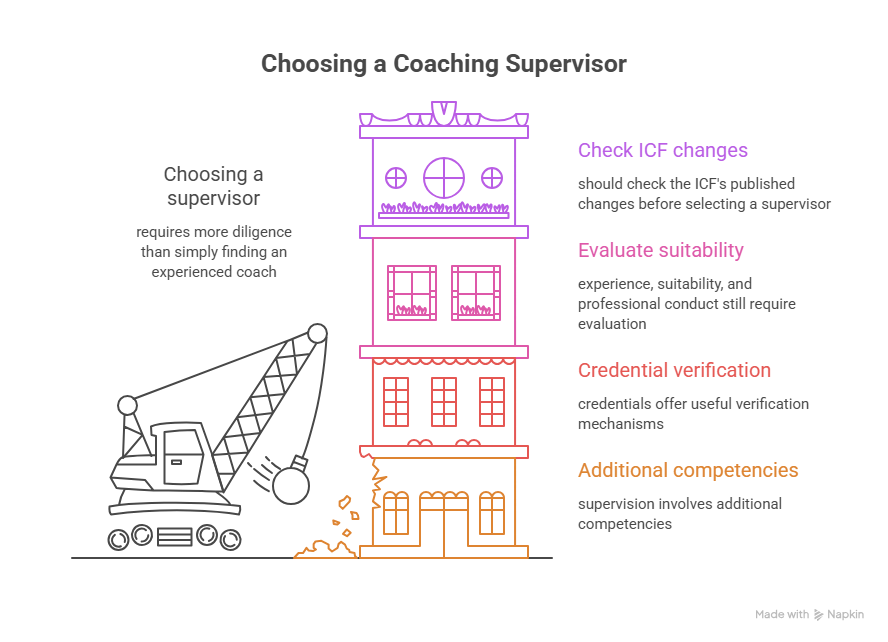
Choosing a supervisor requires more diligence than simply finding an experienced coach.
Professional coaching experience can provide valuable context, but supervision involves additional competencies: facilitating reflective dialogue, managing ethical complexity, understanding professional boundaries, and recognizing how the coach's identity influences their work.
Check supervision qualifications, not just coaching credentials
The ICF introduced its Coaching Supervisor Specialization (CSS) in 2026, recognizing practitioners with dedicated preparation in coaching supervision.
Its standard pathway requires an active PCC or MCC credential, or an eligible advanced credential from another recognized professional body, plus at least 41 hours of relevant supervision education, with at least half delivered synchronously.
EMCC Global also offers its Supervision Individual Accreditation (ESIA), recognizing qualified practitioners who meet its supervision-related standards.
These credentials offer useful verification mechanisms, although the supervisor's experience, suitability, and professional conduct still require evaluation.
An important 2027 change: Beginning January 1, 2027, ICF introduces updated eligibility requirements for supervisors whose hours are used toward relevant credential renewal and ACTC requirements. Coaches planning to claim supervision hours should check the ICF's published changes before selecting a supervisor.
Practitioners pursuing ICF-related coaching pathways should distinguish these requirements from NBHWC board-certification requirements.
Ask eight questions during the introductory consultation
1. What supervision-specific training have you completed? Request the qualification name, awarding body, relevant experience, and an explanation of the supervisor's preferred theoretical approach.
2. How do you handle confidentiality? Ask about anonymizing cases, record storage, disclosure limitations, and any legal or safeguarding exceptions.
3. How do you distinguish supervision from therapy and mentor coaching? A credible supervisor should explain when they will recommend another professional service.
4. What experience do you have with my coaching environment? Supervising corporate health coaches can involve different organizational pressures from supervising independent life coaches or nutrition-focused practitioners.
5. How will we measure development? Look for agreed objectives, documented reflection, review intervals, and observable changes in professional behavior.
6. Who supervises your own supervisory practice? Ongoing professional reflection and accountability are positive indicators of responsible practice.
7. How do you respond when a coach disagrees with you? The answer should demonstrate openness to challenge, collaborative exploration, and respect for professional autonomy.
8. What are the full costs and cancellation terms? Request written information covering session length, frequency, group size where relevant, preparation expectations, and termination conditions.
Five red flags that should stop you from committing
A supervisor guarantees professional mastery after a fixed number of sessions. Reflective development depends on practice, participation, and the nature of the challenges encountered.
They promise to solve every client problem. Appropriate supervision develops professional judgment. Complex cases may also require clinical consultation, legal guidance, or specialist referral.
They encourage sharing identifiable client records without considering confidentiality. Supervisory contracts should explain how information is protected, particularly where sensitive health coaching information or therapeutic boundaries are involved.
They consistently prescribe solutions instead of facilitating reflection. Professional supervision should encourage the coach to examine assumptions, choices, and responsibilities.
They discourage independent judgment or create dependency. A supervisor who expects unquestioning agreement may reinforce the very power dynamics supervision should help practitioners recognize.
Evaluate these behaviors against professional coaching codes, client contracting principles, and duty-of-care expectations.
For coaches developing a leadership coaching specialization, working in holistic coaching, or expanding into health behavior change programs, the supervisor's ability to understand relevant professional contexts can make reflection more productive.
5. Is Coach Supervision Worth the Cost? A 90-Day Professional Development Plan
The value of coach supervision should be assessed through professional development, rather than assumed increases in income or client satisfaction.
A supervisor may help a coach improve boundaries, recognize unhelpful responses, manage difficult conversations, or develop more consistent ethical judgment.
These changes can support stronger professional practice, even where financial benefits cannot be measured directly.
Calculate your supervision investment realistically
Consider a hypothetical coach purchasing one 75-minute individual supervision session each month for $150.
Over three months, the direct supervision expense would be $450.
If preparation, reflection, and follow-up require two additional hours monthly, the total time commitment becomes 9.75 hours across the period.
A useful evaluation asks what development occurred during that investment.
For example, the coach might learn to manage premature advice-giving, improve coaching discovery conversations, strengthen client agreements, and address recurring accountability challenges.
These are potential improvements, rather than guaranteed outcomes. The price is illustrative and should not be interpreted as a market average.
Month 1: Establish a professional baseline
Select two recurring concerns and define how they appear in actual coaching sessions.
For example, the first concern might involve giving advice too quickly. The second might involve struggling to challenge unrealistic client expectations.
Establish observable indicators, such as how often the coach interrupts, initiates solutions before client exploration, or avoids discussing a difficult agreement.
Use a reflective journal after sessions, recording relevant events, interpretations, and alternative responses.
Frameworks such as the CLEAR coaching model, strengths-based coaching, and positive psychology coaching can help organize professional observations.
The baseline should capture genuine practice patterns rather than idealized performance.
Month 2: Test specific changes
Choose one behavioral experiment for each concern.
A coach who habitually offers advice could practice asking clients what options they have already considered before presenting information.
A coach who avoids disagreement might practice respectfully identifying inconsistencies between stated priorities and actual commitments.
Review these experiments during supervision. Explore situations where the changes helped and cases where they created new difficulties.
Consider how emotional agility, cultural competence, and immunity-to-change techniques influence the coach's interpretation.
The objective is to develop professional flexibility across different client situations.
Month 3: Evaluate progress and determine the next development priority
Review the original concerns and identify evidence of improvement.
Useful indicators include clearer session agreements, more client-generated actions, greater comfort discussing boundaries, and better recognition of professional referral needs.
Request feedback from clients where appropriate, using neutral questions that avoid pressuring them to praise the coach.
Also review the coach's well-being and workload. Progress may involve developing healthier boundaries or recognizing unsustainable responsibilities.
These observations can inform professional resilience practices, career burnout prevention, and long-term professional development.
Use a simple supervision effectiveness score
At the end of 90 days, rate five dimensions from zero to four:
Recognition of professional blind spots.
Improvement in reflective questioning.
Confidence managing ethical boundaries.
Ability to respond flexibly to challenging situations.
Consistency translating reflection into practice changes.
The maximum score is 20. Compare the result with the initial baseline and attach concrete examples to each rating.
This is a self-assessment tool for structured reflection, rather than a scientifically validated measure of coaching competence.
If development remains limited, consider whether the supervision objectives were sufficiently specific, whether the supervisor's approach fits your needs, or whether targeted mentor coaching would address the problem more effectively.
Coaches examining long-term career sustainability, client trust factors, and professional service quality can use this review to make more informed decisions about ongoing supervision.
6. FAQs: Coach Supervision, Professional Standards & Coaching Mastery
-
Requirements depend on the credentialing organization, jurisdiction, employer, and coaching role.
ICF generally encourages supervision for professional development and permits eligible supervision hours to contribute toward credential renewal. Initial ACC, PCC, and MCC credentialing pathways focus on mentor coaching, while the ACTC has specific supervision requirements.
The NBHWC Code of Ethics also addresses engagement in supervision or peer review for professional accountability.
Check the requirements associated with your health coach certification pathway, ICF or NBHWC credential goals, and corporate coaching employment.
-
Yes. Beginners can use supervision to develop reflective habits, recognize uncertainty, and establish healthy professional boundaries early.
For example, a new coach struggling with client silence might explore their discomfort with uncertainty rather than immediately adding more questions.
However, practitioners needing technical feedback on specific coaching competencies may benefit more directly from mentor coaching.
New professionals exploring coaching certification value, health coaching employment, and early client acquisition should distinguish the developmental purpose of each service.
-
Begin by removing names, addresses, contact information, and other unnecessary identifying details.
Also examine indirect identifiers. An unusual combination of occupation, location, organizational role, and personal circumstances may allow someone to recognize a client even without their name.
Review the original coaching agreement, relevant privacy laws, professional ethical rules, and the supervisor's confidentiality arrangements.
When case material cannot be sufficiently anonymized, determine whether appropriate client authorization and additional safeguards are required.
Professional coaching contracts, ethical codes, and duty-of-care responsibilities should guide information sharing.
-
A manager can provide useful feedback, professional guidance, and organizational oversight.
However, formal reflective supervision may require additional qualifications, independence, and confidentiality safeguards.
A coach might hesitate to disclose uncertainty when the person providing supervision also controls their performance appraisal, promotion, or employment.
Organizations should clarify whether meetings serve managerial, developmental, or professional supervision purposes and how information will be used.
These distinctions are particularly important in leadership coaching, corporate wellness programs, and remote coaching employment.
-
Supervision may support coaches in recognizing excessive emotional responsibility, reflecting on difficult relationships, and identifying unsustainable professional patterns.
For example, a practitioner who repeatedly checks client messages late at night may discover that anxiety about client outcomes is influencing their availability.
Supervision can help examine that pattern and develop more appropriate boundaries.
However, practitioners experiencing significant distress may also require clinical support, workload adjustments, or other interventions.
Combining supervision with self-care coaching principles, professional resilience practices, and awareness of career burnout can support a more sustainable practice.
-
Identify the nature of the concern, whether anyone may have been harmed, and which professional or legal obligations apply.
A supervisor can help clarify the relevant ethical principles and possible corrective actions.
Depending on the circumstances, appropriate next steps may include seeking qualified advice, correcting records, making necessary disclosures, referring a client, or following a formal complaint or safeguarding procedure.
Immediate risks require timely action rather than postponement until another supervision meeting.
The purpose of reflective learning is to strengthen future judgment while meeting existing professional responsibilities.
Understanding professional ethical guidelines, clinical referral boundaries, and coaching duty of care supports appropriate decisions.
