
Informed consent determines whether clients genuinely understand the coaching relationship they are entering, including its boundaries, confidentiality protections, financial obligations, and potential risks. A signed agreement alone cannot establish that understanding, particularly when clients feel pressured, misunderstand coaching's limitations, or remain unaware of how their personal information will be handled.
For professional coaches, informed consent strengthens client autonomy, prevents avoidable disputes, and creates the foundation for ethical practice. This guide explains exactly what to disclose, how to document consent, when to renew it, and how to handle difficult situations confidently.
1. What Informed Consent Really Means in Professional Coaching
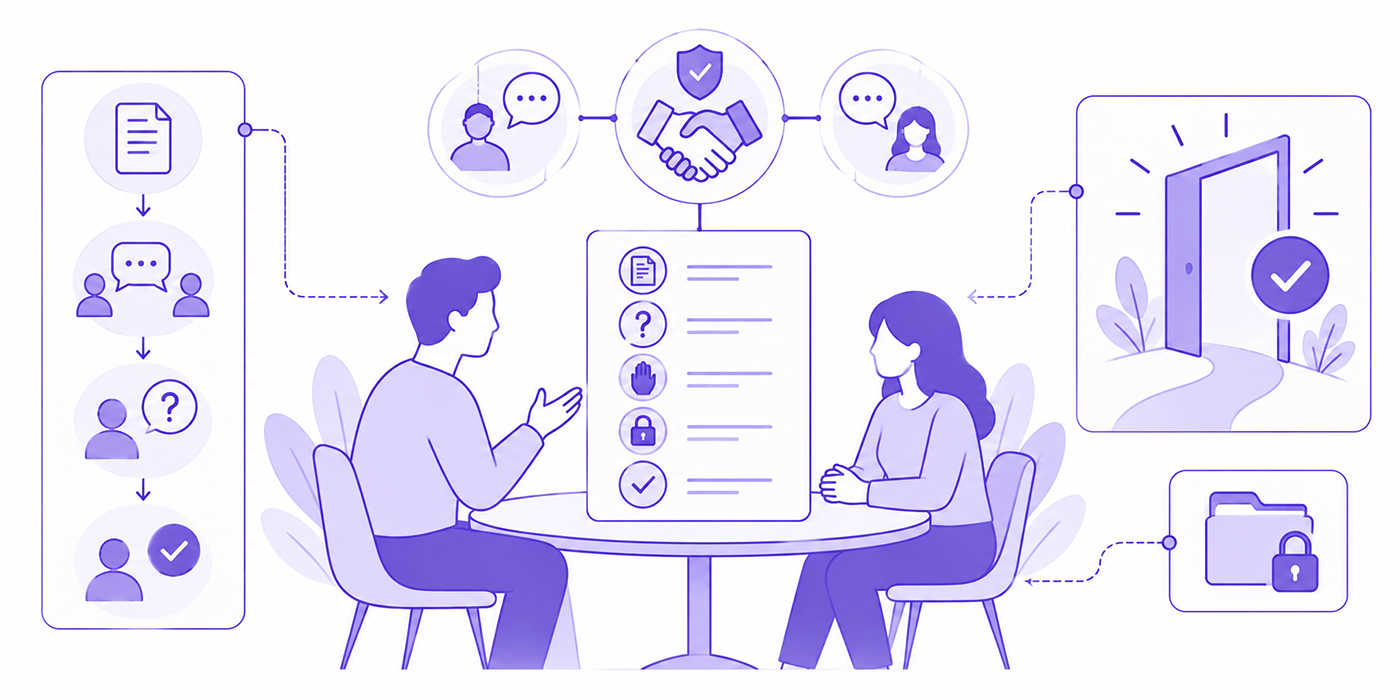
Informed consent is the process through which clients receive sufficient, understandable information about coaching and voluntarily agree to participate. It involves communicating expectations, identifying material limitations, answering questions, and respecting the client's freedom to make decisions.
The International Coaching Federation's Code of Ethics, effective April 1, 2025, requires ICF professionals to explain the nature of coaching and develop agreements covering roles, confidentiality, financial arrangements, and other important conditions before coaching begins.
International Coaching Federation
These expectations connect directly with the principles explored in professional coaching codes of conduct, coaching duty of care, and ethical coaching contracts.
Why a signed coaching agreement is sometimes insufficient
Imagine a client purchasing a twelve-session package after being told that coaching will help resolve persistent anxiety. The coach sends a digital contract, collects payment, and begins sessions.
Three weeks later, the client discovers that the coach cannot provide mental health treatment and expected professional therapeutic support.
The client signed a document, yet the original explanation may have created a materially misleading understanding of the service.
This illustrates why therapist versus life coach boundaries must be explained before enrollment. Coaches offering career burnout coaching, emotional agility coaching, or resilience coaching should clarify the difference between personal development support and clinical services.
Consent becomes meaningful when the client can explain what services are being offered, what happens during sessions, and when additional professional assistance may be appropriate.
The five elements that make consent meaningful
Disclosure: Explain the nature of coaching, techniques involved, expected participation, fees, privacy arrangements, and material limitations. For example, strengths-based coaching and positive psychology coaching may involve different reflective exercises and expectations.
Comprehension: Give clients enough time to understand the explanation. A coach using the CLEAR coaching model or the T-GROW approach should describe how those methods affect the client's participation.
Voluntary choice: Clients should be able to ask questions, decline optional activities, and decide whether to continue. Aggressive sales pressure and misleading claims can undermine that freedom.
Decision-making capacity: Clients need an appropriate ability to understand and decide about participation. Capacity concerns, minors, and legally authorized decision-makers require particular attention to applicable law.
Ongoing permission: Material changes to the relationship require renewed discussion and, where appropriate, documented agreement. Adding assessments, introducing new technology, or involving an employer can change what the client originally authorized.
These principles support the autonomy emphasized in client-centered accountability coaching, the SMART goals framework, and health behavior change coaching.
Coaching consent, contractual agreement, and data-protection consent
These three concepts overlap but address different responsibilities.
Coaching consent concerns a client's informed, voluntary participation in professional services. A coaching agreement documents the rights, responsibilities, and commercial terms governing the relationship. Data-protection consent is a particular legal mechanism for authorizing certain uses of personal information where that legal basis applies.
For instance, a client can agree to receive coaching while declining permission for session recordings to be used in training demonstrations.
The distinction is especially important for online life coaching businesses, corporate coaching arrangements, and professional coaching contracts, where different parties, technologies, and legal obligations may apply.
Practical standard: Before the first paid session, ask clients to describe what they expect from coaching, what information remains confidential, and how they can raise concerns. Correct misunderstandings immediately and document any important clarification.
2. How to Obtain Informed Consent Before the First Coaching Session
A reliable informed-consent process begins before payment whenever the client must commit financially. Coaches should communicate the essential terms early enough for prospective clients to evaluate the offer without pressure.
This matters for online coaching businesses, life coaching discovery calls, and premium coaching packages, where considerable financial commitments may precede the first session.
Start with a clear explanation of the coaching relationship
During the introductory conversation, describe how sessions work, what decisions remain with the client, and what coaching can reasonably help address.
For a coach specializing in life visioning, the explanation might involve exploring personal priorities, identifying goals, and developing an action plan.
For leadership coaching, it may include workplace decision-making, communication challenges, and professional development.
A money mindset coach should also clarify their qualifications and the boundaries between mindset support and regulated financial advice.
The client needs to understand what the coach can competently provide and whether those services fit their situation.
Use the teach-back method to check understanding
Rather than ending with "Do you understand everything?", ask clients to explain key elements using their own words.
For example:
"What would you expect us to do if an issue arises that requires support outside coaching?"
"What information, if any, do you understand I may share with the organization paying for your sessions?"
"How would you end the program if you decided coaching was no longer suitable?"
These questions reveal misunderstandings before they become disputes.
A client might understand accountability coaching as receiving compulsory instructions rather than exploring choices and commitments. Another might expect holistic coaching to include medical or nutritional treatment.
Clarifying expectations strengthens the working relationship and supports the client autonomy central to strengths-based coaching and positive psychology coaching.
Document permission at the appropriate level
Use a written coaching agreement for core service terms. Give the client a copy, record the agreement date, and maintain a version history when the document changes.
For optional activities, introduce separate permission choices. Examples include recording sessions, publishing testimonials, involving third parties, or using identifiable coaching content for demonstrations.
A client could accept coaching while declining recorded sessions. The coach should have a workable alternative whenever recording is optional.
Within ethical coaching contracting, this separation prevents clients from inadvertently authorizing activities unrelated to their primary service.
It is especially useful when coaches employ the Wheel of Life, the Immunity to Change model, or other structured assessments that may reveal sensitive personal information.
Make refusal and withdrawal workable
Clients should know how to decline specific exercises, discuss discomfort, request changes, and end the coaching relationship.
The 2025 ICF Code of Ethics recognizes the right of parties to terminate the relationship at any point, subject to agreed contractual provisions.
International Coaching Federation
For example, a client using the Life Balance Wheel may decline to explore a particular life domain. A client working on public speaking confidence may prefer a private rehearsal instead of a recorded presentation.
Coaches should respect these choices while explaining any genuine effect on the agreed service.
However, withdrawing permission for an optional recording and terminating a prepaid coaching package can have different legal and contractual consequences. Explain those distinctions clearly.
Keep the consent conversation collaborative
A practical consent conversation should feel like a thoughtful professional discussion.
Explain the service in plain language, invite questions, verify understanding, and document the resulting decision.
Then revisit relevant expectations when the client begins goal-setting work, changes their coaching objectives, or requests a different coaching methodology.
Recommended workflow: Introduce the agreement before payment, review essential terms at onboarding, confirm optional permissions separately, and document important changes throughout the engagement.
3. Confidentiality, Data Privacy, AI Tools, and Third-Party Consent
Confidentiality is one of the most consequential parts of informed consent because clients may disclose information they have never shared with an employer, family member, or colleague.
Coaches should explain the confidentiality arrangement before sensitive details are exchanged, including applicable limits and any authorized disclosures.
The ICF Code of Ethics addresses confidentiality, legal disclosures, records management, and the ethical use of technology, including artificial intelligence.
International Coaching Federation
These responsibilities connect with professional coaching conduct, coaching duty of care, and the boundaries relevant to therapist versus life coach relationships.
Explain the actual limits of confidentiality
Clients should understand which information remains private, who can access records, and the circumstances in which disclosure may occur.
Depending on applicable law and the situation, disclosure questions may involve valid legal orders, reporting obligations, or serious risks of harm.
Coaches should avoid blanket promises that every conversation will remain secret under all circumstances.
For example, a practitioner offering resilience coaching may encounter a client experiencing severe distress. A career burnout coach could receive information suggesting immediate danger.
The coach needs a clearly communicated response process grounded in professional competence, relevant laws, and appropriate referral procedures.
The ethical challenges become particularly important in emotional agility coaching, where clients may discuss deeply personal experiences.
Separate consent for recordings, AI, and testimonials
Consider a coach using an AI meeting assistant that automatically records conversations and generates summaries.
The client may have agreed to video coaching without understanding that a third-party service would process their words.
Before activating such tools, explain the specific technology, purpose, information collected, potential recipients, retention arrangements, and available alternatives.
Review vendor data policies, access permissions, and relevant legal requirements. Seek appropriate separate authorization where required, and avoid activating recordings or identifiable AI processing when permission or another applicable lawful basis has not been established.
This is particularly relevant for online life coaching programs, remote health coaching arrangements, and coaches who use digital assessments based on the Wheel of Life or SMART goals.
Testimonials require separate consideration. A client agreeing to coaching has not automatically authorized the coach to publish personal experiences, identifying details, or session recordings.
Distinguish ethical permission from data-protection legal bases
Under the UK GDPR and EU GDPR frameworks, consent is one possible lawful basis for processing personal information. Depending on the processing activity, another basis may be appropriate or required.
When legal consent is used as the basis, it must satisfy requirements concerning informed choice, specificity, affirmative action, and withdrawal. The UK Information Commissioner's Office emphasizes the importance of meaningful choice and separate consent requests for distinct purposes.
ICO+1
Coaches must therefore examine the rules applicable to their jurisdiction, client location, and technology providers.
For example, a business may require certain information to administer a coaching contract while separately requesting consent to use a client's testimonial for marketing.
Privacy notices should explain the relevant lawful basis and rights accurately. Coaches should also avoid assuming that every coaching practice is automatically subject to HIPAA; its application depends on the organization, services, and legal status involved.
This matters when expanding corporate coaching services, developing preventive health coaching, or incorporating lifestyle medicine concepts.
Establish confidentiality boundaries with sponsors and employers
When an organization pays for coaching, three interests may exist: the client seeking personal development, the sponsoring employer seeking value, and the coach responsible for ethical service delivery.
The employer might reasonably request attendance information, agreed program objectives, or aggregate program reporting. Detailed session disclosures require careful consideration of the agreement, appropriate authority, and the client's confidentiality rights.
Before beginning leadership coaching, conscious leadership development, or corporate wellness coaching, document exactly which information may be shared with the sponsor.
If an employer subsequently requests confidential statements about workplace conflict, return to the agreed reporting boundaries.
A useful three-party agreement identifies what the coach reports, who receives it, why the information is needed, and what requires additional client authorization.
Protect consent through appropriate recordkeeping
Maintaining an accurate record helps distinguish what was disclosed, what the client agreed to, and when the permission was obtained.
Store agreement versions, relevant communication records, and authorizations using appropriate security measures.
Document restrictions such as declining recordings or prohibiting testimonial use, and communicate those restrictions to any authorized support personnel.
Follow a retention schedule consistent with applicable legal requirements, contractual obligations, and legitimate recordkeeping needs.
The practical objective is to support ethical client relationships, preserve the confidence underlying client trust, and protect both parties if an issue arises.
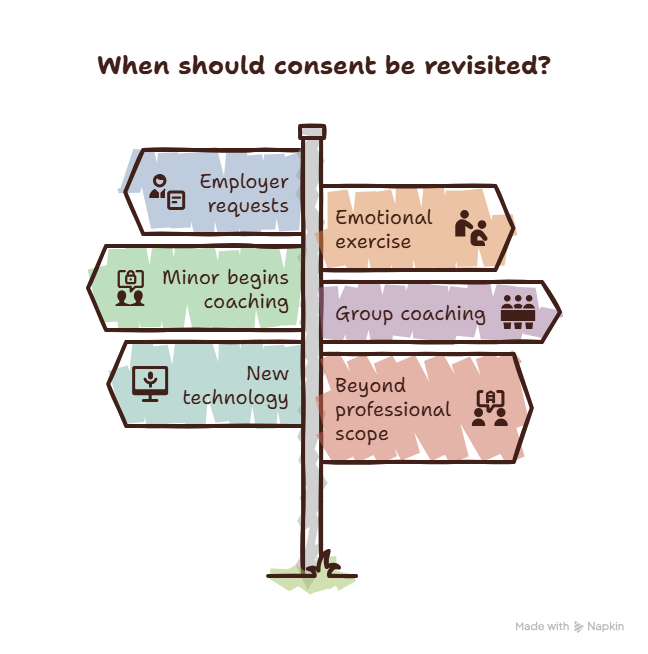
4. Six Situations Where Coaches Must Revisit Informed Consent
Consent should be revisited whenever the coaching relationship changes in ways that materially affect the client's understanding, privacy, financial obligations, or freedom to participate.
A coach who obtained appropriate permission at enrollment may still need fresh agreement several months later.
The following situations demonstrate why informed consent requires ongoing professional judgment.
Scenario 1: An employer requests private coaching details
An executive receives six employer-sponsored sessions to develop communication and leadership skills.
After three meetings, the HR director asks whether the executive has disclosed concerns about their manager.
Before answering, the coach should review the original three-party agreement and determine what information is authorized for disclosure. The coach can propose an appropriate reporting arrangement while protecting confidential session content.
This becomes especially relevant in leadership coaching, corporate coaching relationships, and conscious leadership programs.
Consent checkpoint: Are the client, coach, and sponsor aligned on precisely what information can be reported?
Scenario 2: A client becomes uncomfortable during an emotional exercise
A coach working on self-confidence development introduces an exercise exploring painful childhood memories.
The client becomes distressed and expresses reluctance to continue.
The coach should acknowledge the discomfort, stop or modify the activity, and check whether the conversation remains appropriate for coaching.
Reflective approaches drawn from emotional agility, positive psychology, or resilience coaching may address personal emotions, but the coach must remain within their competence.
Consent checkpoint: Does the client understand the activity's purpose and feel free to decline further exploration?
Scenario 3: A coach begins working with a minor
A parent enrolls a 16-year-old in coaching to improve study habits and confidence.
The parent pays for the program and expects regular updates about the teenager's private conversations.
The coach needs to establish who can legally authorize participation, what the young person understands and agrees to, and what confidentiality and safeguarding arrangements apply.
Parental authority and a minor's privacy rights depend on applicable law and circumstances.
Similar complexities may arise in life-purpose coaching, self-confidence coaching, and goal-setting programs offered to younger clients.
Consent checkpoint: Have lawful authorization, the young person's informed agreement, reporting limits, and safeguarding responsibilities been appropriately established?
Scenario 4: Group coaching exposes information to other participants
A coach launches a group program using the Wheel of Life.
Participants are invited to discuss finances, relationships, health, and career uncertainty.
Even if the coach maintains confidentiality, participants may disclose information outside the group.
Before the first meeting, establish group confidentiality commitments, explain their practical limitations, provide alternatives to public sharing, and clarify recording arrangements.
These precautions matter in couples coaching, holistic coaching programs, and group accountability coaching.
Consent checkpoint: Does every participant understand who can hear their disclosures and what confidentiality protections can realistically be provided?
Scenario 5: New technology changes the original privacy arrangement
Halfway through a coaching package, a practitioner subscribes to an AI transcription platform.
The original agreement covered video meetings and handwritten notes but made no mention of automated transcription or third-party AI processing.
The coach should review the technology and relevant contractual and legal requirements, disclose material changes, and obtain appropriate authorization before use.
Where optional processing is involved, offer a reasonable alternative when possible.
This applies to online coaching services, digital coaching assessments, and technology-assisted behavior-change tracking.
Consent checkpoint: Would the client have made the same decision if they had known how their information would be processed?
Scenario 6: The client needs support beyond the coach's professional scope
A client originally seeking career transition coaching begins describing serious psychological symptoms and asks the coach for treatment advice.
The coach should clarify the limits of their services, assess whether immediate safety action is necessary, and recommend appropriate qualified support.
Continuing to apply ordinary coaching exercises without reassessing suitability may expose the client to additional risk.
This boundary is particularly important for specialists exploring emotional well-being, resilience, or metabolic health coaching.
Consent checkpoint: Can the client understand and choose an appropriate next step, including referral or termination of coaching?
5. Building an Informed Consent System That Protects Clients and Coaches
A dependable consent system should be simple enough to use consistently and detailed enough to address important variations between clients.
The central objective is to make essential disclosures easy to understand, permissions easy to review, and changes easy to document.
Create a concise client-facing consent explanation
Use plain language before introducing legal or technical terminology.
For example, a coach might explain the relationship as follows:
Coaching involves conversations and exercises designed to support your goals, decisions, and development. You remain responsible for your choices. We will discuss the services included, confidentiality and its limits, fees, and how you can change or end our work. You may ask questions or decline optional activities. I will explain any proposed recordings or additional use of your information separately.
Adapt the explanation to the client's circumstances and the service provided.
For leadership coaching, add sponsor-reporting information. For life visioning, clarify the reflective nature of the exercises.
For lifestyle-oriented health coaching, explain boundaries around medical advice, diagnosis, and treatment.
The written contract should provide the full terms behind this summary.
Build a consent record with five essential fields
Your client management system should retain the relevant agreement version, the date and method of acceptance, the identity of the person providing authorization, any important limitations or declined permissions, and a record of subsequent material changes.
These fields help establish an auditable history without unnecessarily duplicating personal information.
For example, a client might accept the agreement on October 5, decline session recording, and authorize a revised scheduling arrangement on November 12.
If the coach later introduces a new assessment or third-party reporting requirement, that change should be recorded appropriately.
This practice supports professional coaching contracts, clear client accountability arrangements, and defensible ethical decision-making.
Audit consent at three critical moments
At enrollment, verify that clients understand the nature of coaching, core terms, financial commitments, confidentiality boundaries, and their rights.
Before sensitive or optional activities, confirm the purpose of the proposed activity and obtain any additional agreement or permission required.
When circumstances change, revisit the consent discussion if the client changes goals, a sponsor requests information, a new technology is introduced, or another material condition changes.
Coaches using the T-GROW model, the OSCAR coaching framework, and strengths-based coaching approaches can incorporate a short permission check when introducing unfamiliar exercises.
That practice gives clients opportunities to influence how coaching proceeds.
Review your language for potentially misleading promises
Consent can be undermined when a coach's marketing creates expectations that the agreement subsequently contradicts.
Statements promising guaranteed breakthroughs, immediate confidence improvements, or permanent transformation deserve particular caution.
Even where a method is useful, individual outcomes vary.
For example, coaches offering self-confidence coaching, money mindset development, or self-actualization coaching should describe intended outcomes without promising predictable personal or financial results.
Review sales pages, discovery-call scripts, onboarding emails, and coaching contracts together.
Clients should receive a consistent explanation from the first marketing interaction through the final session.
This alignment also reinforces client trust in coaching credentials and improves the transparency of coaching business offers.
Establish a response procedure for consent-related mistakes
If a coach discovers that a session was recorded without appropriate authorization, the first priority is to stop the questionable processing and prevent further unnecessary access.
Review what happened, preserve appropriate records, and determine whether notification, deletion, remediation, or reporting is required under applicable law and professional obligations.
Where an employer received information beyond the agreed scope, investigate the disclosure and take proportionate corrective action.
Avoid relying on a new signature to justify past conduct retroactively.
For difficult situations, seek qualified legal, privacy, or professional ethics advice.
A coach who understands professional duty of care, confidentiality boundaries, and ethical contracting will be better equipped to address mistakes responsibly.
Final practice standard: Every client should understand the service before joining, retain meaningful choices throughout participation, and receive updated information when important conditions change.
6. FAQs: Informed Consent, Client Rights, and Ethical Coaching Practice
-
Informed consent refers to the client's meaningful understanding and voluntary acceptance of the proposed coaching relationship. A coaching agreement establishes the service terms, including responsibilities, fees, scheduling, confidentiality, and termination.
Both contribute to professional practice.
A signed contract provides useful documentation, but clients should also understand what they are accepting.
This distinction is important in ethical coaching contracts, professional conduct standards, and client-centered coaching relationships.
The most dependable approach combines a clear written agreement, a meaningful conversation, and appropriately documented permissions for optional activities.
-
Verbal consent may be meaningful in some circumstances, but the legal and professional requirements depend on the service, jurisdiction, and activity involved.
Certain situations may require written authorization or stronger evidence.
For example, consent requirements for recording conversations can differ from those for ordinary coaching participation. Privacy legislation may also impose specific conditions when personal-data processing relies on consent.
Coaches should examine applicable rules and document important decisions.
In online coaching businesses, professional coaching contracts, and employer-sponsored engagements, written records generally make expectations easier to verify.
-
Clients can express a desire to stop participating or withdraw particular permissions. The practical and legal consequences depend on the activity, the agreement, and applicable law.
For instance, a client may withdraw permission for optional recording while continuing ordinary coaching.
Ending a prepaid package raises separate contractual questions about refunds and outstanding payments.
Coaches should explain these distinctions during client onboarding and use them consistently throughout online coaching engagements.
Respecting client autonomy also supports the ethical foundation of accountability coaching and goal-directed development.
-
Parental or guardian authorization may be necessary depending on the minor's age, the nature of the coaching service, and local law.
Coaches should also seek the young person's meaningful agreement at an appropriate developmental level and explain confidentiality limitations.
The parent paying for coaching may have certain rights and responsibilities, but the treatment of the minor's private information requires careful legal and ethical consideration.
This applies to youth-focused confidence coaching, life-purpose exploration, and structured goal-setting.
Coaches should establish appropriate safeguarding procedures and avoid accepting a minor client when they cannot meet the applicable requirements.
-
An employer's payment for coaching does not automatically authorize unrestricted access to private session content.
The parties should establish a clear agreement defining information-sharing boundaries, reporting purposes, and any applicable legal obligations.
For example, an employer may receive agreed attendance or program information while private conversations remain confidential under the engagement terms.
A client may separately authorize sharing specific development goals or progress information.
These distinctions are central to corporate health coaching, executive leadership coaching, and professional contracting.
When reporting expectations conflict, coaches should address the issue before making disclosures.
-
Coaches should provide clear information about relevant AI processing and determine whether separate consent or another legal authorization is necessary.
The assessment should consider whether audio is recorded, whether identifiable information enters external systems, how data is stored, and whether it may be used for additional purposes.
An agreement to participate in an online meeting does not automatically establish authorization for every related data-processing activity.
This is especially important for digital coaching practices, online accountability programs, and coaches using behavior-change tracking tools.
Review the technology's contractual and privacy arrangements before introducing it.
