
A coach promises life-changing results, advertises impressive credentials, and attracts clients with convincing testimonials. Yet one misleading qualification, exaggerated success story, or undisclosed service limitation can destroy years of professional credibility. Misrepresentation creates serious ethical, commercial, and potentially legal risks for both new and experienced coaches. Understanding professional coaching ethics, establishing clear client agreements, and respecting duty-of-care responsibilities help practitioners communicate honestly, protect clients, and build sustainable coaching relationships grounded in genuine expertise.

1. What Is Misrepresentation in Coaching, and Why Does It Damage Professional Trust?
Misrepresentation in coaching occurs when a practitioner communicates false, misleading, exaggerated, or materially incomplete information about their credentials, experience, services, professional authority, or expected client outcomes.
It can happen through deliberate deception, careless marketing, misunderstood qualifications, or promises that exceed what the coach can reasonably deliver.
Consider a health coach advertising themselves as a board-certified wellness professional after completing a private training course. Their course may provide valuable education, but the title National Board Certified Health & Wellness Coach (NBC-HWC) refers to a specific credential awarded through the National Board for Health & Wellness Coaching (NBHWC).
Clients who see an inaccurate credential may reasonably assume that the practitioner has satisfied requirements they never completed.
Understanding health coach certification pathways, ICF versus NBHWC credentials, and what clients expect from certification helps prevent such problems.
Five forms of misrepresentation coaches frequently overlook
1. Credential misrepresentation. Advertising an expired certification, implying membership in a professional organization equals accreditation, or presenting course completion as independent board certification.
2. Outcome misrepresentation. Promising weight loss, increased income, improved relationships, or permanent behavior change without adequate evidence. Coaches promoting preventive health coaching or self-confidence coaching should examine how their promotional language might create unrealistic expectations.
3. Experience misrepresentation. Counting classroom role-play as paid client experience, describing occasional workshops as extensive executive coaching, or exaggerating the number of clients served.
4. Scope-of-practice misrepresentation. Suggesting a coaching qualification authorizes medical diagnosis, clinical nutrition treatment, or psychotherapy. The distinctions between health coaches and dietitians, nutrition coaching boundaries, and therapy versus life coaching are particularly important.
5. Commercial misrepresentation. Hiding mandatory fees, presenting limited support as unlimited access, using fabricated testimonials, or promising a level of personalization that the service cannot deliver.
Why small exaggerations can become major problems
Imagine a life coach advertising a 90% client success rate. That figure may come from nine positive survey responses among ten respondents, while another forty clients never completed the survey.
The underlying responses might be genuine, but the advertisement creates a misleading impression about typical outcomes.
Similarly, a practitioner selling premium life coaching packages might promise ongoing support without explaining response times or communication limits.
Clients could interpret that promise as unrestricted access.
These misunderstandings can produce complaints, refund disputes, reputational damage, and potentially regulatory consequences.
The International Coaching Federation's 2025 Code of Ethics requires accurate identification of qualifications and truthful statements about coaching services. The NBHWC Code of Ethics and Professional Conduct likewise emphasizes truthful marketing, accurate credential representation, and realistic outcomes.
Coaches developing professional contracting practices, improving client trust, and strengthening ethical accountability should treat every public promise as something that must be demonstrably true.
The practical standard is straightforward: a reasonable prospective client should understand the coach's actual qualifications, the service being purchased, its limitations, and the range of outcomes they can reasonably expect.
| Risk Area | Misleading Practice | Ethical Correction | What to Verify |
|---|---|---|---|
| 1. Certification | Claiming board certification after completing a course | State the exact certificate earned and issuing organization | Credential registry |
| 2. Professional membership | Presenting association membership as professional accreditation | Distinguish membership from credentials | Membership category |
| 3. Pending credentials | Advertising an examination candidate as already certified | Describe current eligibility status accurately | Credential award date |
| 4. Expired credentials | Displaying an inactive certification without explanation | Remove or clearly qualify outdated credentials | Current credential status |
| 5. Professional titles | Using regulated clinical titles without authorization | Use a legally permitted and accurate professional title | Applicable licensing rules |
| 6. Clinical authority | Suggesting coaches can diagnose medical conditions | Explain coaching boundaries and medical referral requirements | Scope of practice |
| 7. Nutrition expertise | Promising individualized medical nutrition treatment without qualification | Distinguish wellness coaching from regulated nutrition care | Professional licenses |
| 8. Mental health services | Advertising therapy through a coaching-only qualification | Define coaching services and referral boundaries | Clinical credentials |
| 9. Client experience | Inflating the number of paying clients served | Report verifiable client experience accurately | Documented records |
| 10. Corporate experience | Calling a single workshop a long-term corporate partnership | Describe the actual project and duration | Engagement history |
| 11. Success rates | Advertising a success percentage without a clear denominator | Define success, sample size, and measurement period | Outcome methodology |
| 12. Health outcomes | Guaranteeing weight loss or disease reversal | Use appropriately supported, qualified outcome claims | Supporting evidence |
| 13. Income promises | Claiming coaching guarantees financial success | Disclose realistic uncertainty and outcome limitations | Actual client outcomes |
| 14. Testimonials | Publishing invented or rewritten client endorsements as genuine | Use authentic statements with permission | Original testimonial |
| 15. Exceptional results | Presenting unusual success stories as typical | Explain generally expected outcomes when applicable | Representative results |
| 16. Before-and-after images | Using altered or misleading transformation photographs | Use authentic imagery with appropriate context and consent | Image provenance |
| 17. Paid endorsements | Hiding payments or incentives behind recommendations | Disclose material relationships clearly | Compensation arrangements |
| 18. Affiliate referrals | Recommending products without revealing commissions | Disclose financial interests before recommendations | Referral agreements |
| 19. Research claims | Saying a method is scientifically proven without relevant evidence | Match claims to the quality and scope of research | Original studies |
| 20. Proprietary methods | Presenting widely used coaching models as exclusive inventions | Credit original creators and describe modifications | Attribution records |
| 21. Package contents | Advertising unlimited support with undisclosed limits | Define session counts, channels, and response times | Service agreement |
| 22. Pricing | Concealing mandatory setup, renewal, or assessment charges | Disclose the total payable and payment schedule | Complete fee schedule |
| 23. Refunds | Promising cancellation flexibility that contradicts the contract | Present accurate written refund terms before purchase | Cancellation policy |
| 24. Scarcity claims | Using fabricated enrollment deadlines or limited spaces | Communicate genuine availability and deadlines | Actual capacity |
| 25. Discovery calls | Presenting a sales consultation as an independent assessment | Explain the call's purpose and potential sales component | Booking description |
| 26. Client confidentiality | Implying all information is confidential without explaining exceptions | Disclose privacy practices and applicable confidentiality limits | Consent agreement |
| 27. AI-generated responses | Claiming automated coaching messages were personally written | Disclose material AI involvement and review outputs | Technology policy |
| 28. Sponsor reporting | Promising employees privacy while providing identifiable reports to employers | Agree on reporting and disclosure boundaries in advance | Sponsor contract |
| 29. Client progress | Changing success criteria after the coaching engagement | Agree on baseline measures and review rules | Progress records |
| 30. Referral relationships | Hiding commercial interests in specialist referrals | Disclose commissions and competing interests | Referral terms |
| 31. Crisis support | Advertising round-the-clock emergency support without providing it | State actual availability and emergency escalation procedures | Support policy |
| 32. Professional corrections | Leaving misleading promotional claims online after discovering errors | Correct affected materials and notify relevant parties | Correction records |
2. Misleading Credentials, Professional Titles & Scope-of-Practice Claims
Credential misrepresentation is particularly dangerous because it influences whether prospective clients trust a coach with sensitive personal information or health-related decisions.
A practitioner may complete substantial training yet still describe their qualifications inaccurately.
State what your qualification actually establishes
A certificate of completion, professional association membership, accredited education, and independently awarded credential represent different achievements.
For example, an NBHWC-approved educational program can support eligibility for the NBC-HWC pathway. Completing the program alone does not award national board certification.
Similarly, ICF-accredited coach education and an individual ICF credential have distinct requirements.
Coaches should understand health coaching accreditation pathways, compare ICF and NBHWC recognition, and evaluate certification credibility before publishing professional titles.
An accurate biography should identify the credential, issuing organization, current status, and relevant specialization.
For example, someone who completed a 120-hour health coaching program but has not achieved board certification could describe themselves as a graduate of that specific program and explain their current certification status.
This language allows clients to assess genuine qualifications without drawing incorrect conclusions.
Explain the limits of coaching services before enrollment
Scope-of-practice misrepresentation often develops when coaches try to appear more capable than their professional training permits.
A client asks whether a supplement can treat high blood pressure. Another wants individualized dietary treatment for diabetes. Someone else seeks help processing traumatic experiences.
Each request may fall outside the coach's professional authorization.
Practitioners should understand nutrition advice boundaries, health coach versus dietitian responsibilities, and therapy referral requirements.
A coach with an additional valid healthcare license may possess clinical authority through that separate qualification. The practitioner should clarify which professional role they are performing and the rules governing that role.
For instance, a licensed dietitian who also provides health coaching should explain when an appointment involves nutrition treatment and when it involves coaching.
That distinction strengthens professional contracting and supports ethical duty of care.
Avoid overstating experience or specialization
Experience claims require similar precision.
A coach who facilitated three corporate workshops should describe those workshops rather than advertising a long-term executive transformation practice.
Someone who completed training in leadership coaching should distinguish educational knowledge from demonstrated professional experience.
Likewise, practitioners entering metabolic health coaching, lifestyle medicine-related coaching, or preventive health coaching should represent specialist knowledge accurately and avoid implying qualifications they have not earned.
A useful credential audit asks four questions: Is the qualification current? Can an independent organization verify it? Does the public description reflect its actual scope? Could a reasonable client interpret the claim as granting additional authority?
Correcting ambiguous language before publishing it is considerably easier than repairing a client relationship built on inaccurate expectations.
3. Misleading Testimonials, Income Claims & Coaching Marketing Promises
Marketing creates some of the highest-risk situations for coaching misrepresentation because promotional messages often emphasize exceptional results while minimizing uncertainty.
A genuine success story can still produce misleading expectations when it is presented without appropriate context.
Testimonials must reflect authentic experiences
Suppose a client reports losing 18 pounds while participating in a health coaching program.
Before publishing that testimonial, the coach should establish whether the statement is genuine, whether the client permits its use, and whether the broader advertisement implies that similar results are typical.
For US-facing marketing, the Federal Trade Commission's Endorsement Guides address misleading testimonials, undisclosed material relationships, and unrepresentative results.
A simple statement that individual results may vary does not automatically resolve a misleading impression about typical outcomes.
Coaches providing health behavior change support, preventive health coaching, or holistic wellness coaching should carefully examine the claims communicated by testimonials.
A reliable testimonial process includes obtaining documented permission, preserving the original statement, checking factual accuracy, and evaluating whether additional context is needed.
The coach should also disclose relevant compensation, incentives, or relationships that might affect how prospective customers evaluate an endorsement.
Avoid manufacturing credibility through selective statistics
Consider a coach claiming that 95% of clients achieve their goals.
If the figure represents nineteen positive responses from twenty survey participants, while eighty other clients did not respond, the statement requires substantial clarification.
The survey measures positive outcomes among respondents. It cannot establish a 95% success rate across the entire client population.
A more defensible report explains the total number of eligible clients, response rate, success definition, measurement period, and limitations.
This approach is valuable for practitioners promoting accountability coaching, strengths-based coaching, or resilience coaching.
Coaches should also avoid attributing every improvement exclusively to coaching when clients are simultaneously receiving medical treatment, attending therapy, or making independent lifestyle changes.
Income promises require particular scrutiny
Business coaches and career coaches frequently market transformation through revenue milestones, career advancement, or improved earning potential.
A testimonial from one client who doubled their income can be impressive while providing little evidence about what future clients can generally expect.
Professionals selling career coaching services, money mindset coaching, or leadership coaching should distinguish coaching activities from outcomes influenced by external factors.
Relevant external influences include market conditions, employer decisions, starting income, client experience, and personal circumstances.
The same principle applies when coaching educators advertise certification return on investment or imply that completing training guarantees profitable coaching employment.
Fix vague promises with the claim-evidence-limitation method
Before approving promotional copy, examine three components.
Claim: What precisely are you promising? An assertion about improved confidence should identify the type of improvement rather than implying guaranteed psychological transformation.
Evidence: What supports the claim? Appropriate evidence might include documented client feedback, accurately described experience, or research directly relevant to the intervention.
Limitation: What factors could affect results? Consider client participation, individual circumstances, professional scope, and external influences.
For example, a coach teaching SMART goals could accurately describe helping clients develop measurable action plans.
Promising that every client will achieve those goals within thirty days creates an entirely different obligation.
Clear marketing can still be persuasive. It allows practitioners to explain the actual value of coaching discovery conversations, client accountability, and structured behavior-change work without overstating predictable results.
Submit Your Vote Change Your Vote
Please choose an option above before submitting.
Your Personalized Ethics Recommendation
Based on your selected concern, here's the most important action to take:
Credential accuracy: Audit your website biography, social profiles, sales pages, and email signature. Check your current credentials against official registries. State the issuing body and distinguish course completion from independent certification.
Marketing promises: Identify your five strongest promotional claims. Document supporting evidence for each one. Rewrite unsupported guarantees as accurate descriptions of your coaching process, deliverables, and reasonable limitations.
Scope of practice: Create a written referral guide covering medical questions, clinical nutrition, mental health concerns, and emergencies. Review your coaching agreement and practice responses to requests outside your professional authorization.
Testimonials and results: Confirm client permission, retain original statements, disclose relevant incentives, and check whether exceptional examples create misleading expectations about typical outcomes. Remove unsupported success percentages.
Client agreements: Review your service descriptions against your actual delivery process. Specify session counts, communication channels, response times, payment terms, cancellation rules, privacy practices, and any limits on your professional role.
Interactive on-page selection with personalized guidance. This HTML/CSS-only poll does not store or tally votes.
4. How to Prevent Misrepresentation Through Coaching Contracts, Consent & Client Communication
Most preventable disputes begin with different interpretations of what the coach promised and what the client believed they were purchasing.
A detailed coaching agreement provides a useful foundation, but its value depends on whether the coach explains its terms clearly and consistently delivers what was agreed.
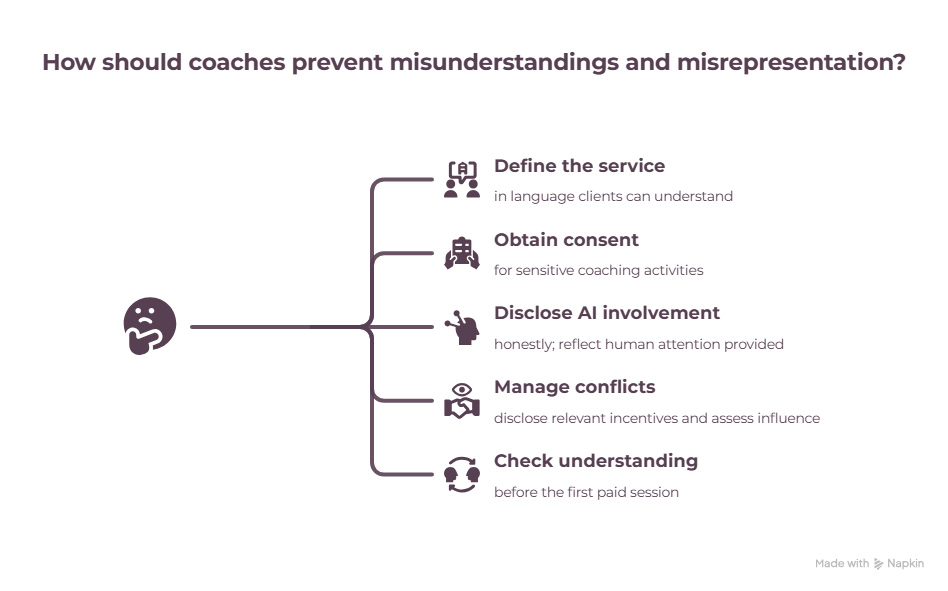
Define the service in language clients can understand
A coaching package should identify the number and duration of sessions, delivery method, included resources, access to between-session support, payment schedule, cancellation policy, and procedures for ending the relationship.
For example, a coach advertising unlimited accountability might provide unrestricted access to digital habit trackers while personally answering messages only during business hours.
The advertisement should explain that distinction.
Clear coaching contracts, realistic health coaching prices, and transparent online coaching business practices help clients compare services intelligently.
An effective agreement should also explain what happens when clients miss sessions, request additional support, or become dissatisfied with progress.
Obtain meaningful consent for sensitive coaching activities
Informed consent becomes particularly important when a coach collects health information, records sessions, uses AI tools, or shares progress reports with third parties.
A client may agree to coaching without understanding that recordings will be stored by an external service provider.
Another may participate in employer-sponsored coaching while assuming that personal conversations will remain completely private.
The coach should clarify what information is collected, why it is needed, who may access it, how long it is retained, and which circumstances permit disclosure.
These practices reinforce professional confidentiality, duty-of-care responsibilities, and appropriate professional boundaries.
Where health information is involved, coaches should identify the privacy laws and professional obligations that actually apply to their circumstances.
Disclose material AI involvement honestly
AI-assisted coaching creates an emerging misrepresentation risk when clients believe they are receiving individually written human guidance while the coach relies extensively on automated responses.
A coach might legitimately use AI to draft general educational resources, prepare session questions, or organize administrative information.
However, the service description should accurately reflect the level of human attention provided.
The 2025 ICF Code of Ethics specifically addresses professional responsibilities arising through AI and other technology systems.
Coaches combining technology with behavior change interventions, habit-tracking support, or accountability systems should ensure that client-facing claims match the actual service.
A practical disclosure might explain that the coach uses approved digital tools for preparation and administrative support, reviews personalized recommendations, and remains responsible for professional coaching decisions.
Manage referral incentives and conflicts of interest
Suppose a health coach recommends a supplement subscription and receives a commission whenever a client purchases it.
The financial relationship may affect how the client interprets the recommendation.
Coaches should disclose relevant incentives, avoid presenting commercial arrangements as independent professional judgments, and remain within applicable professional scope.
The same concerns arise when lifestyle medicine coaches refer clients to external providers or corporate coaches navigate competing expectations between employees and employers.
An effective conflict-of-interest process identifies the relationship, assesses its potential influence, documents appropriate disclosure, and considers whether independent referral is preferable.
Use a client-understanding check before beginning
Before the first paid session, ask clients to explain in their own words what the coaching package includes, how progress will be evaluated, and what happens if they need additional professional help.
This brief conversation can reveal misunderstandings that a signed agreement alone might miss.
It also improves discovery-call transparency, strengthens client trust, and makes professional contracting more effective.
The underlying principle is that informed clients should understand both the opportunities and the limitations of the service before making a financial commitment.
5. A Practical Ethics Audit: How to Identify, Correct & Prevent Misleading Coaching Claims
Even well-intentioned coaches can overlook misleading statements when websites, sales materials, and professional biographies evolve over time.
An effective ethics audit examines what the practice communicates, what evidence supports those claims, and whether actual service delivery matches client expectations.
Step 1: Audit every public claim within seven days
Begin with your website, landing pages, social media biographies, paid advertisements, email sequences, discovery-call scripts, testimonials, and coaching agreements.
Pay particular attention to claims involving professional credentials, experience, client outcomes, response times, refund conditions, and specialist services.
A coach advertising executive leadership expertise should verify relevant experience. Someone promoting health coaching certification should confirm credential status. Practitioners selling specialized health coaching should check every implied professional qualification.
For each claim, document its exact wording, intended meaning, supporting evidence, and potential for client misunderstanding.
Step 2: Classify problems by severity
Critical issues involve claims that could expose clients to harm, including unauthorized clinical services, fabricated qualifications, serious confidentiality failures, or dangerous guarantees.
These require prompt assessment and corrective action.
Major issues include misleading success statistics, undisclosed financial incentives, inaccurate service descriptions, and significant contradictions between sales promises and contracts.
Moderate issues include ambiguous experience claims, outdated professional biographies, unclear response times, and insufficient explanations of program limitations.
This classification helps prioritize risks involving coaching duty of care, clinical practice boundaries, and professional coaching ethics.
Step 3: Correct inaccurate information and address affected clients
When a misleading claim is discovered, preserve relevant records, determine its reach, and identify whether existing clients relied on the information.
Correct promotional materials, update contracts where necessary, and communicate material changes to affected parties.
Suppose a coach advertised board certification that had already expired. Appropriate remediation may include removing the inaccurate title, correcting public profiles, contacting clients who relied on that status, and obtaining professional advice about any resulting obligations.
Where misleading representations materially influenced purchasing decisions, refund or other remedy obligations may arise under applicable laws and contracts.
Ethical remediation should also respect client termination rights and transparent coaching business practices.
Step 4: Introduce a claim-approval process
Before publishing a new advertisement or promise, answer five questions:
What exactly will a reasonable client understand from this statement?
What evidence supports that interpretation?
Does the claim imply qualifications or authority the coach lacks?
Are limitations and material financial interests adequately disclosed?
Can the practice consistently deliver the service being advertised?
Use this process for new coaching packages, health coaching offers, and client acquisition campaigns.
Document the review date and responsible person. Reassess high-impact claims when credentials, prices, services, or professional regulations change.
Step 5: Use supervision and client feedback to identify blind spots
Ethical mistakes sometimes reflect hidden assumptions rather than deliberate dishonesty.
A coach may believe that strong encouragement justifies ambitious promises. Another may struggle to acknowledge limits because they fear losing clients.
Professional supervision provides an opportunity to examine those pressures and develop better judgment.
Feedback from clients can also reveal gaps between advertised services and actual experiences.
Coaches developing conscious leadership, cultural competence, and professional accountability can integrate these insights into continuing development.
A practical monthly review: Examine five promotional claims, two anonymized client agreements, one recent testimonial, and any complaints or misunderstandings. Identify corrective actions and confirm their completion.
This routine helps make ethical accuracy an ongoing operational responsibility rather than a reaction to serious complaints.
6. FAQs: Misrepresentation in Coaching, Ethical Standards & Client Protection
-
The distinction depends on the impression created, the material facts involved, the evidence supporting the statement, and applicable law.
General promotional language may be permissible in certain contexts. Specific claims about credentials, measurable results, clinical authority, or guaranteed outcomes require greater care.
For instance, describing a service as supportive communicates a general characteristic. Advertising a guaranteed 30-day transformation creates a much more concrete expectation.
Coaches should understand professional ethical standards, client trust expectations, and accurate coaching contracts before making promotional claims.
-
Professional title restrictions vary by jurisdiction. Many places regulate titles such as psychologist and particular forms of clinical or therapeutic practice.
Completing life coach training does not automatically authorize the use of protected healthcare titles or regulated mental health services.
Practitioners should investigate local laws before using titles that imply clinical authority.
Understanding therapist versus life coach boundaries, professional duty of care, and ethical coaching responsibilities helps prevent clients from misunderstanding the services offered.
-
Guarantees involving client outcomes can become misleading when results depend on individual behavior, personal circumstances, external decisions, or factors outside the coach's control.
Promises about the services a coach will deliver are easier to define and verify.
For example, a coach can commit to providing six sessions, written action summaries, and agreed progress reviews.
Promising that every client will permanently eliminate anxiety or double their income creates substantial ethical concerns.
Practitioners offering money mindset coaching, self-confidence coaching, and career coaching should make realistic, evidence-supported claims.
-
Yes, testimonials may be presented anonymously when appropriate permission has been obtained and relevant privacy obligations are satisfied.
However, removing a client's name may be insufficient when other details make the individual recognizable.
A detailed transformation story involving a rare occupation, specific location, and personal circumstances could permit identification.
Coaches should discuss what information may be published, preserve original consent records, and explain any intended future use.
These practices support professional confidentiality, clear coaching agreements, and respectful client relationships.
-
First, verify the actual credential status and identify every place where the inaccurate information appears.
Correct public materials promptly and preserve evidence of the original wording and subsequent corrections.
Next, determine whether clients, employers, or sponsors relied on the representation when making decisions.
Material problems may require direct communication, professional advice, formal notification, or appropriate remedies.
Coaches should understand certification recognition requirements, client expectations about qualifications, and professional ethical accountability.
-
Yes. Misrepresentation concerns can arise when clients receive automated materials under the impression that a human coach personally created or reviewed them.
Additional risks include inaccurate health claims, fabricated citations, inappropriate personalization, and confidential information being shared with unsuitable technology systems.
Coaches should disclose material technology involvement, verify outputs, and maintain appropriate privacy safeguards.
This is particularly relevant when AI supports health behavior change programs, habit-stacking interventions, and ongoing accountability services.
The coach remains responsible for accurately describing the service and honoring applicable professional obligations.
