
Decoding Client Behavior: What Your Clients Aren’t Telling You
Most clients will never say, “I am afraid your program will not work for me,” or “I am embarrassed by how badly I slipped this week.” Instead, they show you through reschedules, vague updates, overtalking, jokes, or going quiet when you ask a specific question. If you only listen to words, you miss the emotional drivers that actually decide whether they follow through, re-sign, or refer their friends. In this guide, you will learn how to read hidden client behavior, decode what it means, and turn those insights into more effective sessions, offers, and outcomes.

1. Why Decoding Client Behavior Matters More Than What They Say
Clients often arrive trying to look “coachable.” They repeat language they picked up from goal frameworks like the ones in SMART goal systems and talk about motivation, but their behavior tells you whether those goals are actually grounded in reality. When you combine clear structures from coaching session templates with deep listening, you notice where their energy spikes or drops.
Subtle cues also help you decide which tools to use. A client who lights up around interactive work might respond better to gamified exercises or interactive coaching exercises. Someone who shuts down when you push on numbers may need gentler, story-based approaches drawn from powerful questioning. The more accurately you decode behavior, the more your coaching looks like custom work instead of a generic script, which is what keeps clients renewing and referring.
2. Reading What Clients Aren’t Saying In The Room
Client stories contain three layers: facts, interpretations, and emotional charge. Tools like powerful questioning help you separate those layers, but behavior reveals which layer is driving decisions. Notice what happens when you ask, “What feels most uncomfortable about changing this?” If they suddenly look away, shuffle papers, or change the topic, you are near a core belief.
Your session structure from productivity-boosting templates should leave space for these behavioral cues instead of rushing to solutions. Integrating interactive coaching exercises and simple virtual tools allows you to observe how they act when they must choose in real time. Over several sessions, track patterns the same way you would track data in your coaching toolkit checklists so you are not relying on memory alone.
3. The Signals Clients Send Between Sessions
Behavior outside sessions is often more honest than what you see on a call. Look at how quickly they respond to messages, whether they upload worksheets on time, or how they participate inside your interactive coaching community. A client who reads every post but never comments may be engaged yet fearful of visibility. Someone who is active in group chats but late on tasks could be using community engagement as a way to avoid the hard work.
Your digital ecosystem can be designed to surface these signals. For example, you might combine virtual coaching tools with simple gamification ideas from engagement tools and behavior prompts from free and premium resource libraries. When clients join workshops based on best practices for interactive coaching workshops, observe who contributes, who stays silent, and who disappears after the first session. Each pattern tells you something specific about readiness, fear, and perceived safety.
Poll: Where Do You Struggle Most To Read Client Behavior?
4. Translating Silent Resistance Into Better Coaching Strategies
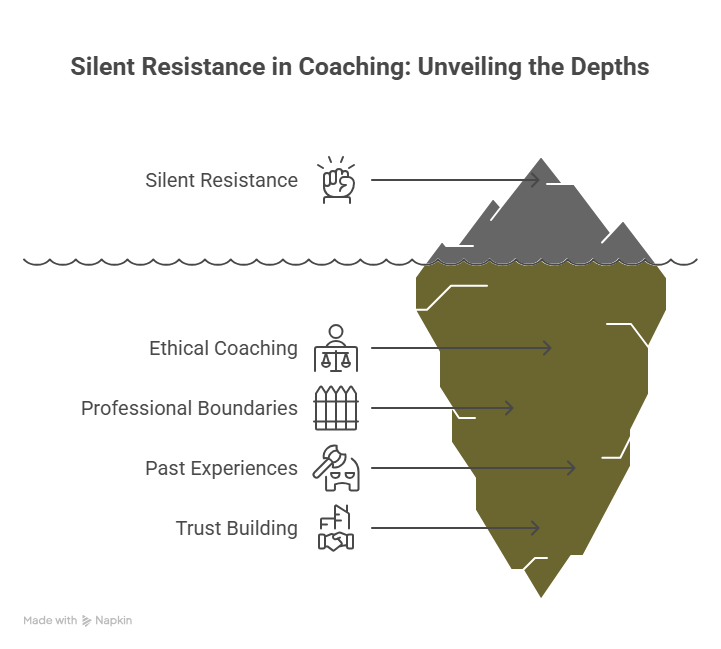
When you decode behavior, your goal is not to confront clients but to reduce friction. Silent resistance often shows up as delays, vague answers, or sudden enthusiasm for new ideas that conveniently avoid the current challenge. Use frameworks from ethical coaching principles and professional boundaries to keep the conversation safe while you name what you see.
For example, “I notice we often change the topic when we get close to discussing your evenings. Would it be all right if we stayed with that for a little longer today?” This blends observation, consent, and clarity. If you realize resistance is tied to past experiences with helpers, tools from managing dual relationships and ethical dilemmas help you decide whether coaching is still the right container or if referral is more appropriate. Over time, this gentler way of addressing resistance builds deep trust and more durable change.
5. Turning Behavioral Insights Into Programs Clients Actually Finish
Once you know how your clients behave under pressure, you can redesign your offers so they work with, not against, human psychology. If many clients disengage halfway through, you might restructure your curriculum following the flow used in coaching retreats and workshops, with deliberate energy peaks such as challenges, guest experts, or bonus sessions. If group members stay silent, borrow techniques from interactive workshops and interactive coaching communities to engineer low-risk ways to participate, like polls, small breakout rooms, or anonymous forms.
Behavioral insights should also inform your content and follow-up systems. You can create short, targeted resources from the free and premium coaching resource library and repurpose them into podcast episodes or engaging content pieces that speak directly to common fears and patterns. When your offers, emails, and communities all reflect a deep understanding of how clients actually behave, not just what they claim to want, you get higher completion rates, better testimonials, and a steadier pipeline of referrals.
6. FAQs: Decoding Client Behavior In Coaching
-
Start by tightening your session structure using tools from coaching session templates so your mind is not occupied with logistics. Then, practice naming simple, neutral observations: “I notice your voice got quieter when we talked about work.” Resources on powerful questioning and ethical coaching principles can guide your language. The goal is not to interpret everything, but to stay curious. Over time, your pattern recognition improves, and you can weave these observations gently into the conversation without making clients feel analyzed or judged.
-
Assume your first interpretation might be incomplete and present it as a hypothesis, not a verdict. For example, “Part of me wonders whether rescheduling has been easier than facing how stuck this feels. Does that land at all?” This honors their autonomy and invites correction. Guides on coaching confidentiality and professional boundaries remind you that humility is part of ethical practice. When clients see you are willing to be wrong, they feel safer sharing the truth, which actually strengthens trust rather than weakening it.
-
Plan your groups using principles from interactive coaching workshops and online communities. Build in private touchpoints such as quick forms, direct messages, or optional office hours. If you notice patterns like chronic late work or invisibility in chats, address them one-to-one, not in front of the group. You might design group-wide interventions that do not single anyone out, such as a mid-program recommitment exercise or a shared interactive coaching exercise. The key is to treat behavior as data about your systems, not a moral judgment about individuals.
-
You do not need complex software to start. Many coaches build simple tracking sheets inspired by resources in coaching toolkits and virtual coaching tools. Track factors such as reschedules, homework completion, emotional tone, engagement in communities, and major life events. Over time, patterns become obvious: which modules lose energy, which weeks see more drop-off, which clients thrive with group support versus one-to-one. These insights help you iterate offers, refine onboarding, and adjust your communication style so you can honor client behavior instead of fighting it.
-
Prospective clients rarely search for “coach who reads behavior well,” but they do look for coaches who “actually get me.” Use stories and case-style examples in your content based on the patterns you see, while protecting confidentiality following coaching ethics. Show how you adjust methods for different personalities, drawing on ideas from branding basics and how certification differentiates your health coaching business. You can also design workshops or webinars on “what your behavior is telling you,” leveraging podcast resources and content strategies to position yourself as the coach who sees beyond scripted answers.
-
The more accurately you read behavior, the more tempting it can be to push harder. Boundaries from dual relationship guidelines and professional boundary practices protect both you and the client. Always seek consent before exploring sensitive interpretations: “Would you like to dig into what might be underneath this pattern?” If their body language stiffens or they say “not today,” you respect that. Sometimes the most skillful behavioral move is backing off and strengthening safety through simpler wins or lighter interactive exercises until they are ready for deeper work.
