
A health coach certification can cost thousands of dollars while leaving graduates confused about board eligibility, employer recognition, practical coaching skills, and career prospects. Reddit discussions reveal recurring frustrations with expensive programs, unclear accreditation claims, limited instructor feedback, and unexpected expenses after graduation. Understanding whether health coaching is still worth pursuing requires examining the actual value of training. Before choosing a program, prospective coaches should understand credentialing requirements, identify misleading promises, and calculate realistic career returns.

1. Health Coach Certification Red Flags: What Reddit Complaints Reveal About Expensive Programs
Health coaching discussions on Reddit repeatedly expose a purchasing problem: prospective students evaluate programs using marketing claims while overlooking the credentials, supervised practice, and employment outcomes those programs actually deliver.
The most revealing complaints concern graduates who discover additional qualification requirements after completing expensive training. Someone pursuing hospital employment may finish a certificate only to learn that their preferred employer wants National Board Certified Health & Wellness Coach (NBC-HWC) credentials. Another graduate may understand coaching theory but struggle with practical client conversations because their course emphasized prerecorded lectures.
These experiences explain why coaching certification value depends on specific career objectives, and why health coach employment requirements should influence enrollment decisions.
Red flag #1: The program promises certification without identifying who awards the credential.
Some providers issue proprietary completion certificates while using language that suggests recognition throughout the healthcare industry. A school-issued credential, NBHWC-approved education, and an independently awarded board certification have different meanings.
Ask the admissions representative to identify the issuing organization, the exact credential earned at graduation, and any additional examination requirements. Compare the answer with the NBHWC certification pathway before paying.
Red flag #2: The curriculum sells inspiration instead of measurable coaching competence.
A course might provide excellent wellness information while offering insufficient opportunities to practice motivational interviewing, reflective listening, collaborative goal setting, and ethical decision-making.
Professional health behavior change coaching requires observing how clients respond to resistance, setbacks, and ambivalence. Effective accountability coaching also demands more than teaching students to distribute habit trackers.
Request a sample assessment rubric, the number of observed sessions, and an explanation of how instructors correct weak coaching performance.
Red flag #3: Testimonials emphasize extraordinary earnings without representative outcomes.
Revenue screenshots from successful alumni reveal little about typical graduate performance. A coach reporting $100,000 in annual sales might have substantial prior experience, an established audience, or considerable advertising expenses.
Investigate realistic health coaching earnings, compare corporate coaching compensation, and examine remote coaching job requirements independently.
Ask whether advertised income figures describe revenue or profit, how many graduates were surveyed, and whether unsuccessful graduates were included.
Red flag #4: Career support ends at a generic marketing webinar.
Some programs advertise business-building support but deliver little beyond templates, introductory social media advice, and encouragement to start selling sessions.
Graduates still need to develop profitable health coaching niches, understand new-coach pricing, and overcome the problems behind failing to attract initial clients.
Request the actual career-services syllabus, employer partnership details, and documented graduate support policies.
Red flag #5: Admissions staff create urgency while avoiding written answers.
Expiring discounts, immediate payment demands, and vague explanations of refunds deserve additional scrutiny. A reputable training provider should be able to explain tuition, cancellation terms, instructor qualifications, and credentialing outcomes without pressuring applicants.
How to interpret Reddit complaints: Treat individual experiences as investigation leads. Compare complaints across multiple independent discussions, distinguish outdated curriculum reviews from current program offerings, and verify substantive claims directly. A negative review becomes particularly useful when it identifies a specific contract clause, missing service, unfulfilled written promise, or discrepancy in program approval.
For students comparing health coaching career opportunities in a crowded market, the following checklist converts those concerns into concrete questions before enrollment.
| Risk Area | Warning Sign | What to Ask | Best Action |
|---|---|---|---|
| 1. Board eligibility | Vague claims of being board eligible | Which professional board recognizes this pathway? | Verify independently |
| 2. NBHWC approval | Approval logo without a matching listing | Is this exact course listed by NBHWC? | Check official directory |
| 3. Pending approval | Pending approval advertised as confirmed | When does official approval become effective? | Get written evidence |
| 4. Program variations | Only one version of a course is approved | Does approval cover my selected track? | Check exact program |
| 5. ICF recognition | ICF accreditation confused with NBHWC approval | Which credential pathway does this course support? | Match career objective |
| 6. CE credits | Continuing education marketed as initial certification | Does this provide initial credential eligibility? | Confirm requirements |
| 7. University affiliation | University name used to imply board recognition | What recognition applies to this specific course? | Separate claims |
| 8. Graduation documents | Board eligibility documentation unclear | What proof of completion will I receive? | Confirm before payment |
| 9. Training hours | Advertised hours include unrelated material | How many hours meet coaching competencies? | Request hour breakdown |
| 10. Live instruction | Mostly recordings despite live-training promises | How many synchronous hours are provided? | Review timetable |
| 11. Practice coaching | No meaningful observed practice | How many sessions receive instructor assessment? | Prioritize skills practice |
| 12. Instructor feedback | Only automated quiz results | Will I receive individual coaching feedback? | Check support policy |
| 13. Final assessment | Certificate awarded for watching videos | How is practical coaching competence tested? | Inspect assessment rubric |
| 14. Instructor qualifications | Faculty credentials are difficult to verify | Who teaches and evaluates the program? | Check professional credentials |
| 15. Class size | Unlimited enrollment with vague instructor access | What is the instructor-to-student ratio? | Verify personal support |
| 16. Attendance rules | Missed classes trigger unexpected charges | What are makeup and deferment policies? | Read written agreement |
| 17. Coaching log | Incorrect advice about eligible practice sessions | When can qualifying sessions be logged? | Follow board guidance |
| 18. Practice clients | Promised practice clients never materialize | Does the program arrange qualifying clients? | Get specific commitments |
| 19. Scientific content | Unsubstantiated health claims presented as evidence | Can I review references and sample lessons? | Evaluate scientific rigor |
| 20. Clinical scope | Graduates encouraged to diagnose conditions | How are clinical boundaries taught? | Major safety warning |
| 21. Nutrition advice | Unrestricted diet-prescribing authority promised | Are jurisdictional scope limits explained? | Verify legal boundaries |
| 22. Graduate outcomes | Job placement figures lack sample sizes | How many graduates were included? | Demand transparent data |
| 23. Employer partnerships | Employer logos without actual hiring relationships | Which employers actively recruit graduates? | Confirm independently |
| 24. Income promises | Exceptional earnings portrayed as typical | Are median earnings and expenses reported? | Reject unsupported claims |
| 25. Career support | Lifetime support consists of generic videos | Which individualized services are included? | Inspect deliverables |
| 26. Client guarantees | Guaranteed clients with unclear conditions | What does the written guarantee cover? | Investigate conditions |
| 27. Total tuition | Mandatory exam and assessment costs excluded | What is the total cost through certification? | Request itemized quote |
| 28. Refund policy | Verbal assurances contradict contract terms | What are the written cancellation deadlines? | Review before signing |
| 29. Financing | Monthly payments hide the total payable | What interest and fees apply? | Compare total repayment |
| 30. Upselling | Essential mentoring requires another purchase | Which services are mandatory extras? | Calculate full cost |
| 31. Privacy | Coaching recordings lack clear data protections | How are recordings stored and deleted? | Protect client information |
| 32. Alumni feedback | No opportunity to hear from recent graduates | Can I speak with graduates independently? | Seek outside validation |
2. Health Coach Certification Accreditation Explained: NBHWC, ICF, Program Approval & Misleading Claims
Accreditation confusion creates one of the most expensive risks for aspiring health coaches. Providers sometimes describe institutional accreditation, training-program approval, professional certification, and continuing education recognition as though they provide equivalent career benefits.
Each designation answers a different question.
NBHWC approval: Does the training qualify graduates for the national board certification pathway?
The National Board for Health & Wellness Coaching (NBHWC) approves educational programs meeting its published standards. Graduates who meet the remaining eligibility requirements can apply for the examination leading to the NBC-HWC credential.
The requirements include completing an NBHWC-approved training program, documenting 50 qualifying coaching sessions, and possessing an associate degree or higher or 4,000 hours of qualifying work experience.
The 50 coaching sessions must occur after passing the program's qualifying practical skills assessment. They must last at least 20 minutes, and sessions with friends, family members, or classmates do not qualify.
Critically, an approved program's certificate does not itself award NBC-HWC status.
Students should understand board-certification requirements before planning health coaching employment or targeting corporate wellness positions.
ICF accreditation: Is the course designed around recognized professional coaching standards?
The International Coaching Federation (ICF) accredits coach education through designated pathways. Level 1 programs generally support the education pathway toward Associate Certified Coach (ACC), while Level 2 programs support the education pathway toward Professional Certified Coach (PCC).
Earning these credentials also requires fulfilling applicable ICF experience, assessment, and examination requirements.
ICF-accredited education can suit professionals pursuing leadership coaching, career burnout coaching, or broader life coaching specializations.
However, ICF accreditation alone does not satisfy the NBHWC-approved education requirement. The ICF versus NBHWC comparison is particularly important for professionals considering both health-focused and general coaching opportunities.
Institutional accreditation: Is the educational institution recognized through an appropriate academic accreditation process?
A university may hold institutional accreditation while offering individual courses with different professional recognition.
Check the exact health coaching program independently, particularly when comparing a university certificate with private training.
Continuing education recognition: Does the course provide professional-development credits?
Continuing education approval may benefit already-qualified professionals maintaining credentials. It should never be assumed to provide eligibility for an initial certification examination.
A provider advertising continuing education credits may offer useful training in lifestyle medicine, positive psychology coaching, or strengths-based coaching without satisfying the requirements of an initial board-certification pathway.
The verification sequence before enrolling:
First, search the exact program in the official NBHWC directory or ICF education directory, whichever fits your goal. Verify approval for the specific course and applicable training dates.
Next, request written confirmation of the credential pathway, required assessments, graduation documentation, and any additional professional experience obligations.
Finally, cross-check those details with actual remote health coaching job advertisements and employer credential preferences.
A program's approval is evidence that it meets a defined educational standard. Its employment outcomes, affordability, customer service, and suitability for an individual student still require separate evaluation.
3. Questions to Ask Before Paying: How to Evaluate Training Quality, Instructor Support & Hidden Costs
The strongest admissions questions require evidence that can be inspected before enrollment. Ask for documents, demonstrations, assessment examples, and specific policies rather than accepting general assurances about program quality.
Q1: How much live, supervised training will I actually receive?
NBHWC-approved programs must provide at least 75 instructional hours, including at least 40 synchronous hours in designated coaching competency areas.
They must also include at least three complete practice coaching sessions of 30 minutes or more, with at least 20 minutes of synchronous post-session feedback for each.
Ask for a schedule separating lectures, supervised practice, independent coursework, and assessments. Training in the CLEAR coaching model, SMART goal setting, and the T-GROW framework becomes more useful when learners can demonstrate these techniques under observation.
Q2: What happens when a student performs poorly during coaching practice?
Request a sample grading rubric and ask whether instructors provide individualized corrective feedback, opportunities to repeat assessments, and structured coaching demonstrations.
A student struggling with client resistance needs practical guidance on emotional agility, immunity to change, and the difference between reflective listening and giving unsolicited advice.
Ask whether reassessments carry additional fees.
Q3: Who teaches the program, and how accessible are instructors?
Check instructors' professional credentials, current coaching experience, clinical qualifications where relevant, and availability for individual questions.
A program teaching metabolic health coaching should distinguish general health education from clinical management. Training connected with preventive health coaching should also explain when medical referral is necessary.
Instructor expertise matters most when students encounter situations beyond straightforward wellness habit formation.
Q4: Will the curriculum teach legal boundaries and safe referrals?
A concerning program may encourage graduates to interpret laboratory results, recommend supplements for medical conditions, prescribe individualized diets, or address psychological disorders without appropriate additional qualifications.
NBHWC's professional scope excludes these clinical activities when a coach lacks the relevant independent professional authorization.
Examine whether the curriculum addresses nutrition coaching limitations, health coach versus dietitian responsibilities, and professional duty of care.
Q5: What will the complete credentialing journey cost?
Request an itemized estimate covering tuition, enrollment charges, educational materials, practical assessment fees, retakes, board examination costs, optional preparation, financing charges, and future credential maintenance.
A lower-priced course can become expensive when essential components require separate payment. Prospective students should compare total costs with health coaching income potential and realistic client acquisition timelines.
Q6: What percentage of graduates achieve the outcomes I want?
Ask for separate figures covering graduation, board-exam success, relevant employment, and self-employment.
Require the number of students measured, the relevant enrollment cohort, the reporting period, and the definition of a successful outcome.
Q7: May I speak with recent graduates who have different outcomes?
Request introductions to a graduate employed in healthcare, a graduate operating a private practice, and a graduate who struggled with the program.
Their experiences can expose weaknesses in client acquisition preparation, discovery-call training, and professional contracting education.
Q8: What exactly happens if I withdraw, miss classes, or fail an assessment?
Read cancellation deadlines, refund calculations, deferment conditions, reentry requirements, and financing obligations.
A useful final request is: “Please send the enrollment agreement, complete fee schedule, sample assessment rubric, accreditation documentation, and refund policy before I make a payment.”
An admissions department that consistently avoids documented answers creates an unnecessary purchasing risk.
Submit Your Vote Change Your Vote
Please select an option above before submitting.
Your Response
Based on your biggest concern, here's what you should verify before enrolling:
Accreditation and recognition: Check the exact training program in the official NBHWC or ICF directory. Request written confirmation of credential eligibility before paying tuition.
Employment and career outcomes: Compare at least ten relevant job postings with the program's credential. Ask for documented graduate employment outcomes, employer partnerships, and specific career support services.
Hidden costs: Request an itemized breakdown of tuition, assessment fees, board examination charges, retakes, financing, and credential maintenance expenses. Calculate the total financial commitment before signing.
Training quality: Request the live instruction timetable, supervised coaching hours, instructor qualifications, and practical assessment rubric. Confirm how much individual feedback each student receives.
Refund protection: Review the complete written cancellation policy, refund deadlines, financing obligations, and enrollment agreement. Preserve copies of every written promise made by admissions staff.
Select one answer to receive personalized guidance. Responses are displayed locally without storing votes.
4. How to Calculate the True ROI of a Health Coach Certification Before Enrolling
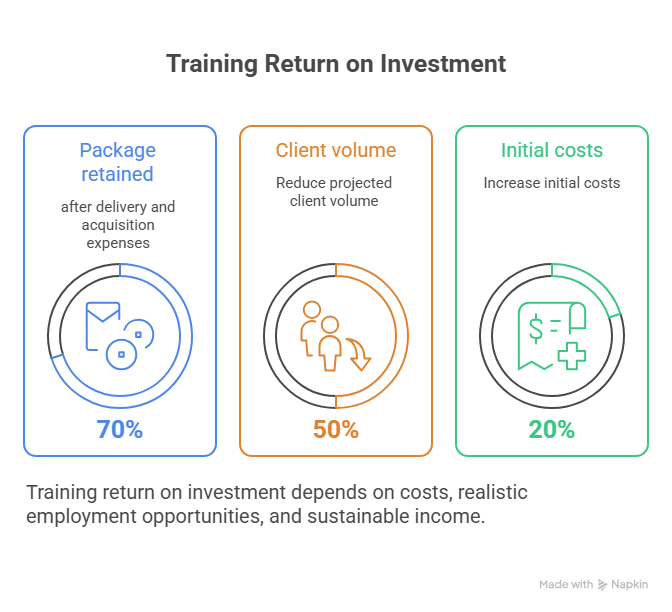
Training return on investment depends on total costs, realistic employment opportunities, and the speed at which graduates can generate sustainable income.
Programs sometimes encourage applicants to calculate profitability by dividing tuition by a premium session price. That approach ignores client acquisition expenses, administrative work, unpaid consultations, insurance, technology, taxes, and the time required to build a practice.
A stronger model uses contribution margin: the amount remaining from revenue after the variable costs directly associated with delivering services.
Consider a hypothetical aspiring health coach:
Training tuition: $3,800
Exam preparation, application, and related costs: $600
Additional setup expenses: $400
Total initial investment: $4,800
Suppose the graduate sells a $400 coaching package and retains 70% after directly attributable delivery and acquisition expenses.
Each package contributes $280 toward recovering the initial investment.
The coach therefore needs approximately 18 completed package sales to recover $4,800 in initial costs, before accounting for income taxes, unpaid owner labor, and ongoing fixed overhead.
That calculation becomes meaningful only when connected to a realistic health coaching pricing strategy and credible first-client acquisition timelines.
Compare three career scenarios before committing.
Scenario A: Salaried employment. Research actual health coaching jobs after certification, corporate wellness employment, and remote coaching positions. Identify whether employers require NBC-HWC, prefer it, or accept other qualifications. Estimate any incremental earnings relative to your current career rather than treating gross salary as the return generated by certification.
Scenario B: Private practice. Investigate health coaching niche demand, client conversion difficulties, positioning mistakes, and referral-based client acquisition. Estimate how many qualified inquiries and paying clients are required each month.
Scenario C: Adding coaching to an existing profession. Healthcare professionals, fitness practitioners, and wellness educators may use coaching skills to strengthen their existing services. Evaluate whether habit-stacking techniques, health behavior change methods, and accountability frameworks provide measurable benefits within your current professional scope.
Apply a financial stress test: Reduce projected client volume by 50%, increase initial costs by 20%, and extend the expected income-generating timeline by six months. Calculate whether the investment remains affordable under those assumptions.
This exercise also clarifies when the health coaching career path offers a rational next step and when additional qualifications, employer research, or business preparation should come first.
5. The 100-Point Certification Screening Method: How to Choose a Program Without Regretting It
Selecting a health coach certification becomes easier when every shortlisted program faces the same evaluation standards. A weighted scorecard makes marketing claims less influential and gives prospective students a defensible way to compare training quality.
Evaluate each program across six categories worth 100 points.
1. Credential alignment — 30 points. Award full points when the exact program has independently verified recognition that matches your intended career. For prospective clinical or healthcare-system applicants, compare NBHWC-approved education requirements with actual health coaching job qualifications. Professionals pursuing broader coaching careers should examine ICF and NBHWC differences before selecting a pathway.
2. Practical training and assessment — 20 points. Evaluate live practice, instructor feedback, competency assessment, and supervised application. Strong programs teach graduates to apply behavior change principles, goal-setting frameworks, and resilience coaching techniques in real conversations.
3. Transparent graduate outcomes — 15 points. Award points for documented completion rates, clearly defined employment outcomes, and credible graduate feedback. Cross-check claims against remote coaching employment realities, corporate wellness hiring criteria, and coaching income reports.
4. Financial transparency — 15 points. Assess complete pricing, refunds, financing, mandatory extras, and credential maintenance expenses. Compare the investment with sustainable package pricing and expected client acquisition performance.
5. Ethics and professional scope — 10 points. Look for explicit teaching around coaching codes of conduct, nutrition practice boundaries, client duty of care, and professional referrals.
6. Graduate and career support — 10 points. Evaluate access to instructors, graduate communities, and documented career services. Private-practice applicants should prioritize actionable training in niche selection, coaching discovery calls, and client retention strategies.
Interpret the final score:
85–100: Strong candidate for enrollment after confirming all written terms.
70–84: Potentially worthwhile, provided identified weaknesses are manageable.
50–69: Significant uncertainties justify further investigation.
Below 50: Consider alternative training providers.
These thresholds are a practical decision framework, rather than independently validated quality ratings.
Apply automatic disqualification rules. A strong numerical score should never override knowingly false accreditation claims, dangerous scope-of-practice instruction, refusal to disclose the enrollment contract, or materially misleading guarantees.
For additional protection, conduct a final 48-hour verification process: compare three programs, examine five relevant job advertisements, speak with at least two recent graduates where possible, and preserve copies of all admissions promises.
This process helps applicants distinguish valuable professional education from polished marketing, particularly when navigating health coaching market saturation and uncertainty about whether clients value coaching certifications.
6. FAQs: Health Coach Certification Scams, Accreditation & Enrollment Decisions
-
An NBHWC-approved program provides education that meets the organization's training standards. Board certification requires satisfying the remaining eligibility conditions and passing the certification examination.
Graduates must complete the qualifying coaching-session log and meet the educational or work-experience requirement before applying.
Review the health coach certification versus NBHWC pathway and compare the outcome with employer credential requirements. Completion certificates and professional board credentials serve different purposes.
-
An independently awarded certificate from a non-approved program does not satisfy the NBHWC-approved education requirement.
NBHWC also states that students must complete an approved program while it holds approval; completing a course before its approval does not establish eligibility through a retroactive bridge pathway.
Anyone considering a program advertising pending approval should investigate the board eligibility process and assess alternative professional coaching credentials before committing tuition.
-
Search the official accrediting or approval organization's directory using the exact program name. Confirm its recognition category, effective dates, and the particular course being purchased.
Request written explanations when advertisements mention accreditation without identifying the accrediting organization.
Examine the differences between coaching credentials, investigate certification credibility factors, and verify what actual employers require.
A logo on a sales page provides weaker evidence than an official directory listing matching your intended training.
-
Requirements vary by jurisdiction, employer, job title, and the services being provided. Some wellness coaching roles may accept applicants without a specific certification, while healthcare organizations can impose formal credential requirements.
Professional scope is especially important. A coaching certificate alone does not authorize medical diagnosis, individualized clinical nutrition treatment, or other regulated professional services.
Understand health coaching without a nutrition degree, review health coach versus nutritionist responsibilities, and establish safe nutrition coaching boundaries.
-
Price alone provides insufficient evidence of training quality. Community colleges, universities, nonprofit education providers, and private training companies may operate with different cost structures.
Compare total tuition against verified recognition, supervised practice hours, assessment quality, and individual instructor support.
A less expensive program with strong skills assessment and appropriate credential alignment may provide better value than a premium course offering extensive branding materials.
Evaluate the investment against real health coaching earnings, certification career value, and the pricing potential of your intended niche.
-
Training completion alone cannot establish employment eligibility for every position or guarantee hiring. Employers may consider prior clinical experience, specific credentials, communication skills, location, and other job requirements.
Ask whether career services include documented employer relationships, individualized interview preparation, introductions, or simply access to job listings.
Examine health coach jobs after certification, remote coaching salary realities, and client acquisition obstacles before relying on employment promises.
