
Choosing a coaching niche can feel like turning away paying clients before they even approach you. Staying general creates a different challenge: prospects may struggle to understand why they should hire you. Reddit coaches report contrasting experiences, from discovering profitable specialties through client work to gaining traction after sharpening their positioning. The implications reach beyond branding, affecting coaching market saturation, first-client acquisition, coaching income potential, and long-term business stability. The strongest decision comes from understanding which positioning strategy your actual market can support.

1. What Reddit Coaches Reveal About Niching Down Versus Staying General
An August 2025 r/lifecoaching discussion titled To niche or not to niche captured three competing perspectives. Some coaches argued that beginners should gain experience before choosing their specialty. Others emphasized that prospective buyers need a clear explanation of what a coach helps them accomplish. Another contributor challenged the tendency to define niches exclusively through demographic characteristics, suggesting that desired outcomes deserve equal attention.
These observations reflect different stages of building an online coaching business, rather than a universal formula for success.
A coach with extensive management experience may already understand the specific challenges facing newly promoted executives. Developing a leadership coaching practice around those problems can be commercially sensible from the beginning. A newly certified practitioner without a substantial client history may need broader exposure before identifying recurring needs, reliable outcomes, and suitable life coaching specialties.
Three approaches emerge from actual coaching discussions
The exploration-first generalist: This practitioner works with several appropriate client types, studies engagement patterns, and identifies where their expertise delivers the most value. The strategy is particularly useful when determining whether life coach certification translates into viable work or exploring the differences between private practice and employed coaching roles.
The focused specialist: This coach targets a recognizable audience experiencing a defined problem. For instance, a professional experienced in organizational development might specialize in career burnout coaching or conscious leadership development. Specific positioning can support stronger referrals, clearer marketing, and more consistent client expectations.
The focused marketer with flexible services: This coach promotes one primary specialty while accepting adjacent work within their competencies. Someone known for resilience coaching might also support existing clients through emotional agility techniques or appropriate strengths-based coaching.
A March 2025 Reddit discussion about coaching offers raised another valuable distinction: coaches can establish a recognizable specialty without automatically excluding every prospect whose circumstances differ. The quality of the offer and clarity of its intended outcome still matter.
Why demographic niches frequently underperform
Consider these two descriptions.
General demographic niche: "I coach women between 30 and 50."
Problem-specific niche: "I help midcareer women returning to work after extended breaks rebuild professional confidence and prepare for leadership responsibilities."
The second statement creates identifiable opportunities for self-confidence coaching, public speaking development, and professional transition support.
A commercially useful niche answers five questions: Who experiences the problem? What makes it urgent? What outcome matters? Who pays? Where can those buyers be reached?
A coach offering life purpose coaching should examine the situations that trigger actual purchases. Someone promoting holistic coaching needs to communicate the practical problem being addressed rather than relying on the breadth of the philosophy.
This helps explain why some certified coaches struggle to find clients. An unclear offer, insufficient market access, or weak sales process can undermine even a qualified coach.
The important conclusion from these Reddit experiences is that specialization should strengthen a clear buying reason and your ability to deliver valuable coaching. Your positioning can change as your professional evidence develops.
2. The Revenue Trade-Offs: Does Niching Down Actually Make Coaches More Money?
The financial appeal of specialization comes from potentially stronger buyer relevance, clearer referrals, more efficient delivery, and greater pricing confidence. However, profitability depends on how much it costs to acquire and serve customers.
The 2025 ICF Global Coaching Study estimated global coaching revenue at $5.34 billion, with approximately 122,974 coach practitioners. Among surveyed practitioners, 59% expected revenue growth, with more expecting growth through additional clients and sessions than through higher fees.
That distinction matters when evaluating life coaching income reports, health coach earning potential, and claims about premium coaching specialties.
Three hypothetical monthly revenue scenarios
Scenario A: The broad generalist. A coach completes 30 qualified sales calls monthly, converts 20%, and charges $450 per package. Six customers produce $2,700 in gross booked revenue. The business may depend on a larger inquiry pipeline, although established coaching referral channels could help contain acquisition costs.
Scenario B: The focused specialist. Another coach completes 20 calls, converts 35%, and charges $700 per package. Seven purchases produce $4,900 in gross booked revenue. The assumptions favor specialization, but they must be achieved through a convincing offer, credible expertise, and effective coaching discovery calls.
Scenario C: The hybrid practitioner. A coach promotes one primary specialty while accepting suitable adjacent clients. With 25 calls, a 28% conversion rate, and a $550 average package, the model produces seven purchases and $3,850 in gross booked revenue.
These examples are hypothetical business scenarios rather than observed industry benchmarks. They assume that the stated conversion rates translate into seven or six completed purchases and that all package revenue is recognized in the same period. Actual cash receipts and accounting revenue may differ for installment plans or sessions delivered over several months.
Why higher sales can still produce lower returns
Suppose the generalist spends $500 on acquisition and direct delivery expenses, while the specialist spends $2,000 due to costly advertising and additional services. Their illustrative contribution after those expenses becomes $2,200 and $2,900, respectively.
Now suppose the hybrid coach spends $600. That produces $3,250 after the same expense categories, giving the hybrid model an advantage despite its lower gross revenue.
These calculations demonstrate why coaching package pricing should be considered alongside the complete customer acquisition and delivery process.
They exclude owner compensation, fixed overhead, financing costs, and taxes.
Five metrics that determine whether specialization pays
Customer acquisition cost: Divide relevant sales and marketing expenditure by new paying clients acquired. Track money and labor separately. A business supported by LinkedIn partnerships and professional referrals may outperform a highly specialized competitor relying on expensive advertising.
Conversion by qualified audience: Compare clients with similar levels of urgency, purchasing authority, and readiness. The discovery-call objections of casually curious prospects should be distinguished from those of qualified buyers.
Gross revenue per working hour: Include client sessions, preparation, administration, and sales activity. For example, a $750 package requiring 10.5 total working hours generates approximately $71.43 per hour before expenses. This is particularly important in accountability coaching programs, where communication between sessions can increase delivery time.
Client lifetime value: Calculate the actual contribution from initial and subsequent purchases, minus associated costs. Programs involving ongoing health behavior change may require longer support, but extensions should depend on client needs and demonstrable value.
Revenue concentration: Measure reliance on one employer, referral partner, or customer segment. An attractive corporate coaching contract can create significant risk if its termination would remove most of your monthly income.
The strongest business model generates sustainable contribution, maintains manageable acquisition costs, and supports competent service delivery. That principle applies when assessing health coaching prices, remote coaching work, and the economics of starting a coaching practice from zero.
3. The Six-Factor Niche Decision Framework: How to Choose Using Evidence
Before committing to a specialty, evaluate whether the audience represents an accessible and financially sustainable market.
The ANHCO decision framework assigns weighted importance to six commercial and professional factors. Each receives a rating from 1 to 5, where 1 means very weak evidence and 5 means strong evidence.
Factor 1: Problem urgency — 25% of the score
Urgent problems tend to create clearer reasons to seek support.
Someone facing an imminent management transition may have a specific deadline. A prospect vaguely interested in personal growth may be less ready to commit.
Assess urgency through actual buyer interviews, spending behavior, and recent attempts to solve the problem.
Relevant opportunities might involve career burnout coaching, leadership development, or resilience during major life changes.
Factor 2: Buyer accessibility — 20%
You need reliable ways to contact qualified buyers.
A niche might have genuine demand but lack affordable acquisition channels. For example, targeting a rare professional subgroup across a small geographical area could make consistent outreach impractical.
Evaluate professional associations, referral partners, search demand, community groups, and relevant client acquisition channels.
An accessible audience with moderate demand can sometimes support a stronger business than an affluent audience that is extremely expensive to reach.
Factor 3: Ability and willingness to pay — 15%
Determine who purchases the service and whether their budget supports your costs.
Distinguish a prospective client's enthusiasm from genuine purchase intent. Examine alternative solutions, spending history, and relevant constraints.
For corporate health coaching, the buyer may be an employer. In personal confidence coaching, the individual may pay directly.
These arrangements create different pricing, sales, and contracting requirements.
Factor 4: Relevant professional competence — 15%
Evaluate your ability to support the problem responsibly, including experience, training, and scope limitations.
Coaches moving into nutrition-related services must consider jurisdiction-specific rules. Those serving clients with potential mental health needs should understand therapist-coach boundaries.
Professional suitability is a minimum requirement. A high commercial score cannot compensate for services that exceed your competence or legal authority.
Factor 5: Delivery suitability — 15%
Consider whether you can help clients using a repeatable, sustainable format without reducing the personalization they need.
Some goals suit structured SMART goal-setting and habit-stacking methods. Others require greater flexibility through the CLEAR coaching model or strengths-based conversations.
Estimate client-facing time, preparation, documentation, and follow-up before finalizing package prices.
Factor 6: Referrals and repeatability — 10%
Assess whether satisfied clients and relevant partners can readily explain who your services suit.
A distinctive leadership coaching specialty may generate repeatable organizational introductions. A health coaching niche could develop referral relationships with suitable wellness providers, subject to ethical and legal boundaries.
Look for reproducible acquisition pathways rather than depending on occasional recommendations.
How to calculate and interpret your score
Multiply each rating by its factor weight and divide by five. Add the six results to obtain a score out of 100.
For example, a midcareer transition coaching specialty might receive ratings of 4 for urgency, 4 for reach, 3 for payment potential, 5 for competence, 4 for delivery, and 4 for referrals.
Its weighted score is 80/100.
A broad offer promising to improve anyone's life might receive ratings of 2, 2, 2, 4, 3, and 2, respectively. Its weighted score is 49/100.
These ratings are illustrative, and the weights are ANHCO planning heuristics rather than validated predictors of profitability.
Use 75 or higher as a promising candidate for testing, 55–74 as an opportunity requiring further refinement, and below 55 as a signal to rethink the market or offer.
These thresholds should guide additional investigation. They should never override serious competency, ethical, or legal concerns.
Compare your results against research on coaching niche competition, buyer trust, and the difference between professional certification and board eligibility.
4. How to Test a Coaching Niche in 30 Days Without Sacrificing Existing Revenue
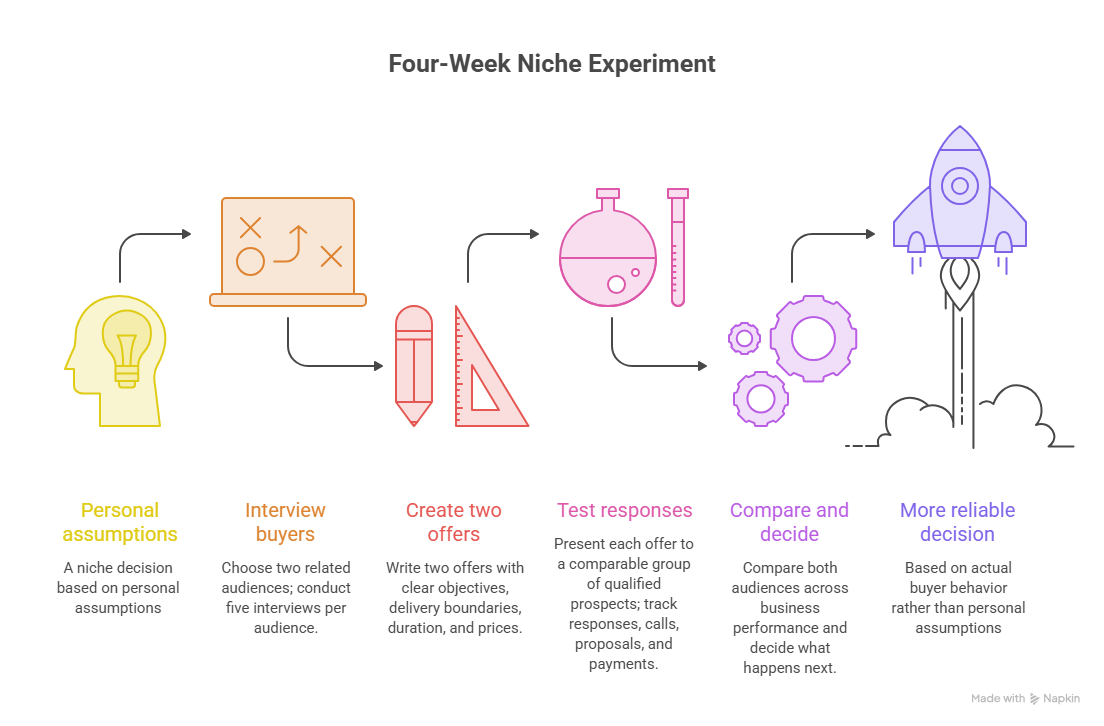
A niche decision becomes substantially more reliable when based on actual buyer behavior rather than personal assumptions.
The following four-week experiment is designed for coaches exploring new coaching specialties, struggling with first-client acquisition, or reconsidering an underperforming online coaching offer.
Week 1: Interview buyers before selecting your messaging
Choose two related audiences you can realistically reach.
For example, a coach experienced in professional development might compare newly promoted managers with midcareer professionals considering a job transition.
Conduct five interviews per audience. Ask about recent difficult situations, solutions already attempted, their consequences, and previous spending.
Useful questions include: "What happened the last time this problem affected your work?" and "What have you already done to improve the situation?"
Avoid asking whether people like your coaching concept. Enthusiasm without behavioral evidence is a weak indicator of demand.
This matters when researching career burnout, life purpose coaching, or emerging health coaching opportunities.
Week 2: Create one defined offer per audience
Write two offers with clear objectives, delivery boundaries, duration, and prices.
One might focus on four sessions supporting newly promoted managers in preparing for challenging conversations. Another might involve six sessions helping career-transition clients clarify priorities and establish action plans.
Both can draw on relevant methods, such as strengths-based coaching, SMART goals, and structured coaching conversations.
Document scope, confidentiality, session arrangements, and responsibilities through a clear coaching agreement.
Define observable progress milestones while avoiding guaranteed outcomes.
Week 3: Test actual commercial responses
Present each offer to a comparable group of qualified prospects.
A manageable pilot might involve 20 targeted outreach attempts per audience, supported by appropriate LinkedIn contacts or referral partners.
Track responses, discovery calls booked, proposals accepted, and payments received.
Also record why qualified prospects decline. Someone who cannot afford the package presents a different challenge from someone who doubts your expertise or sees little urgency.
Use insights from coaching sales objections, client trust signals, and new-coach positioning mistakes to interpret these responses accurately.
Week 4: Compare business performance and decide what happens next
Compare both audiences across qualified response rate, conversion, package revenue, acquisition expense, estimated delivery hours, and client suitability.
If one segment purchases repeatedly at sustainable prices, continue testing it with more prospects. If both show promise, consider a primary specialty with a secondary service lane.
If neither converts, investigate offer relevance, trust, sales execution, and distribution before abandoning the markets.
Sample sizes in a 30-day experiment are small. Results should support further testing rather than automatic permanent commitments.
This process allows an existing life coaching business to maintain current engagements while testing targeted messaging. It also reduces the risk of constantly changing direction whenever coaching demand fluctuates.
5. The Hybrid Coaching Strategy: Build a Specialty While Keeping Profitable Generalist Work
For many established coaches, the strongest business model combines a recognizable primary specialty with professionally appropriate flexibility.
The important distinction is between what a coach advertises and the full range of suitable engagements they can responsibly deliver.
A practitioner might become known for leadership coaching while continuing to serve referred clients seeking related confidence development, career resilience, or public speaking support.
Create one recognizable public identity
Select a primary audience and recurring problem for your homepage, introductory messages, and core offer.
For example:
"I help newly promoted managers strengthen communication, navigate difficult decisions, and establish effective leadership habits during their first three months."
This positioning allows relevant techniques from positive psychology coaching, emotional agility, and strengths-based development to support an understandable client objective.
The coach avoids overwhelming prospective customers with an extensive list of unrelated methods.
Establish three client-acceptance categories
Primary-fit clients: Their needs closely match the advertised specialty, relevant competencies, and established services.
Adjacent-fit clients: They have related goals that fall within the coach's professional competence and can be supported without compromising quality.
Referral-fit clients: They require support beyond the coach's training, legal scope, or professional responsibility.
These distinctions become particularly important in nutrition coaching, couples coaching, and engagements that may require mental health professionals.
Document these criteria in your intake procedures and apply your professional code of conduct consistently.
Strengthen referrals through specific language
People refer professionals more confidently when they recognize a clear client situation.
A statement such as "I help people become their best selves" requires interpretation.
A message such as "I support managers struggling with their first major leadership responsibilities" gives referral partners a concrete introduction trigger.
This can improve conversations with business associations, HR teams, and established coaching referral networks.
Related opportunities may develop through corporate wellness programs, conscious leadership coaching, or professional development partnerships.
Expand only after identifying sustainable demand
A focused practice may eventually develop additional services when existing clients request them and the coach has suitable capabilities.
For example, a specialist in career burnout coaching could test transition coaching or management-development programs. A preventive health coach might explore related lifestyle behavior-change services within their scope.
Evaluate new services using contribution margin, qualified demand, delivery effort, and client-reported progress.
Maintaining flexibility is particularly valuable when a coaching niche experiences seasonal purchasing patterns or depends heavily on one referral source.
The practical choice: Maintain focused marketing where it improves buyer understanding, preserve profitable adjacent services where appropriate, and expand when evidence supports doing so.
That approach can combine the benefits of differentiation with the financial resilience needed to build a sustainable coaching career.
6. FAQs: Coaching Niches, Generalist Practices, Pricing, and Business Growth
-
Beginners can explore a small number of related client problems while developing experience, provided their work stays within appropriate professional boundaries.
Early engagements reveal which client needs recur, what support they can provide competently, and which audiences are willing to purchase.
Start with one or two focused experimental offers instead of waiting for an ideal permanent specialty.
Understanding first-client coaching timelines, certification value, and common client acquisition mistakes can make this exploration more productive.
-
Yes, although purchasing power, reputation, demonstrated expertise, and the perceived value of an engagement influence pricing.
A generalist with excellent referrals and substantial experience may charge more than a specialist who lacks market credibility.
Analyze the economics of life coaching package pricing, full-time coaching earnings, and buyer trust in coaching credentials.
Higher session fees should be assessed alongside utilization, acquisition expenses, and working hours.
-
Demographic characteristics can help identify an audience, but commercially useful positioning also describes a recognizable problem and buying trigger.
"Women in their forties" offers limited insight into what a person wants to achieve. "Professionals returning to management after a career interruption" communicates a more concrete situation.
Coaches exploring life coaching niches, self-confidence coaching, or career transition services should define the problem before investing heavily in demographic targeting.
-
Determine whether clients lack purchasing power, whether the offer fails to demonstrate sufficient value, or whether the intended buyer differs from the person receiving coaching.
Where appropriate, explore group delivery, employer-sponsored programs, community partnerships, or lower-cost services with clearly defined scope.
Avoid imposing financially harmful commitments on clients.
Insights into health coaching package prices, corporate coaching employment, and health coaching career alternatives can help identify different economic models.
-
A health coach may serve several appropriate populations when their competencies, professional permissions, and resources support the services being offered.
However, coaching should remain within applicable scope-of-practice boundaries.
Work related to metabolic health coaching, lifestyle medicine, and food sensitivity concerns requires particular care around diagnosis, treatment claims, and referral responsibilities.
Coaches should review the distinction between health coaches, dietitians, and nutritionists before expanding into regulated services.
-
There is no universally reliable client-count threshold.
A small number of closely related engagements may reveal useful patterns, while many disconnected engagements may provide little market clarity.
Evaluate recurring buyer needs, willingness to pay, successful coaching objectives, and repeatable acquisition channels.
Use structured coaching models, SMART progress measures, and appropriate accountability processes to examine whether your experience supports a defensible specialty.
