
Life coach certification can be a strong investment when it improves three things simultaneously: your coaching skill, your market credibility, and your access to the clients you actually want. In 2026, the harder question is which certification deserves your money. Recent Reddit discussions reveal the same tension repeatedly: coaches value structured training, feedback, ethics, and confidence, while many discover that credentials alone do little to solve weak positioning, poor lead generation, or an unclear niche. The smartest decision begins with expected career ROI rather than the certificate itself.
1. Is Life Coach Certification Worth the Money in 2026?
For many aspiring coaches, certification becomes the first large purchase attached to the dream of building a practice. That creates a dangerous assumption: spending more should make becoming successful more likely.
The return depends on what the program actually changes.
A strong program can sharpen the listening, questioning, contracting, ethics, accountability, and behavior-change skills needed to produce credible client outcomes. Those capabilities become especially useful when your intended practice involves health behavior change, self-care coaching, career burnout coaching, self-confidence coaching, or life purpose coaching.
The strongest 2026 argument for professional development comes from the scale and maturation of coaching itself. The International Coaching Federation's 2025 Global Coaching Study reported approximately 122,974 coach practitioners worldwide and estimated annual coaching revenue of $5.34 billion. More revealing for certification buyers, 73% of surveyed coaches agreed that clients and organizations expect coaches to hold a certification or credential.
That statistic deserves careful interpretation.
A credential can reduce perceived risk. A prospective client considering couples coaching, money mindset coaching, public speaking coaching, or leadership coaching may have very little ability to judge coaching quality before the first session. Training, professional standards, testimonials, specialization, clear coaching contracts, and a coherent methodology become trust signals that help the buyer make the decision.
Certification also has a learning return that is easy to underestimate.
Knowing a great deal about personal development does not automatically create the ability to coach. Effective coaching requires restraint, listening, productive questioning, agreement-setting, awareness-building, action design, and knowing when another professional is more appropriate. Coaches who learn structured approaches such as the CLEAR coaching model, OSCAR coaching model, T-GROW coaching model, SMART Goals model, and Wheel of Life gain repeatable frameworks instead of relying on instinct during every conversation.
Recent Reddit discussions reflect this divide remarkably well. Coaches repeatedly describe structured training as useful for competencies, supervised practice, feedback, confidence, professional networks, and access to corporate work. Other practitioners warn that certification itself does not generate demand, leads, or revenue. One January 2026 discussion summarized the commercial problem neatly: improved coaching capability and increased coaching demand are two separate outcomes.
That distinction should shape your entire purchase decision.
If your real problem is weak session skills, training can address it. If your real problem is positioning, certification may leave that problem untouched. If you cannot explain who you help, what transformation you facilitate, why your approach is credible, and how prospects discover you, another certificate can become expensive procrastination.
2. What Reddit Experiences Reveal About Certification, Confidence, and Getting Clients
The most useful Reddit discussions avoid a universal verdict. They reveal several different versions of “worth it.”
One group values certification primarily for skill development. Practitioners describe structured learning, supervised practice, feedback from experienced coaches, a wider toolkit, professional networks, and clearer competency standards. A July 2025 discussion included a long-time coach who described these benefits and explained that credential progression became particularly useful in leadership and executive coaching.
That experience makes sense. A coach working with conscious leadership, career burnout, self-confidence, life visioning, and health behavior change needs far more than compelling questions. The coach needs to recognize resistance, maintain boundaries, structure accountability, adapt tools, and avoid turning coaching into unqualified therapy or constant advice-giving.
Another Reddit group focuses on commercial disappointment.
A January 2026 thread included the observation that certification can improve coaching capability while leaving demand, lead flow, and revenue unchanged. That is one of the most valuable warnings a prospective student can hear.
Someone can become substantially better at SMART goal setting, learn the ADKAR change model, understand the Immunity to Change model, strengthen positive intelligence, and master coaching agreements while still having an empty calendar.
The missing layer is commercial infrastructure.
You need a market, a painful problem, an offer, evidence, a referral mechanism, discovery conversations, follow-up, positioning, and enough visibility for prospective clients to discover you. Certification improves one part of that system.
A third Reddit pattern concerns confidence. New coaches often worry that every question sounds amateurish, every silence feels uncomfortable, and every difficult client response means they are failing. Structured practice can reduce this anxiety because the coach has experienced observation, feedback, ethics discussions, and repeated sessions before charging meaningful fees. Recent Reddit posters specifically described confidence as one reason certification can help when moving into freelance coaching.
Confidence has economic value when it changes behavior. A coach who understands duty of care, follows a clear coaching code of conduct, can use transactional analysis appropriately, understands cultural competence, and can structure a CLEAR coaching conversation is usually better equipped to explain the service, hold boundaries, and facilitate difficult conversations.
Confidence without execution produces no return. The financial value appears when better capability helps you coach more effectively, retain clients, earn referrals, access stronger opportunities, or charge prices supported by demonstrated value.
3. Client Trust: How Much Does a Life Coaching Certificate Actually Matter?
Client trust is built through accumulated signals.
Certification is one of them.
Prospective clients usually evaluate an unfamiliar coach using visible evidence such as professional training, relevant experience, specialization, testimonials, methodology, ethical standards, communication quality, referral source, clarity of scope, and the quality of the initial conversation. Someone seeking money mindset coaching may prioritize relevant results. A client seeking couples coaching may scrutinize boundaries and methodology. An organization purchasing leadership coaching may apply formal vendor criteria. Someone seeking life purpose coaching may care heavily about personal fit and philosophy.
The certificate therefore carries different weight in different markets.
Corporate and employer-sponsored coaching creates one of the strongest cases for recognized credentials. The 2025 ICF Global Coaching Study reported that more than half of coaching clients were employer-sponsored, showing how deeply organizational buyers now participate in the market.
Independent consumer coaching works differently. The buyer may discover you through a recommendation, podcast, social content, workshop, community, or testimonial. In those environments, trust frequently grows from the combination of specialized knowledge and visible proof. Expertise in self-care coaching, public speaking coaching, career burnout coaching, life visioning, and behavior change can make the value proposition much easier to understand.
There is also an important distinction between completing a certificate program and earning an independent professional credential.
For example, ICF's current ACC pathway requires at least 60 hours of coaching education, 100 hours of coaching experience with at least eight clients, 75 paid coaching hours, 10 hours of mentor coaching, a performance evaluation, and the ACC exam. That makes the credential broader than simply completing coursework.
This distinction is crucial when comparing schools.
A program may provide excellent training while offering a certificate that has little recognition outside its own brand. Another program may align directly with a professional credentialing pathway. Before enrolling, investigate where the training sits within your longer-term plan, especially if you expect to pursue executive and leadership coaching, build strong professional coaching standards, apply formal duty-of-care principles, develop inclusive coaching competence, or create more rigorous client contracting.
Trust also compounds through performance.
A client who experiences clearer thinking, better follow-through, stronger decisions, or sustainable behavior change becomes evidence of capability. That is why excellent training should ultimately improve the quality of your case studies, referrals, retention, and reputation. A certificate sitting beside your name has limited commercial leverage when the rest of the client experience feels generic.
4. Calculate Career ROI Before Paying for Any Certification
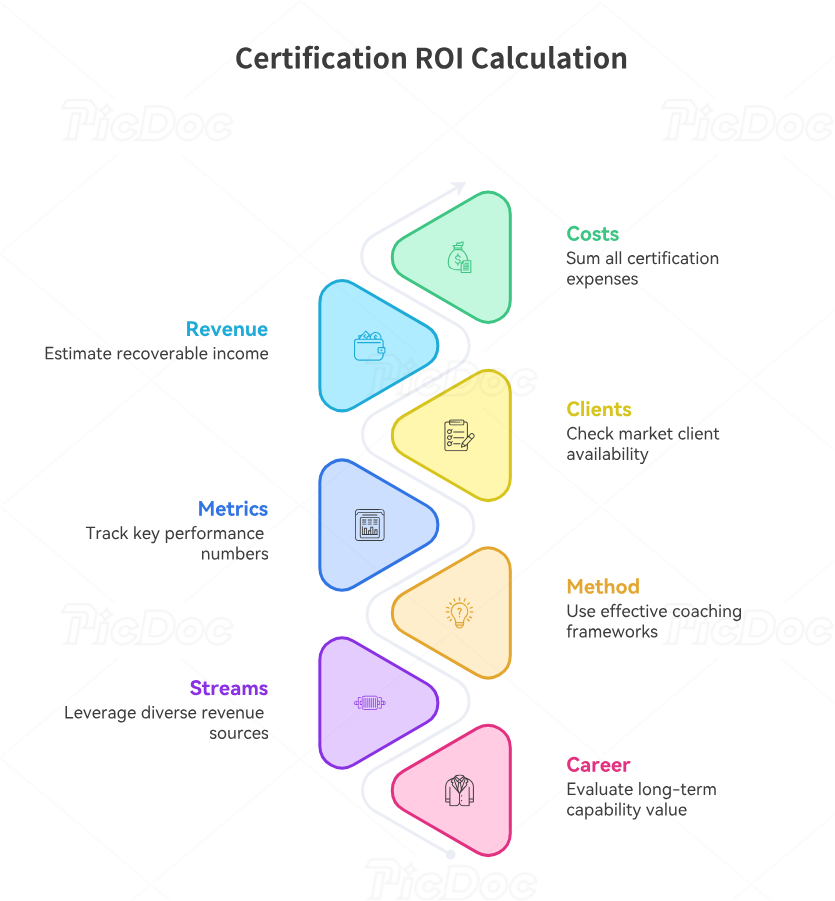
The cleanest way to judge certification financially is to calculate economic cost, recoverable value, and payback time before enrolling.
Start with total economic cost:
Tuition + credential/application costs + required books or assessments + travel + technology + lost earning time + future renewal expenses = total certification investment
Many prospective coaches evaluate tuition alone. That understates the investment. A demanding program may consume evenings that could have been used for paid work, prospecting, building a referral network, or testing a coaching niche.
Then calculate likely recoverable revenue.
Suppose your complete training pathway costs $5,000. After graduating, you sell a six-session package for $900. If delivery and acquisition costs leave approximately $650 of contribution toward recovering the investment, roughly eight such clients would recover the original $5,000.
That is an illustrative model rather than an income forecast. Your pricing, acquisition costs, taxes, cancellation rate, conversion rate, and time commitment will change the result.
The important question becomes: Can your actual market reasonably produce those eight clients?
Someone with an established professional network who moves into leadership coaching, career burnout coaching, public speaking coaching, money mindset coaching, or self-confidence coaching may have an existing source of prospects. A beginner with no audience, professional network, niche, or selling experience needs to build that infrastructure alongside the coaching skill.
This is where many certification ROI calculations collapse.
People calculate future session fees while ignoring customer acquisition. They imagine charging $150 per session and divide tuition by $150. That assumes every dollar collected becomes recovery of the original investment and every available coaching hour contains a paying client.
A stronger model tracks six numbers:
Average revenue per client
Average delivery hours per client
Client acquisition cost
Lead-to-client conversion rate
Monthly qualified leads
Client retention or package completion rate
You should also track your ability to generate outcomes using repeatable processes such as the SMART Goals framework, T-GROW model, OSCAR model, ADKAR model, and Immunity to Change approach. Better methodology can improve client experience and referrals, which strengthens ROI indirectly.
Certification can create career ROI outside private 1:1 coaching as well.
ICF's 2025 study reported that many coaches also provide training, consulting, facilitation, and mentoring. That matters because a professional coaching skill set can support several revenue streams instead of depending exclusively on weekly private sessions.
A coach with expertise in conscious leadership might combine executive coaching with workshops. Someone skilled in health behavior change might develop group programs. A life purpose coach might add retreats or structured cohorts. A practitioner working in self-care coaching could provide organizational wellbeing sessions alongside individual coaching.
The best ROI calculation therefore asks what professional capability the training unlocks across your entire career, then tests that value against realistic demand.
5. When Certification Is Worth Paying For and When the ROI Becomes Weak
Certification becomes especially attractive when you are entering coaching without structured coach-specific training.
Being the person friends naturally seek for advice can indicate empathy, trust, or strong interpersonal instincts. Professional coaching introduces a different discipline. The coach learns to create agreements, listen for patterns, evoke awareness, maintain client ownership, recognize ethical boundaries, and support action without making the relationship dependent on advice.
Programs that strengthen coaching ethics, duty of care, client contracting, cultural competence, and sophisticated behavior-change coaching can provide meaningful professional infrastructure.
Certification can also produce stronger ROI when your target buyer filters coaches by professional standards. Corporate buyers, leadership-development providers, coaching platforms, and institutional clients may care more about recognizable credential pathways than a private consumer choosing a coach through referral. Recent Reddit discussions repeatedly identify corporate and executive work as areas where credentials can become materially more important.
Geographic ambition changes the equation too.
A coach planning to work internationally should examine how the intended credential travels across markets. Someone building a practice in Saudi Arabia, Qatar, the United Kingdom, Germany, or Singapore should investigate local buyer expectations, employer preferences, professional-body recognition, business requirements, and any scope restrictions relevant to the services offered.
The ROI becomes weak when the purchase is driven mainly by fear.
This happens when aspiring coaches keep studying because they feel they need “one more qualification” before speaking to prospects. A second model, third modality, or expensive specialist course can feel productive while postponing the harder work of developing an offer, asking for referrals, conducting discovery calls, gathering legitimate testimonials, and learning what actual clients will buy.
Another warning sign appears when the program's marketing spends more time selling the coaching lifestyle than demonstrating instructional quality.
Look for specific information about observed practice, faculty qualifications, feedback, curriculum, ethics, assessment, mentor support, graduate outcomes, accreditation status, total costs, and the process for developing real coaching experience. Scrutinize programs built around income promises, urgency timers, luxury imagery, or vague claims that becoming “certified” automatically establishes authority.
Your chosen specialty should also influence the curriculum.
A coach focused on couples coaching needs especially strong boundaries. A practitioner entering career burnout coaching should understand referral thresholds and wellbeing considerations. A money mindset coach needs clarity around the boundary between coaching and regulated financial advice. A leadership coach may face confidentiality complexities involving both the participant and sponsoring employer. A coach applying transactional analysis or positive intelligence needs enough training to use frameworks responsibly.
A useful purchasing rule is simple: identify the capability gap before shopping for the program.
If the gap is coaching competence, buy excellent training. If the gap is institutional credibility, investigate recognized credentials. If the gap is specialization, seek relevant advanced education. If the gap is lead generation, invest effort into positioning and customer acquisition. If the gap is client follow-through, deepen your understanding of behavior change, SMART goals, Immunity to Change, ADKAR, and T-GROW.
That approach turns certification from an emotional purchase into a career investment decision.
6. FAQs About Life Coach Certification Cost, Trust, and Career ROI
-
Requirements vary by jurisdiction and the exact services being offered, so prospective coaches should check the rules where they operate. Professional training still carries substantial practical value because it develops coaching competence, ethics, boundaries, and client-management skills. Building around a clear coaching code of conduct, understanding duty of care, establishing proper coaching contracts, improving cultural competence, and mastering client behavior change gives a practice stronger foundations.
-
It can reduce uncertainty, especially before a prospect has personal experience with you. Client trust usually develops from several signals working together: relevant training, professional conduct, a clear niche, appropriate boundaries, strong conversations, credible testimonials, referrals, and demonstrated results. Expertise in areas such as self-confidence coaching, self-care coaching, life purpose coaching, public speaking coaching, or career burnout coaching gives prospects additional context for judging relevance.
-
Training can make you more credible and more effective in discovery and coaching conversations, while predictable client acquisition requires its own system. Develop a specific audience, painful problem, offer, referral strategy, visibility channel, sales process, and follow-up mechanism. Combining that commercial system with strong methods such as CLEAR coaching, OSCAR coaching, SMART Goals, Wheel of Life, and life visioning creates a much stronger business foundation.
-
It can carry greater strategic value when your long-term plan includes an ICF credential, organizational coaching, leadership work, coaching platforms, or clients who screen for recognized professional standards. Current ICF requirements for the ACC include coaching education, documented client hours, mentor coaching, evaluation, and an exam, so candidates should compare the complete credential pathway with the certificate issued by an individual school.
Before spending more, examine how the program supports your intended market, whether you are pursuing leadership coaching, building competence in conscious leadership, specializing in behavior change, developing ethical coaching practice, or strengthening formal coaching agreements.
-
Set your own acceptable payback period before enrolling. Calculate total economic cost, expected revenue per client, delivery costs, acquisition costs, likely conversion rate, and realistic monthly client volume. Then determine how many clients are required to recover the investment.
A coach building a premium leadership coaching practice will have different economics from someone entering self-care coaching, couples coaching, money mindset coaching, or life purpose coaching. Use your expected market rather than somebody else's revenue screenshot.
-
Evaluate accreditation or professional-body alignment, live training hours, observed coaching practice, quality of feedback, mentor access, ethics training, assessment standards, faculty experience, alumni outcomes, business education, total costs, refund terms, continuing support, and the exact credential you receive.
Then evaluate the curriculum itself. Look for training that helps you understand SMART goal design, change management through ADKAR, Immunity to Change, positive intelligence, and effective coaching contracts rather than giving you a collection of disconnected exercises.
