
ADKAR Model: Why Every Coach Should Know This Change Management Method
Clients rarely fail because they lack ambition. Change breaks down when one essential condition remains unresolved: they cannot explain why the change is necessary, they have little personal commitment, they lack practical knowledge, they cannot perform the behavior reliably, or their environment keeps pulling them backward. The ADKAR Model gives coaches a precise way to locate that blockage. Combined with behavior-change science, accountability coaching, and habit formation, it turns vague resistance into a coachable diagnosis.
1. Why the ADKAR Model Gives Coaches a Better Change Diagnosis
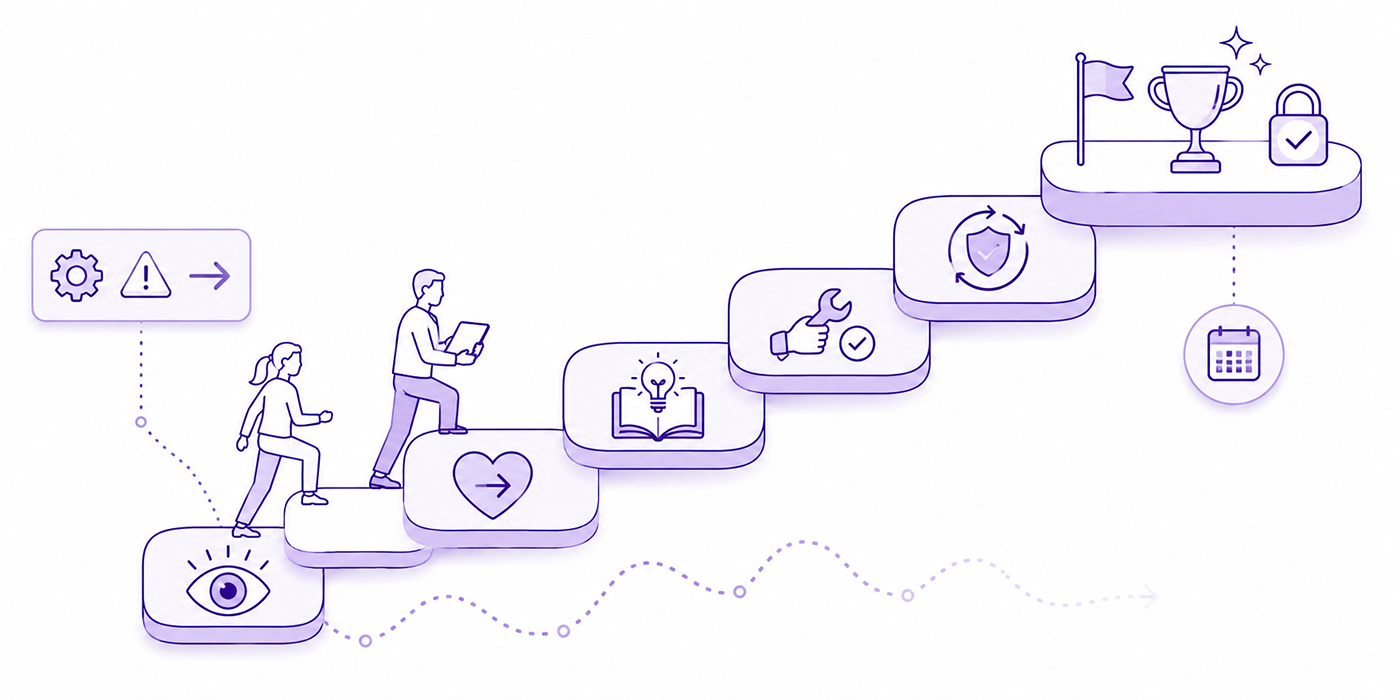
ADKAR organizes successful change into five outcomes: Awareness, Desire, Knowledge, Ability, and Reinforcement. Each outcome answers a different coaching question. Does the client understand the need for change? Do they personally want to participate? Do they know what to do? Can they perform the required behaviors under real conditions? Can they sustain progress after initial motivation fades?
This sequence gives coaches more precision than treating every stalled client as unmotivated. A client may understand the health consequences of inactivity yet feel no personal desire to exercise. Another may desperately want a career change while lacking the knowledge required to identify transferable skills. A third may understand the steps and possess strong commitment, yet anxiety prevents them from performing during interviews. Each client requires a different intervention.
That diagnostic discipline strengthens transformational coaching because it prevents coaches from prescribing solutions before identifying the actual barrier. It also improves client expectation management, since progress can be measured through specific change outcomes rather than emotional enthusiasm alone. A client can feel excited and remain unprepared. Another can feel uncertain while still demonstrating growing ability.
The model also protects the coaching relationship from a common trust-killing mistake: pushing accountability when the client lacks clarity. Weekly targets accomplish little when the client cannot connect the change to a meaningful consequence. Similarly, more education rarely solves weak desire. Sending another worksheet to a disengaged client often increases guilt, avoidance, and ghosting.
Strong coaches diagnose the earliest unresolved ADKAR outcome and work there. This approach supports a safe coaching environment, improves constructive feedback, and reduces the tension associated with difficult client situations. The coach stops labeling the person and starts examining the conditions surrounding the change.
2. How to Coach the Five ADKAR Outcomes in the Correct Order
Awareness: Help the Client Understand Why Change Is Necessary
Awareness requires more than explaining that a problem exists. The client needs a credible, personally relevant understanding of why the current pattern can no longer continue unchanged. Coaches can build this through consequence mapping, discrepancy questions, future projections, stakeholder feedback, and examination of repeated outcomes.
A health client may know that sleep affects energy while underestimating how late-night work contributes to irritability, poor food decisions, and missed exercise. A leadership client may acknowledge communication problems while overlooking the cost to retention and team trust. Awareness becomes useful when the client can explain the issue, its consequences, and the reason action is timely.
This stage benefits from behavior-change science, preventive health coaching, emotional-intelligence coaching, and carefully delivered constructive feedback. Coaches should use evidence without overwhelming clients with fear. Excessive warnings can create shutdown, shame, or defensive argument.
Desire: Build Personal Willingness to Participate
Desire is the most emotionally complex ADKAR outcome because clients weigh benefits, losses, effort, risk, identity, relationships, and confidence. A client may understand the need for change while protecting a familiar pattern that provides comfort, belonging, predictability, or status.
The coach’s task is to expose the full motivational equation. What does the client gain? What discomfort must they tolerate? Which relationships might shift? Which identity could become outdated? What competing commitment keeps the present pattern alive?
This stage requires strong emotional agility, strengths-based coaching, mindset work, and realistic expectation management. Pressure creates superficial agreement. Skilled questioning creates ownership.
A useful desire question is: “What would make this change worth the cost it will require?” This invites the client to evaluate sacrifice openly. Commitment becomes stronger when clients choose the trade-off consciously.
Knowledge: Teach the Client What Successful Change Requires
Once willingness exists, clients need procedural clarity. Knowledge may include information, frameworks, scripts, decision rules, techniques, resources, or an implementation sequence. Coaches frequently lose clients here by giving too much information at once. Information volume can produce the feeling of progress while delaying performance.
Knowledge should answer five practical questions:
What behavior must change?
When should it occur?
How should it be performed?
Which obstacles are predictable?
What response will be used when those obstacles appear?
A coach helping a client establish boundaries might teach a three-part script, identify the first conversation, rehearse likely objections, and define the follow-up action. A coach supporting a health goal might combine habit formation, habit stacking, health-behavior change, and short micro-coaching interventions.
Knowledge is complete when the client can explain and prepare for the behavior. Explanation alone does not establish ability.
Ability: Convert Understanding Into Reliable Performance
Ability develops through action under realistic conditions. Clients need rehearsal, feedback, repetition, environmental support, and gradual increases in difficulty. This stage often exposes hidden barriers that remained invisible during planning.
A client may know how to deliver a presentation and lose fluency when senior leaders enter the room. Another may understand meal planning and abandon it during travel. A manager may learn a feedback framework and soften the message when conflict appears. These failures provide diagnostic information about the conditions surrounding performance.
Coaches can build ability through role-play, simulations, behavioral experiments, cue redesign, skill decomposition, and post-action reviews. Accountability structures, coaching automation, stress-management coaching, and safe coaching environments support practice without turning every mistake into a verdict on the client’s potential.
Reinforcement: Protect Change From Regression
Reinforcement helps a new behavior survive fatigue, disrupted routines, competing priorities, social pressure, and the fading excitement of early progress. It includes measurement, recognition, environmental design, recovery planning, identity consolidation, and continued accountability.
The strongest reinforcement systems reward evidence that predicts durable results. Praising effort can help, although coaches should also track whether the behavior occurred at the required frequency, quality, and context. A client who journals occasionally may feel committed while gaining little benefit from inconsistent practice.
Reinforcement becomes stronger through accountability coaching, positive-psychology coaching, resilience coaching, and thoughtful client feedback systems. The goal is increasing self-management. Clients should gradually rely more on their own cues, standards, and review processes.
3. The Coaching Mistakes That Cause ADKAR-Based Change to Fail
The first mistake is treating ADKAR as five topics to discuss once. Each letter represents an observable outcome. A conversation about desire does not establish desire. The coach needs evidence: voluntary action, protected time, willingness to accept trade-offs, and persistence after discomfort appears.
The second mistake is starting too late in the model. Coaches frequently give strategies to clients who lack awareness or desire. The resulting plan may appear polished while remaining psychologically unsupported. When the client fails to act, the coach adds reminders, tighter deadlines, or stronger accountability. This creates pressure around a foundation that was never established.
A better approach begins with diagnostic questions:
Can the client explain why the change is necessary?
Are their reasons personally meaningful?
Can they describe the required behaviors?
Have they demonstrated those behaviors under realistic conditions?
Which systems will sustain progress?
This diagnostic sequence pairs well with transformational coaching, client expectation management, difficult-client coaching, and the broader science of behavior change.
The third mistake is assuming every client moves smoothly from Awareness to Reinforcement. Major life changes can reactivate earlier concerns. A promotion may create desire initially, followed by doubts when the client discovers the social cost of leading former peers. A health client may develop strong ability at home and lose confidence after returning to work. Coaches should reassess the ADKAR outcomes when circumstances change.
The fourth mistake is confusing emotional distress with resistance. Grief, anxiety, exhaustion, and uncertainty can temporarily reduce capacity. A client facing divorce, redundancy, illness, relocation, or caregiving pressure may need stabilization before intensive performance work. Coaches should draw from emotional-crisis support, anxiety and stress coaching, emotional agility, and appropriate referral procedures.
The fifth mistake is reinforcing outcomes the client cannot control. Promotions, sales, weight changes, and relationship responses involve external variables. Coaches should reinforce controllable behaviors, quality standards, recovery speed, and decision consistency. This maintains fairness and reduces the discouragement created by delayed results.
The sixth mistake is using the model to force organizational compliance. In workplace coaching, clients may have valid concerns about leadership credibility, workload, ethics, job security, or implementation quality. Desire cannot be manufactured through motivational language. The coach should help the client clarify choices, influence what they can, communicate concerns constructively, and protect professional boundaries. Ethical coaching practice, legal awareness, constructive feedback, and scope-of-practice clarity become essential.
4. How to Apply ADKAR to Major Client Transitions
Consider a client who wants to leave an exhausting corporate role and build a consulting practice. The surface goal is clear, although the change contains financial, emotional, relational, and identity risks.
During Awareness, the coach examines the cost of remaining in the current role. Burnout symptoms, reduced family presence, stalled development, and health consequences may create urgency. Career-burnout coaching, life-purpose coaching, life visioning, and emotional-agility work can help the client see the full situation.
During Desire, the client explores income fears, status loss, family expectations, professional identity, and the appeal of autonomy. The coach should avoid treating enthusiasm as commitment. A serious desire assessment examines willingness to build savings, test services, tolerate uncertainty, and reduce discretionary spending.
During Knowledge, the client may need a transition timeline, offer-development process, market research plan, networking strategy, financial forecast, and legal checklist. Relevant support may include financial forecasting, networking strategies, legal requirements, and guidance on setting up a coaching LLC.
During Ability, the client tests the change. They conduct discovery calls, create proposals, explain their value, handle objections, and deliver paid work. Their confidence should be based on demonstrated competence. Role-play, observed practice, structured feedback, and small commercial experiments expose gaps before the client makes irreversible decisions.
During Reinforcement, the client tracks revenue quality, workload, client outcomes, pipeline stability, and energy. A strong system may combine coaching automation, client-retention strategies, exceptional client experiences, and disciplined business scaling.
The same logic applies to health changes, leadership transitions, relationship boundaries, retirement, relocation, recovery from burnout, and identity shifts. The content changes. The diagnostic outcomes remain consistent.

5. How Coaches Can Build ADKAR Into Their Programs and Sessions
A practical ADKAR coaching process begins with an intake assessment. Ask clients to rate each outcome from 1 to 10 and support every rating with evidence. A client who rates ability at eight should be able to describe repeated successful performance under normal conditions. Confidence without behavioral evidence should remain a hypothesis.
At the start of each session, identify the current ADKAR priority. This prevents the conversation from becoming a general emotional update. The coach can ask: “Which outcome, if strengthened today, would unlock the greatest movement?” That question creates focus while preserving client ownership.
Session notes can include five short fields:
Awareness evidence: What does the client understand more clearly?
Desire evidence: What commitment or trade-off have they chosen?
Knowledge evidence: What process, script, or decision rule can they explain?
Ability evidence: What have they successfully demonstrated?
Reinforcement evidence: Which systems protect continued performance?
This structure supports coaching case studies, stronger client experiences, useful client feedback, and more credible certification portfolios.
Coaches can also build one milestone around each ADKAR outcome. A 12-week program might use early sessions for Awareness and Desire, middle sessions for Knowledge and Ability, and later sessions for Reinforcement and independence. Actual pacing should follow client evidence. Some clients arrive with strong awareness and desire. Others require several sessions to resolve ambivalence before planning becomes useful.
Technology can support the process through check-in forms, habit trackers, automated reminders, progress dashboards, and resource libraries. Tools should reduce friction and improve observation. Excessive notifications can create dependence or disengagement. Coaches should choose systems according to the client’s ADKAR gap, drawing from must-have coaching tools, coaching automation, technology in coaching, and business automation.
Ethical boundaries remain essential. Coaches should work within their competence, obtain informed consent, protect confidentiality, document accurately, and refer clients whose needs exceed the coaching scope. The ICF Code of Ethics, NBHWC scope of practice, legal requirements for coaches, and ongoing CPD certification maintenance provide useful professional guardrails.
6. Frequently Asked Questions About the ADKAR Model
-
ADKAR stands for Awareness, Desire, Knowledge, Ability, and Reinforcement. These outcomes describe the conditions a person needs to move from understanding a change to sustaining it. Coaches can use them to diagnose why a client remains stuck and select an intervention that matches the actual barrier. The framework becomes especially powerful when paired with behavior-change science, accountability coaching, and habit formation.
-
The earliest unresolved outcome usually deserves attention first because later outcomes depend on earlier foundations. Clients may still revisit previous stages when circumstances change. A client with strong ability can experience reduced desire after a workplace restructure. A client with established reinforcement can require new knowledge when the goal becomes more complex. Regular reassessment supports transformational coaching, emotional agility, and realistic client expectation management.
-
A client with a Desire gap avoids commitment, questions the value of the change, resists trade-offs, or agrees mainly to please others. A client with an Ability gap wants the result and understands the process, yet struggles to perform under realistic conditions. Desire work explores motivation, identity, confidence, and competing commitments. Ability work uses rehearsal, skill development, friction reduction, feedback, and graduated practice. Strengths-based coaching, micro-coaching, and constructive feedback can support both outcomes.
-
Yes. Coaches can use ADKAR for career transitions, health routines, leadership development, relationship boundaries, relocation, retirement, confidence building, and other significant life changes. The coach translates each outcome into personal evidence. Awareness might involve recognizing the cost of a pattern. Desire might involve choosing a meaningful trade-off. Knowledge might involve learning a new process. Ability might require real-world practice. Reinforcement might include tracking, routines, social support, and identity development. Useful companion approaches include life visioning, life-purpose coaching, and resilience coaching.
-
The greatest risk comes from applying the framework mechanically. Human change involves emotion, relationships, power, health, resources, culture, and unpredictable events. A five-part checklist cannot replace attentive listening or professional judgment. Coaches should use ADKAR as a diagnostic map while adapting questions and interventions to the client’s context. Safe coaching environments, emotional-crisis support, ethical practice, and clear scope-of-practice boundaries remain essential.
-
Measure the durability of behavior across time and changing conditions. Useful indicators include completion frequency, quality of execution, recovery speed after setbacks, reduced dependence on reminders, environmental support, and evidence that the new behavior has become part of the client’s identity. Outcome measures can also be tracked, although they should be interpreted alongside controllable behaviors. Accountability systems, client feedback, positive-psychology coaching, and habit-stacking techniques can strengthen reinforcement.
