
Transformational Coaching: Behavioral Strategies for Lasting Change
Transformational coaching only works when change moves out of inspiration and into repeated behavior under real-life pressure. Clients do not change because they had one emotional breakthrough, wrote a beautiful goal, or left a session feeling motivated. They change when identity, environment, habits, accountability, friction, rewards, reflection, and recovery all start pointing in the same direction. That is where transformational coaching becomes more than a nice conversation.
The coaches who create lasting change know how to turn insight into structure, structure into repetition, and repetition into a new normal. They do not rely on hype. They build systems clients can live inside when stress rises, time gets tight, and old patterns start calling them back.
1. Why Lasting Change Fails For So Many Clients
Most clients do not struggle with knowing what is good for them. They struggle with doing it consistently when life becomes noisy, emotional, inconvenient, or discouraging. That is why transformational coaching has to be behavioral at its core. A client may fully understand what they should eat, how they should sleep, what boundary they should set, or what routine would support them. Knowledge still collapses when the desired behavior has weak cues, high friction, low emotional payoff, poor tracking, or no recovery plan. Coaches who study how to actually change your clients life in 2026, how the world’s best coaches get results, how to make it work every time, and how to actually empower clients real results are usually much better at catching this gap.
A lot of coaching fails because it confuses emotional intensity with durable change. A client cries, feels seen, says they are finally ready, and leaves convinced something major has shifted. Sometimes it has. Often it has not. Emotional clarity is valuable, but it is not the same thing as behavioral repetition. Lasting change requires a behavior that can survive Monday morning stress, family demands, sleep deprivation, social pressure, boredom, and self-doubt. That is why coaches who lean on smart goals 2.0: how top coaches set & achieve client goals, the coaching skill you didn’t know you needed, the 1 coaching technique for client breakthroughs, and strength-based coaching techniques that skyrocket client success usually create better follow-through.
Another reason change fails is that clients often chase the wrong unit of progress. They focus on outcomes they cannot fully control instead of behaviors they can actually execute. “Lose 20 pounds,” “stop being anxious,” “be more disciplined,” “fix my marriage,” or “become confident” sound motivating, but they are terrible daily coaching units. Great coaches translate those ambitions into visible actions: walk after lunch five days a week, close the laptop by 9 p.m., send one difficult email within 24 hours, prep breakfast the night before, or write one boundary sentence before the meeting. This practical shift is supported by interactive goal tracking tools that boost client success, habit formation tools helping clients achieve lasting change, coaching session templates to boost your productivity instantly, and building your coaching toolkit essential templates and checklists.
Change also fails when the coach does not respect how much identity protects old behavior. Clients do not simply repeat habits. They defend familiar versions of themselves. The exhausted caretaker, the chronic procrastinator, the all-or-nothing dieter, the person who always says yes, the high-achiever who collapses alone at night, the professional who performs well but never recovers. Behavioral change threatens those identities before it frees the client from them. Coaches who understand why trust is the most valuable asset in coaching, building deep trust how to strengthen your client relationships, effective listening techniques that transform client conversations, and the art of powerful questioning in coaching usually handle identity resistance with much more precision.
| Strategy | Purpose | How To Use It | Start Small Version | Best For |
|---|---|---|---|---|
| Behavior anchoring | Attach new action to existing habit | Link behavior to something already automatic | Stretch after brushing teeth | Inconsistent starters |
| Implementation intentions | Pre-decide action | Use if-then plans for obstacles | If I miss morning walk, I go after lunch | Busy professionals |
| Environment design | Reduce friction | Change cues in physical space | Put water bottle on desk | Habit drop-off |
| Trigger tracking | Identify behavioral patterns | Map where lapse begins | Note mood before snacking | Emotional eating |
| Identity statements | Support self-concept shift | Create believable self-language | I am learning to protect my energy | Self-sabotage |
| Friction removal | Make good behaviors easier | Prepare before motivation fades | Lay out workout clothes | Low-energy clients |
| Friction addition | Make bad behaviors harder | Add steps to unwanted habit | Delete food delivery apps | Impulse patterns |
| Minimum viable habit | Protect consistency | Shrink behavior to near-certain success | One push-up, one journal line | All-or-nothing clients |
| Recovery planning | Prevent lapse from becoming relapse | Design bounce-back plan | Next meal, not next Monday | Perfectionists |
| Behavior scoring | Track execution quality | Use simple 1-5 rating | Rate sleep routine nightly | Data-driven clients |
| Weekly review | Build reflection loop | Review wins, misses, barriers | Three-question Friday check-in | Plateaus |
| Barrier rehearsal | Prepare for setbacks | Practice the obstacle mentally | What will you do when tired? | Drop-offs under stress |
| Temptation bundling | Increase compliance | Pair desired habit with enjoyable one | Podcast only during walk | Bored clients |
| Decision rules | Reduce negotiation | Use simple non-negotiables | No phone in bed | Overthinkers |
| Social accountability | Increase follow-through | Use visible commitment structure | Text progress photo to partner | Low self-accountability |
| Progress visualization | Make gains visible | Use streaks or charts carefully | Habit tracker grid | Discouraged clients |
| Emotional labeling | Reduce reactive behavior | Name feeling before acting | I am anxious, not hungry | Emotion-driven patterns |
| Pause rituals | Interrupt autopilot | Insert 30-second pause before behavior | Three breaths before replying | Reactive clients |
| Identity evidence logging | Reinforce new self-story | Collect proof of change | Log one aligned action daily | Low confidence |
| Micro-boundary scripts | Protect change from other people | Pre-write short responses | I can’t commit to that tonight | People-pleasers |
| Choice architecture | Guide decisions toward desired path | Limit bad default options | Keep fruit visible, snacks hidden | Home-based habits |
| Future pacing | Make consequence concrete | Walk client through likely outcome | What happens if this repeats 30 days? | Motivation dips |
| Reward engineering | Increase behavior stickiness | Build healthy immediate rewards | Checkmark plus favorite tea | Delayed-gratification struggles |
| Lapse audit | Learn from misses | Analyze without shame | What made yesterday hard? | Recurring failures |
| Energy mapping | Align actions with capacity | Schedule hard tasks at peak times | Walk at 11 a.m. not 7 p.m. | Exhausted clients |
| Keystone habit focus | Create spillover results | Target one high-impact behavior | Consistent bedtime | Scattered goals |
| Values linking | Deepen emotional meaning | Connect habit to identity or purpose | Meal prep equals protecting future energy | Meaning-driven clients |
| Maintenance phase design | Prevent regression after success | Shift from sprint to sustainable rhythm | Three workouts instead of six | Post-goal collapse |
2. The Behavioral Core Of Transformational Coaching
Transformational coaching should feel personal, but it has to function mechanically. Lasting change comes from a few repeatable behavioral levers: cues, routines, friction, rewards, tracking, identity reinforcement, and recovery from lapses. Coaches who understand these levers stop blaming clients for “not wanting it enough.” They see that a client’s failure to follow through often has more to do with weak structure than weak character. That mindset is strengthened by why coaches must avoid this trap, how coaches reach mastery, the neuroscience-based method every coach needs now, and why coaches are embracing this positive change model.
The first lever is cue awareness. Every recurring behavior has a beginning. It starts with a time, place, emotional state, social context, or preceding action. If the client cannot identify where the behavior starts, they will keep trying to fix it too late. By the time they “notice” the bad behavior, the pattern is already moving. Great coaches teach clients to detect the first 10 seconds of the loop. That is where daily journaling prompts the ultimate 2026 guide for coaches, life mapping the ultimate 2026 guide for coaches, powerful client journaling tools for deeper self-awareness, and using surveys and feedback tools to improve coaching outcomes become incredibly practical.
The second lever is friction. The easier a behavior is, the more likely it survives tired, distracted, emotional days. Coaches often ask for too much behavior too soon. They build plans for ideal clients in ideal weeks instead of real humans with messy lives. The stronger move is to build a version of the behavior that still happens on the client’s worst Tuesday. That is why the radical simplicity coaches are loving, why top coaches are obsessed, how one method is revolutionizing coaching, and solution-focused brief coaching matter so much when you want consistency more than temporary intensity.
The third lever is identity evidence. Clients sustain change better when they stop chasing motivation and start collecting proof that they are becoming someone new. The client who says, “I protected my bedtime three times this week,” “I paused before reacting,” or “I prepared lunch even when I was overwhelmed” is building evidence, not just confidence. Evidence is stronger than pep talks. Coaches who use affirmation cards the ultimate 2026 guide for coaches, gratitude journal coaching, the wheel of life reinvented strategies for coaching mastery, and visualization & guided imagery proven methods every coach needs can reinforce this without becoming fluffy or disconnected from behavior.
3. The Best Behavioral Strategies For Creating Lasting Change
The most effective transformational coaches do not use one strategy. They build layered behavior systems. One powerful layer is the minimum viable behavior. Instead of asking the client to meditate for 20 minutes, start with 90 seconds after they sit on the bed. Instead of “work out six times,” start with “put shoes on and walk outside for five minutes.” Instead of “eat clean all week,” start with “build one high-protein breakfast before noon.” This protects momentum and reduces shame. Coaches who have learned from how to inspire clients to take immediate action, effective strategies for reinforcing positive client behaviors, interactive coaching exercises to keep clients motivated, and gamification strategies keeping clients engaged and motivated are often better at making small wins emotionally sticky.
Another high-value strategy is the if-then plan. Clients fail less when they decide in advance what they will do when the predictable obstacle shows up. “If I miss my morning walk, then I will take a 10-minute walk after lunch.” “If I want to stress-eat after work, then I will drink water and wait 10 minutes.” “If my manager asks for a late-night task, then I will respond with my boundary script.” This removes negotiation at the moment of weakness. Coaches who connect this with conflict resolution strategies every coach needs, managing difficult client conversations with ease, techniques for maintaining professional boundaries with clients, and helping clients manage work-life balance successfully create much stronger carryover into real life.
A third strategy is lapse recovery coaching. Many clients are not defeated by one missed behavior. They are defeated by the meaning they attach to one missed behavior. One skipped workout becomes “I always quit.” One overeating night becomes “I blew the whole week.” One missed boundary becomes “I cannot change.” Great coaches train clients to recover within the same day, not after a shame spiral. That mindset is strengthened by inner critic management techniques, the positive psychology framework revolutionizing coaching in 2026, mindfulness and meditation techniques for emotional coaching, and effective strategies for coaching clients through burnout.
One more elite strategy is behavior review without shame. A weekly review should not feel like a courtroom. It should feel like a lab. What worked. What failed. What triggered the lapse. What needs redesign. What needs to be easier. What has become easier than before. Coaches who use creating custom coaching dashboards for enhanced client experience, essential crm tools to manage your coaching client relationships, coaching case study templates demonstrating your value effectively, and comprehensive guide to building a thriving coaching resource hub often deliver much sharper reflection because they can make patterns visible.
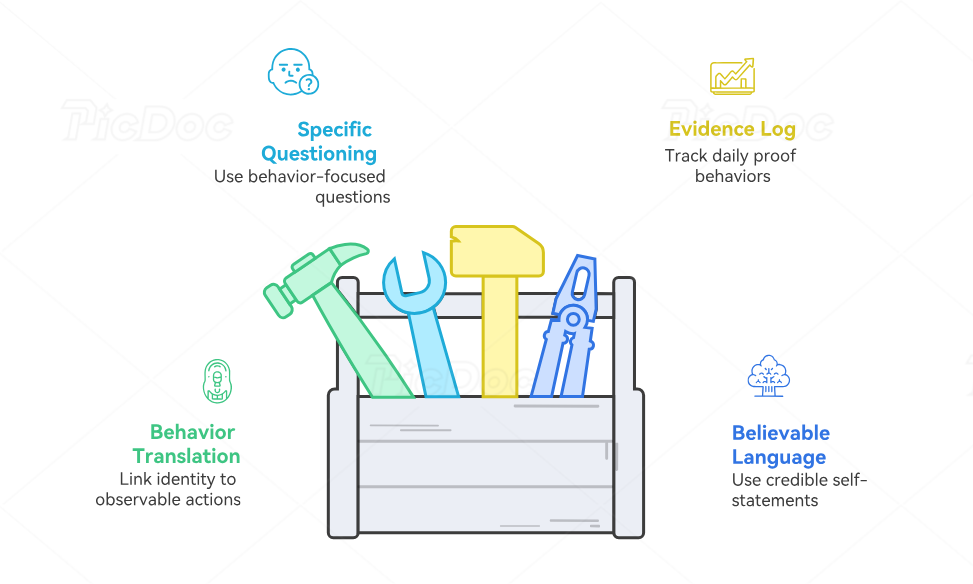
4. How To Coach Identity Shifts Without Becoming Vague Or Performative
Identity change is where transformational coaching becomes powerful, but it is also where many coaches get sloppy. They start speaking in huge abstractions about purpose, alignment, abundance, higher self, or becoming the version you are meant to be. Clients may enjoy that language, but they cannot live inside it unless it gets translated into observable behavior. A real identity shift should be visible in calendar choices, meal decisions, bedtime patterns, work boundaries, emotional regulation, communication, and recovery habits. Coaches who study the communication secret behind successful coaching, powerful questioning techniques that transform coaching sessions, neuro-linguistic programming techniques every coach should master, and transactional analysis the ultimate 2026 guide for coaches can usually guide identity work without drifting into empty inspiration.
The cleanest identity question is not “Who do you want to become?” It is “What does that version of you do on a hard day?” That question removes fantasy and forces behavioral specificity. The client who wants to become “healthy” must define how healthy behaves when work runs late, when family is demanding, when emotions spike, and when motivation disappears. The client who wants to become “confident” must define what confidence sounds like in a meeting, in a text, in a conflict, and in a disappointed moment. Coaches who integrate effective listening techniques, building deep trust, communication techniques every coach should master, and conflict resolution strategies every coach needs are much better at converting identity talk into lived action.
A strong way to reinforce identity is to build an evidence log. Ask clients to capture one behavior each day that proves they are becoming the person they said they wanted to become. Not perfect. Not dramatic. Just real. “I shut down my laptop on time.” “I paused before snapping.” “I ate before I got ravenous.” “I said no without apologizing for three minutes.” That running proof changes self-perception faster than motivational speeches. Coaches can strengthen this through client testimonials capture the ultimate 2026 guide for coaches, powerful client journaling tools, life mapping, and creating a coaching resource library your clients will love.
The other key is to make identity believable. Clients reject self-statements that feel fake. “I am unstoppable” is useless when the client currently misses half their commitments. “I am becoming someone who resets quickly” is believable. “I protect my energy earlier than before” is believable. “I do hard things in smaller pieces now” is believable. Transformational coaching is strongest when it builds language the client can actually inhabit. That is the bridge between psychology and behavior.
5. Systems, Accountability, And Maintenance: How Change Actually Lasts
Change becomes lasting when it stops depending on the weekly coaching call alone. The session should create clarity, but the system between sessions is what carries the client through ordinary life. Great coaches build simple accountability loops: one behavior score, one weekly reflection, one environmental adjustment, one recovery rule, and one visible measure of progress. This is where automated email sequences the ultimate 2026 guide for coaches, best coaching software & platforms for client management in 2025, virtual coaching tools boosting your remote session effectiveness, and the 10 best coaching apps every professional should know can support real consistency.
Accountability also needs the right emotional tone. Too soft, and clients drift. Too harsh, and clients hide. The best accountability is specific, compassionate, and impossible to dodge. Instead of “How did it go?” ask, “How many days did the behavior happen?” “What was the first obstacle?” “What made the good days easier?” “What needs redesign before next week?” This kind of coaching is stronger than praise or disappointment because it stays attached to actual behavior. Coaches who lean on using surveys and feedback tools to improve coaching outcomes, interactive goal tracking tools, coaching session templates, and essential crm tools usually get more honest data from clients.
Maintenance is where many transformations quietly die. The client reaches the goal, feels proud, loosens structure, and gradually slides back into the old pattern. Coaches need to prepare clients for the maintenance phase long before the first big win. That means deciding what “enough” looks like after the sprint. It means reducing intensity without removing identity-supporting behavior. It means naming relapse triggers and building lighter versions of the same system. This is where future-proof your coaching practice top trends to watch, must-know client preferences shaping the future of coaching, coaching automation next-level tools to grow your business faster, and balancing human touch with coaching automation for optimal results align directly with better outcomes.
The final truth is simple. Lasting change does not come from the most inspiring coach. It comes from the coach who can take values, emotion, identity, friction, accountability, and human inconsistency and turn them into a repeatable structure the client can survive inside. That is transformational coaching in its most useful form. It changes behavior first, identity next, and outcomes after that.
6. FAQs About Transformational Coaching And Lasting Change
-
Transformational coaching goes deeper than short-term goal achievement. It targets the beliefs, identities, environments, and repeated behaviors that keep producing the same results. The strongest version of it does not stop at insight. It turns insight into structured action that survives stress, fatigue, and real life. That difference becomes clearer through how to actually change your clients life in 2026, how the world’s best coaches get results, the future model every coach needs to adopt by 2026, and how one method is revolutionizing coaching.
-
Because motivation is unstable and breakthroughs do not automatically redesign daily behavior. Clients relapse when old cues remain, friction stays high, recovery plans are missing, or the client interprets one lapse as total failure. Stronger change requires structure, not just desire. Coaches can learn a lot from habit formation tools helping clients achieve lasting change, effective strategies for reinforcing positive client behaviors, inner critic management techniques, and mindfulness and meditation techniques for emotional coaching.
-
The best first behavior is usually the one that is small enough to repeat, visible enough to measure, and important enough to influence other parts of life. That might be bedtime, breakfast, a daily walk, a pause before reacting, or a weekly planning ritual. High-impact starter behaviors are often easier to identify with smart goals 2.0, the wheel of life reinvented, interactive goal tracking tools, and building your coaching toolkit.
-
By forcing identity language to show up in behavior. Do not stop at “I want to become confident” or “I want to become healthy.” Ask what confidence does in conflict, what health does at lunch, what discipline does at bedtime, and what self-respect says in a boundary moment. That translation is strengthened by powerful questioning techniques that transform coaching sessions, the art of powerful questioning in coaching, effective listening techniques, and building deep trust.
-
It becomes too much when clients feel monitored instead of supported, or when the coaching relationship starts producing secrecy and performance. Good accountability creates clarity and redesign. It asks for real data without shaming the client. Coaches can improve this balance with essential crm tools to manage your coaching client relationships, automated email sequences, coaching session templates, and using surveys and feedback tools to improve coaching outcomes.
-
They ask clients to live at a level of consistency that the client cannot yet support. The plan looks exciting in session and impossible in real life. Great coaches shrink, simplify, layer, and repeat until the behavior becomes normal enough to survive a hard week. That philosophy is echoed in the radical simplicity coaches are loving, why top coaches are obsessed, how to make it work every time, and how coaches reach mastery.
