
Affirmation Cards: The Ultimate 2026 Guide for Coaches
Affirmation cards aren’t “cute motivation.” In 2026, they’re a delivery tool: a way to install language that clients can actually use when stress hits, cravings spike, or self-talk turns hostile. Most coaches fail with affirmations because they hand clients generic lines that don’t match behavior, identity, or context—so clients feel fake, quit, and blame themselves. This guide shows you how to build affirmation cards that stick: tied to triggers, shaped to the client’s values, and deployed at the exact moments that usually derail progress—so your clients get calmer, more consistent, and more resilient.

1) What Affirmation Cards Really Are in 2026 (And Why Most Coaches Waste Them)
Affirmation cards work when they replace a default thought with a better operating script at the exact moment the old script normally wins. If you treat affirmations like inspirational quotes, you’ll get inspirational results: a two-day dopamine hit and then nothing. If you treat them like behavioral prompts, you’ll get measurable outcomes—especially when paired with clear goals like SMART goals and a repeatable coaching process like the one used by the world’s best coaches.
Here’s the core shift: affirmation cards are not “positive thinking.” They’re micro-interventions that target (1) identity, (2) self-talk, (3) emotional regulation, and (4) follow-through. They help clients move from “I can’t” to “Here’s what I do next,” which is exactly how you build long-term trust—because clients see that you can create structure in chaos, not just hype. That’s why high-performing coaches obsess over language as a coaching skill, not a vibe—because communication is the lever behind retention, referrals, and results (see the communication secret behind successful coaching and why trust is the most valuable asset in coaching).
Most clients don’t quit because they “lack motivation.” They quit because their internal dialogue becomes a courtroom: guilty, ashamed, behind, failing. When you teach clients to install better scripts, you reduce relapse loops, missed check-ins, and “ghosting” behavior—problems that crush coach income and confidence. If you’ve ever felt like you’re doing everything “right” but clients still disappear mid-program, you’re not alone—client engagement is becoming the make-or-break skill in 2026 (see the future of client engagement and why top coaches are obsessed).
A professional affirmation-card system has five rules:
It must match the client’s real trigger. Not the trigger you wish they had.
It must be believable. “I am unstoppable” fails if the client feels behind and overwhelmed.
It must be actionable. It should point to the next behavior, not just a feeling.
It must be practiced when calm. Not introduced only during crisis.
It must be audited. If it doesn’t work, you refine it like any intervention.
This is also where coaches level up from “supportive” to “masterful.” A master coach runs language experiments, tracks what lands, and refines delivery like a system (see how coaches reach mastery and the coaching technique for client breakthroughs). If you want affirmation cards to produce outcomes, you need to design them with the same seriousness you’d apply to a program arc or a session template (see coaching session templates and powerful questioning techniques).
2) How to Build Affirmation Cards That Don’t Feel Fake (The 5-Part Coach Framework)
Your client’s brain rejects affirmations that sound like a lie. The fix isn’t “say it louder.” The fix is better design. Use this five-part framework to write affirmation cards clients can actually adopt—especially the skeptical ones who have tried everything, are tired of advice, and quietly assume they’re the problem.
Part 1: Identify the trigger moment. Ask: “When do you usually break the plan?” Not in theory—in real life. Is it 9pm snacking, Sunday dread, work stress, family comments, travel, loneliness, or boredom? If you don’t name the trigger, you’ll create a card that never shows up when it matters. This is the same principle behind outcomes-based coaching systems (see how to make it work every time and how one method is revolutionizing coaching).
Part 2: Find the default script. The default script is the thought that appears automatically: “I deserve this,” “I can’t handle this,” “I’m already behind,” “It’s not worth it,” “I’ll start Monday.” This script is why your client keeps repeating the loop even with a great plan. If you skip this step, your affirmation will be irrelevant, and irrelevance is why clients stop using tools (see why coaches must avoid this trap and how coaches avoid career-ending mistakes).
Part 3: Choose the “believable upgrade.” The believable upgrade is a script that feels possible today. Not “I am perfect,” but “I can take one small step.” Not “I love my body,” but “I treat my body with respect.” Believability is the entry fee. If the client can’t say it without cringing, it will die in a drawer.
Part 4: Attach it to a behavior. The best affirmation card includes a next action. “I pause and drink water,” “I take a 10-minute walk,” “I send my check-in,” “I follow my default plan,” “I do a two-minute start.” This is where affirmations stop being “mindset content” and become a delivery mechanism—especially in modern coaching where tech + structure matters (see how technology is completely transforming the coaching industry and best coaching software & platforms).
Part 5: Make it testable. A professional coach doesn’t “hope” it works. You test it. In the next session, you ask: “Did you use the card? When? What happened? What did your brain say back?” This is how you build a system that actually changes lives (see how to actually change your clients life in 2026 and how to actually empower clients).
This framework also protects you from a huge coaching danger: giving clients tools that fail and quietly erode trust. Every time a client tries something and it doesn’t work, they don’t just doubt the tool—they doubt themselves and your program. That’s why standards matter (see the non-negotiable standards every coach must know and why this skill determines your coaching success).
3) Where Affirmation Cards Fit in Your Program (So Clients Actually Use Them)
A card system only works when it’s integrated into the client journey. Most coaches “add” affirmations like optional homework, then wonder why compliance is low. The truth: clients aren’t lazy—they’re overloaded. If your program doesn’t make the tool feel essential, it becomes another tab in their brain.
Here’s a high-performing placement strategy that works across niches—health, life, habit change, stress, confidence, and career transitions.
Phase A: Onboarding (Days 1–7). Create 5–7 cards that target the client’s biggest derailers. Keep them short, specific, and tied to a daily trigger. This is also where you build early wins—because early wins reduce drop-offs (see the radical simplicity coaches are loving and why it’s the hidden goldmine of coaching).
Phase B: Momentum (Weeks 2–6). Add “situational cards” for upcoming challenges: travel, social events, family pressure, busy weeks, emotional dips. This is how you prevent the classic mid-program collapse where motivation fades and reality shows up (see why they’re changing the game for coaches and the future model every coach needs to adopt by 2026).
Phase C: Identity shift (Weeks 6+). Create “identity cards” that reinforce the client’s new self-concept: “I’m consistent,” “I reset quickly,” “I keep promises,” “I plan ahead,” “I handle discomfort.” This is the real endgame: clients keep results when they believe the identity is who they are, not a phase.
To make usage stick, pair cards with simple delivery rituals:
A “morning anchor” card: sets the day’s tone.
A “trigger card”: used at the known derail moment.
A “night reset” card: closes the loop and protects self-trust.
If you want even higher compliance, embed the card ritual into content and community: weekly prompts, wins rituals, and shared language. This is exactly why community-driven engagement outperforms isolated coaching in many niches (see how to build an interactive coaching community online and interactive coaching exercises).
Finally, use a “card audit” every two weeks. Ask: “Which card did you actually use? Which one felt cringe? Which one made you take action?” You’re not just coaching the client—you’re coaching the tool to fit the client. That’s what professional delivery looks like (see how coaches reach mastery and the coaching skill you didn’t know you needed).
4) Advanced Affirmation Card Types That Drive Real Behavior Change
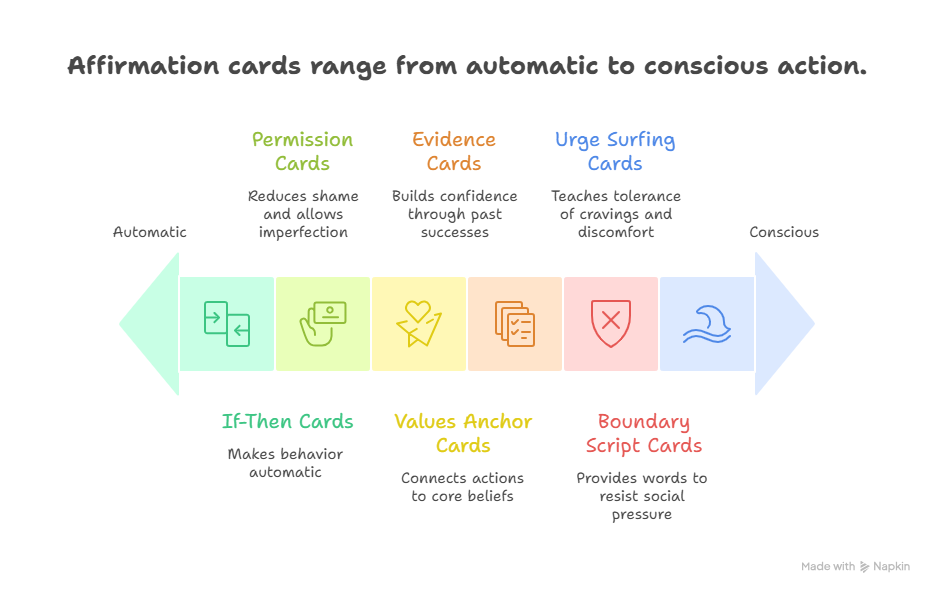
If you want affirmation cards to improve outcomes, you need more than one type. Different client problems require different scripts. Below are high-leverage categories that help you solve real coaching pain points: inconsistency, self-sabotage, emotional eating, avoidance, and low self-trust.
1) “If–Then” cards (implementation intentions).
These are the highest ROI cards for follow-through because they make behavior automatic. “If it’s 9pm and I want snacks, then I drink water and brush my teeth.” These work because the client doesn’t have to “decide” in the moment. Decision fatigue kills consistency, especially for busy clients.
2) “Permission” cards (nervous system relief).
A lot of clients derail because they believe they must be perfect or they’ve failed. Permission cards say: “I’m allowed to be human and still continue.” These reduce shame, and shame is the silent killer of check-ins and honesty. When clients hide, coaching fails.
3) “Values anchor” cards (meaning-based motivation).
Motivation fades. Values don’t. A values card might say: “I choose the action that aligns with my health and future.” These are powerful when clients feel tempted, resentful, or tired of “trying.”
4) “Evidence” cards (confidence built from proof).
Confidence isn’t a declaration; it’s a file folder of proof. Evidence cards say: “I’ve done hard things before; I can do one small hard thing now.” This is crucial for clients who have failed many times—they don’t need hype, they need credibility.
5) “Boundary script” cards (social pressure protection).
Clients relapse because they can’t hold boundaries with family, friends, coworkers, or partners. A boundary card gives them words: “No thanks, I’m good,” “I’m choosing something lighter,” “I’m done eating.” Short scripts reduce awkwardness and prevent “I caved because I didn’t know what to say.”
6) “Urge surfing” cards (cravings + emotional regulation).
Cravings peak and pass. But clients treat them like emergencies. An urge surfing card gives a time window and a process: breathe, wait, walk, text, water, then reassess. This is where coaches actually change lives—because you’re teaching clients to tolerate discomfort without self-destructing.
You can amplify all of this with tech—without making your coaching feel robotic. For example, a weekly card pack delivered through a client portal, a pinned note, or a simple reminder system can drastically improve adherence (see virtual coaching tools, video conferencing hacks, and the wider shift in how technology is transforming coaching). If you want engagement at scale, you can even pair cards with light gamification (see gamification tools coaches are using and how to create engaging coaching content).
The professional move is to stop thinking “affirmations” and start thinking “scripts.” Scripts win because they are usable in the real world—when the client is tired, stressed, triggered, or tempted.
5) Coaching Delivery: How to Personalize Cards Fast (Without Burning Out)
Coaches burn out when they try to custom-write everything from scratch. You don’t need to. You need a template library and a personalization method that is fast, consistent, and high-quality.
Use a three-layer approach:
Layer 1: Universal templates (your backbone).
These are the 30–50 scripts that apply across most clients: restarting, pausing, choosing defaults, handling urges, reducing perfectionism, setting boundaries, and staying consistent. Build them once, refine them with results. This is similar to building a resource library clients love (see creating a coaching resource library and free & premium coaching resources).
Layer 2: Personalization hooks (swap-in slots).
Design your templates with swap points:
Trigger time (“After work,” “late night,” “Sunday,” “before meetings”)
Identity language (“I’m becoming someone who…”)
Values word (“health,” “freedom,” “calm,” “confidence,” “longevity”)
Next action (“walk,” “protein first,” “check-in,” “two minutes,” “breathing”)
A strong template looks like:
“I can feel [emotion] and still do [next action] because [value/identity] matters.”
Layer 3: Client voice (make it sound like them).
This is the cheat code for believability. Ask clients:
“What do you say to yourself when things go wrong?”
“What would you want a calm, wise version of you to say back?”
“What phrase would feel supportive but not cheesy?”
Then write the cards in their voice. Not yours. When the card sounds like them, usage skyrockets.
To deliver it professionally, create a “Card Pack Ritual”:
Session: write 3 cards live together (client co-creates).
Between sessions: client tests them in real triggers.
Next session: you audit usage, revise one card, add one new card.
This turns affirmation cards into a living system, not static content. It also increases retention because clients feel progress is personalized and alive, not copy-paste coaching. If you’re building career stability as a coach, systems like this matter (see launch your successful health coaching career and why it’s the ultimate client magnet in 2026).
If your clients still “don’t do the work,” don’t moralize it. Diagnose it. Usually it’s one of three issues:
The card isn’t believable.
The card isn’t connected to a trigger.
The card has no behavior attached.
Fix those three, and you’ll feel the difference in your programs—fewer drop-offs, higher check-in rates, better follow-through, and clients who say, “I heard the card in my head and it stopped me.”
6) FAQs: Affirmation Cards for Coaches (2026)
-
Start with 5–7. More than that becomes noise. A client needs a small set they actually use: one morning anchor, one trigger card, one boundary script, one reset card, and one values/evidence card. Then expand only after the first set is being used consistently (pair this with structured goal work like SMART goals).
-
Don’t argue—redesign. Make them more believable and behavior-based. Swap “I am confident” for “I can take one small step even while nervous.” Use the client’s voice and real triggers. This aligns with professional standards in coaching communication (see the communication secret and non-negotiable standards).
-
A card by itself is just a sentence. The power comes from how you use it: tied to triggers, practiced repeatedly, attached to actions, and reviewed. In practice, you’re leveraging mechanisms like cognitive reframing, self-compassion, and implementation intentions—delivered in a client-friendly format that improves adherence.
-
Track three metrics:
Usage: did they use the card in the trigger moment?
Outcome: did it change behavior (even slightly)?
Emotion: did it reduce shame/spiral intensity?
Ask: “When you used it, what happened next?” If nothing changed, revise the wording or the attached action. Build this into your engagement system (see future of client engagement).
-
Use what clients will actually see at the trigger moment. Digital wins for speed and reminders; physical wins for presence and ritual. Many clients do best with both: phone card for high-risk moments, physical card on desk/bathroom mirror for daily anchors (tech can support delivery without becoming the whole program—see virtual coaching tools).
-
Every 2–4 weeks. If a card becomes invisible, stale, or irrelevant, it stops working. Treat cards like any intervention: test → review → refine. This is how coaches move from “helpful” to “masterful” (see how coaches reach mastery).
-
They write generic identity claims with no trigger, no behavior, and no audit. Clients then “fail” to use them and feel worse. The professional move is to design cards like tools: specific, believable, actionable, and reviewed—so clients gain self-trust instead of losing it (see why trust is valuable).
