
The Non-Negotiable Standards Every Coach Must Know
If you are a coach in 2026, your biggest risk is not “lack of clients.” It is lack of standards. One weak boundary, one sloppy intake, one vague promise, one undocumented referral, one unprofessional message at the wrong time, and your reputation can fracture quietly before you even notice. The best coaches are not the most charismatic. They are the most consistent under pressure, the most clear in structure, and the most disciplined in ethics. This guide breaks down the non negotiables you must operate by if you want results, retention, referrals, and real longevity.

1) The Standard Gap That Quietly Destroys Coaching Careers
Most coaching “problems” are just standards problems in disguise.
A client says they are not getting results. That is often unclear outcomes and weak measurement, not motivation. A group program has low engagement. That is usually poor container design, not “hard audiences.” A client becomes emotionally dependent. That is almost always boundary drift, not client personality. A refund request shows up after week two. That is usually misaligned expectations created by marketing, sales calls, or onboarding.
Standards are the operating system behind every client conversation. They tell you what you do when things get messy. They prevent you from over coaching, under coaching, rescuing, guessing, improvising, or crossing lines.
If you want to build a practice that lasts, treat standards like your coaching version of “clinical hygiene.” Nobody celebrates it publicly, but every professional notices when it is missing. That is why professional boundaries matter more than vibe, and why you should study real boundary frameworks like the ones covered in techniques for maintaining professional boundaries with clients.
Standards also protect your clients from confusion. When you anchor clients into a structure, you stop them from relying on “how they feel today” and start teaching them how to follow a process. That is the difference between coaches who create outcomes and coaches who create dependency. If you want a results based framework, model the operational discipline described in how the world’s best coaches get results and the deeper skill stack in how coaches reach mastery.
Finally, standards protect you. If you ever want to scale a program, hire support, run groups, or build a premium offer, you need standards or your business becomes a patchwork of exceptions. That is why future proof coaches are studying trends and expectations, not just tactics, including what is outlined in 2025 health coach certification trends: future proof your career now and what modern coaching demands in why coaches need it more than ever 2026.
Below are the core non negotiables you must internalize, not memorize.
2) Ethical Standards That Protect Clients and Protect You
Ethics is not “being a good person.” Ethics is making decisions that remain stable when stakes rise.
Your first ethical standard is scope discipline. You are not a therapist. You are not a physician. You are not a crisis responder. If a client presents clinical risk, your job is not to be heroic. Your job is to be professional. This is exactly why credentialing and structured training matter, because they teach you how to draw lines without abandoning the client. That larger “why certification matters” argument is explored in how certification differentiates your health coaching business.
The second ethical standard is consent and clarity. Clients must understand the container: how sessions work, what messaging support exists, what happens if they miss sessions, and what progress measurement looks like. If you skip this, you create surprise. Surprise creates resentment. Resentment kills retention.
The third ethical standard is no hidden manipulation. Your marketing cannot create fear to sell relief you cannot actually deliver. If you use shame to get urgency, you train your audience to distrust themselves. That may create quick purchases, but it creates long term churn and reputational decay. To pressure test your messaging, compare it to the quality standards in how one method is revolutionizing coaching and why they’re changing the game for coaches.
The fourth ethical standard is documentation and confidentiality hygiene. If you do not have a clean system for notes, you will rely on memory. Memory is biased, emotional, and inconsistent. Notes are not about being “clinical.” Notes are about being repeatable. They allow you to spot patterns, track commitments, and avoid re coaching the same issue every week. If you want a behavior reinforcement approach that supports documentation, look at effective strategies for reinforcing positive client behaviors.
The fifth ethical standard is referral readiness. A referral is not a failure. A referral is a standard. Great coaches refer sooner, not later, because they know the cost of letting risk grow. Clients respect you more when you protect them.
If you want to communicate your standards publicly without sounding rigid, your resume and credential positioning should reflect professionalism and boundaries, like the clarity shown in health coach certification credentials: how to list on your resume.
3) Delivery Standards That Create Results Instead of “Nice Conversations”
Results come from systems, not inspirational sessions.
A non negotiable delivery standard is session architecture. You need a repeatable flow that keeps clients out of story loops and into decision loops. A simple high performance structure looks like this:
confirm outcome and focus for today
identify obstacle and behavior driver
build a plan with friction removal
lock commitments and tracking
close with a recap and next step
This structure is how you avoid endless “processing” sessions that feel supportive but create no movement. If you want a deeper view on what actually produces results, read the 1 coaching technique for client breakthroughs and how to actually empower clients real results.
Another non negotiable standard is behavior design over advice. Advice fails because it assumes the client has the same context, bandwidth, and nervous system stability as you do. Behavior design works because it adapts to reality. When clients fail to follow through, do not ask “why are you not disciplined?” Ask:
what is the friction point
what is the trigger failure
what emotion is blocking action
what environment is reinforcing the old behavior
what is the smallest stable step we can repeat
If your niche includes health behavior change, the standard becomes even higher because diet and lifestyle decisions are emotionally loaded. Use the practical framing in how coaches can actually change client diets and the action orientation of how to inspire clients to take immediate action.
A third delivery standard is measurement that does not overwhelm. You do not need complex dashboards. You need a weekly scorecard that keeps the client honest without making them feel judged. Use 3 categories:
one behavior metric (did it happen)
one capacity metric (sleep, stress, energy, focus)
one outcome marker (progress toward the goal)
When you measure consistently, you prevent the most common coaching failure: “We talked a lot, but nothing changed.” That failure is discussed indirectly in how to actually change your client’s life in 2026 because the point is not inspiration. The point is transformation that survives real life.
A fourth delivery standard is reinforcement and relapse planning. Clients do not fail because they are weak. They fail because they did not build a plan for high risk moments. Your job is to identify the relapse triggers before the relapse happens. Then you build a plan that works in “bad weeks,” not just “good weeks.” If burnout is involved, your delivery standards must include recovery pacing and realistic output. Use the playbook style thinking in effective strategies for coaching clients through burnout.
4) Professional Boundary Standards That Stop Dependency and Drama
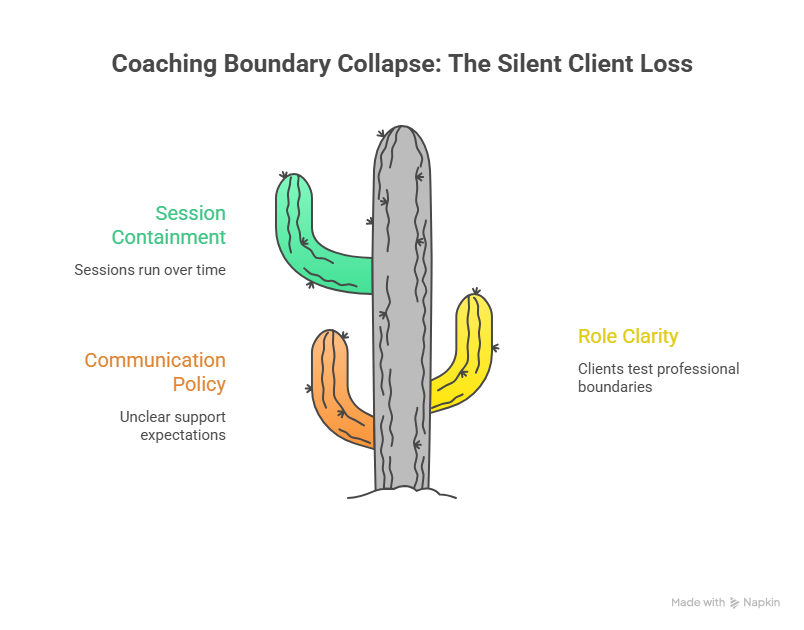
Most coaches do not lose clients because of results. They lose clients because boundaries collapse quietly.
A non negotiable boundary standard is communication policy. If you offer between session support, define:
what channel (email, portal, app)
what hours
typical response time
what qualifies as urgent
what you will not handle in messages
Without this, you accidentally train clients to treat you like emotional emergency support. That is not coaching. That is unstable attachment and you will burn out. If you need a modern boundary framework, anchor your practice in techniques for maintaining professional boundaries with clients.
Another boundary standard is role clarity. Clients will test your role when they are distressed. They will ask you to mediate marriages, diagnose health issues, validate big life decisions, or become their accountability police. Your job is to bring them back to self leadership. This is why coaching leadership skills are not optional. They are required. Use the leadership framing in coaching leadership skills: how to lead and inspire clients to stay steady without becoming controlling.
A third boundary standard is session containment. A session must have a start, middle, and end. If your sessions run over, you teach clients that time boundaries are flexible and that emotional intensity earns extra access. That creates dependency. Instead, create a strong close ritual. Summarize what was decided, confirm next steps, and end cleanly. Rituals improve outcomes. That is why coaches build “sticky” containers, like the community mechanics described in the future of client engagement 2026.
A fourth boundary standard is referrals without shame. If a client needs a different support level, you do not frame it as rejection. You frame it as care. The cleanest script is:
“I care about your safety and progress. This is outside my scope. I can support you with coaching, and I recommend you also work with a qualified professional for that part. Here are options.”
This script protects the client and protects you. It also signals professionalism, which is why credibility based growth in 2026 favors coaches with real operational standards. That credibility advantage connects directly to why it’s the ultimate client magnet in 2026 and why it’s the hidden goldmine of coaching.
5) Business Standards That Separate “Real Coaches” From Content Creators
In 2026, it is easy to look like a coach online. It is hard to run a coaching business that works under real client pressure.
A non negotiable business standard is offer clarity. Clients should understand, in simple language:
who this is for
what problem it solves
what the process looks like
what support is included
what outcomes are realistic and measurable
When offers are unclear, you get client mismatch. Mismatch creates refunds, low engagement, and endless “hand holding.” If you want your marketing to connect to delivery properly, build an ecosystem that supports trust and expectation setting through content, like the strategies in leveraging content marketing to grow your coaching audience, building and monetizing your coaching blog, and email marketing strategies for coaches.
Another business standard is distribution discipline. If you only post randomly on social media, you are not building a business. You are borrowing attention. A standard based coach turns one idea into multiple assets and makes sure the right people see it repeatedly. That is why the coaches who scale build systems across channels, including social media mastery for health and life coaches and authority channels like growing your coaching practice through podcasts. If you want credibility at scale, you also learn visibility mechanics like how to get featured in media as a coaching expert.
A third business standard is time management as an ethical issue. If you are disorganized, clients pay the price. Late reschedules, messy follow ups, and inconsistent delivery communicate “you are not safe to rely on.” Your calendar is part of your client’s psychological safety. That is why operational discipline frameworks matter, including managing your time efficiently as a successful coach.
A fourth business standard is pricing and revenue stability. Coaches who constantly change prices and packages are not experimenting. They are reacting. Reaction signals insecurity. Insecurity leaks into sales calls, boundaries, and delivery. If you want stable pricing, build offers supported by multiple revenue streams so you are not forced to accept misfit clients. Study the strategy stack in developing multiple revenue streams as a coach and the long game thinking in creating passive income opportunities in coaching and how to create and sell coaching online courses.
A fifth business standard is professional presence. If you want higher caliber clients, you need a strong foundation. Your website is not decoration. It is a trust engine. Build it properly using building your first coaching website: a complete guide and reinforce your authority with strategic visibility skills like mastering public speaking as a coach and long form positioning like writing and publishing your first coaching book.
If you want the blunt truth, coaches are not competing on “knowledge” anymore. They are competing on standards. Clients can find advice anywhere. They hire the person who looks stable, structured, and safe.
6) FAQs: The Non Negotiable Standards Coaches Ask About Most
-
Start by standardizing your session structure, your communication policy, and your progress measurement. Those three create immediate stability for clients. Write a one page “container document” that explains how sessions work, how support works, and how progress is tracked. Then apply it to every client for 30 days with no exceptions. When exceptions appear, treat them like data. Ask what broke, where the boundary was unclear, and what rule you need. Use boundary guidance from techniques for maintaining professional boundaries with clients and results frameworks from how the world’s best coaches get results.
-
Boundaries feel harsh when they appear suddenly. Make them feel normal by setting them during onboarding, not during conflict. Use warm language and clear structure: “Here is how I support you best.” Give a reason that protects the client: “This keeps support consistent and prevents confusion.” Then repeat boundaries before they are needed. A simple reminder in week one and week three reduces future tension dramatically. If you need language that stays firm but human, align with the professional tone recommended in coaching leadership skills: how to lead and inspire clients.
-
Group coaching needs standards around safety, participation, and moderation. You need clear rules for confidentiality, respectful communication, and how conflict is handled. You also need predictable rituals that create engagement, like weekly prompts, wins check ins, and structured hot seats. Without rituals, groups become passive content consumption. If you want modern engagement mechanics, use the container thinking in the future of client engagement 2026 and the practical “make it work every time” mindset in how to make it work every time.
-
You handle it with role clarity and referral readiness. Validate the emotion, clarify your scope, and present options. “I can support your goals and habits through coaching. For deeper emotional processing, I recommend therapy alongside this.” Then give referrals or resources. Do not keep coaching deeper into clinical territory because you feel responsible. That creates risk for the client and liability for you. This is why credentialing and professionalism matter, which is also emphasized in how certification differentiates your health coaching business.
-
Keep measurement simple and tied to the client’s real goal. Use one weekly behavior target, one capacity check, and one outcome marker. Then ask one reflection question: “What made this easier or harder?” This keeps progress visible without turning coaching into paperwork. The key is consistency, not complexity. If you want a reinforcement based approach, use ideas from effective strategies for reinforcing positive client behaviors and behavior change content like how coaches can actually change client diets.
-
Audit every claim. Ask four questions: What proof do I have, what process creates it, what timeframe is realistic, and what limitations exist. Ethical marketing does not mean “soft marketing.” It means accurate expectations. If your marketing creates urgency by implying guaranteed outcomes, you are attracting misfit clients. Instead, market the process and the standard, not fantasy results. Then support marketing with trust building content systems like leveraging content marketing to grow your coaching audience and nurture through email marketing strategies for coaches.
-
Referral worthy coaches do three things consistently: deliver structured sessions, maintain clean boundaries, and end coaching with a maintenance plan. Clients refer when they feel safe recommending you. Safety comes from your professionalism more than your personality. Build your ecosystem so your standards are visible in every touchpoint, including your website and authority channels like building your first coaching website: a complete guide, audience building strategies in social media mastery for health and life coaches, and long form trust channels like growing your coaching practice through podcasts.
