
Gratitude Journal Coaching: The Ultimate 2026 Guide for Coaches
Gratitude journaling in 2026 isn’t a “feel-good” habit—it’s a coaching lever for emotional regulation, adherence, and identity change. When clients are stressed, inconsistent, or stuck in self-criticism, a well-coached gratitude practice rewires what they notice, what they reinforce, and what they repeat. The difference is coaching it like a behavior system, not a diary. Done right, it increases follow-through, improves self-trust, reduces relapse spirals, and strengthens client retention—especially when paired with modern engagement strategies like the future of client engagement 2026 and high-performance coaching principles from how the world’s best coaches get results.

1. Gratitude Journal Coaching in 2026: Why It Produces Real Outcomes (Not Just “Positivity”)
Most clients don’t fail because they lack motivation—they fail because their attention is trained on threat, deficiency, and “what’s wrong with me.” That attention creates predictable behaviors: avoidance, overreacting to setbacks, and abandoning plans after an imperfect week. Gratitude journaling—when coached correctly—acts like an attention re-training protocol. It doesn’t deny problems; it prevents the client from living inside them.
What makes gratitude journaling outcomes-driven (and not cheesy) is what it reinforces:
Progress detection: clients start noticing small wins and momentum, which protects consistency—similar to the “compounding” mindset behind the radical simplicity coaches are loving.
Stress recovery: gratitude shifts the nervous system out of constant alarm, so clients make better choices under pressure—supporting the deeper change work you see in the neuroscience-based method every coach needs now.
Identity strengthening: clients build “I’m the kind of person who notices and repeats what works,” which improves follow-through and confidence—exactly the identity-centered approach described in how to actually empower clients real results.
Trust and retention: clients who feel progress emotionally keep showing up. Gratitude creates a repeatable proof loop, reinforcing the relationship dynamics in why trust is the most valuable asset in coaching.
Where coaches mess this up in 2026: they assign “write 10 things you’re grateful for” and expect behavior change. That creates two problems. First, clients force generic entries and get no emotional signal. Second, perfectionists treat the journal as another performance task and quit. You avoid both by coaching gratitude as a structured skill with clear prompts, measurable “done” definitions, and a tight link to goal execution—aligned with the rigor in the non-negotiable standards every coach must know and the action-first discipline in how to make it work every time.
The real value: gratitude journaling becomes a behavior amplifier. It helps clients keep promises to themselves because they stop interpreting discomfort as failure. They learn to recover fast, re-engage fast, and keep momentum—exactly what elite coaching aims for in how coaches reach mastery and what modern coaching models prioritize in the future model every coach needs to adopt by 2026.
2. The 2026 Gratitude Journal Setup Coaches Should Use (So Clients Don’t Quit in Week 2)
If gratitude journaling is assigned like homework, clients treat it like homework. Your goal is to make it feel like a high-return ritual that takes 2–4 minutes and produces a noticeable emotional shift. That’s the simplicity-to-consistency bridge emphasized in the radical simplicity coaches are loving and one of the practical reasons structured coaching systems win in how to make it work every time.
Step 1: Define the “done” rule (no ambiguity).
A gratitude practice fails when the client doesn’t know what counts. Your “done” rule should be painfully clear:
3 bullets, 1 sentence each
60–120 seconds total
written at the same daily anchor (after brushing teeth, before lunch, after dinner)
Linking it to an anchor is how you build a real habit instead of relying on motivation, similar to the execution principles in how the world’s best coaches get results and the planning rigor behind coaching session templates to boost your productivity instantly.
Step 2: Choose a prompt type that matches the client’s bottleneck.
You don’t use the same prompt for everyone. Match the prompt to the behavior problem:
If they spiral after setbacks → “recovery proof” prompts.
If they don’t follow through → “kept promise” prompts.
If they’re anxious → “safety cue” prompts.
If they discount wins → “micro-win that counts” prompts.
This is the same “precision coaching” mindset that turns generic advice into outcomes, and it supports client trust the way why trust is the most valuable asset in coaching describes.
Step 3: Coach specificity (generic gratitude doesn’t change behavior).
“Grateful for my family” won’t rewire behavior. Specificity creates emotional signal:
“Grateful my friend texted me when I was slipping.”
“Grateful I chose a walk instead of doom-scrolling.”
“Grateful I ate a real lunch instead of snacks.”
Specificity also gives you coaching data. You can see what’s working and reinforce it, which is exactly how mastery-level coaches operate in how coaches reach mastery and how behavior change frameworks evolve in how to actually change your clients life in 2026.
Step 4: Tie gratitude to action (the “grateful → therefore” bridge).
This is the pro move. After each gratitude entry, add one short line:
“Therefore, tomorrow I will ___.”
It turns reflection into behavior design and protects follow-through, aligning with goal mechanics from smart goals 2.0 how top coaches set & achieve client goals.
Step 5: Install a “low-energy version” (so the habit survives real life).
When the client is exhausted, the journal must still be doable:
1 bullet only
voice note allowed
“What didn’t collapse today?” prompt
This protects consistency during hard weeks and prevents dropout—an engagement strategy consistent with the future of client engagement 2026 and the professionalism standards in the non-negotiable standards every coach must know.
3. Coaching Frameworks: How to Use Gratitude Journaling Inside Sessions to Improve Adherence
A gratitude journal becomes powerful when it stops being “writing” and becomes a feedback loop your coaching uses weekly. Clients don’t need more insight; they need better reinforcement. Gratitude entries show you exactly what increases their capacity, decreases relapse risk, and improves follow-through.
Framework 1: The “Proof Loop” (wins → identity → commitment)
In session, you ask:
“What are 3 wins that counted this week?”
“What do these wins say about who you are becoming?”
“What is the smallest commitment you will definitely keep next week?”
This prevents clients from dismissing progress and keeps momentum stable, reinforcing the breakthrough mechanics discussed in the 1 coaching technique for client breakthroughs and the trust dynamics in why trust is the most valuable asset in coaching.
Framework 2: The “Bright Spot Replication” model (what worked → design it again)
Use gratitude entries as evidence:
“When did it feel easier?”
“What made it easier?”
“How do we recreate that condition on purpose?”
This turns emotion into engineering and pairs well with systems-focused coaching approaches in how technology is completely transforming the coaching industry and execution reliability in how to make it work every time.
Framework 3: The “Setback Shield” (miss → repair → resilience)
If the client had a miss, you don’t ask “Why did you fail?” You ask:
“What did you do to recover?”
“What support helped?”
“What will be your 24-hour reset next time?”
Then you assign gratitude prompts that reinforce recovery skills (not perfection). This is one of the fastest ways to prevent shame-based dropout, which is a major retention lever in the future model every coach needs to adopt by 2026.
Framework 4: The “Behavior-Linked Gratitude” approach (gratitude that drives goals)
Instead of “3 good things,” you use structured prompts tied to the coaching goal:
“Grateful for a choice that aligned with my plan.”
“Grateful for a boundary I protected.”
“Grateful I practiced the skill even imperfectly.”
This keeps the journal aligned with outcomes and prevents “pretty journaling” that doesn’t change behavior—an approach consistent with high-level coaching standards in the non-negotiable standards every coach must know.
4. Tools, Tracking, and “2026-Proof” Gratitude Journaling Systems That Clients Actually Maintain
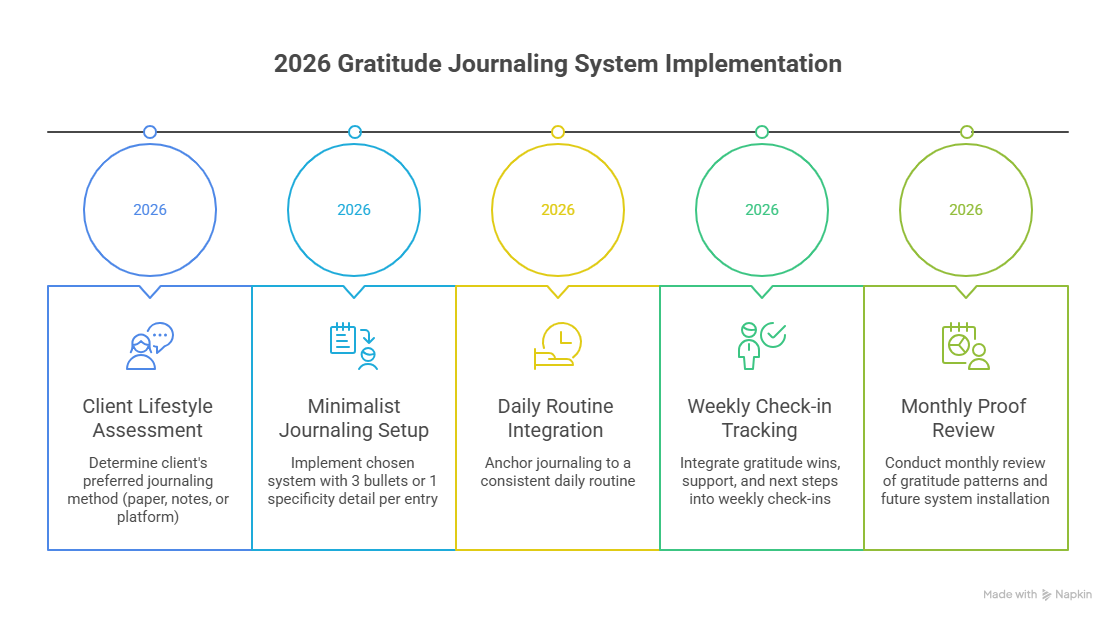
In 2026, clients don’t need more apps—they need fewer decisions. Your job is to design a gratitude journaling system that fits their lifestyle and reinforces progress without becoming another task. This is why coaching tech must be used intentionally, as covered in best coaching software & platforms for client management in 2025 and the delivery upgrades discussed in virtual coaching tools boosting your remote session effectiveness.
Option A: Paper journal (best for emotional signal + presence)
Use paper when the client:
overthinks on screens
wants a calming ritual
needs reduced tech friction
Coaching move: keep it minimal—3 bullets only. If clients decorate, perfectionism can sabotage consistency. Anchor the habit to a daily routine and reinforce “done beats perfect,” consistent with the simplicity ethos in the radical simplicity coaches are loving.
Option B: Notes app or voice note (best for consistency + low friction)
Perfect for busy professionals who won’t sit and write. Use:
“3 bullets” typed in Notes
a 60-second voice note at night
Coaching move: require one specificity detail per entry (a concrete moment, person, or behavior). This turns generic gratitude into meaningful reinforcement and keeps the practice aligned with the engagement and retention priorities in the future of client engagement 2026.
Option C: Coaching platform check-ins (best for accountability + data)
If you already use structured client management tools, integrate gratitude as part of the weekly check-in:
1 win
1 support
1 “therefore next step”
This makes gratitude part of your coaching operating system and increases follow-through—consistent with “results architecture” emphasized in how the world’s best coaches get results.
What to track (without turning it into a spreadsheet)
You track only what improves coaching decisions:
Consistency streak (days practiced / week)
Specificity score (was it concrete or generic?)
Behavior link (did they add “therefore I will…”?)
This creates coaching leverage without overwhelming clients, and it supports the professional standards and clarity discussed in the non-negotiable standards every coach must know.
The “Monthly Proof Review” (retention weapon)
Once per month, you review:
“What did you repeatedly appreciate?”
“What patterns made you stronger?”
“What’s one system we should install next?”
This makes the client feel progress and protects retention by turning coaching into a visible arc—aligned with how to actually empower clients real results and the outcomes-focused approach of how to actually change your clients life in 2026.
5. Troubleshooting: Fix the 2026 Gratitude Journal Problems That Kill Consistency
If a client says gratitude journaling “doesn’t work,” it usually means one of these issues is present. Fixing these quickly is what separates professional coaches from generic advice.
Problem 1: “It feels fake.”
Cause: prompts are too abstract or forced.
Fix: switch to evidence-based gratitude:
“What choice are you proud of?”
“What did you do that supported future you?”
“What support showed up today?”
This makes gratitude credible and ties it to identity-through-action, a principle consistent with how coaches reach mastery.
Problem 2: “Entries are repetitive.”
Cause: client is using the same category daily.
Fix: rotate prompt categories on a simple 3-day loop:
Day A: win/pride
Day B: support/connection
Day C: recovery/repair
Rotation prevents autopilot and keeps emotional signal strong—key for engagement in the future of client engagement 2026.
Problem 3: “They only journal when life is good.”
Cause: they treat it as celebration, not regulation.
Fix: add a hard-week prompt:
“What didn’t collapse today?”
“What did you handle better than before?”
“What tiny thing kept you steady?”
This transforms gratitude into resilience training and protects against dropout. It also strengthens trust, because clients stop hiding when they aren’t ashamed—directly aligned with why trust is the most valuable asset in coaching.
Problem 4: “They quit after 5 days.”
Cause: the habit is too big or poorly anchored.
Fix: install a minimum viable version (one bullet only) and a clear anchor (after brushing teeth). This is the same “make it survivable” philosophy behind the radical simplicity coaches are loving and the execution reliability approach of how to make it work every time.
Problem 5: “It doesn’t improve follow-through.”
Cause: gratitude isn’t linked to action.
Fix: add the “grateful → therefore” bridge daily:
“I’m grateful I walked at lunch—therefore tomorrow I’ll schedule it again.”
Tie the journal to the client’s core goal and measure follow-through weekly using goal frameworks from smart goals 2.0 how top coaches set & achieve client goals.
If you want this to hit even harder for health coaching specifically, layer it into behavior change topics like nutrition and consistency from how coaches can actually change client diets and modern coaching trends from why it’s the next major health trend for coaches ANHCO.
6. FAQs: Gratitude Journal Coaching (2026)
-
Professional coaching makes it specific, behavior-linked, and measurable. Instead of “write what you’re grateful for,” you define what counts, choose prompts that match the client’s bottleneck, and use entries as weekly coaching data—consistent with the standards in the non-negotiable standards every coach must know.
-
For consistency, 2–4 minutes is the sweet spot. If it takes longer, perfectionists overdo it and quit. If you need a fallback, use a 60-second “one bullet only” version—aligned with the radical simplicity coaches are loving.
-
Use evidence-based prompts that reinforce self-trust:
“What promise did you keep?”
“What did you recover from?”
“What choice are you proud of?”
These prompts reduce shame and stabilize follow-through—supporting trust and retention emphasized in why trust is the most valuable asset in coaching.
-
Yes, if it reinforces repeatable behaviors: bright-spot meals, recovery after a slip, and identity-through-action. Pair it with practical nutrition coaching execution from how coaches can actually change client diets.
-
Require one specificity detail per entry:
a moment
a person
a behavior
a concrete “because”
Specificity is what creates emotional signal and usable coaching data—aligned with performance-focused coaching in how the world’s best coaches get results.
-
Run a monthly “proof review” from the journal:
“What changed?”
“What’s easier now?”
“What patterns built your progress?”
It makes progress visible and keeps clients engaged, supporting the retention logic in the future of client engagement 2026.
-
Yes, but you adjust prompts away from forced positivity. Use resilience prompts like:
“What didn’t collapse?”
“Who supported you?”
“What tiny repair step did you take?”
This keeps it honest while training recovery skills and protecting follow-through—aligned with the real-world coaching rigor in how to actually change your clients life in 2026.
