
The Radical Simplicity Coaches Are Loving
Most coaches do not lose clients because they lack knowledge. They lose clients because their process feels heavy. Too many worksheets, too many options, too many “things to do,” and the client leaves the call motivated but confused. Radical simplicity fixes that. It turns coaching into a clean sequence clients can follow on their worst week, not their best week. If you want stronger follow through, better referrals, and calmer delivery, you do not need more content. You need less noise and sharper decisions.
This guide breaks down the simplicity moves coaches are using to create faster wins, protect their energy, and build trust without over explaining, using proven internal frameworks like effective listening, powerful questioning, and professional boundaries.

1) What “Radical Simplicity” Actually Means in Coaching (And Why Clients Crave It)
Radical simplicity is not “basic.” It is the discipline of removing everything that does not change client behavior. It is the difference between a session that produces insight and a session that produces action. When a client is already overloaded, complexity becomes a silent blocker. That is why coaches who integrate stress management techniques and work life balance coaching see a shift when they simplify delivery. It is also why burnout focused coaches get better outcomes with burnout recovery strategies that emphasize fewer steps and stronger repetition.
Clients love simplicity because it reduces decision fatigue. They do not want fifteen “good habits.” They want one habit that moves the needle and a way to measure it. They do not want a complicated mindset lecture. They want a short reframe and a clear next step. Coaches love it because it protects energy, reduces prep time, and makes sessions repeatable. When you pair radical simplicity with building deep trust and communication techniques, clients stop feeling managed and start feeling supported.
Radical simplicity also creates safety in sensitive work. If you coach grief, your job is not to “fix” grief. Your job is to create steady support using compassionate grief strategies that respect pace and capacity. If you coach trauma, simplicity helps clients stay regulated while you apply PTSD and trauma support approaches and emotional stabilization tools like mindfulness and meditation techniques. In both cases, simplicity reduces overwhelm and increases follow through without pressure.
The core idea is simple: clients do not need more options. They need fewer decisions and better structure. You create that structure with powerful questioning, stronger accountability through reinforcing positive behaviors, and consistent action triggers from inspiring immediate action. When your method feels light to execute, it becomes heavy in results.
2) The Simplicity Audit in Action: What to Remove First So Clients Move Faster
Start your simplicity audit with the parts of coaching that create the most friction. Friction is not always obvious. It shows up as “I forgot,” “I got busy,” “I did not know where to start,” or silence. When you hear those lines, it is rarely a motivation problem. It is a design problem. Your method might be good, but the execution might be too heavy. Use the audit to remove friction and replace it with repeatable actions supported by reinforcing positive behaviors and inspiring immediate action.
The first place to cut is the “too many goals” problem. Clients often bring a list of struggles that feel equally urgent. Your job is to identify the one goal that makes the others easier. This is where powerful questioning and effective listening protect the client from overwhelm. The moment you narrow to one keystone goal, the client feels relief. Relief creates trust, and trust grows faster when you focus on building deep trust instead of flooding the client with advice.
The second cut is homework overload. Too many coaches assign “six things” because they want clients to feel value. But clients measure value by progress, not by workload. Replace “six tasks” with one non negotiable action and one checkpoint. That checkpoint can be a tiny message, a quick form, or a two line reflection. Keep it simple, then reinforce it using positive behavior strategies. If the client struggles with stress, pair your one action with stress management techniques and a short emotional reset from mindfulness coaching.
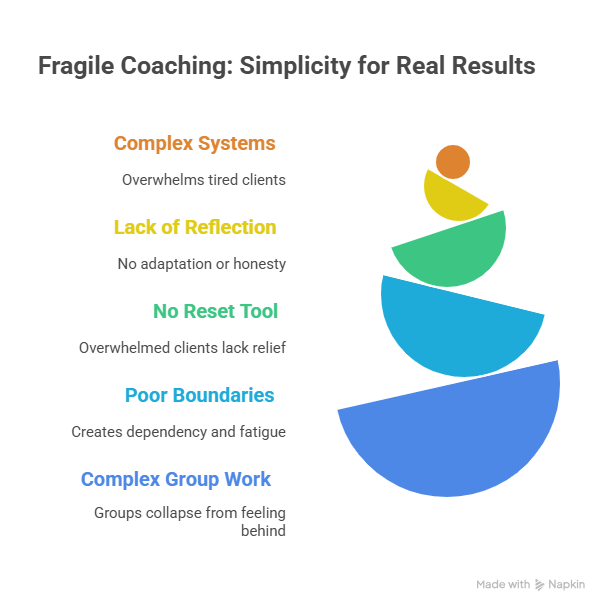
The third cut is unclear boundaries. When boundaries are unclear, clients over message, coaches feel pressure, and sessions get sloppy. Clear boundaries reduce stress for both people. They also improve results because clients learn to self regulate rather than outsource regulation to you. Use professional boundaries as part of your simplicity system, then support tough moments with managing difficult conversations and conflict resolution strategies.
Finally, simplify how you “teach” inside sessions. If you are explaining for ten minutes, your client is listening, not changing. Instead, convert teaching into practice. One concept, one example, one application. Then end with one commitment question. This blends communication techniques with powerful questioning and locks the session into action. The goal is not to sound smart. The goal is to make the client move.
3) Simple Session Design: How to Get More Results in Less Time Without Feeling Rushed
Radical simplicity does not mean shorter sessions. It means sharper sessions. The easiest way to sharpen a session is to prevent topic hopping. Topic hopping feels productive but creates no decision. When clients jump between problems, they stay in story mode. Your job is to bring them into choice mode. You do that with effective listening, then you narrow with powerful questioning, then you clarify with communication techniques, then you protect the process with professional boundaries.
A simple session template that works across niches looks like this.
First, name the present moment. Ask what is happening right now in the client’s week. Not their entire history. Not the full identity narrative. Right now. This immediately reduces anxiety and helps you coach the real context. If the client is stressed, use stress management techniques and a short reset from mindfulness and meditation techniques. If the client is burning out, anchor the session in burnout coaching strategies so you do not accidentally build a plan that is too heavy to execute.
Second, pick one decision. Every strong session ends in one decision. The decision can be an action choice, a boundary choice, a scheduling choice, or a communication choice. If the client wants to fix everything, your job is to choose the one decision that creates the biggest cascade. This is where powerful questioning matters. Great questions narrow. They do not widen. If the client is stuck in conflict with someone, pull from conflict resolution strategies to shift the conversation from blame to requests. If the client avoids honesty, use scripts from managing difficult conversations to bring truth into the room without judgment.
Third, commit to one action with proof. A commitment without proof turns into good intentions. Proof can be a screenshot, a calendar entry, a short check in, or a weekly metric. Then build a reinforcement loop using reinforcing positive behaviors so the client learns that consistency is a skill, not a mood. When you want quicker movement, use inspiring immediate action to create a small first step the client can do within 24 hours.
Simplicity also protects emotional safety. If you coach grief, your sessions must be paced and supportive, using grief and loss strategies that focus on steadiness, not speed. If you coach trauma, your sessions must respect capacity and avoid pressure, using PTSD and trauma support and emotional grounding from mindfulness coaching. In these niches, radical simplicity is not only effective. It is protective.
4) Between Session Simplicity: The Support System That Makes Clients Actually Follow Through
If clients only change during the call, your coaching will always feel fragile. Real results come from Tuesday, not from the session high. Radical simplicity between sessions means you build a tiny system clients can execute even when they are tired. That system should have one action, one check in, and one recovery tool. This is where inspiring immediate action matters because clients do not need more accountability. They need fewer steps and clearer triggers. Pair that with reinforcing positive behaviors so progress becomes automatic, not emotional.
Start with the minimum win. Define the smallest version of success that still counts. If the client cannot do the full plan, what is the minimum action that keeps identity intact. This is powerful for clients who struggle with burnout recovery, chronic stress, or unstable routines. Then add a short check in system. One mid week message and one end week review. Keep the questions simple and honest. The goal is not to police. The goal is to create reflection and adaptation. To increase honesty, use language from building deep trust so the client does not feel judged.
Next, add one emotional reset tool. When clients get overwhelmed, they need a reliable pattern they can do without thinking. A 60 second breathing routine is often enough. A five minute walk is enough. A two line journal prompt is enough. Use mindfulness and meditation techniques and frame the reset as performance fuel, using ideas from self care coaching. If you work with grief or trauma, keep this tool gentle and consistent, aligned with grief support strategies and trauma informed coaching.
Between session simplicity also depends on boundaries. If clients can message anytime with no structure, you invite dependency. Dependency creates coach fatigue and weakens client self trust. Set expectations clearly using professional boundaries, then handle violations calmly using managing difficult conversations and conflict resolution strategies. Clients respect boundaries when you communicate them with consistency.
If you run groups, keep between session work even simpler. Groups collapse when people feel behind. Choose one weekly action, one group prompt, and one “share your win” ritual. Use engagement ideas from the ANHCO resource on group engagement and keep the focus on practice, not content. When people practice, they stay.
5) Radical Simplicity in Your Coaching Business: More Clarity, Better Clients, Less Exhaustion
A simple coaching business is easier to scale because it is easier to explain. If you cannot explain what you do in one sentence, your marketing becomes heavy. Heavy marketing attracts heavy clients who want you to carry them. Radical simplicity starts with offer clarity. Decide the transformation you own, then build one pathway to deliver it. This also ties into credibility. Coaches who clarify their training and positioning often sell faster because the message feels stable. If you want a credibility framework, use how certification differentiates your coaching business. If you are choosing training, use how to choose the right program and validate recognition using accredited certifications recognized globally. If you want speed to start, align your pathway with get certified fast in 2025.
Simplify packages next. Too many packages create indecision. Two tiers often wins. Standard and premium. Clients choose faster when the difference is clear. If your audience worries about investment, address hidden costs using health coach certification costs and hidden fees and life coach certification costs breakdown. When you speak directly to cost anxiety, you remove friction in the buying decision.
Then simplify your resources. Most coaches build thirty resources and consistently use three. That creates wasted effort and inconsistent delivery. Build one core playbook that supports your pathway. If you need ideas for structuring resources, adapt the best formats from ANHCO coaching resources. Your best content should become your best system. A system is what keeps delivery consistent, even when your week is chaotic.
Finally, simplify client selection. A simple business requires fewer “rescue clients.” If your onboarding and messaging are clear, you attract clients who are ready to act. That reduces emotional labor and helps you maintain energy. When difficult moments happen, you handle them with clear communication using communication techniques coaches should master, stronger trust building through deep client relationships, and clean repair strategies from managing difficult conversations. Radical simplicity is not a style. It is a business advantage.
6) FAQs: Radical Simplicity Coaching Questions Coaches Actually Ask
-
Simplicity becomes “enough” when it produces results and has a measurement. Start with one action that directly supports the client’s primary outcome. Then attach proof, such as a weekly metric or a visible checkpoint. To strengthen follow through, build a reinforcement loop using reinforcing positive behaviors and reduce overwhelm with stress management techniques. If the client doubts simplicity, use powerful questioning to help them choose the smallest action they will actually complete, then support recovery using self care coaching.
-
Use three steps: name the present moment, choose one decision, commit to one action with proof. This prevents spiraling and keeps the session anchored. Improve accuracy with effective listening and clarify the next step using communication techniques. If tension shows up, handle it calmly with managing difficult client conversations and use conflict resolution strategies to move from blame to choices.
-
Make accountability short and predictable. Use one mid week check in and one end week review. Ask two questions: what did you do, what blocked you. Create honesty with building deep trust so clients stop performing. Celebrate small wins using reinforcing positive behaviors and trigger faster movement with inspiring immediate action. If clients disappear, reduce the plan to a minimum win and rebuild momentum gradually.
-
Yes, when simplicity is consent based and paced. With grief, support steadiness and meaning rather than speed, using grief and loss strategies. With trauma, reduce pressure and focus on safe steps, using PTSD and trauma support. Add a gentle grounding practice from mindfulness coaching. Simplicity helps because it reduces overwhelm and increases stability.
-
Describe your offer as one transformation with one pathway. Avoid listing ten deliverables because prospects cannot tell what changes. Improve credibility with certification differentiation. If you are choosing training, use choosing the right program and verify recognition using accredited certifications. If prospects worry about cost, address it directly using health coach certification costs and life coach certification costs.
-
Give fewer tools but make them more usable. Replace “more PDFs” with one tool applied in multiple scenarios. Structure your resources using the approach from ANHCO coaching resources. When clients want certainty, give them a repeatable process. Pair the process with a reset routine from self care coaching and emotional grounding from mindfulness techniques. Then lock behavior with positive reinforcement strategies.
-
Cut content and increase practice. Choose one weekly theme, one live exercise, and one action commitment. Boost participation with the framework in group engagement. Build safety through deep client trust and keep sessions crisp using communication techniques. Close every session with immediate action so progress happens between calls.
