
How Coaches Can Support Clients with PTSD and Trauma
Supporting clients with PTSD and trauma is not about “fixing” them. It is about safety, choice, and steady progress that never overwhelms their nervous system. The coach who wins here is the one who stays in scope, builds deep trust, and uses trauma informed tools that help clients function in real life. This guide shows you how to do that step by step, while protecting the client and protecting your practice with clean ethics, clear boundaries, and strong session structure.

1) Trauma Informed Coaching for PTSD: What You Can Do (and What You Must Not Do)
Trauma informed coaching starts with one hard truth: PTSD is not just a memory problem. It is a body alarm system that learned to stay on high alert. That is why clients can look “fine” and still feel unsafe in normal life. Your job is to coach function and agency, not to process trauma like a therapist. If you are unclear on ethics, start with ethical coaching principles and revisit coaching confidentiality before you coach a single trauma adjacent client.
A trauma informed coach uses language that reduces shame and increases control. You do not label the client as broken. You normalize protective responses and redirect toward skill building. That fits perfectly with building deep trust and the micro behaviors inside effective listening. Clients with trauma often scan your tone more than your words.
Stay very clear on scope. Coaching supports goals like sleep routines, work performance, relationships, boundaries, and habit consistency. Therapy treats disorders, diagnoses, and trauma processing. If you feel pulled into “tell me what happened,” pause and return to the present. If you need a safety and scope script, pull from how to set clear professional boundaries and reinforce it with managing dual relationships.
A client with PTSD may dissociate, freeze, or spiral when they feel trapped. That is why consent is not a one time checkbox. It is an ongoing rhythm. Before any exercise, ask for permission. Offer options. Let them stop. This aligns with the art of powerful questioning and keeps your sessions from turning into accidental exposure.
You also need a clean escalation plan. If a client mentions self harm, imminent danger, or abuse, you do not coach through it. You shift to safety steps and referral. If you have not read it recently, review ethical dilemmas coaches face and keep a written protocol in your client file system.
Finally, understand that trauma creates inconsistent motivation. A client can want change and still avoid it. That is not laziness. It is protection. That is why coaching must combine compassion with structure using frameworks from how to inspire immediate action and reinforcing positive behaviors. You build momentum without pushing too hard.
2) Build Safety First: Screening, Agreements, and the First Two Sessions
If you do not create safety early, you will spend months chasing consistency. Clients with trauma often show up eager, then disappear. They cancel last minute, ghost for two weeks, then return apologizing. That cycle is usually nervous system avoidance, not disrespect. Your structure must make it easier for them to stay.
Start with a short intake that screens for scope fit. Ask what they want from coaching and what kind of support they already have. You are not collecting details of trauma. You are collecting stability indicators. If you want to keep this ethical, anchor your intake process in ethical coaching principles and your documentation practices in coaching confidentiality. Make sure clients know what you do with notes, how data is stored, and what the limits of confidentiality are.
Session one should focus on three things: safety, goals, and recovery capacity. You can use a simple question flow from the art of powerful questioning but you must keep it choice based. Ask what “better” looks like in daily life. Ask what feels safe enough to work on right now. Ask what has helped them recover in the past. Then build a plan that starts small, using the momentum framework from how to inspire clients to take immediate action.
Session two should deepen predictability. A client with PTSD often fears surprises. So create a consistent agenda: check-in, nervous system state, goal, micro step, barriers, recovery plan. This is where templates matter. If you want to build repeatable structure fast, pull ideas from building your coaching toolkit and combine it with trust rituals from building deep trust.
Boundaries are not optional. Trauma clients can unintentionally test them because they have learned that people disappear. If you over give at the start, you teach dependence. Then you resent it. Then they feel it. Then they leave. Avoid this cycle by setting clear support windows using how to set clear professional boundaries and reinforcing them with techniques for maintaining professional boundaries.
Also watch for dual relationship risk. If the client wants friendship, social media closeness, or “just texting,” you need clarity. Trauma clients often confuse intimacy with safety. Use guidance from managing dual relationships and keep your coaching container clean and professional.
3) Coaching Tools That Help PTSD Clients Function in Real Life (Without Triggering Them)
The biggest mistake coaches make is using intensity as a shortcut. With trauma, intensity often backfires. Clients need titration, which means small doses with recovery built in. Your goal is to help clients build capacity for life, not to “push past” fear.
Start with stabilization. Teach clients to notice early body signals of activation. Tight chest, jaw clench, tunnel vision, irritability, nausea. These are the first dominoes. When clients can catch the early signal, they can intervene. Pair this with practices from mindfulness and meditation techniques and keep it simple. Complex meditation can trigger some clients. Short grounding is often better.
Use micro commitments. PTSD clients can struggle with big plans because their system anticipates failure or danger. One micro action that is repeated builds safety. Use reinforcement principles from reinforcing positive behaviors and link it to the action framework from how to inspire immediate action. The win is not a huge leap. The win is showing up consistently.
Coach recovery like it is a skill. Many clients do not know how to come down after activation. Build a recovery menu: movement, sensory reset, hydration, music, safe contact, nature, warm shower, journaling. This fits nicely with balance systems from helping clients manage work life balance and burnout recovery protocols from coaching clients through burnout. The overlap is real: both require energy budgeting and boundaries.
Be careful with “mindset” language. Trauma is not fixed by positive thinking. It is supported by safety, skill, and gradual re engagement. You can still use reframe tools, but keep them grounded. Focus on choice: “What is one thing you can control today?” That is aligned with powerful questioning and keeps the client from feeling blamed.
If you use NLP or visualization, do it gently. Some visualizations can cause flashbacks. If you want to use these tools, study NLP techniques every coach should master and always ask permission first. If the client says no, that is data, not resistance.
Finally, coach identity rebuilding. Many trauma clients feel like they became a different person. That grief is real. Help them separate “what happened” from “who I am.” This is a trust heavy process, so keep your trust skills sharp with building deep trust and your conversation hygiene strong with effective listening.
4) How to Run Trauma Safe Sessions: Language, Pacing, and Repair
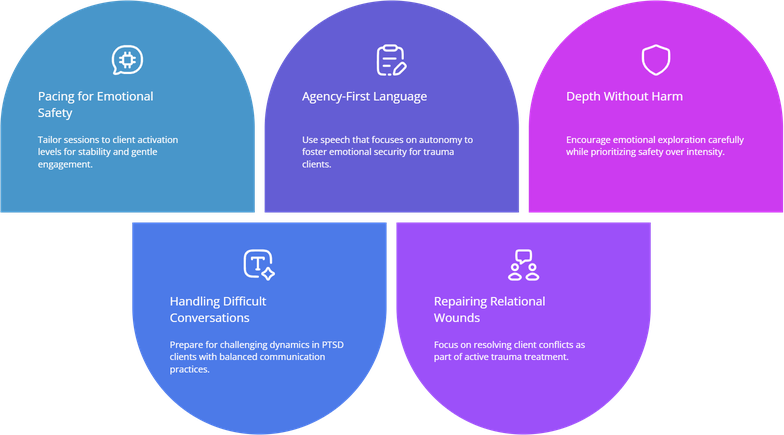
Trauma safe sessions are built on pacing. If a client is activated, you slow down. If they are numb, you invite gentle engagement. You never chase emotion for “depth.” Depth without safety becomes harm. The fastest way to lose a trauma client is to make them feel trapped or judged.
Use language that protects agency. Instead of “Why did you do that,” ask “What happened right before that choice.” Instead of “You need to face this,” ask “What feels safe enough to practice this week.” This is where effective listening and powerful questioning become your main tools. You are coaching the present moment skills that create stability.
Expect difficult conversations. PTSD clients can swing between closeness and withdrawal. They may cancel, then accuse you of not caring. They may become defensive when you ask for accountability. Prepare for this by training your conflict skills with managing difficult client conversations and your repair skills with conflict resolution strategies. Repair is not a bonus. Repair is treatment for the relational wound.
Do not hide behind politeness when boundaries are tested. If a client texts you at midnight for emotional support, respond in your agreed window and remind them of the plan. Then help them build a crisis alternative list. Use the boundary frameworks in how to set clear professional boundaries and techniques for maintaining boundaries. Consistency is kindness, especially for trauma.
Use reinforcement carefully. Praise can trigger some clients if they associate approval with control. So anchor praise in autonomy: “You chose to do the hard thing.” That ties to reinforcing positive behaviors while staying trauma sensitive. Avoid “I am proud of you” if you sense it creates discomfort. Ask what kind of feedback helps them feel safe.
Also watch your own nervous system. Coaches can become dysregulated when clients share distress. If you tense up, clients will feel it. Keep your regulation tools active using simple practices from mindfulness and meditation techniques and protect your schedule with boundaries so you do not burn out like the patterns described in coaching clients through burnout.
5) Supporting Trauma Clients Outside Sessions: Accountability, Community, and Life Systems
PTSD rarely lives in one area. It bleeds into work, relationships, sleep, and self worth. That is why coaching must build life systems. You are not coaching a feeling. You are coaching a life.
Start with work and energy. Many clients overwork to avoid vulnerability, then crash. Others avoid work because it triggers danger signals. Use structure from work life balance coaching and blend it with the burnout framework from effective strategies for coaching through burnout. The goal is a schedule that reduces activation, not a schedule that looks productive on paper.
If you coach groups, be careful. Trauma clients can feel exposed in groups. You need clear agreements, opt out options, and consistent moderation. Community can be healing, but only if it is safe. Pull your community rules and rituals from your templates in building your coaching toolkit and make sure every participant understands boundaries and confidentiality norms drawn from coaching confidentiality.
Use accountability that respects trauma. Aggressive accountability can trigger shame, which triggers avoidance, which creates disappearance. Instead, use “evidence based accountability.” You track what happened, you find the friction point, and you adjust the step size. That is why reinforcing positive behaviors is a core piece of trauma coaching, and why action frameworks like inspiring immediate action must be scaled to the nervous system.
Also coach relationships. Trauma can create extreme independence or extreme attachment. Either one can harm the client. Use conversation tools from managing difficult client conversations and conflict repair from conflict resolution strategies. Then help the client practice small, safe relational steps like asking for what they need without apology.
If the client is building a coaching business themselves, trauma can show up as fear of visibility. They avoid marketing, avoid sales, avoid being seen. They call it strategy, but it is fear. If you coach coaches, pair business confidence with ethical clarity through branding basics and competence building through how certification differentiates. That creates safety in identity, which reduces avoidance.
6) FAQs
-
Yes, as long as the coach stays in scope and the client has the right level of stability. Coaching can support goals like routines, boundaries, work performance, and communication. What a coach should not do is trauma processing, diagnosis, or treatment. If you want a clean scope framework, anchor your work in ethical coaching principles and protect your client data using coaching confidentiality. When symptoms are severe, a therapist should lead clinical care and you can support daily life progress.
-
Start with safety and predictability, not deep exploration. Use an intake that clarifies goals, current supports, and boundaries. In the first sessions, co-create a stop signal, set session structure, and choose small actions that build momentum without overwhelm. The trust skills in effective listening and the structure from building your coaching toolkit help you create a stable container. If the client becomes activated easily, keep steps smaller and build recovery skills first.
-
Use consent, pacing, and choice. Ask permission before any exercise. Offer two options. Let the client stop instantly without explaining. Focus on present-day skills and avoid asking for detailed trauma stories. When a client shows activation, shift to grounding and orientation. Supportive practices from mindfulness and meditation techniques can help, but keep them short and simple. You can also use question patterns from the art of powerful questioning to keep the client in control.
-
That is a boundary issue, not a moral failure. Dependence often happens when clients feel unsafe alone. Your role is to build their self-trust, not become their coping tool. Reinforce your communication windows, use clear policies, and teach recovery alternatives. Use frameworks from how to set clear professional boundaries and techniques for maintaining professional boundaries. If the client wants crisis support, refer them to appropriate services and consider pausing coaching until there is clinical support.
-
Refer when the client needs diagnosis, trauma processing, medication evaluation, or crisis intervention. Refer when dissociation is frequent, self harm is mentioned, abuse is active, or daily functioning is collapsing. You can still coach practical goals alongside therapy, but therapy must lead clinical work. If you are unsure, use the decision guidance inside ethical dilemmas coaches face and keep your scope clean with ethical coaching principles. Your credibility grows when you refer responsibly.
-
Use “evidence based accountability.” Track what happened, identify the friction point, and adjust the step size. Reward consistency and effort, not perfection. Trauma clients often avoid tasks because their nervous system sees danger, not because they do not care. That is why skillful reinforcement from reinforcing positive behaviors matters, and why action frameworks like inspiring immediate action must be scaled down to safe micro commitments. Accountability should feel like safety, not punishment.
-
Focus on energy budgeting, boundaries, and recovery rituals. Many trauma clients overwork to avoid feeling, then crash hard. Others avoid work because it triggers danger cues. Build a realistic schedule that includes shutdown routines and recovery blocks. Use guidance from helping clients manage work life balance and integrate the recovery strategies from coaching clients through burnout. Then reinforce small wins weekly so the client builds evidence that stability is possible.
-
You need competence, not just confidence. At minimum, you should understand trauma informed principles, ethical scope, boundaries, and referral protocols. If you want to build long-term credibility, follow a structured development path like how to become a certified life coach and review how credentials can impact trust and professionalism in how certification differentiates your coaching business. The safest trauma coach is the one who stays in scope and keeps learning.
