
Conflict shows up in coaching when expectations clash, emotions spike, or accountability hits a nerve. If you avoid conflict, clients learn to avoid discomfort. If you handle it badly, clients lose trust or become defensive. The goal is not to “win” a tough moment. The goal is to protect the coaching container, keep the conversation productive, and turn friction into forward movement.
This guide gives you clear frameworks, exact scripts, and practical systems to resolve conflict professionally without losing warmth, authority, or results.

1) The Real Reason Conflict Happens in Coaching
Most coaching conflict is not about what the client says it is about. It is about unmet needs, unclear agreements, or fear of change. A client argues about homework because they feel judged. A client snaps over pricing because they feel powerless. A client withdraws because they fear failing publicly. Your job is to spot the real driver without turning the session into therapy or a debate.
Start by separating content from process. Content is the topic being fought about. Process is how the client is responding: defensiveness, blame, withdrawal, sarcasm, or controlling behavior. When you coach process, the content becomes easier. This approach pairs well with reinforcing positive client behaviors because conflict is often a behavior pattern, not a one time event. It also keeps you aligned with ethical coaching principles so you do not drift into roles you should not play.
The fastest conflict prevention move is expectation clarity. Most “hard clients” are actually confused clients. Make the working agreement explicit, especially around boundaries and communication, as explained in setting clear professional boundaries. When clients know the rules, they feel safer, and safety reduces conflict. If you coach people under pressure, burnout, or overload, conflict will show up more often, so anchor your structure like you would in coaching clients through burnout and helping clients manage work life balance.
Most importantly, understand this: conflict is a moment where clients test whether your coaching is real. If you collapse, they learn they can override the process. If you stay calm and structured, they learn emotional regulation and self responsibility.
| Conflict Trigger | Likely Root Cause | Coach Move | Script You Can Use | Follow Up Tool |
|---|---|---|---|---|
| Defensiveness Client argues every suggestion | Threatened identity, fear of being wrong | Switch to data and experiments | “Let’s test one step for 7 days and review what actually happens.” | One week experiment sheet |
| Avoidance Client changes topics | Discomfort, shame, fear of failure | Gently hold focus | “I notice we keep moving away from this. What feels hard about staying here?” | Resistance journal |
| Blame Client blames others | Low agency, external control belief | Return control to client | “What part of this is within your control this week?” | Circle of control map |
| Scope Client demands extras | Unclear agreement, entitlement | Re-anchor contract | “Support happens inside our sessions. If you want more access, we can upgrade the plan.” | Offer ladder |
| Boundaries Late night messaging | Anxiety, dependency | Office hours, self coaching | “I respond during office hours. Capture this in your tracker and we’ll address it.” | Between-session tracker |
| Accountability Homework not done | Overwhelm, avoidance, low clarity | Reduce task size | “What made it hard, and what is the smallest version you can do?” | Micro action plan |
| Emotion Client raises voice | Flooded nervous system | De-escalate first | “I hear frustration. Let’s slow down so we can solve this.” | 90 second reset |
| Money Client asks for discount | Low trust, budget stress | Hold value, offer options | “My pricing reflects the structure. We can reduce scope or pause until it fits.” | Starter option |
| Timing Client wants emergency calls | Urgency addiction | Redirect to process | “I don’t do unscheduled calls. Add this to our agenda and we’ll cover it.” | Agenda template |
| Trust Client says “You don’t get me” | Feeling unseen | Reflect then clarify | “Tell me what I missed so I can understand accurately.” | Needs clarification |
| Withdrawal Client goes silent | Shame, fear, overload | Name the moment | “I notice silence. What’s happening for you right now?” | Emotion labeling |
| Control Client interrupts constantly | Anxiety, need for certainty | Set turn-taking rule | “Let’s do one minute each. I’ll go first, then you.” | Structure timer |
| Manipulation Guilt tactics | Testing limits | Warm, firm boundary | “I care, and I support you best through the structure we agreed on.” | Boundary reminder |
| Conflict Client attacks coaching method | Fear of change | Return to outcomes | “Let’s reconnect to your goal. What result do you want by next week?” | Goal scoreboard |
| No-show Missed sessions | Low commitment, avoidance | Apply policy | “No-shows are charged. If you want to continue, we reset the agreement.” | Recommitment plan |
| Overwhelm Client says “Too much” | Task size too large | Reduce and sequence | “Let’s cut this into the next three smallest steps.” | Three-step ladder |
| Values Client refuses a boundary | Different expectations | Align or exit | “This is how I work. If it’s not a fit, we can close professionally.” | Closure script |
| Scope Client wants therapy support | Clinical needs | Refer ethically | “This needs a clinician. Coaching can support actions alongside that care.” | Referral list |
| Reality Client denies facts | Protecting ego | Mirror evidence | “Let’s look at what happened, step by step, without judgment.” | Timeline review |
| Blame Client blames you | Avoiding ownership | Return to agreement | “Here’s what we agreed. What part will you commit to now?” | Commitment recap |
| Group Client dominates in group | Attention seeking | Protect the room | “I’m going to pause you so others can share. We’ll come back.” | Group norms |
| Group Side conversations | Low engagement | Name and reset | “Let’s bring focus back. What is the key takeaway right now?” | Participation rule |
| Boundaries Social media DMs | Blurred access | Redirect channel | “I don’t coach in DMs. Please use the client portal.” | Client portal policy |
| Resistance “That won’t work” | Fear of disappointment | Explore evidence | “What specifically makes you believe it won’t work?” | Belief audit |
| Emotion Crying in session | Release, overload | Validate then ground | “Take a breath. What do you need right now to feel steady?” | Grounding routine |
| Money Refund pressure | Regret, low fit | Process, not panic | “Let’s review progress and decide next steps based on the agreement.” | Progress review |
| Power Client challenges your authority | Need to feel in control | Collaborate, not fight | “You decide. My role is to guide the process. What do you choose?” | Choice framework |
| Avoidance Client keeps postponing goals | Fear, low clarity | Time-box decision | “We choose one step today. Small, specific, and scheduled.” | Calendar lock-in |
| Exit Client threatens to quit | Fight or flight response | Offer clean closure | “We can pause, or we can do a closure session to capture wins and next steps.” | Closure session plan |
2) The 3-Phase Method to Resolve Conflict Without Losing Authority
When conflict hits, most coaches either over-explain or go silent. Both are mistakes. Over-explaining invites negotiation. Silence invites the client to control the room. Use a three-phase method that keeps you calm and makes the session feel safe and productive.
Phase one is regulation. Slow your speech, lower intensity, and reduce your words. Your nervous system sets the pace. If you coach clients who are already stressed, regulation is the entry point, similar to how you stabilize the container in burnout coaching strategies and work life balance coaching. If you try to “solve” while the client is flooded, you will get more conflict.
Phase two is clarity. Name the issue in neutral language and separate facts from interpretation. Facts are observable behaviors. Interpretation is meaning. A strong coaching statement sounds like: “We agreed on two actions last week, and they were not completed.” That is a fact. A weak statement sounds like: “You don’t care.” That triggers shame and escalation. This keeps you aligned with ethical coaching principles because ethics begins with non-judgment and professionalism.
Phase three is ownership. Conflict ends when responsibility is returned to the client. Ask a question that forces choice: “What do you want to do differently this week?” If they dodge, reduce scope: “What is the smallest step you can complete in 10 minutes?” Ownership is also how you avoid creating dependency patterns that later turn into boundary problems, as described in setting professional boundaries.
This method works because it protects dignity. The client does not feel attacked. They feel guided. That is the difference between a confrontation and a coaching moment.
3) High-Impact Conflict Scripts for the Conversations Coaches Avoid
Most conflict resolution fails because the coach lacks language in the moment. You feel the tension, then your brain reaches for either niceness or dominance. Neither is leadership. Leadership is calm clarity.
Use the validate, boundary, next step structure. Validate emotion. State the boundary or fact. Offer the next step. For example: “I hear this feels frustrating. We still need to stay with what we agreed. Let’s decide one next action right now.” That script protects relationship and results, and it mirrors behavior shaping principles from reinforcing positive behaviors.
For blame, use the control question: “What part of this is within your control today?” Then follow with a measurable commitment. Clients who blame often feel powerless. Your job is to rebuild agency. Agency is also the foundation of inspiring immediate action, because action requires believing you have influence.
For client coach conflict, use the reset line: “I want this to work. Let’s reset tone so we can solve it.” Tone resets are underrated. They create safety without apology. They also keep you from crossing into personal conflict, which can create ethical complications like those discussed in managing dual relationships.
For scope conflict, anchor the agreement. “That is outside this program scope. If you want that outcome, we can add it as a new goal or adjust the plan.” Scope clarity is part of premium professionalism and supports long-term business stability when you are strategically expanding your coaching practice. A coach without scope boundaries becomes a service provider. A coach with boundaries becomes a trusted guide.
For pricing conflict, avoid persuasion. Use choices. “We can reduce scope, extend timeline, or pause until it fits.” This aligns with pricing your coaching services and prevents resentment that later becomes conflict. A client who feels trapped becomes a difficult client. A client who chooses becomes invested.
4) Preventing Conflict With Agreements, Boundaries, and Coaching Structure
The best conflict resolution strategy is conflict prevention through structure. This is not about controlling clients. It is about removing ambiguity. Ambiguity creates expectations that later collide.
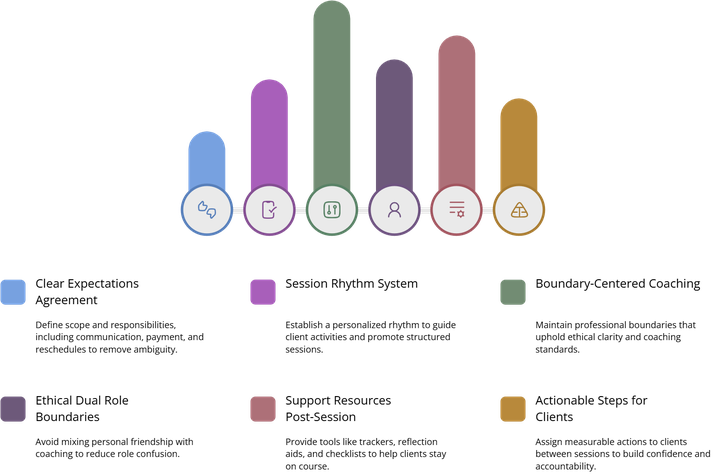
Start with a working agreement that covers scope, communication, session rhythm, late payments, reschedules, and how support works between sessions. This should align with coaching confidentiality and professional boundaries. Clients respect what you consistently enforce, not what you casually mention.
Next, build a weekly rhythm. When clients know what to do between sessions, they do not panic message you. Give them a tracker, reflection questions, and one measurable action. Resources like essential templates and checklists are not “nice to have.” They prevent chaos. A client with a system asks better questions and creates fewer fires.
Also, separate coaching from friendship. Coaches who blur roles invite conflict because clients start negotiating access and emotional labor. If a client wants personal closeness, you must stay anchored in ethical clarity like dual relationship ethics. This is not coldness. This is professionalism. It also protects your long-term business growth if you are scaling your coaching practice or building credibility through certification differentiation.
Finally, use consistent consequences. A boundary with no consequence becomes a suggestion. No-shows should follow policy. Late payments should pause sessions. Scope creep should require a plan change. This is how you keep the coaching container stable and prevent resentment on both sides.
5) Advanced Conflict Resolution: Repairing Ruptures and Keeping Clients Long-Term
Some conflict is not about a single issue. It is a rupture in trust. Maybe the client felt misunderstood. Maybe you pushed too hard. Maybe the client is ashamed. Rupture repair is an advanced coaching skill because it requires humility without losing authority.
The first move is to name the rupture. “Something feels off today. Did anything land wrong last session?” That opens a door without forcing the client to accuse you. Then listen fully. Do not defend. Defensive coaches turn small issues into exits. After listening, reflect the need: “You needed more clarity and less pressure. I understand.” Then reset the plan: “Here’s how we adjust while still moving forward.”
This approach keeps the relationship intact and protects the outcomes. It also builds trust signals that support your reputation and referrals, especially if you are building a career path with guides like becoming a certified life coach or showing authority in areas like ethics you cannot ignore.
When a client repeatedly creates conflict, treat it as a pattern, not a personality trait. Use pattern language: “I notice a cycle. We set a plan, then something happens that leads to conflict, then the plan resets. What do you want to change in that cycle?” This keeps the conversation focused on behavior and results, similar to how you coach habit change in reinforcing positive behaviors. It also allows you to decide fit. If a client refuses the structure, a professional closure may be best.
Long-term clients stay when they feel two things: safety and progress. Conflict resolution provides safety. Clear actions provide progress. If you deliver both, you do not just retain clients. You elevate your brand and increase referrals.
6) FAQs
-
Slow down. Lower your voice. Shorten your sentences. Name the emotion neutrally and pause. “I hear frustration. Let’s slow this down so we can solve it.” De-escalation is a nervous system skill, not a logic skill. Once intensity drops, return to goals and next actions, similar to how you stabilize clients in burnout coaching and work life balance.
-
Do not argue. Shift to control and ownership. Ask: “What part of this is within your control this week?” Then require a measurable action. Blame often hides fear and powerlessness, so rebuilding agency is key. This also supports progress frameworks in inspiring immediate action.
-
Anchor the agreement and offer options. “That is outside our current scope. We can schedule it for later, or we can revise the plan.” This protects professionalism and prevents resentment. If you need to tighten boundaries, align your approach with setting professional boundaries and your ethics baseline in ethical coaching principles.
-
Use neutral facts and curiosity. “We agreed on two actions and they were not completed. What got in the way?” Avoid labels like lazy or uncommitted. Labels create shame and conflict. Facts create clarity. Then reduce the task size and rebuild follow-through, like in reinforcing positive behaviors.
-
Do not match the energy. Reset tone and return to goals. “I want this to work. Let’s reset tone so we can solve this.” If disrespect continues, enforce your respect boundary. Calm consequences protect safety and your brand. For ethical clarity, stay aligned with dual relationship ethics.
-
Name it, listen fully, reflect the need, and adjust the plan. “What did you need that you did not feel you got?” Then make one specific change in how you coach them next week. This strengthens trust and reduces future conflict. It also supports long-term client retention as you expand your coaching practice.
-
Refer when the issue becomes clinical, trauma processing, or crisis-level support. Coaching can support actions, but it should not replace therapy or emergency care. This is part of ethical practice and aligns with coaching confidentiality and scope.
