
Effective Listening Techniques That Transform Client Conversations
Effective listening is the quiet skill that decides whether clients feel deeply seen or politely managed. When you refine how you listen, every other coaching tool works better. Questions land more precisely, reflections feel more accurate, and clients trust you enough to follow through on plans from sessions on burnout recovery, work life balance, and reinforcing positive behaviors. This guide shows you how to turn listening into an intentional system that transforms the quality of every coaching conversation, not just the occasional great session.
Throughout, you will see how listening techniques connect with tools from building your coaching toolkit, ethics from the ultimate guide to ethical coaching principles, and growth strategies in 7 unconventional strategies to scale your coaching business in 2025.

1) Why Listening Is The Core Skill That Multiplies All Your Coaching
Most coaches underestimate the commercial impact of listening. Clients do not renew or refer because you own more templates from building your coaching toolkit. They stay because you hear the thing under the thing: the quiet fears behind burnout, the unspoken resentment behind work overload, the shame behind missed goals. When clients feel that level of recognition, they buy higher level programs, attend your workshops and retreats, and recommend you as the one person who actually understands them.
Listening also reduces resistance. Many clients arrive guarded after experiences where professionals talked more than they listened. When your presence mirrors principles from coaching confidentiality, ethical dilemmas in coaching, and boundary setting, they feel safe enough to be honest about money fears, poor habits, and difficult relationships. That honesty makes every strategy conversation about pricing your services or expanding your practice far more realistic.
Finally, deep listening becomes a strategic advantage in crowded coaching markets. Most marketing messages promise transformation. Fewer coaches can sit in silence, track language precisely, and give a client the experience of being fully heard. When your listening skills match your credentials from life coach certification roadmaps, health coach certifications, or international coaching programs, you stand out as a professional, not just another voice online. Clients feel the difference in the very first session.
| Client Scenario | Listening Focus | Technique | Coach Action | Session Outcome |
|---|---|---|---|---|
| Burnout from workload | Energy language | Track words about exhaustion and pressure | Reflect patterns before discussing solutions | Client sees hidden energy leaks |
| Work life imbalance | Boundary hints | Notice every time they say should | Ask which shoulds can be renegotiated | Clearer boundary experiments |
| Fear of raising prices | Money stories | Listen for family and culture narratives | Separate inherited beliefs from current reality | More grounded pricing plan |
| Client stuck in self blame | Harsh self talk | Echo exact phrases back gently | Ask whose voice that sounds like | Access to compassion work |
| Rapid topic switching | Attention drift | Track jumps between themes | Name the pattern and refocus | More structured session flow |
| Over explaining goals | Unclear intention | Listen for missing concrete outcomes | Ask for one sentence goal summary | Sharpened coaching target |
| Conflict with partner or team | Blame language | Notice they, always, never statements | Invite ownership language instead | Shift from blame to agency |
| Shame around habits | Hidden needs | Listen for relief, comfort, escape words | Explore needs beneath each habit | Replacement strategies feel humane |
| Fear of visibility | Safety cues | Track body language when they mention sharing online | Pause, regulate, then continue strategy | Marketing feels less threatening |
| New certified coach | Identity language | Listen for I am now statements | Align behaviors to new identity | Faster post certification growth |
| Client considering new niche | Excitement spikes | Notice tone lift for certain audiences | Highlight where energy is highest | More aligned niche choice |
| Overcommitment to projects | Obligation phrases | Track have to and cannot disappoint | Question which commitments are negotiable | Lean calendar with more margin |
| Stalled marketing | Confusion points | Listen for I do not know how | Clarify one specific skill gap | Targeted learning plan |
| Group program design | Shared patterns | Hear repeating themes across clients | Bundle repeated issues into curriculum | High relevance group offer |
| Client considering certification | Motivation signals | Notice motives like status or service | Align training choice with motive | Better certification ROI |
| Client undercharges long term clients | Loyalty conflicts | Listen for fear of rejection | Design stepwise price increase plan | Stronger, clearer agreements |
| Repeated burnout cycles | Pattern loops | Map timeline of past episodes | Highlight early warning signs | Customized relapse prevention |
| Difficulty saying no | Values clash | Notice competing values in language | Clarify hierarchy of values | More confident decisions |
| Unclear business model | Offer confusion | Listen for mixed metaphors and promises | Mirror confusion back neutrally | Cleaner positioning statement |
| Fear of delegation | Control language | Notice only I can phrases | Explore worst case stories | First small delegation experiment |
| Client arrives defensive | Threat perception | Listen more, ask fewer questions | Reflect and validate experience first | Deeper safety for later work |
| Low follow through | Ambiguous commitments | Catch vague language around tasks | Translate into specific actions and dates | Higher completion rates |
| Overwhelm describing goals | Complexity level | Listen for too many initiatives | Ask for top one priority | Focused, realistic plan |
| Client in career transition | Identity grief | Notice language about loss and endings | Make space to mourn old role | Cleaner transition into new chapter |
| Conflict of interest risk | Ethical clues | Track when stories include power imbalance | Pause and discuss ethics explicitly | Clearer referral and boundary plan |
| Client unsure about coaching | Expectation mismatch | Listen for what they think coaching is | Align expectations with your model | Better fit and engagement |
2) Foundations Of Deep Coaching Presence And Active Listening
Before advanced techniques, effective listening starts with presence. Presence is the ability to keep your attention on the client instead of your internal agenda. It means noticing micro changes in their breathing, tone, and pace while your mind stays quiet. Simple practices from mindfulness work, such as short centering exercises, help you arrive fully before calls. You can borrow ideas from emotional tools discussed in pieces like mindfulness and meditation techniques for emotional coaching and stress protocols from burnout coaching. When your nervous system is settled, you can listen at a much finer resolution.
Next comes reflective listening. This is more than repeating words. It is the art of distilling what the client said into a sharper form that reveals structure they did not see. For example, “It sounds like you are trying to be a perfect coach, partner, and parent at the same time, with no recovery time built in.” That reflection explicitly names impossible standards and missing margin. When you link those reflections to resources on work life balance, professional boundaries, and dual relationship ethics, clients see how emotional patterns connect to practical decisions.
Finally, foundational listening includes tracking silence. Many coaches become anxious and fill every pause. Yet silence is often where new insight forms. When you resist the urge to rush to the next question from your coaching toolkit or your NLP playbook, clients feel invited to go deeper. A simple line like “Take your time, I am here” can turn a short pause into the moment they finally admit a truth about their niche, their prices, or their relationships that transforms the rest of your work.
3) Advanced Listening Techniques That Transform Client Outcomes
Once your presence is solid, advanced techniques help you listen for patterns, not just stories. One powerful method is listening in layers. Track content, emotion, and meaning at the same time. Content is what happened. Emotion is how they felt. Meaning is the story they created about what it says about them. When a client describes a failed launch, you listen for shame, fear, and identity conclusions like “I am not cut out for this.” Then you can link your coaching to growth concepts from branding basics, niche selection, and financial freedom through coaching.
Another advanced tool is language mirroring. Many clients reveal their mental model through small word choices. If they say “I always have to fix everything,” mirror the phrase later: “You mentioned you always have to fix everything, what happens if you do not?” This targeted echo exposes hidden rules. Combined with ethical clarity from coaching principles and coaching confidentiality, mirroring helps clients challenge beliefs without feeling attacked. You are not debating, you are holding their own words in front of them and inviting inspection.
A third technique is timeline listening. When clients feel stuck, ask them to describe the past six months in sequence. Listen for repeated triggers, decisions, and emotional peaks. You might notice that every burnout episode follows a decision to take on a new group program without adjusting one to one workload. That insight lets you integrate strategies from outsourcing secrets, building a coaching team, and strategic expansion. Listening becomes a diagnostic tool, not just a courtesy.
4) Designing Listening Systems Across Your Coaching Business
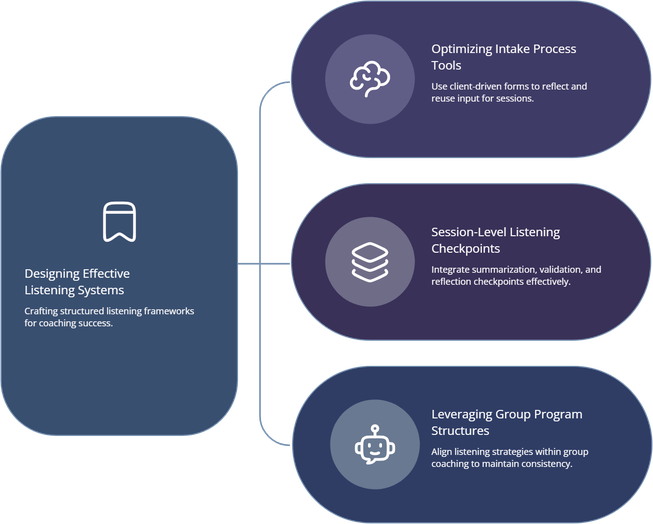
Elite coaches do not rely on memory to listen well. They design systems that support listening across discovery calls, regular sessions, and group programs. Start with your intake process. Instead of long questionnaires that clients fill out once and never see again, design forms that capture language you will re use. For example, ask “What would make this coaching relationship feel like a success in six months?” Then paste those exact phrases into your session notes so you can mirror them back later. This connects directly to offer design work in choosing the perfect name for your coaching business and branding basics for new coaches.
Next, standardize listening checkpoints inside each session. Early in the call, ask a short focusing question, then summarize what you heard. Midway through, pause and reflect both content and emotional tone. Near the end, summarize again and confirm one or two key commitments. This simple spine ensures every session includes validation, clarity, and momentum, even when clients bring multiple topics. You can weave these checkpoints into program structures described in hosting retreats and workshops, effective networking techniques for coaches, and leveraging LinkedIn, so your listening remains consistent across formats.
Finally, create a listening library for your own development. After each week of calls, capture phrases that repeat across clients: fears about certification value from is a life coach certification worth it, confusion about life coach certification costs, or doubts about health coach credentials. Turn those repeated phrases into content topics for blogs, podcasts, or books using resources like writing and publishing your first coaching book and podcast resources that keep coaches ahead of industry trends. Listening then feeds both your session work and your marketing strategy.
5) Common Listening Mistakes And How To Fix Them Quickly
Even experienced coaches fall into predictable listening traps. The first trap is solution jumping. You hear the first part of a story and immediately think of a tool from your coaching toolkit or a strategy from 7 unconventional ways to scale your business. The fix is a simple internal rule: no advice before three clarifying questions. Ask about context, constraints, and past attempts. This prevents you from solving the wrong problem and shows clients you respect the complexity of their situation.
The second trap is over identification. When a client describes a struggle you know well, you may project your story onto theirs. You might assume they want the same kind of practice, pricing, or lifestyle that you chose after following guides like achieving financial freedom through coaching or the ultimate guide to strategically expanding your coaching practice. To correct this, silently name the trigger to yourself and shift back to curiosity. Ask, “How is this for you?” and “What outcome would feel like success in your context?” Ethics frameworks from managing dual relationships and ethical dilemmas in coaching can remind you to keep the focus on the client.
The third trap is invisible listening. You may listen well internally but fail to show that you are listening. Clients cannot see your thoughts. They need verbal proof. Use short summaries, highlight exact phrases, and ask permission before making meaning. For example, “You used the phrase exhausted at least four times in the last minute, can we explore that?” This makes your listening transparent and aligns with principles of respect and clarity in ethical coaching guides, coaching confidentiality, and professional boundary setting. When clients experience that level of care, they rarely shop for another coach.
6) FAQs: Effective Listening Techniques In Coaching
-
Instead of memorizing long protocols, choose three micro habits that you apply in every session. For example, begin with one focusing question, offer one mid session summary, and end with a clear recap. Use tools from building your coaching toolkit to structure notes so these moments feel natural. Over time, the habits become automatic and you can improvise freely while still hitting the essentials that clients need for clarity and trust.
-
Repeating back copies words. Reflective listening condenses meaning. When a client says, “I feel like I am failing at work, at home, and in my business,” basic repetition would mirror the sentence. Reflective listening might respond, “It sounds like you are carrying three full time roles with no time for yourself.” That reflection adds structure and insight. You can deepen it with resources on work life balance, burnout coaching, and boundary setting so reflection leads to concrete change, not only validation.
-
Design a simple split system. During the session, write only key phrases and emotion words, not full sentences. After the call, expand these notes into structured summaries that support future work and ethical standards from coaching confidentiality. You can even turn repeated phrases into tags that feed your content strategy for media features, LinkedIn growth, or future workshops and retreats. This way notes serve both client care and business strategy without stealing presence in the moment.
-
Effective listening increases retention, referrals, and conversion rates. When potential clients feel deeply heard during discovery calls, they are more likely to enroll in higher value programs, especially if you connect your understanding to clear offers shaped by pricing strategies and financial freedom through coaching. Current clients stay longer and move into advanced services such as retreats or group programs when sessions consistently deliver relevant insight. Listening also gives you language for powerful testimonials and case studies that strengthen your brand.
-
Look for programs that combine coaching competencies with supervised practice, feedback, and ethical training. Articles like top internationally recognized life coaching certifications, life coach certification costs, and certification return on investment can help you compare pathways. Choose options that emphasize observation, presence, and recorded session review rather than only theory. Complement formal training with your own study plan built from must have coaching books and podcast resources so your listening continues to sharpen long after certification.
