
Trust is the invisible engine of coaching results. When clients trust you, they tell the truth faster, try harder, and stay consistent when motivation drops. When they do not, every session becomes surface-level performance, excuse-making, or polite agreement with zero change. Deep trust is not built through being nice. It is built through clarity, safety, competence, and follow-through, repeated until the client feels your process is reliable. This guide shows you how to create that reliability with specific systems, language, and behaviors that strengthen client relationships without blurring boundaries.

1) The Four Pillars of Deep Trust in Coaching
Deep trust is not a vibe. It is a structure. Clients trust coaches who are consistent across time, emotionally steady under pressure, and clear about what the work requires. You earn trust by making your coaching feel predictable in a good way. Predictable does not mean boring. It means the client knows you will not panic, chase, judge, or collapse when things get messy.
Pillar one is ethical safety. Clients relax when they know you operate with standards, not moods. That starts with a clear ethics baseline like the ultimate guide to ethical coaching principles you can’t ignore and is reinforced by clear privacy rules like coaching confidentiality. When clients know their information is protected, their honesty increases. Honesty is where breakthroughs live.
Pillar two is boundaries that protect the container. Boundaries communicate professionalism and emotional stability. When boundaries are unclear, clients either test limits or feel unsafe. Use frameworks from how to set clear professional boundaries with coaching clients and the applied tactics in managing dual relationships. Trust grows when the relationship is clean.
Pillar three is competence expressed as process, not opinions. Clients do not trust motivational speeches. They trust repeatable methods. Build your structure using practical tools like building your coaching toolkit and behavior shaping from reinforcing positive client behaviors. Process reduces uncertainty. Uncertainty creates resistance. Resistance slows results.
Pillar four is accountability with dignity. Clients trust coaches who challenge them without shaming them. This is the difference between pressure and leadership. If your accountability triggers defensiveness, it is usually because the client feels exposed. Use a calm, facts-first approach that mirrors the clarity you would apply in coaching clients through burnout. Burnout often includes shame, and shame blocks trust. Your job is to keep accountability clean and non-personal.
Trust is earned by repetition. Every session is either proof that your coaching is safe, or proof that it is unpredictable. Build pillars and the relationship strengthens automatically.
| Trust Moment | What the Client Feels | Coach Behavior | What to Say | Result |
|---|---|---|---|---|
| Start First session nerves | “I might be judged.” | Normalize struggle without minimizing | “You’re not behind. You’re here, which means we can build.” | Safety increases |
| Clarity Confusion about goals | “I don’t know what to focus on.” | Choose one outcome | “If we fix one thing first, what should it be?” | Focus strengthens |
| Respect Client is emotional | “I might be too much.” | Stay calm and steady | “Take a breath. We can handle this step by step.” | Regulation spreads |
| Proof Client doubts change | “Nothing works for me.” | Use small tests | “Let’s run a 7-day experiment and learn from results.” | Hope becomes practical |
| Listening Client tells a hard truth | “Will they reject me?” | Reflect without shock | “Thank you for saying that. What do you want to change now?” | Honesty increases |
| Accountability Homework not done | “I failed.” | Remove shame, keep standards | “No judgment. Let’s find the friction and redesign the step.” | Consistency improves |
| Boundaries Extra access requests | “Do they really care?” | Warm firmness | “I care, and we keep support inside the structure for best results.” | Container stays clean |
| Follow-up Client needs clarity | “I’ll forget everything.” | Send a crisp recap | “Here are the 3 decisions and your next action.” | Execution increases |
| Timing Client is late | “They’ll be angry.” | Hold time policy calmly | “We’ll use the remaining time well. Next time let’s protect the full slot.” | Respect grows |
| Repair Misunderstanding happened | “They don’t get me.” | Name it directly | “Did anything land wrong last session?” | Trust repairs faster |
| Autonomy Client asks for answers | “Tell me what to do.” | Return agency | “What do you think the best next step is?” | Confidence grows |
| Precision Client talks in vagueness | “I’m stuck.” | Ask for specifics | “What exactly happens right before you stop?” | Patterns emerge |
| Pace Client overwhelmed | “This is too much.” | Simplify instantly | “We cut it to one step. Ten minutes. Scheduled.” | Relief and action |
| Identity Client ashamed | “I’m broken.” | Separate person and behavior | “You’re not broken. This is a pattern we can change.” | Shame drops |
| Progress Client wins small | “It doesn’t matter.” | Celebrate correctly | “This is evidence your system works. We build on it.” | Motivation stabilizes |
| Conflict Client gets defensive | “I’m being attacked.” | Switch to curiosity | “Help me understand what feels unfair.” | Defense softens |
| Confidentiality Sensitive info shared | “Will this leak?” | Reassure with policy | “This stays confidential within our agreement.” | Depth increases |
| Consistency Coach mood changes | “This feels unsafe.” | Keep tone steady | “We stay calm and solve this.” | Security builds |
| Competence Client tests expertise | “Can they help?” | Offer a framework | “Here is the model we’ll use and why it works.” | Authority increases |
| Limits Therapy-level needs | “I need more.” | Refer ethically | “This needs a clinician. Coaching supports action alongside that.” | Safety protected |
| Structure Client wants randomness | “Let’s talk about everything.” | Anchor to agenda | “We choose one priority that moves your goal.” | Results improve |
| Integrity Client tries to bend rules | “Are limits real?” | Repeat boundary once | “We stay inside the agreement.” | Respect increases |
| Belonging Client feels alone | “No one gets it.” | Normalize without rescuing | “Many clients face this. We will build your plan, your way.” | Isolation drops |
| Momentum Client stalls | “I’m not ready.” | Time-box decision | “We choose one step today, even if it’s small.” | Action returns |
| Closure Client wants to quit | “I failed again.” | Offer clean ending | “Let’s do a closure session to capture wins and next steps.” | Professional trust remains |
| Feedback Client wants honesty | “Tell me the truth.” | Direct and kind | “Here’s what I see, and here’s what will change it.” | Trust deepens |
| Results Client improves | “Can I keep this?” | Build a maintenance plan | “We’ll lock habits into a weekly rhythm so it lasts.” | Long-term retention |
2) Communication Moves That Make Clients Feel Seen Without Losing Structure
Clients do not trust coaches who simply agree. They trust coaches who understand them and still lead them. The most important trust-building skill is accurate listening followed by clean direction. That means you reflect what you heard, identify the pattern, then move the session toward a specific decision.
Use three layers of listening. First, content. What happened. Second, meaning. What they think it means. Third, need. What they actually need from you. When a client says, “I failed again,” the content is missed action, the meaning is identity shame, the need is a plan that feels doable. If you only address content, you miss the need. If you only address emotion, you lose results. Balance both.
A professional way to do this is to reflect in one sentence, then ask a precision question. “You feel disappointed because you expected yourself to follow through. What exactly got in the way at the moment of decision?” Precision creates clarity. Clarity creates control. Control reduces anxiety. Reduced anxiety increases trust. If you need structured questioning models, tools like NLP techniques every coach should master can help you spot language patterns without turning sessions into mind games.
Trust also grows when clients know you will not weaponize their vulnerability. That is why confidentiality and boundaries must be repeated, not assumed. Tie your process back to coaching confidentiality and keep your relationship clear using professional boundaries with clients. Clients who feel safe go deeper. Deeper work leads to results. Results reinforce trust.
Avoid over-validating. Over-validation can feel like pity. Clients do not want pity. They want competence and stability. Validate emotion, then move to action. This mirrors the structure of inspiring clients to take immediate action because the fastest trust repair is progress. A client who takes one clean step feels supported, not coddled.
Finally, protect tone. Tone is a trust signal. If you sound rushed, annoyed, or uncertain, clients become guarded. Keep tone calm and steady. You can be firm without being sharp. You can be warm without being soft. That balance is what makes relationships strong.
3) Trust Through Results: How to Build Reliability With Systems and Micro Commitments
Clients trust what works. The fastest way to build trust is to help the client experience small wins that prove the process. Big goals create pressure. Pressure creates avoidance. Small wins create momentum. Momentum creates belief. Belief deepens trust.
Start by turning every goal into micro commitments. A micro commitment has three parts: specific action, time-box, and proof. “Walk for 12 minutes after lunch on three days.” That is specific. “Schedule it now.” That is time-boxed. “Send a one-line note when done.” That is proof. Proof removes ambiguity and protects against self-deception. This structure aligns with reinforcing positive behaviors because behavior change depends on reinforcing completion, not intention.
Use a weekly rhythm. Clients do not need unlimited support. They need a predictable cadence. Weekly agenda, one priority, one barrier, one action, one review. This rhythm creates reliability, and reliability creates trust. Pair it with tools from building your coaching toolkit so clients stop relying on motivation and start relying on systems.
Track progress with a simple scoreboard. Scoreboards are not for pressure. They are for clarity. When clients can see progress, their nervous system calms down. Calm clients trust faster. This is especially important when coaching people who are overloaded or close to burnout, where emotional reactivity is high, as covered in coaching clients through burnout. A scoreboard replaces vague self-judgment with data.
Trust also grows when you handle setbacks correctly. Do not treat setbacks like failure. Treat them like feedback. Ask, “What did this week teach us about the plan?” Then adjust the plan. That approach makes the client feel supported and competent, not broken. Clients stay loyal to coaches who do not collapse under setbacks.
To deepen reliability, keep your admin clean. Clear scheduling, clear reschedule rules, clear payment terms. Admin chaos kills trust. If your structure is messy, the client assumes your coaching will be messy too. Protect the container using professional boundaries and ethics from ethical coaching principles. Professionalism is trust, expressed daily.
4) Trust Repair: What to Do When a Client Pulls Away, Gets Defensive, or Tests You
Trust is not built only through good weeks. It is built through repairs. Repairs are where clients learn whether you are safe when things go wrong. If a client pulls away, gets defensive, becomes passive, or starts testing boundaries, treat it as data, not disrespect.
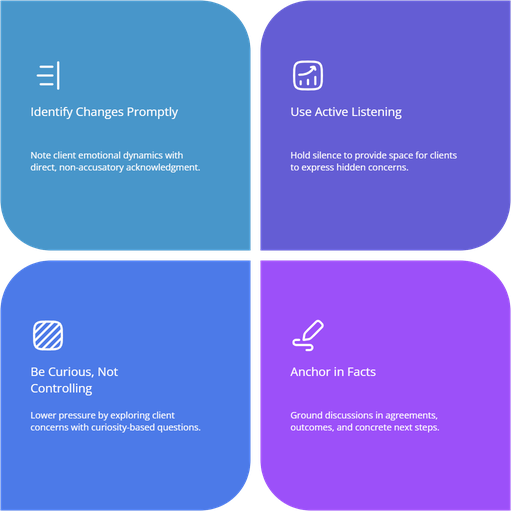
Step one is to name the shift. “Something feels different today. Are we good?” Simple. Direct. Non-accusatory. This opens the door without pushing the client into shame. Step two is to listen for the real issue. Many clients will not state it clearly. They will hint. Your job is to hold silence long enough for honesty to emerge.
When clients get defensive, do not increase pressure. Increase curiosity. “Help me understand what feels unfair.” Curiosity lowers threat and keeps you out of power struggle. Then move to facts. “Here’s what we agreed. Here’s what happened. What do you want to do next?” Facts protect dignity. They also protect the process, which is part of ethical professionalism described in ethical dilemmas coaches face.
When clients test boundaries, respond with warm firmness. A boundary that changes under pressure destroys trust because it feels unpredictable. Use the structure from setting clear professional boundaries and the ethical clarity from managing dual relationships. Say, “We stay inside the agreement.” Then offer the next step. Clients trust coaches who do not wobble.
If the client felt misunderstood, do not defend yourself. Repair first. Ask, “What did you need from me that you did not feel you got?” Then reflect, confirm, and adjust. “Got it. Next session, I’ll slow down and confirm the plan before we move on.” Specific adjustments rebuild trust. General apologies without change do not.
If trust issues are recurring, go deeper. Often the client has a history of unstable relationships. They expect disappointment. Your consistency becomes corrective. Keep your tone steady, keep your follow-through tight, and keep your accountability clean. Trust becomes inevitable.
5) Scaling Trust: How to Keep Relationships Strong as You Grow
Scaling often breaks trust because attention becomes thinner and systems become sloppy. The solution is not to work more hours. The solution is to upgrade your structure so clients still feel held even as you grow.
First, standardize onboarding. Onboarding should introduce your process, boundaries, confidentiality, and expectations. Clients trust what is explained upfront. Use ethics anchors like ethical coaching principles and privacy anchors like coaching confidentiality. Then reinforce boundaries using professional boundaries with clients. A clean onboarding reduces conflict later and protects your brand.
Second, improve your tool stack. Clients should have a single place to track actions, reflect, and ask questions. When tools are scattered, clients feel unsupported. When tools are organized, clients feel guided. That is why resources like building your coaching toolkit matter. They reduce chaos and increase trust. Tool clarity also supports content positioning and authority if you build visibility through leveraging LinkedIn because your audience can feel your professionalism.
Third, set communication standards. Office hours. Response windows. One channel. Clear rules. This prevents the relationship from becoming emotionally dependent and keeps you aligned with dual relationships ethics. Clients do not lose trust because you are not available 24/7. They lose trust when access is inconsistent and unclear.
Fourth, build trust through community and proof. If you run groups, set norms that protect psychological safety. Normalize wins, normalize struggle, and keep sessions structured. Structure is what keeps groups from becoming vent circles. If you are scaling into higher-income offers, remember that premium clients value structure even more. It signals competence. It signals standards. It signals outcomes.
Finally, keep your word. Do what you say you will do. Send recaps. Show up on time. Track progress. Protect confidentiality. Hold boundaries. These details feel small but they compound into deep trust. Deep trust becomes referrals. Referrals become growth.
6) FAQs
-
Build trust through clarity and early wins. Clarify goals in the first session, set one micro commitment, and confirm boundaries and confidentiality using coaching confidentiality and professional boundaries. Then follow up with a short recap and a measurable action. Clients trust coaches who make progress feel simple and structured.
-
Reduce perceived judgment. Use curiosity, silence, and precise questions. Reflect their words accurately and avoid rushing to advice. Reinforce ethical safety by referencing your standards from ethical coaching principles. When clients feel safe, truth rises. When truth rises, coaching becomes powerful.
-
Boundaries reduce uncertainty. Uncertainty creates anxiety. Anxiety blocks trust. Clear boundaries protect the container and prevent resentment on both sides. When you hold boundaries consistently, clients feel your coaching is stable. Use structures from setting professional boundaries and keep role clarity with dual relationships ethics.
-
Remove shame, keep standards. Treat the missed action as feedback, then redesign the step smaller. Use behavior shaping principles from reinforcing positive behaviors and keep language focused on friction, not identity. Clients trust coaches who do not judge them while still protecting results.
-
Name it directly, listen fully, reflect the need, then adjust your approach in a specific way. “Next time, I’ll slow down and confirm the plan before we move forward.” Trust repairs when clients see changed behavior, not just words. If the misunderstanding touches ethical safety, re-anchor to ethical dilemmas and confidentiality standards.
-
Use structure. Office hours, clear channels, and a between-session framework protect you and help clients become self-reliant. Being constantly available creates dependence, not trust. Clean support inside the container is what strengthens trust long-term, as shown in building your coaching toolkit.
-
Consistency, clarity, and follow-through. Online clients cannot feel your presence the same way, so your systems become your presence. Clear onboarding, clear communication rules, and reliable recaps create a feeling of being held even at a distance. Pair visibility with professionalism using leveraging LinkedIn.
-
Standardize your process so every client receives the same high-quality container. Keep your ethics clear, your boundaries consistent, and your tools organized. Scaling should increase structure, not reduce attention. Use strategically expanding your coaching practice to grow without losing relational depth.
