
The Importance of Self-Care Coaching for Client Mental Health
Self care coaching is not a fluffy add on. It is one of the most practical ways to protect a client’s mental health while they chase goals, run businesses, raise families, and try to stay functional. When self care is missing, progress gets noisy, motivation collapses, and “I’m fine” becomes a mask for burnout. When self care is coached correctly, clients build emotional stamina, reduce overwhelm, and make better decisions under stress. This guide shows exactly how to coach self care without crossing into therapy, and how to make it stick.

1) Why Self Care Coaching Matters for Client Mental Health
Most clients do not break down because they lack ambition. They break down because their nervous system is running a constant emergency drill. They wake up tired, push harder, then wonder why their mood is unpredictable, their patience is gone, and their confidence feels fragile. When this happens, self care coaching becomes a mental health stabilizer because it targets the real drivers of collapse: overload, poor recovery, weak boundaries, and inconsistent routines.
A lot of clients also confuse self care with treats. A bath does not fix chronic stress. A day off does not repair a year of emotional neglect. Self care coaching forces the client to build a system, not a moment. That system includes recovery habits, workload boundaries, emotional regulation tools, and a realistic schedule they can repeat on hard weeks, not only on perfect weeks. This is the same kind of sustainable approach you use when helping clients manage work life balance successfully, and it prevents the “crash and rebuild” cycle that destroys long term progress.
If you coach clients through burnout, you already know the pattern: they ignore signals, then they spiral, then they try to restart from zero. Self care coaching interrupts that pattern early, before symptoms become a full collapse. It pairs perfectly with effective strategies for coaching clients through burnout because it gives the client daily protection, not just a crisis plan.
Self care coaching also improves action taking. Many clients say they want change but they cannot move. Their brain feels foggy, and decision making feels heavy. That is not laziness. That is depletion. When recovery improves, action becomes easier, which connects directly to how to inspire clients to take immediate action. You are not “motivating” them. You are restoring capacity so motivation can work again.
Finally, self care coaching protects the coaching relationship. When clients are dysregulated, they misinterpret feedback, become defensive, miss sessions, or disappear. Building stable routines and emotional regulation increases consistency and makes trust easier to maintain, which aligns with building deep trust by strengthening client relationships and lowers the chance you end up stuck in repeated “same problem, different week” conversations.
| Client Signal | Coaching Focus | Micro Self-Care Action | Powerful Check-In Question | Refer When |
|---|---|---|---|---|
| Chronic exhaustion | Recovery design | Daily 20-minute shutdown ritual | What drains you before 6 PM? | Functioning is impaired |
| Emotional irritability | Nervous system regulation | 2-minute slow breathing resets | Where do you feel tension first? | Anger feels uncontrollable |
| Brain fog | Energy basics | Protein before caffeine | When do you eat on busy days? | Cognitive confusion increases |
| Anxiety before tasks | Action simplification | 10-minute starter step | What is the safest first move? | Panic attacks escalate |
| Overcommitting | Boundary scripting | Write one firm “no” response | Where do you say yes too fast? | Coercion or pressure exists |
| Perfection paralysis | Expectation reset | Define “minimum viable done” | What does good enough mean? | Obsessive control patterns |
| Weekend crashes | Workload balance | Schedule one Friday recovery anchor | What drains you midweek? | Burnout feels chronic |
| Sleep disruption | Evening routine | Phone outside bedroom | What keeps you wired at night? | Sleep loss affects safety |
| Stress eating | Stability over restriction | Add planned afternoon snack | What happens before the urge? | Eating disorder signs appear |
| Low motivation | Values alignment | One goal tied to identity | Why does this matter to you? | Depressive symptoms deepen |
| People pleasing | Self-worth boundaries | Pause before responding | What are you afraid of losing? | Emotional manipulation exists |
| Decision fatigue | Reduce choices | Create default daily schedule | What decision repeats daily? | Impaired judgment |
| Negative self-talk | Language reframing | Replace “should” with “choose” | What’s the kinder truth? | Self-harm language |
| Social withdrawal | Connection planning | Low-pressure check-in text | Who feels emotionally safe? | Isolation intensifies |
| Emotional numbness | Body awareness | 3-minute body scan | Where do you feel nothing? | Dissociation appears |
| Work identity overload | Identity expansion | Add one non-work joy ritual | Who are you outside work? | Distress when resting |
| Constant overwhelm | Priority discipline | Choose top 3 weekly outcomes | What truly matters this week? | Shutdown responses emerge |
| Skipping sessions | Friction audit | Reduce plan to two habits | What feels hardest to sustain? | Avoidance patterns grow |
| Rumination loops | Thought containment | Set a daily worry window | When do thoughts spiral? | Intrusive thoughts worsen |
| Guilt when resting | Rest reframing | Write “rest fuels results” rule | What do you fear will happen? | Compulsive behavior shows |
| Boundary resentment | Assertive communication | Practice one boundary script | Where do you feel resentful? | Power imbalance exists |
| Mood swings | Daily anchors | Fix wake and wind-down times | What anchors keep you stable? | Severe instability |
| Relapse cycles | Restart strategy | 15-minute recovery reset plan | How do you restart fast? | Addiction risk appears |
| Client feels alone | Support mapping | List 3 immediate supports | Who can you message today? | Hopelessness escalates |
2) The Self Care Pillars That Actually Protect Mental Health
Self care coaching works when you stop treating it like “add more tasks” and start treating it like “remove the leaks.” The goal is not to make the client busy with wellness. The goal is to make them stable enough to handle life without constantly snapping.
Pillar one is recovery, not rest. Rest is passive. Recovery is intentional. Recovery means the client leaves the day with something that lowers stress hormones and resets their attention. A walk counts if it truly decompresses them. A nap counts if it improves function. But mindless scrolling rarely counts because it keeps the brain stimulated and increases bedtime anxiety. Tie this back to coaching clients through burnout so the client sees recovery as performance protection, not indulgence.
Pillar two is boundaries that prevent resentment. Most clients do not fail because they cannot do habits. They fail because they let other people own their schedule. Teach them to protect time, energy, and focus with simple scripts, and build that into the coaching container using how to set clear professional boundaries with coaching clients. When clients learn boundaries, they stop living in “react mode,” and anxiety drops fast.
Pillar three is emotional regulation skills. Clients do not need to become Zen. They need a repeatable method to downshift when stress spikes. That can be breath, grounding, movement, or mindfulness routines. The key is repetition in real life moments, not theory. If you need a practical skill stack, pair this with mindfulness and meditation techniques for emotional coaching so the client has tools that work mid conflict, not only on Sunday mornings.
Pillar four is consistent action design. Mental health gets worse when clients constantly “start over.” Every restart creates shame. Instead, coach minimum viable routines that survive chaos. That approach strengthens confidence and improves follow through, which connects to reinforcing positive client behaviors. Your job is to make the plan friction proof, not inspirational.
Pillar five is social and environmental support. Many clients say they “have no time,” but they also have no support. They are the support. That creates invisible mental pressure. Self care coaching includes support mapping, asking for help, and reducing isolation. This becomes easier when clients build trust and communication skills using effective listening techniques that transform client conversations.
3) How to Coach Self Care Without Crossing Ethical Lines
Self care coaching can deeply impact mental health, which means you must be clear about scope. You are not diagnosing. You are not treating mental illness. You are coaching behavior, habits, boundaries, and lifestyle structure. That clarity protects the client, and it protects you.
Start with consent and expectations. Tell the client what coaching is, what it is not, and what you will do if safety concerns appear. This aligns with the ultimate guide to ethical coaching principles you cant ignore and helps clients trust you because they know you operate with boundaries.
Next, protect privacy and boundaries. Mental health conversations can get personal fast. You must handle client information properly, and you must keep the relationship clean. Use the frameworks from coaching confidentiality and how to protect your clients and your practice so you are not casually storing sensitive information or oversharing client stories.
Also watch for dual relationships and blurred lines. When clients feel emotionally raw, they may seek extra access, more texting, or emotional reassurance outside sessions. That is how dependency forms. Keep the container stable by applying managing dual relationships as essential ethics for coaches and do not let “being nice” become a boundary violation.
Finally, learn your referral triggers. If a client shows signs of self harm, severe depression, active addiction, trauma symptoms, or anything that suggests clinical risk, the right move is referral. Coaching can still support habits, but licensed care may be needed. If you want to stay confident under pressure, review ethical dilemmas coaches face and how to solve them gracefully. The best coaches are not the ones who handle everything. They are the ones who know when to escalate.
4) The Self Care Coaching Method That Makes Habits Stick Under Stress
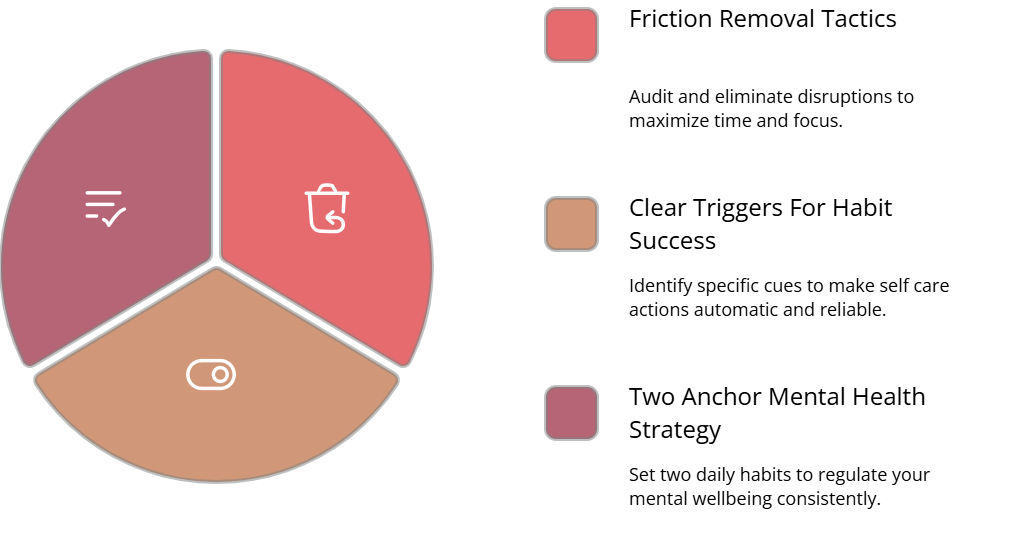
Most clients fail self care because they build plans for their best mood, not their real life. Your job is to design a self care system that survives stress weeks. That means fewer habits, clearer triggers, and tighter accountability.
Start with a two anchor model. Two anchors means two daily actions that protect mental health no matter what. Examples: a 10 minute decompression walk and a five minute shutdown routine at night. Anchors are not optional. They are the base layer. This also strengthens self trust, which makes relationship work easier, and it supports deeper engagement like conflict resolution strategies every coach needs because regulated clients communicate better.
Next, coach friction removal before motivation. If the client says “I have no time,” audit what steals time. Notifications, open ended tasks, and social obligations are the usual suspects. Teach the client to protect their calendar and say no cleanly, building on techniques for maintaining professional boundaries with clients. When boundaries improve, self care becomes possible without heroic effort.
Then use micro commitments. A micro commitment is an action that takes under five minutes and still counts. The win is consistency, not intensity. Intensity is what triggers “I failed” thinking. Consistency is what repairs mental health. Reinforce every streak, and use the behavior loop ideas from reinforcing positive client behaviors so the client learns to reward the identity, not the outcome.
Also coach recovery language. Many clients feel ashamed resting. They call themselves lazy. This language destroys mental health because it turns recovery into a moral failure. Train them to speak about recovery as skill, preparation, and protection. Pair this with work life balance success strategies so they stop treating their life like an endless sprint.
Finally, measure the right things. Instead of tracking only outcomes, track stability signals: sleep quality, mood swings, irritability, focus, and boundary success. Clients feel safer when progress is visible. That reduces anxiety and increases commitment, which supports the action mindset you reinforce in inspiring clients to take immediate action.
5) Self Care Coaching Tools That Build Trust, Not Dependency
Self care coaching should make clients more independent, not more attached to you. If the client needs you to regulate their emotions, the system is broken. Your job is to teach them how to self manage and how to ask for support appropriately.
Use powerful questions to help clients notice patterns. The best self care breakthroughs come when clients see cause and effect in their own behavior. Use question frameworks from the art of powerful questioning in coaching to uncover the real issue behind “I’m overwhelmed,” such as fear of disappointing people, perfectionism, or lack of boundaries.
Use structured listening to reduce emotional escalation. Clients often feel mentally unwell because they feel unheard in their life. In sessions, give them a different experience: clear reflection, calm pacing, and validation without rescuing. This supports mental health directly and aligns with effective listening techniques that transform client conversations. When clients feel understood, their nervous system calms, and coaching becomes more productive.
Keep your ethics clean. Do not blur roles. Do not offer 24 7 emotional support. Do not hold secrets that create risk. Build clear confidentiality practices using coaching confidentiality guidance, and keep an ethics checklist from ethical coaching principles you cannot ignore so you stay consistent even when a client is distressed.
Also prepare for difficult conversations. Self care coaching sometimes reveals uncomfortable truths: a toxic job, an unhealthy relationship, a client who is addicted to chaos. You must be able to speak directly without shaming them. For communication structure, model your approach after managing difficult client conversations with ease. That is how you maintain trust while still confronting reality.
Lastly, remember that the best self care plans include community and identity. People stay mentally healthier when they feel connected and purposeful. Encourage clients to build supportive networks and professional visibility through strategies like effective networking techniques for coaches, because isolation is a quiet mental health risk, especially for high achievers.
6) FAQs: Self Care Coaching and Client Mental Health
-
Self care coaching focuses on behavior change, routines, boundaries, and lifestyle structure that protect mental health. Therapy treats mental health conditions and processes trauma using clinical methods. A coach supports self management and performance stability, while staying inside an ethical scope. Clear boundaries matter because clients can become emotionally vulnerable when they are stressed. If you want to keep scope clean, pair your coaching practices with ethical coaching principles and strong confidentiality standards.
-
Look for chronic fatigue, irritability, inconsistent follow through, emotional eating, sleep problems, and constant overwhelm. Many clients also show “busy addiction” where they cannot relax without guilt. Self care coaching works best when you catch these signals early, before a crash. If the client already feels burned out, integrate your plan with burnout coaching strategies and a realistic work life balance system.
-
You do not add more. You remove leaks. Audit what steals time, then protect two daily anchors that take under 15 minutes combined. The goal is consistency, not perfection. Coach boundaries, reduce distractions, and simplify the plan until it survives chaos. You can reinforce follow through using positive behavior reinforcement and increase momentum through immediate action frameworks.
-
That guilt is often a learned belief, not truth. Coach rest as preparation, protection, and performance support. Replace shame language with reality language: rest prevents relapse, emotional outbursts, and burnout. Then build a recovery routine the client can follow without negotiating with themselves. This is where emotional regulation tools help, including mindfulness and meditation techniques and stronger boundaries with others.
-
Design self regulation systems, not constant reassurance. Teach clients to use grounding tools, boundary scripts, and restart plans without you. Keep communication expectations clear and avoid blurred lines that turn coaching into emotional rescue. If a client begins over relying on access, address it directly using the same structure you would use in difficult client conversations and stay aligned with dual relationship ethics.
-
Take it seriously and stay ethical. You can support habits and stability, but you should refer to licensed care if symptoms suggest clinical risk, self harm ideation, severe depression, trauma symptoms, addiction, or loss of function. Have a referral protocol ready, and document your boundaries. When in doubt, use guidance from ethical dilemmas coaches face and protect the client with strong confidentiality practices.
-
Frame it as capacity building. High achievers respect systems, metrics, and performance. Track stability signals like sleep quality, irritability, focus, and follow through. Build two anchors, remove friction, and treat recovery as part of execution. Then link self care to action: better recovery equals better decisions and faster progress. This approach ties naturally into powerful questioning and effective listening because regulated people communicate and perform better.
