
Coaching Clients Through Grief and Loss: Compassionate Strategies
Grief changes how clients think, decide, and function. It can flatten motivation, distort time, and make simple tasks feel heavy. In coaching, your job is not to fix grief or rush closure. Your job is to create a safe, ethical container that helps clients keep living, keep choosing, and keep moving with compassion and structure. This guide gives you practical coaching strategies, clear boundaries, and language frameworks to support grieving clients without drifting into therapy or emotional overreach.

1) What Grief Looks Like Inside Coaching Sessions
Grief does not show up as one emotion. It shows up as waves. A client can feel numb, then angry, then oddly productive, then crushed, all in the same week. Coaches who expect grief to be linear misread clients and create pressure that breaks trust. Your first skill is to normalize unpredictability without turning the session into endless venting. This is where ethical clarity from ethical coaching principles matters because grief support requires high integrity and clean scope.
In sessions, grief often appears as forgetfulness, missed commitments, and reduced tolerance for feedback. Some clients overwork to avoid feeling, which links directly to patterns you already see in coaching clients through burnout and struggles described in managing work life balance. Others withdraw socially and stop sharing. When clients go quiet, do not fill space with advice. Hold calm silence, then ask one gentle precision question. Precision reduces overwhelm.
Grief also increases boundary testing. Clients may message late at night, seek constant reassurance, or ask you to become their primary emotional support. This is where you protect both client and coach with clear structures from professional boundaries with clients and role clarity from managing dual relationships. Compassion without structure becomes emotional entanglement. Structure without compassion feels cold. Your aim is both.
Confidentiality becomes more important in grief because clients often share sensitive family conflict, financial stress, or personal regret. Anchor your container using coaching confidentiality and remind clients that they can be honest without fear. Honesty is how grief becomes integrated rather than hidden.
Finally, understand that grief often includes identity collapse. A client is not just sad. They are re learning who they are in a new reality. If you rush goals too early, they feel unseen. If you avoid goals forever, they feel stuck. You hold both truth and gentleness.
| Client Moment | What It Might Mean | Coach Strategy | What to Say | Outcome to Track |
|---|---|---|---|---|
| Numb “I feel nothing” | Protective shutdown | Gentle grounding | “Let’s focus on what your body notices right now.” | Ability to name sensations |
| Overwork “I stay busy” | Avoidance of pain | Time boundary plan | “What is one rest block you can protect this week?” | Rest scheduled |
| Anger Snapping at others | Grief energy | Channel anger safely | “What does the anger want you to protect?” | Conflict reduced |
| Guilt “I should have…” | Meaning making | Reality check compassion | “What did you know then versus now?” | Guilt intensity drops |
| Regret “I did not say goodbye” | Unfinished business | Letter exercise | “Would writing a letter help you release what is stuck?” | Letter completed |
| Brain fog Forgetting tasks | Cognitive overload | Micro planning | “Let’s choose one priority and make it tiny.” | One action done |
| Sleep Insomnia | Nervous system activation | Wind down routine | “What is your ten minute night reset?” | Sleep consistency |
| Isolation Avoiding people | Protection from pain | Low pressure contact | “Who is one safe person for a simple check in?” | One connection made |
| Spiraling “I cannot handle this” | Flooded emotions | Stabilize first | “We slow down. One breath. One next step.” | Regulation skill used |
| Identity “Who am I now” | Life shift | Values based rebuild | “What matters most in this season?” | Values clarified |
| Decision Avoiding choices | Fear of more loss | Time box decisions | “We decide one small thing today.” | Decision made |
| Conflict Family tension | Different grief styles | Boundary language | “You can love them and still protect your limits.” | Boundary stated |
| Triggers Anniversaries | Predictable spikes | Plan for the date | “How do you want to honor that day?” | Plan created |
| Avoidance Skipping routines | Energy collapse | Minimum viable routine | “What is the simplest version you can do?” | Routine restarted |
| Crying Tears mid session | Release | Hold space then ground | “Take your time. What do you need right now?” | Client feels steadier |
| Hopeless “Nothing matters” | Meaning collapse | Micro meaning task | “What is one thing worth caring for today?” | One caring action |
| Somatic Tight chest | Body holding grief | Body scan prompt | “Where do you feel it most right now?” | Awareness increased |
| Work Performance drop | Reduced capacity | Workload renegotiation | “What can you pause without harm?” | One task paused |
| Parenting Short fuse | Low emotional bandwidth | Repair script | “I am overwhelmed. I love you. I will reset.” | Repair done |
| Health Appetite changes | Stress response | Simple nourishment plan | “What is one easy meal you can rely on?” | Meal consistency |
| Avoid Avoiding places | Trigger management | Gradual exposure plan | “What is the smallest safe step toward that place?” | Step completed |
| Spiritual Questioning beliefs | Meaning reframe | Values reflection | “What belief still supports you right now?” | Support belief named |
| Money Financial fear | Loss impact | Stabilize plan | “Let’s list what must be handled this month only.” | Must do list done |
| Support Wants constant contact | Anxiety and dependency | Boundary plus tool | “Use the tracker between sessions. I respond in office hours.” | Dependency reduced |
| Blame Self blame | Control seeking | Compassion reframe | “Blame is the brain trying to regain control.” | Self kindness up |
| Stuck “I cannot move on” | Fear of forgetting | Honor plus forward plan | “Moving forward does not erase love.” | Action chosen |
| Need Clinical symptoms | May need therapy | Ethical referral | “This may need a clinician. Coaching can support actions too.” | Referral made |
2) Coaching vs Therapy: Ethical Scope and Safety in Grief Work
Grief coaching must stay ethical. Clients in grief are vulnerable, and vulnerability can blur roles. Your first responsibility is scope clarity. Coaching supports goals, habits, decisions, and meaning aligned action. Therapy treats mental health conditions and trauma processing. If a client needs clinical care, you refer while still supporting practical life structure inside coaching.
This is where ethical dilemmas coaches face becomes real. If a client shares severe depression symptoms, self harm thoughts, or traumatic flashbacks, it is not the time to improvise. Follow your ethical standards from ethical coaching principles and reinforce safety through coaching confidentiality. Confidentiality has limits if safety is at risk, and your client agreement should be clear on that.
Boundaries protect grief work. Grieving clients may unconsciously push for unlimited access because the loss makes them feel unsafe. Unlimited access does not heal grief. It creates dependence and burns out the coach. Use the standards from setting clear professional boundaries and avoid blurred roles described in dual relationships. You can be compassionate and still be firm. In grief coaching, firmness is kindness because it makes the support predictable.
A professional way to frame scope is to say: we can support your daily functioning, choices, routines, and coping systems. We do not replace clinical care. This keeps the relationship clean. It also preserves trust, which you strengthen using principles from building deep trust with clients if that piece is in your content library.
Practical ethics tip: do not diagnose, do not label, do not promise emotional outcomes. Promise process. Promise support. Promise structure. That is coaching integrity.
3) Compassionate Coaching Frameworks That Actually Help Clients Function
Grief makes people feel like they are failing at life. The key is to shift clients from performance standards to capacity standards. Capacity standards ask: what can you realistically do with the energy you have today. This aligns with the compassion and structure balance used in burnout coaching and reduces shame.
Use a three layer framework: stabilize, simplify, then rebuild.
Stabilize means prioritizing sleep, food, hydration, and basic routines. It also means reducing unnecessary stress. Ask clients to list what is truly essential. Everything else becomes optional. This approach echoes decision simplification used in work life balance strategies because overwhelmed clients need fewer decisions, not more motivation.
Simplify means shrinking goals into tiny actions. Grief shrinks cognitive bandwidth. Your coaching should shrink action steps. Replace big commitments with micro commitments that take ten minutes. Ten minutes is small enough to start. Starting is how the nervous system regains confidence.
Rebuild means slowly reintroducing identity habits. In grief, clients often fear moving forward because it feels like betrayal. Address this directly. Moving forward does not erase love. Progress does not cancel memory. Help clients build honoring rituals that coexist with life goals. Rituals are structure for emotion. This is where tools from coaching toolkits and templates become powerful because grieving clients need simple systems they can follow without mental strain.
Use language that reduces shame. Avoid saying “you should.” Use “what is possible.” Avoid saying “move on.” Use “carry it differently.” The words you choose either create safety or trigger defensiveness. If you need help with difficult moments, frameworks from managing difficult client conversations and conflict resolution strategies can be applied gently in grief contexts.
A final framework is meaning based action. Ask: what does this season require from you. Not forever. Not five years. Just this season. Seasonal thinking lowers pressure and increases follow through.
4) Handling Guilt, Anger, and Family Conflict Without Escalation
Grief is rarely clean. It comes with guilt, anger, resentment, and complicated family dynamics. Coaches must be careful not to become the judge, the rescuer, or the replacement for support systems. Your role is to help clients clarify choices and protect their mental and emotional energy.
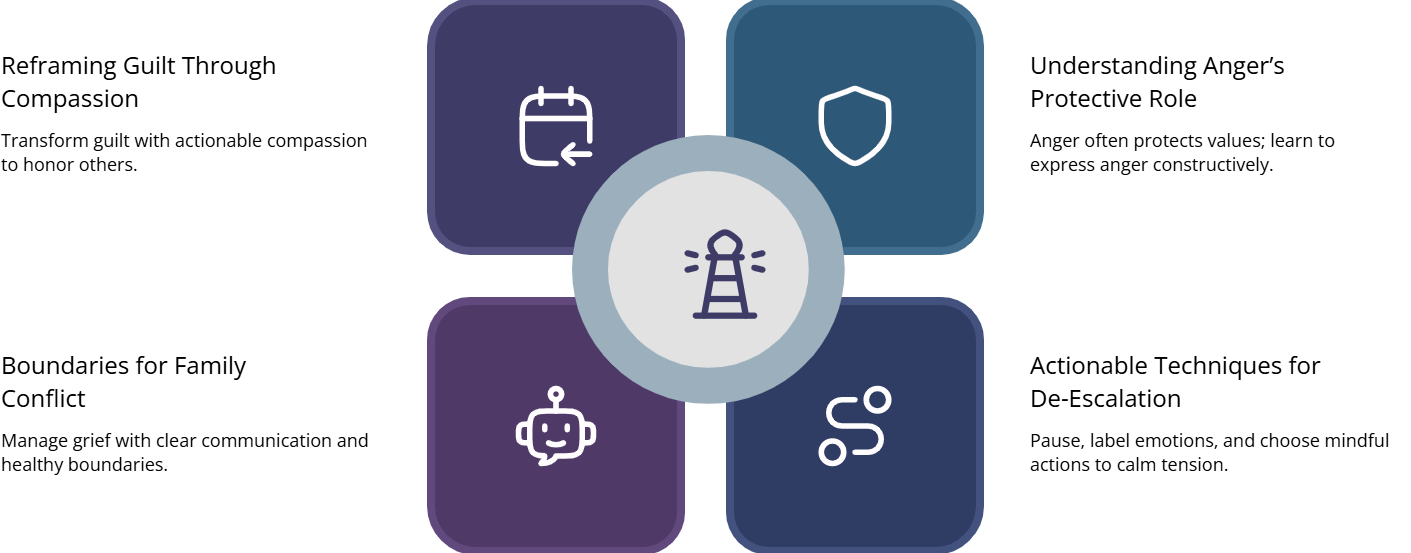
For guilt, distinguish responsibility from hindsight. Guilt often comes from applying today’s knowledge to yesterday’s situation. Ask, “What did you know then.” Ask, “What was realistic then.” This reframes guilt into compassion and reduces self punishment. It also creates action: what can the client do now to honor the person or experience. An honoring action transforms guilt into meaning.
For anger, help the client find what the anger is protecting. Anger often protects a broken expectation. It can protect love. It can protect fairness. It can protect safety. When you identify the protected value, you can move the client toward healthy boundaries and healthy expression. This is where conflict resolution strategies becomes relevant because grief often triggers interpersonal conflict.
For family conflict, focus on boundaries and communication. Grieving families often have different grief styles. One person wants to talk, one wants silence, one wants rituals, one wants to avoid. Teach clients to name needs without attacking. “I need quiet tonight.” “I need to step away from that conversation.” Protect the client’s space using setting professional boundaries and keep ethics clean using dual relationship guidance. If clients are pulled into unhealthy family expectations, remind them that boundaries are not rejection. Boundaries are protection.
When conversations get tense, use a simple de escalation structure: pause, label, then choose. Pause with a breath. Label the emotion. Choose the next small action. This keeps the client out of reactive spirals. If the client tends to avoid hard talks, strategies from managing difficult client conversations can be adapted to grief work in a gentle way.
The aim is not to remove pain. The aim is to keep the client from making painful situations worse through impulsive choices, boundary collapse, or isolation.
5) Creating a Gentle Progress Plan When Motivation Is Gone
Grief often kills motivation. Waiting for motivation is the fastest way to stay stuck. Replace motivation with a minimum viable plan. A minimum viable plan has three characteristics: it is small, it is scheduled, and it is emotionally safe.
Start by choosing one daily anchor. It might be a morning walk, a short meal routine, or a simple journal check in. One anchor creates stability. Stability reduces anxiety. Anxiety reduction increases capacity. This is the same logic used in burnout coaching strategies and is essential when grief drains energy.
Then build weekly micro goals. One micro goal for health, one for connection, one for life admin. Life admin is often the hidden stressor in grief. Bills, paperwork, funeral follow ups, estate tasks, moving tasks, or work responsibilities can overwhelm clients. Your coaching can be a stabilizing force by helping clients sort tasks into must do, should do, and can wait. This supports work life balance management and reduces the guilt of not doing everything.
Next, create a ritual. Rituals are not only spiritual. They are structured moments that help the client honor and integrate loss. A ritual could be writing a letter, creating a memory note, donating in someone’s name, or setting a weekly reflection. Rituals reduce the fear that moving forward means forgetting. That fear is one of the biggest blockers to re engaging with life goals.
Finally, protect your coaching structure. Do not offer constant availability. Instead, create between session tools. A grief tracker, a trigger plan, and a one line daily check in can replace the urge to message you constantly. Tools like those in building your coaching toolkit are practical trust builders, and they keep boundaries clean as described in professional boundaries.
Progress in grief is not linear. Your goal is to help the client build a life that can hold sadness and still function. That is compassionate coaching.
6) FAQs
-
Start with validation, then return to capacity. “This is a heavy season. You are not broken. Your nervous system is carrying a lot.” Then ask, “What feels possible today.” Keep language non judgmental and grounded in ethical care from ethical coaching principles. The goal is to reduce shame and create one small action.
-
Treat it as feedback, not failure. Reduce the plan to the smallest version. Create one anchor habit and one micro commitment. Use behavior shaping principles from reinforcing positive behaviors and apply the compassion of burnout coaching strategies. Consistency matters more than intensity.
-
Stay in coaching scope: routines, decisions, boundaries, and meaning aligned actions. Do not diagnose, do not process trauma deeply, and do not promise emotional outcomes. Keep the container clear using coaching confidentiality and role clarity from dual relationship ethics. If clinical needs emerge, refer ethically.
-
Set a warm boundary and give a tool. “I respond during office hours. Use your tracker and bring the key points to our session.” This protects both client and coach and aligns with professional boundaries with clients. Constant access creates dependence. Structure creates stability.
-
Name the emotion, then ask what it protects. Anger often protects a value like fairness or love. Once the value is clear, create a boundary or action aligned with that value. If anger triggers conflict at home or work, adapt strategies from conflict resolution to keep relationships intact.
-
Plan ahead. Ask clients how they want to honor the day and what support they need. Create a simple schedule, a grounding routine, and one connection point with a safe person. Planning reduces fear and prevents spirals. This approach fits the structure used in work life balance coaching.
-
Refer when symptoms suggest clinical depression, trauma responses, crisis, or inability to function safely. Also refer if the client expresses self harm thoughts. This is part of ethical professionalism and aligns with ethical dilemmas. Coaching can continue alongside therapy, focusing on daily structure and goals.
-
Do not force meaning. Start with values. Ask what matters in this season, what they want to protect, and what small acts feel honoring. Build rituals that keep memory alive while life continues. Over time, meaning becomes lived, not declared. Support their progress with simple tools from building your coaching toolkit.
