
Stress Management Techniques Every Coach Should Know
Stress is not just “too much to do.” It is what happens when the nervous system believes it has more demands than capacity, for too long, without recovery. Coaches who understand this stop giving generic advice and start building systems that reduce overload in real life. In this guide, you will learn the stress management techniques every coach should know, how to use them with clients, and how to protect your own energy so you do not burn out. Everything here is practical, ethical, and built for coaching conversations.

1) Stress Management for Coaches: How Stress Actually Works in the Body and Behavior
Stress shows up as emotion, but it runs on physiology. When a client is stressed, their attention narrows, their tolerance drops, and their decision quality collapses. That is why even motivated clients fall into avoidance, procrastination, irritability, or shutdown. If you want to coach stress professionally, start by building trust through strengthening client relationships and using transformational listening skills. Clients regulate faster when they feel safe.
Stress is also a boundary issue. Many clients are not stressed because life is hard. They are stressed because they say yes to everything, they overfunction, and they never recover. This is where setting professional boundaries and maintaining boundaries consistently becomes core coaching work. If you coach stress without coaching boundaries, you are coaching symptoms.
A professional coach treats stress like a system problem. You map triggers, identify patterns, and design recovery into the week. That is the same thinking that makes work life balance coaching effective and makes burnout coaching strategies feel real instead of inspirational.
Also know the ethics. If a client is having panic attacks, trauma responses, self harm ideation, or clinical impairment, you do not “push tools.” You stabilize, set scope, and refer when needed. Keep your foundation strong with ethical coaching principles and protect your practice with coaching confidentiality standards. A coach who understands scope becomes more trustworthy, not less.
Finally, stress coaching must be action based. Insight without behavior change becomes another mental load. Use action frameworks like inspiring immediate client action and reinforcement methods from reinforcing positive behaviors. Your goal is simple: reduce stress inputs, increase recovery outputs, and build capacity over time.
2) The Core Skill: Stress Awareness Coaching That Makes Clients Feel Safe and Seen
Most clients do not lack information. They lack accurate self awareness under pressure. Stress awareness coaching means you help the client notice their early signals before the blow up. That starts with language. Reflect what you see without judgment using skills from effective listening techniques and relationship safety from building deep trust. When clients feel understood, they stop fighting themselves.
Use a simple three part map: trigger, story, behavior. Trigger is the moment stress rises. Story is the meaning they attach to it. Behavior is what they do next. The coach’s job is not to argue with the story. It is to test it with questions using powerful questioning methods. This reduces emotional reactivity and increases choice.
Stress often hides inside difficult conversations. Clients delay feedback, avoid conflict, and then the stress becomes chronic. Teach them to prep conversations and to repair quickly. Use frameworks from managing difficult client conversations and the clean structure from conflict resolution strategies. This turns stress from a vague fog into a solvable problem.
Also coach boundaries as an identity skill. Many clients believe they are only valuable when they are available. That belief produces endless stress. Use professional boundary guidance and boundary maintenance techniques to make boundaries feel safe instead of selfish.
Finally, reinforce the behaviors that reduce stress. Most clients only notice what went wrong. You train them to notice what worked. Use reinforcing positive behaviors and connect actions to momentum using inspiring immediate action. Stress reduces when clients build proof that they can handle life again.
3) Systems That Reduce Stress: Time, Energy, Boundaries, and Recovery
Stress becomes chronic when life has no recovery design. Many clients plan their work but not their recovery. You coach the opposite. You coach the system that prevents stress from stacking. Start with balance frameworks from work life balance support and apply burnout prevention principles from burnout coaching strategies.
Use time protection before time management. Protect the top two priorities, protect sleep, protect meals, protect movement. Then fit everything else around that. This avoids the trap where clients build a perfect schedule they cannot live. If clients run a business, stress is often a delegation issue. The client is holding too much because they do not trust others. Use scaling and capacity ideas from outsourcing secrets and growth structure guidance from strategically expanding a coaching practice.
Boundary stress is also relationship stress. Clients who cannot say no will always feel overwhelmed, even with good time blocks. Coach short scripts and consequences using how to set clear boundaries and keep it consistent with techniques for maintaining boundaries. Short scripts reduce cognitive load, which reduces stress.
Recovery needs structure. Teach clients a shutdown ritual. Teach them micro breaks. Teach them a weekly reset. If you want tools that make this fast, pull from coaching toolkit templates. Then reinforce consistency using positive behavior reinforcement. Stress reduces when recovery becomes automatic.
Also coach ethical clarity. Stress rises when clients are in moral conflict or role confusion. Coaches also feel stress when they are unclear on scope. Keep your foundation clean with ethical principles and protect your client container using confidentiality practices. Clarity is calming.
4) Coaching Conversations That Lower Stress Fast: Scripts, Questions, and Real Interventions
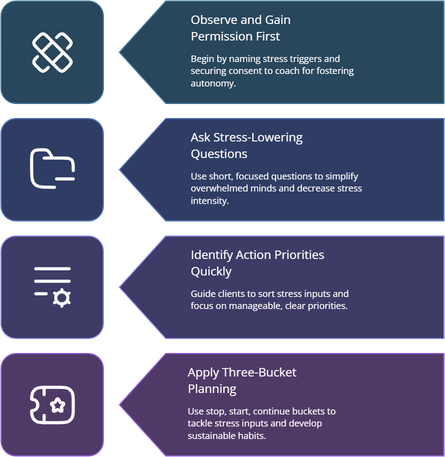
When stress is high, clients need simplicity. Your first goal is to lower intensity enough to create choice. Begin by naming what you observe and asking permission to coach it. This preserves autonomy and builds trust using deep trust methods and effective listening skills.
Use short questions that reduce mental load. Ask what feels most urgent. Ask what is controllable today. Ask what one action reduces stress by ten percent. These question patterns come from powerful questioning and work well when clients are overwhelmed.
Then move into action selection. Chronic stress often comes from unclear priorities. Use a three bucket method: stop, start, continue. Stop one stress input, start one recovery action, continue one stabilizing habit. Reinforce that plan using reinforcing positive behaviors and connect it to momentum using immediate action coaching.
Many stress cases are really conflict cases. A client is stressed because they are avoiding a conversation with a boss, partner, or family member. Help them script it. Rehearse it. Plan the follow up. Use difficult conversation coaching and conflict resolution strategies to make this practical. Stress drops when avoidance ends.
Also coach boundaries with consequences. A boundary without a consequence is a request. Teach clients to communicate limits calmly and then follow through. Use professional boundary guidance and boundary maintenance techniques. This is one of the highest ROI stress interventions you can teach.
Finally, recognize burnout risk. If the client is exhausted, cynical, and detached, stress management is not enough. They need load reduction and recovery. Shift to burnout coaching and use burnout support strategies alongside work life balance coaching. Protect scope using ethical coaching principles.
5) Stress Management for Coaches: Protect Your Own Nervous System and Avoid Burnout
Coaches absorb stress. You listen to pressure, fear, and urgency all day. If you do not manage your own load, you will become reactive, exhausted, and less effective. Professionalism includes self regulation. Start with workload boundaries. Protect your session calendar, message windows, and recovery time using professional boundaries and maintaining boundaries.
Also protect your emotional labor. If you do not have a debrief process, you will carry clients into your personal life. Build a short after session reset and a weekly review. Borrow structure from coaching toolkit templates and pair it with recovery planning from work life balance strategies.
Watch for coaching burnout. Signs include dread before calls, irritability, numbness, and reduced empathy. If you feel these, reduce load and restore your fundamentals. Use burnout coaching strategies on yourself, because burnout rules apply to coaches too.
Ethics reduces stress as well. Coaches feel stress when clients push for therapy, crisis support, or constant access. Stay in scope, document clearly, and refer when needed using ethical coaching principles and ethical dilemma guidance. Your calm comes from clarity.
Finally, build your practice with sustainability. If you are trying to do everything alone, stress becomes structural. Consider systems, delegation, and smarter operations. Business related stress is real, so use guidance from outsourcing secrets and strategic expansion. A healthy coach builds a healthy practice.
6) FAQs
-
The best techniques are the ones that reduce load and increase recovery. Start with trigger mapping, capacity budgeting, boundary scripts, and micro recovery breaks. Then add simple grounding tools for acute moments. These tools work because they create choice and stability. Use work life balance coaching for weekly structure, and use reinforcing positive behaviors to make the habits stick. If the client is overwhelmed, combine this with inspiring immediate action so progress stays practical.
-
First lower intensity, then create a next step. Reflect what you observe using effective listening and ask permission to coach the stress. Use short grounding, then ask one powerful question like “What reduces stress by ten percent today” using powerful questioning. End with one action and one recovery step, then reinforce it with positive behavior strategies. The goal is not perfection. The goal is relief and direction.
-
Most plans fail because they are too big, too vague, or not matched to capacity. Clients under stress have less executive function. They need small actions that are easy to repeat. That is why micro commitments from immediate action coaching work better than complex routines. It also helps to reduce hidden stress drivers like weak boundaries, so use setting professional boundaries and maintaining boundaries. Consistency comes from design, not willpower.
-
Boundaries stop stress at the source. Many clients are stressed because they accept obligations that do not fit their time, energy, or values. When they set limits, they reduce overload and restore control. Coaches should teach short scripts and follow through, using professional boundary guidance and boundary maintenance techniques. Boundaries also reduce conflict stress because expectations become clear. This builds healthier relationships and lower baseline stress.
-
Stress often comes from avoidance. The conversation feels risky, so the client delays, and stress grows. Coaches should help clients prepare, script, and rehearse. Use managing difficult conversations and conflict resolution strategies to keep it structured. Start with a clear goal, a calm opening, and one request. Then plan the recovery step after the conversation. Clients feel safer when they know what to say and what to do next.
-
Stress is pressure with the belief that action can help. Burnout is exhaustion with reduced hope and reduced capacity. A stressed client can often recover with better systems and boundaries. A burned out client needs load reduction and deep recovery. Coaches should shift approach using burnout coaching strategies and reinforce weekly recovery with work life balance support. Always stay ethical and scope aware using ethical coaching principles.
-
Coaches need boundaries, recovery, and clear scope. Protect your calendar, messaging windows, and mental load using professional boundaries and maintaining boundaries. Use a short after session reset and a weekly review using coaching toolkit templates. Watch for burnout signs and use burnout strategies early. Your calm is part of your service quality.
