
Managing Difficult Client Conversations with Ease
Difficult client conversations are not a sign that your coaching is failing. They are a sign that real work is happening. Resistance, defensiveness, frustration, avoidance, and emotional spikes show up when clients are confronted with change, accountability, or uncomfortable truths. The difference between coaches who burn out and coaches who scale is not whether they face difficult conversations. It is how they handle them.
This guide gives you precise techniques, language frameworks, and systems to navigate hard conversations without emotional exhaustion, boundary collapse, or loss of authority while strengthening trust and results.

1) Why Difficult Conversations Are Inevitable in High-Quality Coaching
If your clients are never uncomfortable, they are not changing. Difficult conversations appear when you challenge patterns, interrupt excuses, surface misalignment, or confront behavior that blocks progress. Coaches who avoid these moments end up reinforcing stagnation rather than transformation. Coaches who mishandle them create defensiveness, disengagement, or dependency.
The key shift is understanding that conflict is not failure. Conflict is data. It tells you where fear, identity, or resistance lives. Your role is not to smooth things over or rescue emotions. Your role is to hold the process steady. This principle connects directly with reinforcing positive client behaviors and inspiring clients to take immediate action. When you avoid difficult conversations, you teach clients that discomfort can be escaped. When you lead them through it, you teach resilience and self-responsibility.
Many coaches confuse empathy with agreement. Empathy acknowledges emotion without abandoning structure. Agreement abandons the container. This distinction protects you from ethical drift covered in ethical coaching principles and prevents emotional enmeshment that later becomes a boundary issue like those described in professional boundaries with clients. Difficult conversations are where professionalism is either reinforced or quietly lost.
| Scenario | What Clients Say | Coach Response | Purpose of Response |
|---|---|---|---|
| Missed homework | “I didn’t have time.” | “Let’s examine what you prioritized instead and what that tells us.” | Restore ownership |
| Blaming others | “My team is the problem.” | “What part of this is within your control?” | Shift locus of control |
| Defensiveness | “You don’t understand.” | “Help me understand what feels missed.” | De-escalate emotion |
| Resistance | “That won’t work.” | “What have you tried so far, and what happened?” | Invite reflection |
| Overtalking | Constant explaining | “Let’s pause and name the key point.” | Slow the session |
| Victim language | “It’s always like this.” | “What pattern do you notice repeating?” | Pattern awareness |
| Anger | Raised voice | “I hear frustration. Let’s slow this down.” | Regulate intensity |
| Avoidance | Topic switching | “Let’s stay with this for a moment.” | Maintain focus |
| Discount pressure | “Can you lower the price?” | “My pricing reflects the structure and outcomes.” | Hold value |
| Scope creep | “Can we add this?” | “That’s outside this phase. We can plan it next.” | Protect structure |
| Emotional dumping | Long venting | “What outcome do you want from sharing this?” | Redirect to action |
| Passive resistance | “Sure, I’ll try.” | “What would trying look like this week?” | Clarify commitment |
| No-shows | Silence | “Missed sessions are charged. Let’s reset expectations.” | Reinforce policy |
| Authority challenge | “I’ve already tried that.” | “What specifically didn’t work?” | Move to data |
| Dependency | “Tell me what to do.” | “What do you think the next step is?” | Build autonomy |
| Oversharing | Trauma detail | “That’s important. Coaching focuses on action.” | Stay in scope |
| Deflection | Jokes | “Humor aside, what’s the real concern?” | Refocus |
| Excuse stacking | Multiple reasons | “Which one matters most right now?” | Reduce overwhelm |
| Entitlement | Extra access | “Support happens inside sessions.” | Hold boundaries |
| Comparison | “Others have it easier.” | “Let’s stay with your path.” | Reduce distraction |
| Emotional shutdown | Silence | “What’s happening for you right now?” | Re-engage |
| Conflict escalation | Arguing | “Let’s pause and reset tone.” | Protect safety |
| Ultimatums | “If this doesn’t change…” | “Let’s clarify expectations.” | Stabilize process |
| Testing limits | Rule pushing | “We’re staying inside the agreement.” | Consistency |
| Exit threat | “Maybe I should quit.” | “We can do a closure session.” | Professional exit |
| Blame shifting | “You didn’t tell me.” | “Let’s review what was agreed.” | Reality check |
| Emotional manipulation | Guilt tactics | “I support you best through structure.” | Maintain leadership |
2) The Psychology Behind Client Defensiveness and Pushback
Clients rarely resist coaching itself. They resist what coaching threatens. Identity, habits, comfort, self-image, and perceived safety are all at stake. When you ask a client to own behavior, stop blaming external factors, or follow through on commitments, you are challenging internal narratives they rely on.
Defensiveness shows up as excuses, sarcasm, withdrawal, over-talking, or sudden emotional reactions. None of these require fixing. They require containment. Containment means staying calm, slowing the pace, and naming what is happening without judgment. This aligns with emotional regulation strategies found in coaching clients through burnout and helps prevent escalation into conflict that derails sessions.
A powerful reframe is this: the more defensive a client becomes, the more important it is to reduce your verbal output, not increase it. Overexplaining signals uncertainty. Calm brevity signals leadership. When clients feel emotionally flooded, their cognitive capacity drops. The goal of a difficult conversation is not persuasion. It is restoring enough safety that accountability can continue.
This is why difficult conversations must always reconnect to agreed goals. Goals act as neutral ground. They are not personal attacks. They are commitments the client already made. Linking conversation back to goals keeps discussions grounded, similar to frameworks used in managing work life balance where structure stabilizes emotional overload.
3) Conversation Frameworks That De-Escalate Without Weakening Authority
Every difficult conversation should follow a predictable internal structure. Structure keeps you calm and prevents reactive coaching. The first step is naming the issue neutrally. Not “you are avoiding,” but “I notice the commitment hasn’t been followed through.” Neutral language reduces shame and keeps clients engaged.
Second is linking behavior to impact. Impact is not punishment. It is information. “When sessions go without practice, progress slows.” This mirrors techniques used in reinforcing positive behaviors and prevents moral judgment.
Third is returning responsibility. “What do you want to change before next session?” Responsibility cannot be outsourced. When coaches absorb responsibility, clients disengage. This is how dependency forms, which later creates burnout for both parties.
Fourth is closing with clarity. End with a specific next step and timeline. Vagueness creates future conflict. Precision prevents it. This precision is critical for sustainable practices described in strategically expanding your coaching practice.
4) How to Stay Calm When Clients Get Emotional or Confrontational
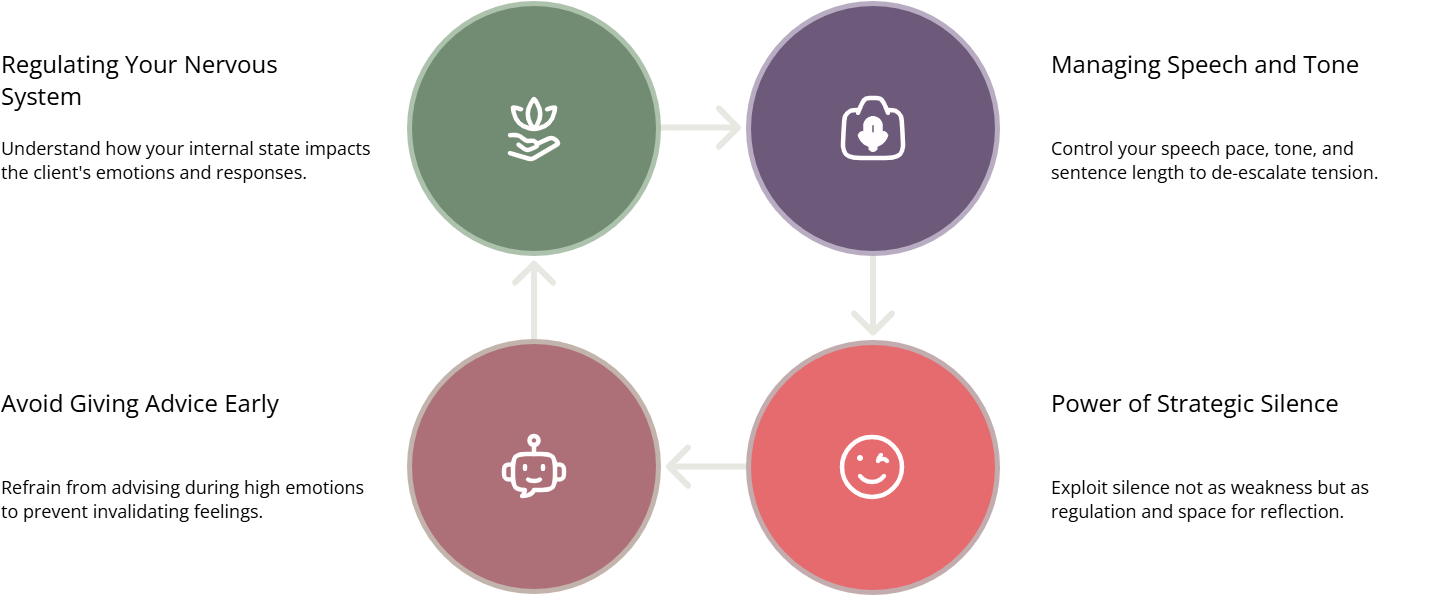
Your nervous system leads the room. If you escalate internally, clients feel it immediately. The fastest way to regain control is to slow the pace of speech, lower your voice slightly, and shorten sentences. Silence is not weakness. Silence is regulation.
When emotions spike, avoid advice. Advice during emotional flooding feels invalidating. Instead, reflect one sentence and pause. “I hear frustration about feeling stuck.” Pause. This gives the client space to self-regulate. Once intensity drops, redirect to action.
This approach protects you from ethical overreach discussed in managing dual relationships and keeps sessions within coaching rather than therapy. If emotions repeatedly overwhelm sessions, that is data indicating a referral may be appropriate, consistent with coaching confidentiality and scope.
5) Turning Difficult Conversations Into Momentum Instead of Conflict
The goal is not to “win” difficult conversations. The goal is to convert friction into forward movement. Always end difficult discussions by identifying one controllable action. Progress repairs trust faster than reassurance.
Track patterns across sessions. If the same issue repeats, escalate structure, not emotion. Add written commitments, deadlines, or metrics. This mirrors strategies used in coaching business scaling where systems outperform motivation.
Difficult conversations handled well increase respect. Clients may not enjoy them in the moment, but they remember who held them steady when avoidance was easier. That reputation is what supports long-term credibility and premium positioning.
6) FAQs(Frequently Asked Questions)
-
By staying neutral, calm, and goal-focused. Trust erodes when you avoid truth, not when you speak it. Anchor feedback to agreed outcomes and keep language observational, not judgmental.
-
Slow the pace, reduce words, and return responsibility. Defensiveness often fades when clients realize the boundary will not move.
-
No. Avoidance creates stagnation. Clients may stay comfortable but will not achieve results, leading to disengagement later.
-
Shift from opinion to data. Ask what they tried, what happened, and what result they want next. Authority comes from process, not dominance.
-
Pause advice. Reflect emotion briefly, then redirect to action. If emotions consistently overwhelm sessions, consider referral.
-
When it moves into clinical territory, trauma processing, or dependency. Stay aligned with ethical coaching principles.
-
Yes. They are often the turning point. Clients grow fastest when avoidance is replaced with clarity.
-
When boundaries are repeatedly violated or safety and respect are compromised. Offer a clean, professional closure.
