
Managing Client Expectations: Techniques to Maintain Motivation
Many coaching relationships lose momentum for a simple reason: the client expects progress to feel cleaner, faster, and more emotionally satisfying than it actually does. They expect immediate confidence, instant consistency, and steady upward progress. Then real change arrives with friction, boredom, relapse, resistance, and uneven wins. When that gap is not managed well, motivation drops fast.
That is why expectation management is one of the most important coaching skills in the entire relationship. Done well, it protects trust, reduces dropout, strengthens accountability, and helps clients stay engaged when progress looks messy. Done poorly, it turns normal setbacks into proof that the client is failing, the plan is broken, or the coaching is not working.

1. Why Expectation Management Is a Motivation Skill, Not Just a Communication Skill
Many coaches think expectation management is mostly about avoiding misunderstandings. It goes much deeper than that. Expectations shape emotional interpretation. If a client expects rapid change, one hard week feels like failure. If they expect motivation to stay high, a low-energy stretch feels like something is wrong. If they expect insight to automatically produce action, every lapse becomes a character problem. This is why expectation management directly influences motivation, confidence, and follow-through.
Clients do not lose motivation only because change is difficult. They lose motivation because difficulty surprises them. That surprise creates discouragement. Discouragement creates self-doubt. Self-doubt creates avoidance. Avoidance then gets misread as laziness or lack of commitment. Coaches who understand how to actually change your clients life in 2026, how the worlds best coaches get results, new data proven coaching methods for maximum client success, and strength-based coaching techniques that skyrocket client success know that keeping clients motivated requires changing how they interpret the process, not just telling them to stay positive.
Expectation management also protects the coaching relationship itself. Clients often begin coaching with an invisible fantasy: this time things will finally click without much friction. When that fantasy breaks, disappointment can quietly turn toward the coach, the method, or the structure of the program. That is one reason why coaches who study why trust is the most valuable asset in coaching, coaching integrity building trust and credibility in your practice, building deep trust how to strengthen your client relationships, and the communication secret behind successful coaching are usually better at retention. They name reality early, which keeps normal struggle from becoming relational disappointment.
A major part of this work is helping clients understand that motivation is unstable by nature. It rises and falls with sleep, stress, identity, environment, emotional state, and recent wins or losses. That means sustainable coaching cannot depend on motivation alone. It needs structure, friction reduction, and better interpretations of slow progress. Coaches using habit formation tools helping clients achieve lasting change, interactive goal tracking tools that boost client success, gamification strategies keeping clients engaged and motivated, and effective strategies for reinforcing positive client behaviors tend to understand this more practically: motivation is protected when the path feels understandable and survivable.
Expectation management matters because clients are always making meaning out of their progress. A missed day can mean “I am failing” or “I need a smaller system.” A bad week can mean “This is not working” or “This is where coaching becomes valuable.” The coach’s job is to help clients build the second interpretation more often. That is not sugarcoating reality. It is protecting reality from distortion.
| Client Expectation | Why It Hurts Motivation | Better Reframe | Coach Response | Best Time to Use |
|---|---|---|---|---|
| I should feel motivated every day | Normal dips feel alarming | Consistency matters more than mood | Build a low-energy version | Early onboarding |
| One bad week means failure | Shame grows fast | One week is data, not identity | Review friction points | After setback |
| Insight should create change instantly | Action lag feels discouraging | Insight needs repetition and design | Turn insight into one action | Post-breakthrough |
| If it’s hard, I’m doing it wrong | Normal resistance becomes threat | Hard often means the pattern is real | Shrink the task | Resistance phase |
| Progress should be obvious | Quiet wins get ignored | Micro-wins count | Track behavioral proof | Weekly review |
| I need the perfect plan first | Starting gets delayed | A usable plan beats a perfect plan | Launch a tiny version | Beginning phase |
| Relapse means I’m back at zero | Clients quit after slips | Recovery speed matters more | Design a reset step | Behavioral work |
| I should be farther along by now | Comparison drains energy | Real pacing depends on real life | Compare to old baseline | Mid-program dip |
| Good clients do the homework | Avoidance becomes shame | Missed work reveals design problems | Ask what made it hard | Check-ins |
| The coach should fix my motivation | Dependency grows | Coach supports systems, not mood rescue | Co-create motivators | Expectations talk |
| Big goals need big action | Overwhelm crushes momentum | Small actions survive stress | Break it down | Action planning |
| The first weeks should feel exciting | Normal boredom feels wrong | Boring systems often last longer | Normalize repetition | Week 2–3 |
| Being overwhelmed means I need more information | Clients consume instead of act | Overload often needs simplification | Cut the options | Analysis paralysis |
| A motivated client never ghosts | Re-entry feels embarrassing | Silence often means shame or overload | Create easy return language | Retention recovery |
| My schedule has to be ideal first | Action waits forever | Messy schedules still allow small wins | Design for chaos | Busy seasons |
| Feeling resistant means I don’t want it | Ambivalence is misread | Resistance can signal fear, effort, or identity change | Explore resistance kindly | Emotional work |
| Progress should be linear | Normal fluctuation becomes drama | Progress usually loops and climbs | Show a non-linear model | Onboarding |
| If I really cared, I’d do it naturally | Effort feels shameful | Care often requires structure | Honor support systems | Identity work |
| One strong session should carry me all week | Momentum gaps surprise clients | Support needs reinforcement | Add midweek check-ins | Between-session planning |
| If I need to restart, I failed | Clients avoid rebooting | Restarting is a core skill | Teach reset rituals | After lapses |
| Results should come before confidence | Clients wait to act | Confidence often follows evidence | Collect small proofs | Low-confidence clients |
| The best plan leaves no room for mistakes | Rigidity triggers collapse | Flexible plans survive life better | Build fallback options | System design |
| Feeling bored means it’s not working | Clients abandon useful routines | Boredom often marks stabilization | Name boring success | Habit formation |
| Motivation should come before action | Clients wait too long | Action can generate motivation | Use a two-minute start | Procrastination |
| Setbacks mean the method is wrong | Clients abandon workable systems | Methods need adjustment, not panic | Change one variable | Review cycles |
| Support should make this feel easy | Effort becomes disillusioning | Support makes hard work more doable | Clarify the coaching role | First month |
| I need a major breakthrough | Quiet gains are ignored | Change often compounds slowly | Spot subtle progress | Plateau periods |
| Clients who struggle are doing coaching badly | Shame blocks honesty | Struggle often means real work is happening | Normalize friction | Any difficult phase |
| The right time to change will feel clear | Clients wait endlessly | Readiness often grows through action | Start with one proof point | Ambivalent clients |
| I need to feel fully ready before I commit | Action is postponed | Partial readiness is enough for a small move | Use a micro-commitment | Start-up conversations |
2. The Client Expectation Patterns That Most Commonly Destroy Momentum
One major expectation problem is speed. Clients routinely overestimate how fast visible change should happen and underestimate how much repetition behavior change requires. They imagine that once they are “serious,” consistency will arrive quickly. Then they run into real life: poor sleep, emotional eating, avoidance, family obligations, low energy, stress spikes, travel, and old identity patterns. Coaches who work from how to inspire clients to take immediate action, the radical simplicity coaches are loving, how to make it work every time, and why its the hidden goldmine of coaching know that motivation stays higher when progress is framed as cumulative rather than immediate.
Another pattern is perfection. Some clients quietly believe that a good coaching client follows through every week, remembers every insight, completes every task, and never needs to be reminded. As soon as they fall short of that fantasy, they become ashamed. Shame makes them less likely to check in honestly. Then the coach loses access to the real situation. That is why expectation work needs to connect with effective listening techniques that transform client conversations, managing difficult client conversations with ease, conflict resolution strategies every coach needs, and the art of powerful questioning in coaching. The more shame a client carries, the more skill the coach needs to keep truth available.
A third pattern is emotional expectation. Clients expect the right plan to feel energizing most of the time. They expect motivation to rise when the goal is meaningful. But meaningful goals often provoke fear, grief, grief-like resistance, self-doubt, and internal conflict. That is why expectation management is crucial in work related to stress management techniques every coach should know, helping clients manage work-life balance successfully, effective strategies for coaching clients through burnout, and the importance of self-care coaching for client mental health. Clients need to know that discomfort often means the work matters, not that they chose the wrong goal.
Another destructive pattern is expecting clarity before movement. Many clients think they need to fully understand the right plan, the right sequence, or the right version of themselves before taking action. That creates overthinking and information hoarding. Coaching becomes less effective when the client uses reflection to delay contact with reality. Strong expectation-setting here is supported by coaching session templates to boost your productivity instantly, interactive goal tracking tools that boost client success, using surveys and feedback tools to improve coaching outcomes, and creating custom coaching dashboards for enhanced client experience, because concrete systems can redirect the client away from endless mental rehearsal.
A final pattern is misreading setbacks. Clients often assume setbacks erase progress, when in reality setbacks reveal the next weak point in the system. That is a far more useful interpretation. The coach who teaches this early protects motivation later.
3. How to Set Expectations Early Without Killing Enthusiasm
Good expectation-setting does not flatten hope. It protects hope from fantasy. Coaches should aim to create motivated realism: enough optimism to keep the client engaged and enough honesty to stop normal difficulty from feeling like betrayal. This begins in the first conversation. Explain that progress is usually uneven, behavior change often feels less exciting after the first burst, and setbacks are expected material for coaching, not proof that the client is doing it wrong. That approach aligns well with the future of client engagement 2026, must-know client preferences shaping the future of coaching, future-proof your coaching practice top trends to watch, and the future model every coach needs to adopt by 2026, because modern clients value clarity and emotional honesty.
One strong technique is naming the emotional phases of change in advance. The coach can say that early sessions often feel energizing, the next phase often brings friction, and later progress may feel boring before it feels powerful. That single conversation can save weeks of avoidable discouragement. It works especially well alongside how to actually empower clients real results, the 1 coaching technique for client breakthroughs, why coaches need it more than ever 2026, and why top coaches are obsessed, because clients are being prepared for the emotional mechanics of lasting change rather than sold a smoother fantasy.
Another technique is defining what progress will actually be measured by. Many clients focus only on visible outcomes: weight, income, mood, consistency streaks, productivity, or external validation. Those matter, but they are not the only signs of movement. Better metrics include honesty speed, recovery after slips, willingness to restart, reduced avoidance, better planning, increased awareness of triggers, and more flexible self-talk. Coaches who use powerful client journaling tools for deeper self-awareness, daily journaling prompts the ultimate 2026 guide for coaches, gratitude journal coaching the ultimate 2026 guide for coaches, and life mapping the ultimate 2026 guide for coaches often get better buy-in because clients start noticing change earlier and more accurately.
A third technique is offering “minimum viable actions.” This keeps clients from equating motivation with huge effort. Every important action should have a low-energy version, a busy-day version, and a restart version. That way a client never has to choose between perfect execution and total collapse. This principle connects strongly with how to set them and save your career, why coaches must avoid this trap, the coaching skill you didnt know you needed, and how coaches reach mastery. Clients stay motivated longer when the plan respects the fact that life is rarely ideal.
One more technique: ask clients what they are secretly expecting. Many disappointments are never spoken out loud. Until the coach brings them into language, they keep shaping the client’s experience in the background.
4. Techniques Coaches Can Use to Maintain Motivation When Expectations Crash Into Reality
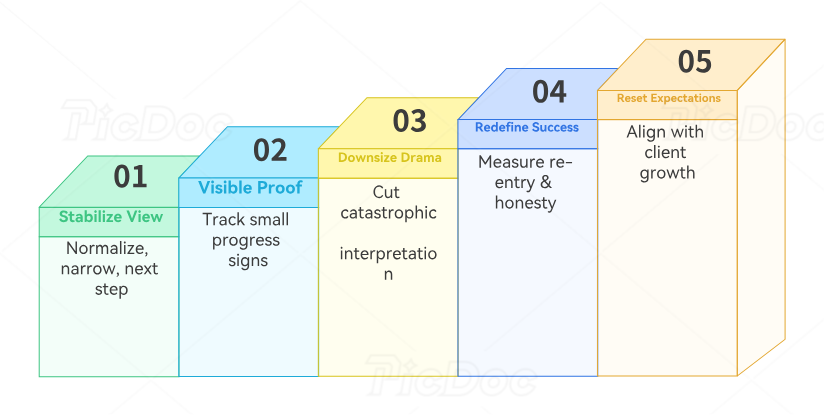
When client expectations break, the coach’s first task is not to re-motivate through intensity. It is to stabilize interpretation. The client needs help understanding what happened without turning it into a personal indictment. One practical method is the “normalize, narrow, next step” sequence. First, normalize the struggle without trivializing it. Second, narrow the focus to the real friction point. Third, design one useful next move. This works far better than long pep talks and pairs naturally with effective coaching communication for nbhwc certification, detailed review of nbhwc coaching competencies, essential coaching skills for icf credentialing, and common pitfalls in the nbhwc certification exam, where skilled communication is central to change.
Another useful technique is visible proof collection. Motivation improves when clients can see evidence that the effort is working, even before big outcomes arrive. That evidence might be reduced hesitation, faster recovery after a lapse, fewer all-or-nothing thoughts, better emotional awareness, more honest reporting, or one extra moment of self-control. Coaches can build this through client testimonials capture the ultimate 2026 guide for coaches, coaching case study templates demonstrating your value effectively, interactive goal tracking tools that boost client success, and using surveys and feedback tools to improve coaching outcomes. When progress is made visible, it becomes emotionally easier to continue.
A third technique is emotional downsizing of the miss. Many clients interpret one missed workout, one emotional meal, one skipped boundary, or one silent week as a catastrophic event. Coaches need to cut off that drama spiral early. The question is rarely “How do we make sure this never happens again?” It is usually “What stopped working here, and how do we reduce the odds next time?” That approach is strengthened by mindfulness and meditation techniques for emotional coaching, inner critic management techniques the ultimate 2026 guide for coaches, appreciative inquiry the ultimate 2026 guide for coaches, and solution-focused brief coaching sfbc the ultimate 2026 guide for coaches.
A fourth technique is changing the unit of success. Instead of measuring success only by full completion, measure it by re-entry speed, emotional honesty, willingness to adjust, and ability to keep contact with the process under stress. This is especially important for clients navigating effective strategies for coaching clients through burnout, helping clients manage work-life balance successfully, coaching clients through grief and loss compassionate strategies, and how coaches can support clients with PTSD and trauma, where maintaining motivation often requires much more compassionate pacing.
A fifth technique is mid-course expectation resets. Coaches should not assume the initial framing is enough. As the client grows, the emotional meaning of progress changes. New phases create new disappointment risks. Revisiting expectations every few weeks helps keep motivation aligned with reality.
5. How to Keep Expectation Management Ethical, Honest, and Still Encouraging
Expectation management becomes manipulative when the coach uses it to lower standards unfairly or excuse weak coaching. That is not the goal. The goal is honest calibration. Clients should not be told to expect mediocre results. They should be told to expect a non-linear process with real emotional friction and learn how to stay in contact with that process without turning every dip into a verdict. This is where understanding ethical responsibilities as a health & life coach, why emotional consent matters in every coaching session, the ultimate guide to ethical coaching principles you cant ignore, and managing dual relationships essential ethics for coaches matter so much. Ethical coaching tells the truth about both effort and possibility.
Encouragement should also be specific. Generic reassurance often backfires because it sounds disconnected from the client’s actual experience. “You’re doing great” is too vague when the client feels lost. Better encouragement names what is still working: honesty, restart behavior, willingness to reflect, a smaller-than-usual relapse, or better awareness at the moment of choice. Coaches drawing from the communication secret behind successful coaching, communication techniques every coach should master, effective listening techniques that transform client conversations, and building deep trust how to strengthen your client relationships often do this better because they track the client’s process closely enough to encourage with precision.
Expectation management should also respect individuality. Some clients need more realism earlier because they tend to fantasize fast results. Others need more hope because they expect disaster and quit before momentum forms. Coaches who overuse one style with everyone create problems either way. This is why strong coaches combine structured tools like virtual coaching tools boosting your remote session effectiveness, the 10 best coaching apps every professional should know, automated email sequences the ultimate 2026 guide for coaches, and coaching automation next-level tools to grow your business faster with relational judgment. Systems help. Sensitivity decides how to use them.
The coaches who manage expectations well do something powerful: they protect motivation from distortion without diluting ambition. They teach clients to keep going when progress is imperfect, feelings are unstable, and change is slower than fantasy promised. That is not a minor communication win. It is one of the core engines of long-term results.
6. FAQs About Managing Client Expectations and Maintaining Motivation
-
Because wanting the result does not automatically prepare them for the emotional experience of change. Many clients underestimate boredom, resistance, inconsistency, and setbacks. When those appear, they often interpret them as failure instead of normal parts of the process.
-
At the very beginning. The first conversation should already include honest framing about how progress usually works, what setbacks mean, and what motivation can and cannot be relied on to do. Waiting until the first major struggle is often too late.
-
Focus on truthful optimism. You are not lowering hope. You are protecting it from fantasy. Explain that change is absolutely possible, but the path usually includes friction, adjustment, and uneven progress rather than a smooth upward line.
-
Many clients assume one setback means the plan is broken or they are incapable. That interpretation destroys momentum much faster than the setback itself. Reframing setbacks as information is one of the most valuable things a coach can teach.
-
Do not rush into hype. First help them interpret the week clearly. Identify what changed, what became hard, what still worked, and what the next smaller move should be. Clean interpretation often restores motivation better than emotional intensity does.
-
Sometimes they should lower the action size without lowering the long-term standard. That is often the smarter move. Smaller actions preserve identity, momentum, and honesty. Huge actions that go undone usually damage all three.
-
Very often, yes. Clients stay longer when they understand the process well enough not to panic during normal difficulty. Clear expectations protect trust in the method, the coach, and the client’s own capacity to keep going.
