
Client Testimonials Capture: The Ultimate 2026 Guide for Coaches
Client testimonials aren’t “nice to have” in 2026—they’re the trust currency that decides whether a prospect books a call or bounces in 9 seconds. But most coaches capture testimonials in the weakest way possible: vague praise, no specificity, no transformation arc, and no proof signals—so the testimonial looks like a favor, not evidence. This guide gives you a professional capture system: what to ask, when to ask, how to structure it, how to reduce client friction, and how to turn honest feedback into conversion assets without sounding desperate or salesy—while protecting ethics and trust.
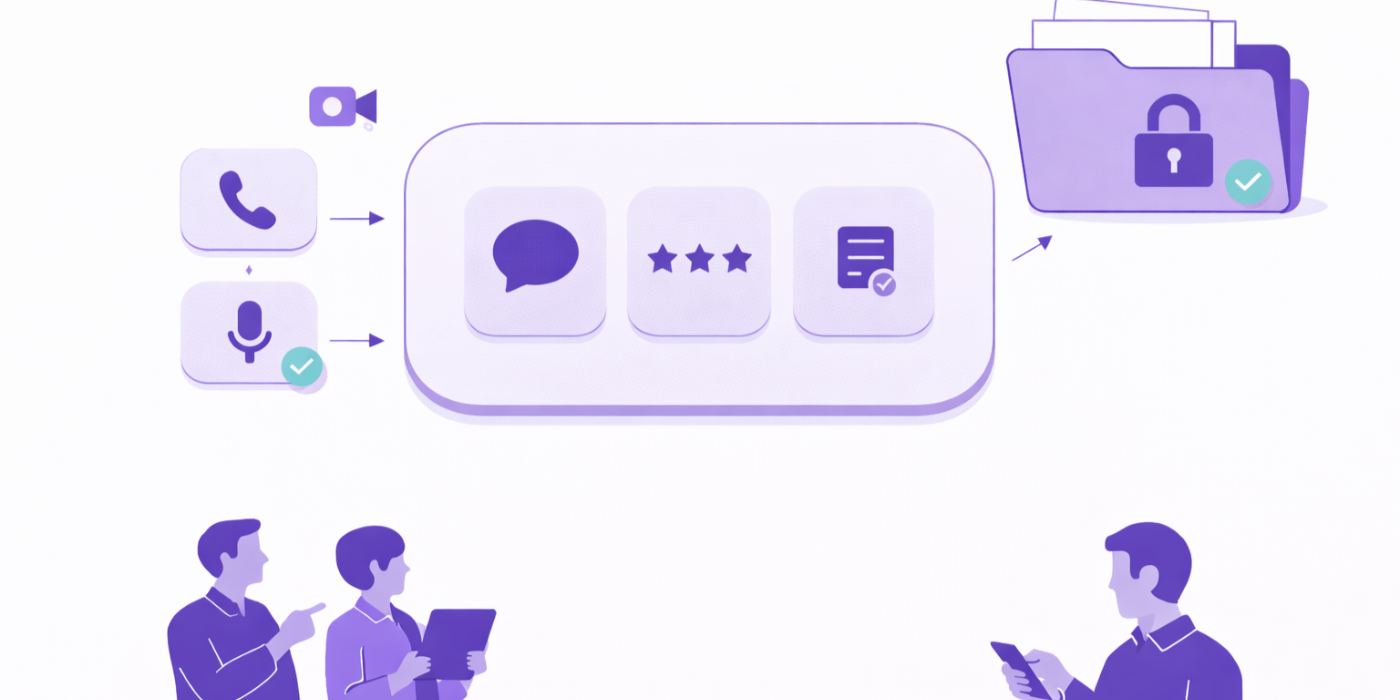
1) Client Testimonial Capture in 2026: What Actually Converts (And Why Yours Might Be Killing Trust)
A testimonial is only valuable when it answers the buyer’s real question: “Will this work for someone like me?” In 2026, prospects have seen thousands of generic “Highly recommend!” quotes. Those don’t build trust—they trigger skepticism. A converting testimonial is specific, credible, and context-rich. It shows who the client was, what they struggled with, what changed, how it changed, and *what results look like now.
This is why testimonials are inseparable from coaching fundamentals like trust-building, communication clarity, and outcome design. If your coaching process is strong, testimonials become easy to capture because clients can articulate the change you helped them create (see why trust is the most valuable asset in coaching, the communication secret behind successful coaching, and how the world’s best coaches get results). If your process is fuzzy, testimonials become awkward because clients can’t explain what they paid for—so they default to vague compliments.
Here’s the professional reality: testimonials do two jobs at once.
They reduce perceived risk. Prospects fear wasting money, failing again, or feeling judged. Good testimonials show safety + clarity.
They create “proof of delivery.” They demonstrate you have a real method, not motivation talk.
This is especially important because coaching prospects are often carrying quiet shame: “I’m the one who can’t stick to things.” Your testimonials must counter that shame with stories of real humans getting traction through a clear system (see how to actually change your clients life in 2026, the radical simplicity coaches are loving, and how to actually empower clients).
The biggest myth is that testimonials are “marketing.” They’re not. Testimonials are product feedback and delivery evidence. If you capture them correctly, they improve your offer, your onboarding, your coaching sessions, and your retention—because you’ll see patterns in what clients say mattered most (see the future of client engagement 2026 and how coaches reach mastery).
What kills testimonial power in 2026:
No starting point: “I feel better” compared to what?
No problem clarity: prospects can’t self-identify.
No mechanism: the client can’t explain what you did that worked.
No friction story: buyers want to know if the process is realistic.
No integrity: overly polished testimonials look fake and backfire.
If you want testimonials that convert, you need a capture system—not a one-time ask at the end when the client is busy and emotionally done.
2) The 2026 Testimonial Capture System: A Repeatable Process Coaches Can Run Every Week
If you only ask for testimonials at the end, you’re asking at the worst time: clients are transitioning, busy, and emotionally closed. You need a weekly capture rhythm that pulls proof out naturally—without pressure. The best system is built around three moments:
Moment A: Capture “micro-proof” during the program (weekly)
Micro-proof is the small shift that signals delivery: consistency, calmer self-talk, fewer binges, better boundaries, improved sleep, clearer decisions. These are the moments clients actually remember—and prospects relate to them more than big claims.
Use the same coaching mindset you apply to results: make it structured, specific, and trackable (see how to make it work every time, the coaching technique for client breakthroughs, and smart goals). Micro-proof also builds your content engine—because you can turn one client quote into a post, an email, a landing page section, and a sales call story (see how to create engaging coaching content clients love and email marketing strategies for coaches).
Weekly capture method (high compliance):
Ask one question at the end of a session: “What’s one thing that’s easier this week?”
Then ask one specificity follow-up: “What changed that made it easier?”
Then ask one proof follow-up: “What would you tell someone who’s stuck where you were?”
That’s it. You’re not begging for praise—you’re collecting data about change. This approach aligns with high integrity coaching because it centers the client’s experience and reduces manipulation (see the non-negotiable standards every coach must know and why coaches must avoid this trap).
Moment B: Capture “objection reversal” early (Weeks 1–2)
The most powerful testimonials start with doubt: “I wasn’t sure this would work for me.” That line alone reduces risk for prospects. Ask early:
“What were you worried about before starting?”
“What feels different already?”
“What made this feel doable?”
These create the exact proof that converts hesitant buyers—especially those who’ve tried apps, programs, and past coaches (see why it’s the hidden goldmine of coaching, why top coaches are obsessed, and the future model every coach needs to adopt by 2026).
Moment C: Capture “full transformation” at milestones (monthly + end)
Instead of a single end-of-program request, collect milestone testimonials monthly. People can recall details better when the change is fresh. A monthly template creates depth over time—like chapters of a case study.
Milestone prompt:
“Where were you a month ago?”
“What’s different now?”
“What part of the process made the biggest difference?”
When clients name your process, your testimonials stop sounding like luck and start sounding like a method (see how coaches reach mastery, how the world’s best coaches get results, and the communication secret behind successful coaching).
3) The Questions That Pull High-Converting Testimonials (Without Leading or Sounding Fake)
Great testimonial capture is question design. If you ask weak questions, you get weak answers. If you ask specific questions, clients give you specific outcomes—without you “putting words in their mouth.”
Here are the question sets that consistently produce conversion-grade testimonials.
Set 1: The “Before → After → How” triad
Before: “What was the hardest part before coaching?”
After: “What’s easier now?”
How: “What did we do that helped you get here?”
This set forces context, outcome, and mechanism—three things generic testimonials lack. It also aligns with the way real behavior change happens: method + structure + consistency (see how to actually change your clients life in 2026, the neuroscience-based method every coach needs now, and why this skill determines your coaching success).
Set 2: The “Friction story” set (this is what sells)
Most coaches try to hide friction. Don’t. Smart buyers want realism. Ask:
“What was harder than you expected?”
“What helped you keep going anyway?”
“What changed when motivation dropped?”
These answers create trust because they show the client didn’t magically transform—they built it through a supported process (see the radical simplicity coaches are loving, how to make it work every time, and why they’re changing the game for coaches).
Set 3: The “Buyer-identification” set
These prompts generate testimonials prospects immediately relate to:
“Who would benefit most from this coaching?”
“What kind of person would struggle with this?”
“What would you say to someone on the fence?”
This creates audience targeting inside the testimonial itself, which boosts conversions because prospects self-select. It also supports your content strategy and positioning (see why it’s the ultimate client magnet in 2026, how to get featured in media as a coaching expert, and building and monetizing your coaching blog).
Set 4: The “Trust & safety” set (for sensitive niches)
“What made coaching feel safe?”
“What did you appreciate about how we handled setbacks?”
“What felt respectful about the process?”
These answers build the kind of trust that makes prospects commit—especially if they’ve had past bad experiences. Trust isn’t fluff; it’s conversion infrastructure (see why trust is the most valuable asset in coaching and the non-negotiable standards).
The key: do not ask, “Can you write me a testimonial?” Ask one question at a time, collect the raw material, then (with permission) you can format it into a clean testimonial while keeping the client’s voice intact.
4) Consent, Ethics, and Trust: How to Capture Testimonials Without Damaging Your Reputation
In 2026, credibility is fragile. One “too polished” testimonial page can make you look like a scammer. Ethical testimonial capture isn’t optional—it’s a trust strategy.
Here’s the professional standard:
1) Ask for permission in writing (always)
Even if a client messages you praise, you still ask: “Can I share this?” If you want to use a screenshot, ask explicitly. Offer anonymization by default. This reinforces safety and professionalism (see the non-negotiable standards every coach must know and why coaches must avoid this trap).
2) Don’t force outcomes or exaggerate results
Your testimonials should reflect reality. Overclaiming destroys long-term trust and attracts the wrong clients. You want testimonials that highlight process wins as much as results—consistency, self-trust, calmer decisions, better routines (see how coaches can actually change client diets and how to set them and save your career).
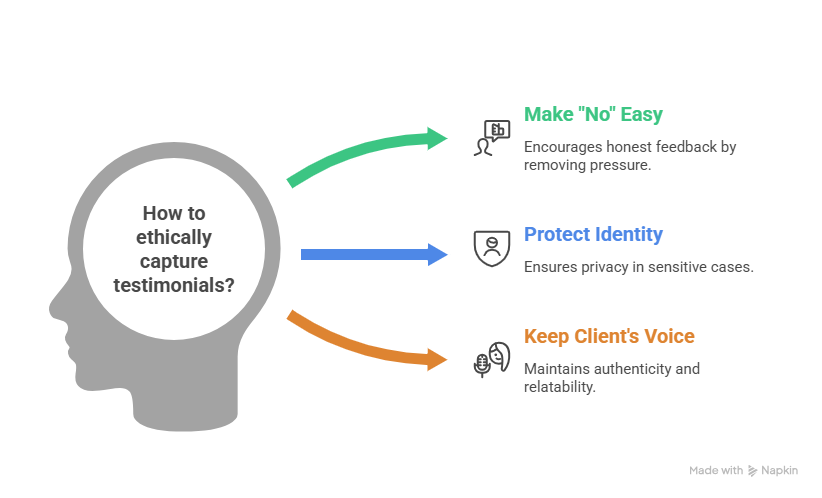
3) Make “no” easy
Tell clients: “No pressure at all.” When you remove pressure, you get more honest, higher-quality feedback.
4) Protect identity in sensitive cases
If the topic involves health, trauma, or private struggles, default to anonymous. Use details that help prospects relate without exposing the client. This is also where strong communication and boundaries matter in your coaching brand (see the communication secret and coaching leadership skills).
5) Keep the client’s voice
Don’t rewrite into corporate marketing language. You can clean grammar lightly, but don’t sterilize. Raw, human language converts because it feels real.
Ethical capture isn’t just “being nice.” It’s a strategic moat. When prospects sense integrity, they trust you faster—and trust reduces sales friction more than any tactic (see why trust is the most valuable asset in coaching and why it’s the ultimate client magnet in 2026).
5) Turning Testimonials Into a Conversion Engine (Without Posting Random Quotes)
Capturing testimonials is step one. The real leverage is using them correctly. Random praise quotes are weak because they don’t match buyer intent. You need a testimonial library organized by the exact problems prospects search for and fear.
Build a testimonial library by “pain point categories”
Create folders (or tags) such as:
Consistency & follow-through
Emotional eating / cravings
Confidence / self-talk
Boundaries & people-pleasing
Busy schedule / overwhelm
Skepticism / “I’ve tried everything”
Structure / clarity / accountability
Identity shift / self-trust
This matches how prospects think. They don’t buy “coaching.” They buy relief from a specific stuck loop (see the coaching skill you didn’t know you needed, why this skill determines your coaching success, and how coaches avoid career-ending mistakes).
Use testimonials in the right places (high-impact placements)
Sales page: match testimonials to sections (objections → proof).
Discovery calls: keep a 5-story “proof stack” you can pull from quickly.
Email sequences: insert one short story per email to reduce skepticism (see email marketing strategies for coaches).
Content posts: use testimonials as the hook, then teach the “how” behind it (see how to create engaging coaching content and creating a coaching resource library).
Community: share anonymized “wins of the week” to boost engagement and retention (see how to build an interactive coaching community online and interactive coaching exercises).
The 6-sentence testimonial format that converts
If clients give you raw answers, you can assemble them into a clean format (with approval):
“Before coaching, I struggled with ___.”
“The hardest part was ___.”
“What changed was ___.”
“The thing that helped most was ___.”
“Now I can ___.”
“If you’re on the fence because ___, here’s what I’d say: ___.”
This structure creates clarity, credibility, and identification—without hype. It also aligns with a professional coaching journey that is structured and repeatable (see launch your successful health coaching career and step-by-step guide to become a certified life coach).
When you use testimonials this way, they stop being “nice words” and start being sales friction removers—which is the real game in 2026.
6) FAQs: Client Testimonial Capture for Coaches (2026)
-
Ask at peak emotion moments: early wins, breakthrough sessions, slump recoveries, milestone weeks, and renewals. Don’t wait until the end. Monthly capture produces deeper, more accurate stories (and improves retention) (see the future of client engagement 2026).
-
Your questions are too broad. Replace “How was coaching?” with structured prompts: “What was hard before?” “What’s easier now?” “What specifically helped?” This pulls mechanism and specificity (see powerful questioning techniques).
-
Stop asking for “a testimonial.” Ask for feedback on change. One question at a time. “What changed this week?” is natural and non-salesy. You’re collecting delivery data, not compliments (see the communication secret).
-
Video is powerful, but only if it’s easy. Many clients prefer voice note or written. Start with low-friction formats first, then invite video as an option. Consistency beats “perfect format” (see virtual coaching tools and video conferencing hacks).
-
Always get explicit permission, offer anonymization, and clarify where it will be used. If a client is uncomfortable, do not push. Ethical capture builds long-term brand trust (see non-negotiable standards and why trust matters most).
-
Add one 30-second question to every session: “What got easier since last time?” Save the answer. Once per month, send a 3-question form to turn those into structured proof. This creates a proof library without extra workload (see managing your time efficiently as a successful coach).
-
You don’t need hundreds—you need coverage. Aim for 3–5 testimonials per major pain point category (consistency, self-talk, busy schedule, boundaries, skepticism). The goal is to help prospects self-identify quickly (see why it’s the ultimate client magnet in 2026).
