
Why This Skill Determines Your Coaching Success
If you want one skill that reliably separates “nice conversations” from real client change, it is your ability to listen with precision. Not passive listening. Not polite nodding. I mean listening that detects patterns, lowers defenses, surfaces the real problem, and converts insight into weekly action.
Most coaching businesses stall for one of three reasons: clients do not feel deeply understood, sessions do not produce measurable progress, or trust is too thin to handle hard conversations. All three are listening problems. Fix the listening, and the entire business flywheel changes.
1) The Skill Behind Breakthroughs: Listening That Changes Outcomes
Coaching success is not built on how smart you sound. It is built on how accurately you can hear what is actually happening in the client’s world, then reflect it back in a way that creates movement. This is why effective listening techniques that transform client conversations are not “soft skills.” They are outcome skills.
Most clients do not come to you with the real problem in sentence one. They come with a safe version. They mention symptoms instead of causes. They share details instead of decisions. They describe stress instead of the boundary they refuse to set. If your listening is shallow, you will coach the symptom. If your listening is sharp, you will coach the decision.
Here is the business truth coaches avoid: clients do not leave because your framework is wrong. They leave because they feel unseen, or they feel like sessions do not change anything. That is why building deep trust and strengthening client relationships and communication techniques every coach should master are directly tied to retention.
Listening is also the foundation of your authority. Authority is not volume. Authority is accuracy. When you can mirror a client’s real fear, the one they have not admitted out loud, you become instantly credible. That credibility makes it easier to guide them into discomfort, accountability, and growth without triggering resistance. That is the same credibility you need for managing difficult client conversations with ease when emotions spike.
Great listening does three high-value things at once:
It reduces noise so you do not chase irrelevant details.
It reveals leverage points so you coach what matters most.
It creates safety so clients tell the truth earlier and act faster.
When a client says, “I know what I should do, I just do not do it,” your job is not to repeat generic motivation. Your job is to locate the friction: fear, identity, environment, skills, or lack of a plan. Listening identifies which one it is, then your coaching becomes surgical. Pair this with how to inspire clients to take immediate action and you stop running sessions that feel good but change nothing.
Listening is also how you prevent the most expensive coaching mistake: giving solutions the client is not ready to use. If you push tactics before you earn emotional permission, you create subtle resistance. That resistance looks like “busy,” “overwhelmed,” “not the right time,” and “I forgot.” Those are not time problems. They are trust and readiness problems, which is why reinforcing positive client behaviors must start with listening for what the client will realistically commit to.
Finally, precision listening protects your scope. When clients bring trauma, grief, burnout, or mental health concerns, what you say matters less than how you hold the moment. You need the listening maturity to know when coaching is helpful and when referral is appropriate, which is why coaching clients through grief and loss and supporting clients with PTSD and trauma are essential reading for serious professionals.
2) The Coaching Success Flywheel: How Listening Improves Trust, Retention, and Referrals
If you want consistent income, you need consistent retention. Retention is not created by more worksheets. It is created by clients feeling, “This coach gets me and I am progressing.” That is why building deep trust and strengthening your client relationships is a revenue skill, not a mindset quote.
Listening improves trust because it proves effort. When you accurately reflect what matters to a client, you signal that you are paying attention to their life, not your template. When you miss the mark, you trigger the silent thought that kills coaching relationships: “They don’t really understand me.” Once that thought exists, the client filters your guidance through doubt.
Listening also improves outcomes because it improves targeting. Most clients struggle with competing priorities, emotional friction, and environment problems that sabotage action. If you only coach goals, you miss the system. If you listen for patterns, you coach the system. That is the difference between random motivation and repeatable progress, which is the exact bridge taught in how to inspire clients to take immediate action and reinforced through strategies for reinforcing positive client behaviors.
Referrals are also a listening outcome. People refer coaches who make them feel safe, clear, and capable. They do not refer “information.” They refer transformation. Transformation requires the courage to face the truth, and clients only face truth when they trust you. That trust is created session by session through listening moves like summarizing, naming the pattern, validating the emotion, and creating a next step that fits their reality. This connects directly to communication techniques every coach should master because listening is the hidden half of communication.
The fastest way to lose your flywheel is to sound impressive while missing the point. Coaches do this when they talk too much, teach too fast, or push frameworks that are not aligned with the client’s current capacity. Then the client “tries,” fails, and starts hiding. When clients hide, you cannot coach. This is why the ability to handle truth without judgment matters as much as the advice itself, and why managing difficult client conversations with ease becomes a non-negotiable skill as you work with higher stakes clients.
Finally, ethical listening keeps you in the right lane. If a client’s story moves into trauma, PTSD, or grief, you must know how to listen without turning your coaching into therapy. You do not need to panic. You need boundaries and competence, guided by supporting clients with PTSD and trauma and coaching clients through grief and loss. The most respected coaches are not the ones who “handle everything.” They are the ones who handle what they should, and refer what they must.
3) Advanced Listening Frameworks You Can Use in Real Sessions
Most coaches think listening means “being present.” Presence is step zero. The skill that determines success is structured listening, which means you listen for specific signals and respond with specific moves.
Framework 1: Listen for Level, Not Just Content
Clients speak on different levels: facts, feelings, meaning, and identity. If you respond to facts when the client is actually speaking from identity, you miss them. Example: “I keep failing at consistency” is often not about a schedule. It is about self-trust. Responding with tactics alone makes the client feel misunderstood. Use the reflective style taught in effective listening techniques that transform client conversations to mirror meaning first, then build the plan.
Framework 2: Listen for the Hidden “No”
Clients rarely say “I won’t do that.” They say “I’ll try,” “I’ll see,” “I’m busy,” and “I’ll start Monday.” Those are polite “no’s.” A high-skill coach hears the reluctance and explores it without shame. Pair this with the art of powerful questioning in coaching to identify whether the issue is fear, uncertainty, misalignment, or unrealistic scope.
Framework 3: Listen for the Pattern That Repeats
When the same problem shows up in different outfits, it is not a problem. It is a pattern. People pleasing. Avoidance. Perfectionism. All-or-nothing thinking. Overgiving. A coach who hears patterns can coach identity-level change, not symptom management. This is also where conflict resolution strategies every coach needs become relevant because many patterns are relational.
Framework 4: Listen for the Emotional Need Under the Complaint
Complaints are often disguised needs: respect, safety, control, rest, or clarity. If you solve the complaint without addressing the need, the client stays stuck. When you meet the need, behavior changes become easier and more stable. That is why self-care coaching for client mental health is not fluff. It is need-based coaching.
Framework 5: Listen for Capacity Before You Assign Actions
High-value coaching is not “more tasks.” It is “right-sized actions.” A client in burnout cannot execute a high-performance plan. A client under chronic stress needs stability first, supported by coaching clients through burnout and stress management techniques every coach should know. When you listen for capacity, your actions convert.
If you want a simple rule that upgrades everything: do not give a solution until you can summarize the real problem in one sentence that makes the client say, “Yes. That’s it.” That moment is where trust locks in, and it is what makes your coaching feel premium.
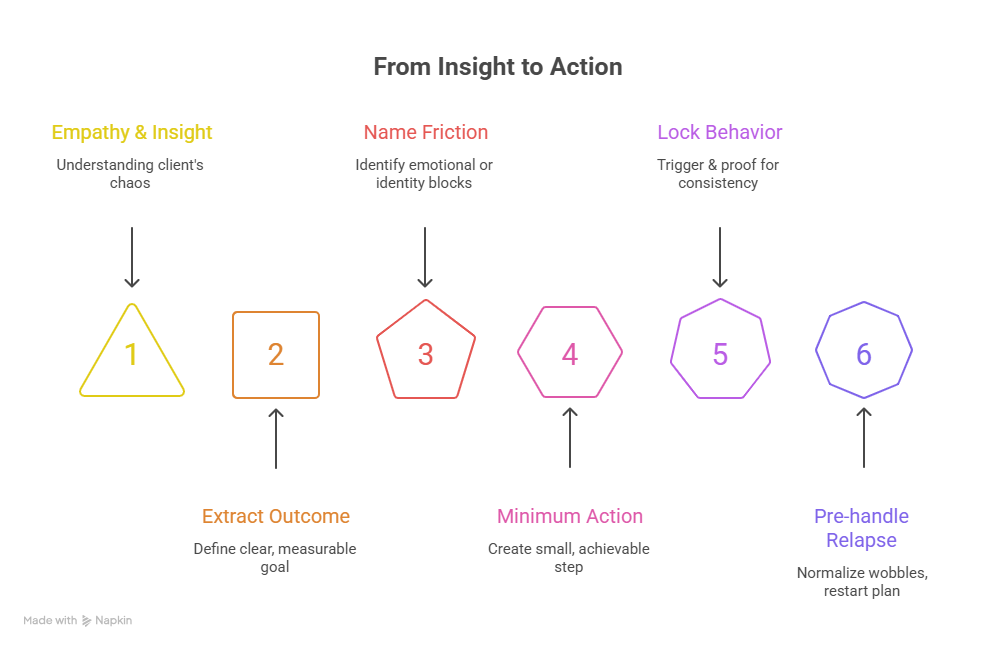
4) Turning Listening Into Action: The “Insight to Weekly Wins” Method
Listening becomes a business skill only when it produces behavior change. That is where many coaches fail. They become excellent at empathy, but weak at conversion: converting insight into action. Fix this, and your sessions become outcome machines.
Step 1: Extract the real outcome from the story
Clients often describe chaos. Your job is to turn chaos into a clear outcome: “By next week, we want X.” If you skip this, the session ends with inspiration but no measurable win. Use the focus tools inside how to inspire clients to take immediate action to turn talk into motion.
Step 2: Name the friction honestly
If a client has a plan but never follows it, the friction is not information. It is emotion, identity, or environment. Say it cleanly: “The plan isn’t the problem. The fear is.” That single line builds trust because you are not pretending. This is where powerful questioning becomes your weapon, not to interrogate, but to locate the truth.
Step 3: Create a minimum viable action
Coaches often assign actions that match the goal, not the client’s current capacity. That is why clients disappear after week two. Your job is to create an action that is small enough to complete, but meaningful enough to matter. This is exactly how you build consistency, and why reinforcing positive client behaviors is a core part of high retention coaching.
Step 4: Lock the behavior with a trigger and a proof
An action without a trigger is a wish. Ask, “When will you do it and what will remind you?” Then ask, “How will you prove it to yourself?” Proof can be a note, a photo, a message, or a quick tracker. This turns coaching into a feedback loop rather than a weekly conversation.
Step 5: Pre-handle the relapse
Clients relapse because they assume relapse means failure. High-skill coaches normalize the wobble and create a restart rule. This is vital in stress-heavy seasons, supported by stress management techniques and especially for exhaustion cycles addressed in coaching clients through burnout.
When you use this method, the client does not leave with “hope.” They leave with a clear action, a trigger, a proof, and a restart plan. That is why they renew. That is why they refer. That is why your coaching becomes a business, not a hobby.
5) The Listening Mistakes That Quietly Kill Coaching Businesses
Most coaches do not fail loudly. They fail quietly. They lose renewals, get ghosted, and wonder why the client “wasn’t committed.” In reality, the coach made listening mistakes that eroded trust.
Mistake 1: Treating every client like your best client
Your best client is proactive. Many clients are not. If you assign actions that require high self-leadership to a client who is drowning, you create repeated failure and shame. Listen for capacity first, then scale the plan. This is why work-life balance coaching and self-care coaching are not optional topics.
Mistake 2: Solving too early
When you solve early, you teach the client that they do not need to think. They just need to receive. That creates dependency and low ownership. Instead, listen longer, reflect better, and use questions that transfer ownership, as taught in the art of powerful questioning.
Mistake 3: Avoiding tension
If you avoid tension, you avoid growth. Clients pay you to go where they cannot go alone. You can only do this if you have the skill to handle discomfort with calm, which is why managing difficult client conversations and conflict resolution strategies matter for every niche.
Mistake 4: Letting boundaries drift
Boundary drift is a listening issue. You feel the discomfort, but you ignore it. Then resentment grows, the relationship gets messy, and professionalism drops. Strong coaches listen to their own signals too, and set clean standards guided by techniques for maintaining professional boundaries with clients.
Mistake 5: Missing emotional subtext
Clients rarely say, “I’m scared.” They say, “I’m busy,” “I’m not sure,” “It’s complicated.” If you cannot hear fear, shame, grief, or trauma signals, you will push too hard or coach the wrong thing. That is why ethical competence includes knowing how to listen safely in sensitive moments, supported by PTSD and trauma support for clients and coaching through grief and loss.
Fix these mistakes and your results change fast. Sessions become clearer. Clients act more. Trust grows. Renewals increase. And you stop feeling like you have to “sell” your value, because the outcomes sell it for you.
6) FAQs
-
Record sessions (with consent) and audit three moments: where the client gave a clue, where you solved too early, and where you missed emotion. Practice summarizing the “real problem” in one sentence, then confirm it. Use the reflection structures inside effective listening techniques that transform client conversations and pair them with powerful questioning to tighten your accuracy.
-
Interrupt kindly with structure. Validate what they shared, then narrow: “Let’s pick one thread that changes your week.” Circling is often avoidance or overwhelm, so listening must convert emotion into a decision. Combine this with communication techniques every coach should master and use immediate action strategies to end sessions with measurable wins.
-
Venting is not wrong, but it must transition into agency. Listen, reflect, then ask: “What do you want to choose next?” Build a minimum viable action and attach a trigger so it actually happens. For consistency, use reinforcing positive client behaviors and lean on stress management techniques when emotions are driving the spiral.
-
Name the avoidance gently and stay calm. “I notice we’re moving away from this. What’s the fear here?” Defensiveness is usually protection, not disrespect. Your listening must preserve dignity while still holding standards. This is exactly where managing difficult client conversations and building deep trust work together.
-
Do not force details. Stabilize the present moment, focus on safety, and stay within your scope. Listen for what is workable today, and know your referral thresholds. Use guidance from supporting clients with PTSD and trauma and coaching clients through grief and loss to keep your coaching safe, professional, and effective.
-
Better listening increases results and trust, which increases retention, renewals, and referrals. Clients stay when they feel deeply understood and see weekly progress. Listening also reduces churn caused by misaligned action plans. Tie your listening to action using inspiring immediate action, and protect long-term relationships through strong client trust and professional boundaries.
