
Future-Proof Your Coaching Practice: Top Trends to Watch
Future-proofing a coaching practice is not about chasing every shiny tool, trendy platform, or loud prediction.
It is about building a business that still works when client expectations rise, attention spans shrink, AI gets better, and generic coaching becomes easier to ignore. Coaches who stay broad, vague, and manually overloaded will feel the pressure first. Coaches who build proof, systems, trust, sharper positioning, and stronger client follow-through will keep winning. The question is not whether coaching is changing. The question is whether your practice is changing fast enough.

1. The Next Era Of Coaching Will Reward Specificity, Proof, And Cleaner Positioning
The first trend to watch is the death of the generic coach.
In the next phase of the market, broad claims like “I help people transform their lives” will keep losing power because clients are becoming better at comparing options, spotting vague promises, and filtering out soft positioning. A future-proof practice will be easier to understand, easier to trust, and easier to remember. That means sharper niche clarity, clearer outcomes, stronger language, and visible signals that you know exactly who you help, what problem you solve, and how your process works. Coaches who study the most profitable coaching niches, understand how certification differentiates your health coaching business, and learn how to launch a successful health coaching career will position faster than coaches who keep sounding interchangeable.
This shift is not just about marketing.
It is also about buyer psychology. Clients do not want more inspiration. They want faster confidence in the decision. They want to know whether you can guide their kind of challenge, whether your standards are strong, and whether your process creates movement outside the call. That is why future-proof coaches will lean harder into coaching integrity, ethical responsibilities, trust as a coaching asset, and non-negotiable coaching standards. A practice that feels credible before the first session will close more easily, retain more cleanly, and refer more naturally.
Specificity also protects you from a brutal pricing trap.
When your offer is fuzzy, price becomes the main comparison point. When your offer is precise, proof-backed, and structurally clear, clients compare value instead. That is why a coach who understands how top coaches get results, uses powerful questioning techniques, builds around smart goals 2.0, and applies session templates that boost productivity will look stronger in the market than a coach who just sounds motivational.
2. Clients Will Expect Measurable Outcomes, Not Just Insightful Conversations
One of the biggest future trends in coaching is the shift from session quality to outcome visibility.
For years, many coaches sold depth of conversation as the product. That is no longer enough. Clients increasingly want to feel progress, see patterns, track wins, and understand whether the coaching is actually changing behavior. The future-proof practice will not depend on “great sessions” alone. It will use interactive goal tracking tools, surveys and feedback tools, custom coaching dashboards, and coaching case study templates to make progress concrete.
This matters because insight without implementation creates a dangerous illusion.
Clients can leave a session feeling understood, energized, and emotionally lighter while making almost no real-world change. That gap destroys retention because the client eventually senses it, even if they cannot name it cleanly. Future-proof coaches will design for behavior, not just reflection. They will build progress cues into habit formation tools, use journaling tools for deeper self-awareness, support action through strength-based coaching techniques, and simplify execution with the coaching technique for client breakthroughs.
The coaches who survive the next phase of the market will also get much better at documenting value.
That means turning results into stories, stories into assets, and assets into trust signals. Instead of collecting vague praise, they will collect evidence tied to specific client obstacles, interventions, shifts, and outcomes. They will know how to ask for better proof, where to store it, and how to use it across content, consults, and nurture. That is why client testimonial capture, building a thriving coaching resource hub, free and premium coaching resources, and creating a coaching resource library clients will love will matter more than many coaches realize.
A future-proof practice will answer one brutal question well: can a stranger quickly see what changes because of your work?
If the answer is no, your practice is more fragile than it looks.
3. AI, Automation, And Smarter Tech Will Reshape Delivery, But Human Judgment Will Become More Valuable
Another major trend to watch is not simply “more technology.”
It is better orchestration.
The strongest coaching practices will stop using tech as decoration and start using it as leverage. Coaches buried in scheduling, reminders, note-writing, follow-up, fragmented resources, and inconsistent lead handling will lose speed and clarity. Coaches who build around automating your coaching business, essential CRM tools, best coaching software and platforms, and virtual coaching tools for remote effectiveness will create cleaner operations and stronger client consistency.
But there is a trap here.
Many coaches assume future-proofing means adding more tools. Usually, it means removing friction. The client does not want seven apps, four logins, two calendars, and a buried PDF library. The client wants one clear flow. One place for the plan. One place for the recap. One place for the next step. The future belongs to coaches who understand radical simplicity, build a perfect coaching toolkit for every niche, use essential templates and checklists, and choose the best coaching apps every professional should know without burying clients in complexity.
AI will accelerate this divide.
It will help with notes, summaries, drafts, personalization support, content ideation, and admin compression. It will also flood the market with generic content and low-trust sameness. That means the human parts of coaching will matter more, not less. Judgment. Emotional timing. Pattern recognition. Boundary management. Reading resistance without shaming it. Adapting a framework to a real person instead of forcing a real person into a framework. Coaches who understand how artificial intelligence is changing client interactions, respect balancing human touch with coaching automation, use technology to transform coaching, and prepare for the future model every coach needs to adopt will not become more robotic. They will become more available for the work only humans can do well.
Wearables, data-informed coaching, and hybrid delivery models will grow too.
But the winning coaches will use them to sharpen conversations, not to drown clients in metrics. Wearable technology for the future of coaching, leveraging wearable tech for next-level coaching, video-conferencing best practices, and video-conferencing hacks for flawless sessions will matter most when they reduce chaos and strengthen client follow-through.
4. Between-Session Engagement Will Matter More Than The Session Itself
A coach who is brilliant for 50 minutes and invisible for the other 10,030 minutes of the week will struggle to keep clients moving.
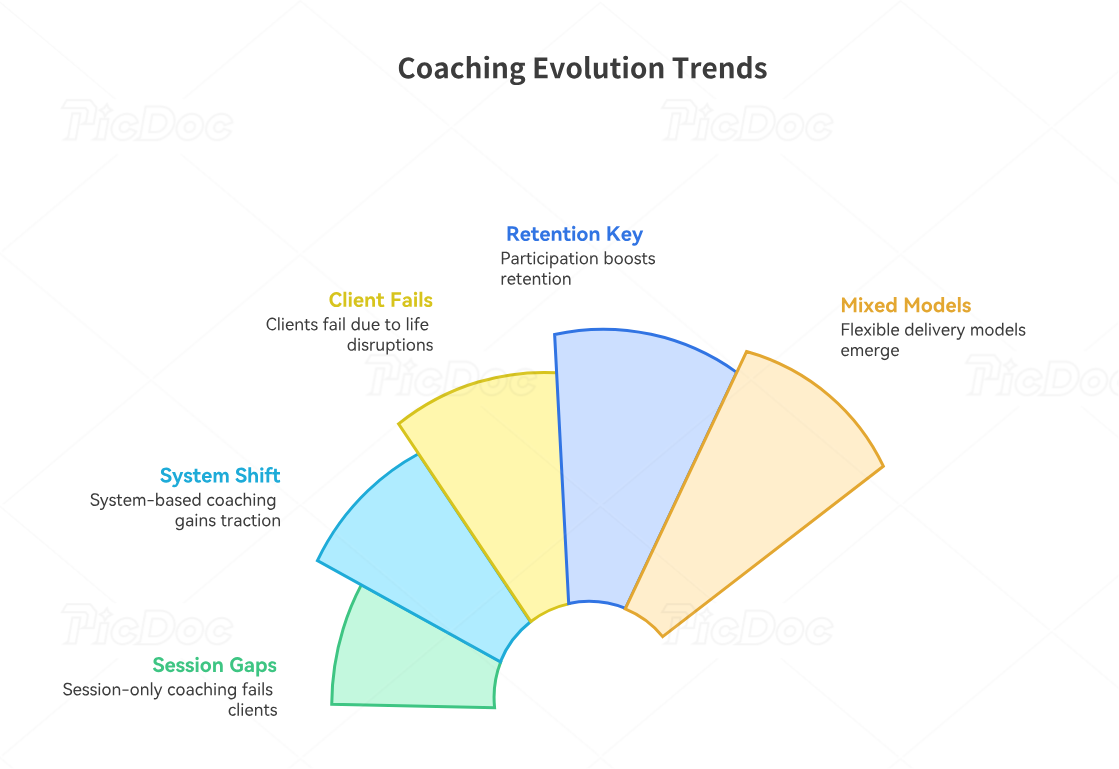
That is why one of the biggest trends to watch is the shift from session-based coaching to system-based coaching. The future-proof practice will create continuity between calls. It will guide attention, reinforce action, reduce forgetting, collect signals, and protect momentum. Coaches who study the future of client engagement, build interactive coaching exercises, use gamification tools for maximum engagement, and create interactive workshops will outperform coaches who rely on good intentions alone.
This is where many practices quietly leak results.
Clients do not usually fail because they lacked insight. They fail because life got loud, the next action felt too big, the emotional friction returned, and no system caught them when motivation dropped. Future-proof coaches design around that reality. They use automated email sequences, create engaging coaching content clients love, offer community-building systems online, and build virtual retreat platforms coaches are using successfully when the model calls for deeper immersion.
The deeper trend here is retention through participation.
A client who is interacting with the process keeps feeling coached. A client who only sees you live on the calendar starts treating coaching like an event instead of a system. That is dangerous for renewals and even more dangerous for outcomes. Stronger practices will use daily journaling prompts, gratitude journal coaching, affirmation cards, life mapping, and guided imagery methods as structured reinforcement tools, not decorative extras.
Coaches should also watch the rise of mixed delivery models.
Some clients will want one-to-one intensity. Others will want community, flexible access, short-form learning, or asynchronous support. A future-proof practice will not force every client into one rigid delivery format. It will design an ecosystem. That may include a core coaching offer, a resource hub, a structured follow-up pathway, and lighter-touch continuation options. Coaches who understand the hidden goldmine of coaching, why top coaches are obsessed with certain engagement models, why they are changing the game for coaches, and how one method is revolutionizing coaching will build more resilient revenue and stronger retention at the same time.
5. Trust Architecture, Ethical Clarity, And Continuous Learning Will Become Competitive Advantages
The coaching market is getting louder, but clients are getting more careful.
That means future-proofing is not only about growth tactics. It is also about safety, credibility, and professional maturity. The coaches who keep growing will be the ones who make trust easier. They will be clear about boundaries, honest about scope, consistent in communication, and steady in how they handle emotionally charged moments. That is why emotional consent in every coaching session, coaching confidentiality, managing dual relationships, and setting clear professional boundaries are not side topics. They are long-term business advantages.
This trend will matter even more as AI-generated advice, low-barrier coaching offers, and shallow wellness content keep multiplying.
When the market fills with noise, trust becomes easier to notice. A clear code, a well-defined process, visible credentials, responsible messaging, and a reputation for not overselling will separate serious coaches from opportunists. That is why future-proof coaches keep refining essential coaching skills for ICF credentialing, studying effective coaching communication for NBHWC certification, reviewing detailed coaching competencies, and understanding common pitfalls in certification exams not just to pass tests, but to sharpen their professional standard.
Continuous learning is another trend that will divide the market hard.
The coaches who stay future-proof will not wait until they feel behind. They will schedule learning before stagnation becomes visible. They will study new frameworks, sharpen delivery, and update their toolkit without turning their practice into a random collection of borrowed methods. They will learn from online courses for continuous coaching education, deepen with appreciative inquiry, strengthen pattern work through transactional analysis, simplify execution with solution-focused brief coaching, and work more carefully with self-sabotage through inner critic management techniques.
The final point is simple.
A future-proof practice is not built by guessing what will be popular. It is built by becoming structurally stronger. Stronger positioning. Stronger proof. Stronger systems. Stronger engagement. Stronger ethics. Stronger learning rhythm. Coaches who understand coaching market growth opportunities, watch coaching industry trends and insights, follow proven methods for maximum client success, and keep refining how to actually change your clients’ lives will not just survive change. They will use change as leverage.
6. FAQs
-
It means building a coaching business that can adapt without breaking when client expectations, technology, competition, and buying behavior change. A future-proof practice does not depend on one platform, one vague offer, or one manually exhausting workflow. It builds resilience through clear positioning, strong coaching systems, proof-driven delivery, and trust-building integrity.
-
Start with the trend that removes the biggest business risk first. For many coaches, that means clearer positioning and better proof. If people do not understand your offer or cannot see why it works, everything else becomes harder. Begin by tightening your niche, clarifying your outcomes, and using client testimonials, custom dashboards, goal tracking, and client engagement systems to make your value visible.
-
AI will replace a lot of admin, repetitive content, and generic support tasks faster than it will replace great coaches. What it will do is punish coaches whose offer is too generic, too shallow, or too dependent on basic information delivery. The safer position is to automate the repetitive parts while increasing the value of your human judgment, pattern recognition, emotional timing, and ethical discernment through balanced automation, AI-aware client interaction design, technology transformation in coaching, and future-ready coaching models.
-
There are a few painful signs. Your offer sounds broad. Your clients like you but do not refer consistently. Your delivery depends too much on live sessions. Your tech stack creates friction. Your follow-through is inconsistent. Your proof is vague. Your learning has stalled. Those are signals to revisit your toolkit, your systems, your marketing engine, and your skill development rhythm.
-
They are not a magic fix, but in many cases they are absolutely part of future-proofing because they can increase clarity, trust, and professional structure when they are relevant to your niche and business model. The key is choosing credentials strategically, not collect-them-all thinking. Coaches can strengthen credibility by exploring top accredited health coach certifications, learning how to choose the right program, reviewing online certification programs for busy professionals, and understanding whether certification is really worth it.
-
Between-session design is still badly underestimated. Many coaches are trying to improve outcomes by making sessions better, when the bigger opportunity is often building better support between sessions. Small check-ins, habit prompts, resource delivery, reflection tools, and participation systems can change retention and results more than adding another talking point to a call. That is why journaling prompts, interactive exercises, community systems, and gamification tools matter so much.
-
Quarterly is a smart rhythm for strategic trend review, with monthly checks on whether your positioning, tech, engagement, and proof systems are still serving the business well. The goal is not to chase noise. The goal is to decide what actually deserves adoption, testing, or rejection. Use that review to assess industry reports, market opportunities, proven client-success methods, and the communication skills behind successful coaching.
