
Appreciative Inquiry: The Ultimate 2026 Guide for Coaches
Appreciative Inquiry (AI) is one of the rare coaching approaches that can increase accountability without increasing pressure—because it replaces “fix what’s broken” with “scale what already works.” In 2026, that matters more than ever: clients are burnt out, skeptical of rigid plans, and overwhelmed by self-improvement content. AI gives you a clean way to build momentum fast, protect motivation, and create behavior change that feels personally meaningful—not externally imposed. If you want clients to stop “knowing what to do” and start doing it consistently, AI is a power tool for trust, clarity, and follow-through.
1. Appreciative Inquiry for Coaches in 2026: What It Is (and Why It Works When Other Approaches Stall)
Most coaching fails for one reason: the client leaves with insight, but not ownership. AI flips that by making the client the expert of their own success patterns. Instead of asking “Why can’t you?” you ask “When can you—and what was different then?” That single shift changes everything: defensiveness drops, story quality improves, and you start working with real evidence instead of self-criticism.
In practice, AI is a structured method for discovering strengths, mapping conditions of success, and turning those conditions into repeatable systems. It’s not “toxic positivity.” It’s disciplined attention to what produces results—so you can engineer more of it.
Why AI is especially lethal in 2026:
Clients are identity-fragile: they interpret setbacks as “proof I’m not that kind of person.” AI protects identity by rooting change in real wins and existing capability—similar to how elite coaches build resilience in why trust is the most valuable asset in coaching.
Information overload is killing action: AI narrows the field to what’s already working and scales it. Pair it with clarity practices from the radical simplicity coaches are loving.
Behavior change now requires better engagement design: AI creates emotionally compelling goals and micro-commitments that improve retention, aligning with the future of client engagement 2026.
Your differentiation matters: AI makes your coaching feel premium because it’s evidence-led and personalized, not generic—especially when combined with advanced skill-building from how coaches reach mastery.
A strong AI coach is not “cheerful.” They’re precise. They listen for patterns, isolate success variables, and turn vague wins into executable steps—using the same kind of intentional communication that top performers sharpen in the communication secret behind successful coaching.
2. The 5 Core Principles of Appreciative Inquiry (and the Micro-Skills Coaches Must Master)
If you want AI to produce outcomes instead of “nice conversations,” you need to coach with discipline. AI works because it changes what the brain searches for. When you lead the client to scan for capability, resources, and past proof, you create a higher-quality plan—then you lock it in with a clear commitment.
Here are the core principles (and what they look like as coaching behaviors):
The “Evidence Principle” (strengths must be observable)
Don’t accept vague confidence statements. Ask for behavioral evidence: “What did you do specifically?” This prevents motivational fantasy and creates usable data—similar to the execution-first approach highlighted in how the world’s best coaches get results.The “Conditions Principle” (success is situational, not magical)
A win is not luck; it’s a pattern of conditions. Your job is to extract those conditions:
What time of day?
What environment?
What support?
What emotional state?
What preparation?
This is how you turn one-off wins into repeatable systems—exactly the kind of career-saving rigor discussed in how coaches avoid career-ending mistakes.
The “Language Principle” (words create behavior)
Clients live inside their self-talk. AI helps you replace identity sabotage (“I’m lazy”) with strategy truth (“My plan is too high-friction after 6pm”). This is where your communication skill becomes your leverage, and why the craft matters as described in powerful questioning techniques that transform coaching sessions.The “Agency Principle” (clients must co-design the plan)
AI is not you “finding the positive.” It’s the client discovering their own operating system. When clients design the method, they defend it. That’s why AI pairs beautifully with modern engagement models like how to make it work every time and retention-focused coaching in why they’re changing the game for coaches.The “Compounding Principle” (small wins must be stacked, not celebrated then forgotten)
AI isn’t a highlight reel. It’s compounding. Every win becomes a new standard. Every standard becomes a system. This is how you build sustainable behavior change instead of emotional spikes—aligned with deeper frameworks like the neuroscience-based method every coach needs now and the practical behavior-change emphasis in how coaches can actually change client diets.
Micro-skills you must bring to every AI session (or it stays surface-level):
Pattern listening: you listen for conditions, not just feelings.
Specificity drilling: you convert “I felt motivated” into “I walked at 7:30 because my shoes were by the door.”
Strength naming: you label strengths in action terms (“You design environments that support you”).
Constraint respect: you do not design plans that ignore time, energy, or real life.
Commitment calibration: you scale the plan to the client’s current reliability level, not their ideal self—an approach echoed in smart goals 2.0: how top coaches set & achieve client goals.
3. The 4-D Cycle for Coaching: Turn Appreciative Inquiry Into a Session Framework That Produces Results
AI is often taught as a 4-D cycle: Discover → Dream → Design → Destiny. Coaches mess this up by treating it like inspiration. In coaching, it needs to become a decision pipeline.
1) Discover: find the “bright spots”
You’re looking for moments when the client already did the thing:
ate better without white-knuckling
exercised without bargaining
stayed calm under stress
held a boundary without guilt
Then you extract:actions (what they did)
conditions (what made it easier)
meaning (why it mattered)
High-leverage questions:
“What did you do that made it work?”
“What support existed that day?”
“What did you remove that helped you succeed?”
This kind of precision is what separates average coaches from mastery-level practitioners described in how coaches reach mastery and differentiates your sessions from generic advice found everywhere.
2) Dream: build a future that pulls behavior forward
The “dream” phase isn’t fantasy. It’s an emotionally credible future description the client wants to live into. You define it in daily-life terms:
“How do your mornings look?”
“How do you handle weekends?”
“What do you do when you’re tired?”
This is how you prevent the common trap of outcome obsession and create behavior-based identity change—an idea that pairs well with the 1 coaching technique for client breakthroughs and motivation anchoring in why it’s the hidden goldmine of coaching.
3) Design: turn success conditions into a system
This is where AI becomes powerful. You convert discovered patterns into repeatable design choices:
Environment defaults: “Make the good choice the easy choice.”
Schedule anchors: “Lock habits to consistent time windows.”
Support architecture: “Add accountability that fits your personality.”
Friction removal: “Remove one barrier permanently each week.”
A design plan should feel like engineering, not motivation. That’s why this work complements modern coaching operations and tools discussed in best coaching software & platforms for client management in 2025 and engagement systems in how to create engaging coaching content clients love.
4) Destiny: install follow-through and feedback loops
“Destiny” is not willpower. It’s feedback loops:
weekly review (wins + misses + patterns)
two micro-adjustments
one new commitment
This is how you prevent ghosting and keep clients moving—especially relevant to retention strategies in the future model every coach needs to adopt by 2026 and coaching systems that protect long-term consistency.
A simple AI session template (repeatable weekly):
5 min: “What worked since last time?”
10 min: Extract conditions + strengths
10 min: Choose one lever to scale
10 min: Design the next 7 days (simple, realistic)
5 min: Commitment + obstacle plan
This template also pairs extremely well with practical workflows from coaching session templates to boost your productivity instantly.
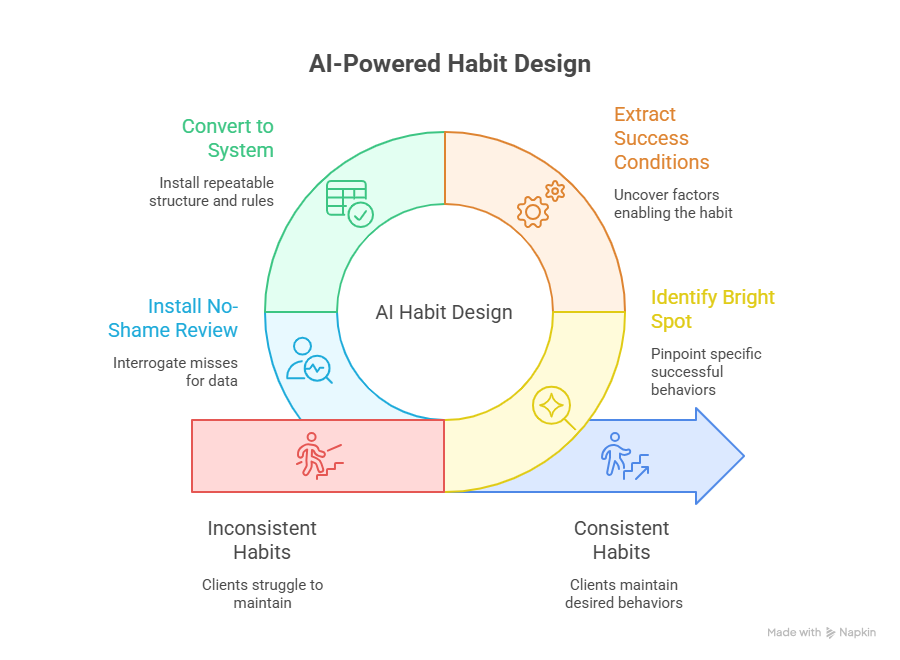
4. Appreciative Inquiry for Behavior Change: How to Turn “Wins” Into Habits Clients Keep
AI becomes transformational when you stop using it as reflection and start using it as habit design. Your client’s “best week” is basically a blueprint. Your job is to replicate it—without requiring perfect circumstances.
Here’s the high-value method:
Step 1: Identify the client’s “bright-spot behavior”
Not “I was healthier.”
You want: “I cooked twice, walked after lunch, and didn’t snack at night.”
This is where many coaches lose power: they stay in identity talk without extracting behavior. To keep it sharp, borrow the specificity discipline from how technology is completely transforming the coaching industry and the behavior-first approach behind how to actually change your clients life in 2026.
Step 2: Extract the “success conditions” (the real secret)
Ask:
“What made that week different?”
“What did you do before the habit that helped it happen?”
“What did you not do that removed friction?”
Common conditions that create repeatable results:
a time anchor (same time window)
a prep default (food, clothes, calendar)
a support nudge (friend, coach message, group)
a lowered bar (smaller minimum dose)
a recovery rule (what happens after a miss)
These conditions tie directly into engagement and consistency mechanics discussed in interactive coaching exercises to keep clients motivated and community-driven reinforcement from how to build an interactive coaching community online.
Step 3: Convert conditions into a “repeatable system”
You’re not prescribing motivation. You’re installing structure.
Example system (fitness + nutrition):
If it’s Sunday, then I do a 12-minute prep (groceries + two default meals).
If it’s 1pm weekdays, then I walk 10 minutes after lunch.
If I miss two days, then I do the 24-hour reset (one walk + one clean meal).
This “rules not goals” approach reduces decision fatigue and protects follow-through. It also fits the reality of modern coaching operations and tools, especially when you’re running remote clients as discussed in virtual coaching tools: boosting your remote session effectiveness.
Step 4: Install a “no-shame review” so misses become data
The best AI coaches do not punish misses. They interrogate them:
“What changed in your environment?”
“What demand increased?”
“What support disappeared?”
“What was your minimum dose—and was it realistic?”
This creates momentum because the client stops hiding. That’s a trust amplifier, aligning with why trust is the most valuable asset in coaching and the standards-based professionalism in the non-negotiable standards every coach must know.
5. Advanced Appreciative Inquiry in 2026: Use It for Groups, Leadership Coaching, and Client Retention
AI is not only a 1:1 tool. It scales beautifully for groups, cohorts, and leadership coaching—because it creates shared language around success.
AI for groups: create collective proof (not generic motivation)
Instead of “Let’s stay consistent,” you ask:
“When have we been consistent as a group?”
“What conditions made that happen?”
“What would it look like to make those conditions our default?”
This immediately elevates your group from “support chat” to “learning system.” Pair this with engagement rituals discussed in how to build an interactive coaching community online and content that keeps people participating as outlined in best practices for creating interactive coaching workshops.
AI for leadership/executive coaching: extract peak performance conditions
Leaders don’t need more “mindset quotes.” They need performance engineering:
“Tell me about a week you led powerfully—what were your decisions and boundaries?”
“What did you protect on your calendar?”
“What did you stop doing?”
This approach complements leadership skill development in coaching leadership skills: how to lead and inspire clients and time mastery in managing your time efficiently as a successful coach.
AI for retention: stop relying on willpower and build a “progress identity”
Retention doesn’t fail because your client doesn’t like you. It fails because:
progress feels slow
the plan feels heavy
the client feels judged
wins are invisible
AI fixes this by making progress trackable in meaningful ways. You routinely ask:“What changed in you this month?”
“What’s easier now?”
“What did you handle better?”
This makes the client feel the ROI, which protects continuation and referrals—especially when paired with client-magnet strategies from why it’s the ultimate client magnet in 2026 and credibility markers like health coach certification credentials: how to list on your resume.
One high-retention AI ritual (use monthly): “The Proof Review”
“What wins are you proud of?”
“What skills did you build?”
“What problems do you solve faster now?”
“What system made that happen?”
“What’s the next system to install?”
That ritual alone can prevent silent drop-off, because it makes the client see the arc—an engagement advantage aligned with how to actually empower clients: real results and performance psychology themes from how the positive psychology framework is revolutionizing coaching in 2026.
6. FAQs: Appreciative Inquiry for Coaches (2026)
-
No. AI is not optimism; it’s evidence-based pattern extraction. You’re not ignoring problems—you’re identifying the conditions under which the problem loses power. That’s why AI works so well for clients stuck in shame cycles, and why it pairs with deeper change models like why coaches are embracing this positive change model.
-
Treat it as a search problem, not a truth statement. Narrow the scope:
“When was it slightly better?”
“What’s one time you kept a promise to yourself?”
“Who have you shown up for consistently?”
You only need one exception to build a system. If you want a sharper questioning toolkit, study the structure in powerful questioning techniques that transform coaching sessions.
-
Yes—often better than deficit-driven coaching because it builds repeatable adherence. You look for bright spots: meals that were easy, routines that were sustainable, environments that reduced cravings. Then you scale those conditions. For coaching-specific nutrition execution, pair this with how coaches can actually change client diets.
-
You must end every story with a transfer:
“What does this teach us about your success conditions?”
“What rule are we installing this week?”
“What friction are we removing permanently?”
AI becomes elite when every insight becomes a decision. This performance standard aligns with the non-negotiable standards every coach must know.
-
Use one of these:
“What worked—and what made it work?”
“What is the smallest commitment you will definitely keep?”
“What will you do when the plan gets hard?”
If you want better session flow overall, combine this with coaching session templates to boost your productivity instantly.
-
AI makes progress visible and personal. Clients drop when they feel stuck or judged. AI replaces judgment with data and replaces “stuck” with “we learned something.” It’s a direct fit with the future of client engagement 2026 because it builds momentum without emotional burnout.
-
Absolutely. AI tells you what’s realistic and what conditions enable success; SMART goals make the output measurable. Use AI first to ensure the goal is aligned with how the client actually operates, then structure it using smart goals 2.0: how top coaches set & achieve client goals.
