
Habit Formation Tools: Helping Clients Achieve Lasting Change
Changing a client’s life rarely hinges on one breakthrough conversation. It usually hinges on whether a new behavior survives Tuesday stress, low motivation, travel, self-doubt, boredom, and the quiet return of old defaults. That is why habit formation tools matter so much in coaching. They turn insight into repetition, repetition into identity, and identity into lasting change.
The strongest coaches do not rely on inspiration alone. They build structured systems using interactive coaching exercises, practical coaching session templates, behavior-focused smart goals strategies, and proven client engagement frameworks. When the right tools support consistency, clients stop starting over and begin building change that actually holds.

1. Why habit formation tools are the missing layer in many coaching results
Many clients do not fail because they lack desire. They fail because desire is unreliable under pressure. A client may fully understand what to do, genuinely want the outcome, and still not follow through when work gets chaotic, sleep drops, emotions spike, or the environment pulls them back into default behavior. This is where coaching without habit tools starts leaking results.
Coaches often overestimate the power of insight and underestimate the force of repetition. Insight can create urgency, but repetition creates evidence. If a client wants better energy, emotional stability, weight management, confidence, or focus, they need more than a motivational session. They need small, repeatable actions reinforced through daily journaling prompts, better powerful questioning techniques, structured life mapping, and carefully timed interactive coaching exercises.
Habit formation tools matter because they reduce the distance between knowing and doing. That distance is where most coaching businesses lose credibility. Clients say they will walk every morning, meal prep every Sunday, journal before bed, breathe before reacting, or stop stress-snacking after work. Then life happens. Without a system, the coach is left reteaching commitment every session. With a system, the client can see patterns, anticipate obstacles, and recover faster from inconsistency using effective strategies for reinforcing positive client behaviors, how to inspire clients to take immediate action, effective listening techniques, and stronger coaching communication.
These tools also help expose the real barrier. Many clients say they need more discipline when the actual issue is unclear cues, unrealistic planning, emotional avoidance, identity conflict, or poor recovery after missed days. A habit tracker, reflection form, routine builder, trigger plan, or friction audit can reveal whether the problem is motivation, environment, shame, overwhelm, or inconsistency. That level of specificity is what separates generic support from the kind of coaching described in how the world’s best coaches get results, new data-proven coaching methods, the neuroscience-based method every coach needs now, and why top coaches are obsessed.
| Client Goal | Habit Formation Tool | How to Use It | Common Breakdown It Prevents | Best Coaching Tip |
|---|---|---|---|---|
| Morning routine consistency | Habit tracker | Track one anchor action daily | All-or-nothing thinking | Start with a 2-minute version |
| Healthier eating | Meal planning template | Plan 3 fallback meals | Decision fatigue | Coach for repeatability, not perfection |
| Hydration | Cue-based reminder system | Link water intake to existing actions | Forgetting during busy days | Use environmental cues first |
| Exercise adherence | Weekly movement planner | Schedule realistic movement blocks | Vague intentions | Pre-plan low-energy options |
| Stress regulation | Breathing prompt card | Use before predictable trigger moments | Reactive emotional spirals | Pair with a trigger inventory |
| Better sleep | Evening shutdown checklist | Repeat 3 pre-sleep behaviors nightly | Inconsistent wind-down | Keep checklist short and visible |
| Emotional awareness | Mood log | Track feelings with context and behavior | Pattern blindness | Look for timing patterns, not just feelings |
| Meal consistency | Photo logging | Capture meals without calorie obsession | Avoidance and underreporting | Use curiosity, not judgment |
| Breaking evening snacking | Trigger map | Identify cues, emotions, and contexts | Mislabeling urge as hunger | Replace the routine, not just the food |
| Journaling | Prompt sequence | Deliver the same prompt at the same time | Waiting for inspiration | Use one line minimum rules |
| Confidence building | Wins journal | Record proof of follow-through daily | Identity lag | Measure kept promises, not mood |
| Reducing procrastination | Micro-step planner | Break one behavior into tiny steps | Overwhelm paralysis | Shrink until resistance drops |
| Meditation consistency | Streak tracker | Track repetitions, not duration | False perfection standards | Protect the habit before optimizing it |
| Reducing phone distraction | Friction builder | Add steps that slow impulsive use | Automatic checking loops | Make bad habits harder, not just forbidden |
| Walking habit | Anchor routine card | Attach walks to an existing daily cue | Relying on spare time | Use fixed cues, not loose intentions |
| Self-compassion practice | Reflection reframe sheet | Convert self-criticism into useful language | Shame after missed days | Repair beats guilt every time |
| Consistency with supplements | Stacking cue | Take with an existing morning action | Random timing failures | Place tools where the cue happens |
| Reducing emotional eating | Pause protocol | Use a 90-second interrupt before reacting | Impulse-based coping | Interrupt first, analyze later |
| Reading habit | Page minimum tracker | Set a tiny daily floor | Skipping when time feels short | Minimums beat motivation swings |
| Boundaries at work | Script library | Prepare responses for predictable pressure | People-pleasing defaults | Practice wording before stress hits |
| Weekly planning | Sunday reset template | Review priorities, meals, and habits | Reactive weeks | Create defaults before Monday chaos |
| Reducing burnout | Recovery block scheduler | Pre-book rest actions like appointments | Treating recovery as optional | Schedule rest before fatigue peaks |
| Reducing negative self-talk | Thought replacement card | Use one practiced reframe repeatedly | Unchallenged inner critic loops | Repeat one believable reframe |
| Better follow-through after coaching sessions | Action recap form | Document one next action and trigger | Post-session drift | Tie action to exact time and place |
| Community participation | Weekly prompt rhythm | Use the same day for community engagement | Passive disengagement | Rituals increase response rates |
| Identity-based change | Identity statement tracker | Log evidence that supports a new self-image | Feeling unchanged despite progress | Collect proof, not hype |
| Long-term maintenance | Recovery plan template | Plan what happens after missed days | Collapse after setbacks | Teach recovery before failure happens |
2. The most effective habit formation tools coaches can use with clients
The best habit formation tools are not always the flashiest. They are the ones clients actually use when real life gets messy. A tool is only valuable if it survives low-energy days, travel weeks, emotionally hard seasons, and the kind of inconsistency that makes people doubt themselves. Coaches need tools that simplify behavior change rather than turning it into another performance task.
Habit trackers remain one of the most useful tools when used correctly. The mistake is asking clients to track too much. When a client tracks eight habits at once, the tool becomes a guilt dashboard. When they track one keystone behavior, it becomes a visibility tool. A good tracker works beautifully alongside the wheel of life reinvented, focused coaching toolkit templates, stronger client session recaps, and behavior-rich case study templates.
Check-in forms are another high-value tool because they force pattern awareness. Clients who say “I had a bad week” often mean six different things: they slept poorly, skipped meals, had conflict at home, ignored their own routines, spiraled after one missed day, or felt embarrassed to report inconsistency. A short weekly reflection form can separate feeling from fact. This makes the next coaching session far more precise and works especially well with effective coaching communication, building deep trust, managing difficult conversations, and conflict resolution strategies.
Journaling tools also deserve more respect in habit coaching. Not because journaling is magical, but because it creates a place for the client to see what drove the behavior. Was the skipped walk caused by weather, avoidance, resentment, exhaustion, poor planning, or quiet self-sabotage? That distinction matters. Coaches using gratitude journal coaching, affirmation cards, inner critic management techniques, and transactional analysis can help clients interrupt deeper emotional loops, not just surface routines.
Cue cards, prompt libraries, environmental design checklists, and recovery plans are also powerful because they support behavior before willpower becomes necessary. A client who puts walking shoes by the door, preps three fallback lunches, places a journal on the pillow, sets a “pause before snacking” reminder, and scripts their response to workplace pressure is far more likely to succeed than a client relying on good intentions. These kinds of tools pair naturally with stress management techniques, mindfulness and meditation techniques, helping clients manage work-life balance, and effective strategies for coaching clients through burnout.
The most underused tool, however, may be the recovery plan. Many clients believe success means never missing. That belief quietly destroys long-term progress. When clients miss once, they feel they have failed. When they feel they have failed, shame takes over. When shame takes over, they disengage. A recovery plan teaches them what to do after a miss: restart small, remove blame, study the trigger, and protect the next repetition. That is how habits survive real life, and it aligns closely with coaching integrity, why emotional consent matters, understanding ethical responsibilities, and how coaches avoid career-ending mistakes.
3. How coaches should match the right tool to the right client
Not every client needs the same habit tool, and this is where many well-meaning coaches get lazy. They hand everyone the same worksheet, the same tracker, the same accountability app, and the same reflection prompt. Then they wonder why some clients thrive while others avoid the process completely. Habit formation works best when the tool fits the client’s psychology, daily rhythm, resistance style, and level of self-awareness.
For highly analytical clients, structured dashboards, measurable trackers, and pattern logs often work well because they like visible evidence. They want to see streaks, totals, consistency percentages, and clear inputs tied to results. But even with these clients, the risk is overcontrol. They can turn tools into scoreboards and scoreboards into self-judgment. Coaches need to offset that with the radical simplicity coaches are loving, emotionally intelligent positive psychology frameworks, more human communication techniques every coach should master, and gentle trust-building practices.
For emotionally overwhelmed clients, simple tools usually work better. A one-question daily check-in can outperform a complex planner. A visual cue on the fridge can outperform a detailed app. A two-minute reset routine can outperform a perfect morning ritual. These clients do not need more information. They need lower friction. That is why coaches should draw from how to make it work every time, how to actually empower clients for real results, the 1 coaching technique for client breakthroughs, and why this skill determines your coaching success.
For clients with strong self-criticism, the tool must never become a weapon. That means avoiding systems that highlight failure more than effort. A habit calendar with big empty gaps may trigger collapse. A better choice may be a wins log, a compassionate recovery form, or an identity-evidence sheet that helps the client collect proof they are changing even if they are not perfect. This aligns well with inner critic management techniques, the coaching skill you didn’t know you needed, how coaches reach mastery, and the positive change model coaches are embracing.
For avoidant or inconsistent clients, timing matters more than complexity. Tools must show up exactly when the old behavior tends to happen. A pause card before entering the kitchen at night. A reminder before the commute home. A pre-packed gym bag by the door. A Sunday planning prompt before the week explodes. This is where how coaches can actually change client diets, why it’s the hidden goldmine of coaching, how one method is revolutionizing coaching, and why they’re changing the game for coaches become relevant: the best habit interventions are often about timing and design, not pressure.
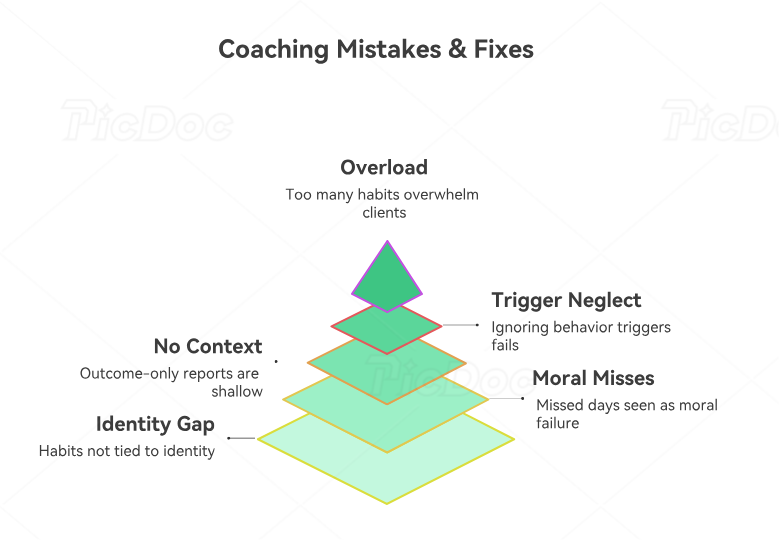
4. The coaching mistakes that quietly destroy habit change
One of the biggest mistakes coaches make is assigning habits that are too large for the client’s current life. It sounds ambitious to prescribe meal prep, daily workouts, meditation, hydration goals, sleep rules, and journaling all at once. In reality, that often sets up an emotional crash. Clients can sustain intensity briefly, but if the system demands too much before it becomes automatic, the habit becomes another source of failure. Coaches who understand the future model every coach needs to adopt by 2026, the future of client engagement, how technology is transforming coaching, and best coaching software for client management know that behavior change must be operationalized, not just encouraged.
Another mistake is coaching only the desired behavior and not the trigger pattern behind it. If a client stress-eats every night at 9 p.m., the behavior is not random. There is a sequence: emotional depletion, environmental cue, mental permission, then action. If the coach only says “make better choices,” nothing meaningful changes. Habit tools must surface the chain. That is where appreciative inquiry, solution-focused brief coaching, NLP techniques every coach should master, and powerful questioning become far more useful than generic accountability.
A third mistake is making the client report outcomes without reporting context. “Did you do the habit?” is not enough. Two clients can both miss a walk, but one missed because of travel and one missed because of resentment, perfectionism, or low mood. Without context, the intervention becomes shallow. With context, the coach can decide whether the client needs environmental redesign, emotional support, schedule compression, self-trust repair, or a more realistic target. That kind of nuance reflects the depth found in building deep trust, effective listening techniques, managing difficult client conversations, and coaching clients through grief and loss.
A fourth mistake is letting missed days become moral events. This is devastating for clients already dealing with shame. Coaches must teach from the beginning that missed days are data, not identity. They are signals. They reveal friction, not character failure. If the client learns to interpret misses correctly, the habit has a chance to survive. If not, one off day turns into a week-long disengagement spiral. This is why why emotional consent matters, how to set clear professional boundaries with coaching clients, the ultimate guide to ethical coaching principles, and coaching confidentiality are not separate from habit work. They shape the emotional safety in which habit work happens.
The final mistake is failing to connect habits to identity. Clients often think habits are chores required to earn a future self. That framing is weak. Better coaching helps the client see that each repetition is evidence of who they are becoming now. One walk is not just exercise. It is proof that they are a person who keeps promises to themselves. One boundary script is not just communication. It is proof that they protect their energy. One meal logged honestly is not just data. It is proof they are capable of facing reality without avoidance. That identity-level shift is what gives habits staying power, and it is echoed in how to actually change your client’s life in 2026, why coaches need it more than ever, how coaches can actually empower clients, and the coaching success trap coaches must avoid.
5. How to build lasting change instead of short-term compliance
Lasting change is not built by getting clients to obey a plan for two weeks. It is built by helping them create behaviors they can return to under imperfect conditions. That means the goal is not perfect streaks. The goal is reliable recovery, realistic consistency, and a system that still works when life becomes inconvenient. Coaches who understand this stop glorifying intensity and start engineering durability.
The first principle is to make habits emotionally survivable. If the habit is associated with pressure, judgment, or constant self-correction, the client will unconsciously resist it. Habits last longer when they feel clear, achievable, and self-respecting. A short evening shutdown routine, a two-minute breathing pause, a realistic breakfast plan, or a simple daily reflection may sound less impressive than a full transformation routine, but it is more likely to hold. This approach aligns with balancing human touch with coaching automation, virtual coaching tools boosting remote session effectiveness, gamification tools coaches are using for maximum engagement, and how to build an interactive coaching community online.
The second principle is to build cues and environments that reduce dependence on memory. Clients are often not inconsistent because they are careless. They are inconsistent because their day is crowded. Good coaching helps them pre-decide. Put the water bottle where the meeting starts. Set the walking shoes by the exit. Prepare the fallback meal before the stressful workday. Leave the journal where the bedtime cue happens. Habit success is often more architectural than motivational. That is why tools from curating the perfect coaching toolkit for every niche, creating a coaching resource library your clients will love, free and premium coaching resources, and must-have coaching tools every professional needs become so practical.
The third principle is to reinforce evidence quickly. Clients need to see that the habit is doing something. That does not always mean weight loss, fewer symptoms, or dramatic external change right away. Sometimes the evidence is subtler: fewer afternoon crashes, less guilt, smoother mornings, better self-trust, fewer emotional rebounds, more clarity after hard days. Coaches should help clients capture those micro-wins through wins rituals, stronger client testimonials capture systems, structured resource delivery, and better interactive workshop practices. When clients feel progress before they see dramatic outcomes, adherence improves.
The fourth principle is to coach for maintenance from the start. Clients should know what the “minimum viable version” of the habit looks like on hard days. If the full habit is a 30-minute walk, the minimum may be five minutes outside. If the full habit is full meal prep, the minimum may be one prepared protein option. If the full habit is a long journal entry, the minimum may be one sentence. This protects the identity loop. It tells the client, “Even on hard days, I am still the kind of person who returns.” That is the difference between temporary compliance and durable change.
6. FAQs
-
There is no single best tool for every client, but a simple habit tracker paired with a weekly reflection form is often the strongest starting combination. The tracker creates visibility, while the reflection form provides context. Together they help coaches spot whether the challenge is motivation, planning, emotional resistance, or environmental friction. This works especially well when supported by coaching session templates, interactive coaching exercises, smart goals, and the communication secret behind successful coaching.
-
Usually one primary habit and, at most, one supporting behavior. More than that often creates confusion, emotional fatigue, and inconsistent execution. Clients need early wins more than they need an ambitious list. Protecting one keystone habit is often what unlocks confidence for the next one. That principle fits well with the radical simplicity coaches are loving, how to make it work every time, how coaches reach mastery, and why top coaches are obsessed.
-
Teach recovery before the break happens. Clients need a written plan for what to do after a miss: remove blame, identify what changed, shrink the next repetition, and restart quickly. The faster the repair, the lower the emotional cost of inconsistency. This is much more effective than lecturing clients about discipline. It also aligns with effective strategies for coaching clients through burnout, stress management techniques every coach should know, the importance of self-care coaching, and why emotional consent matters in every session.
-
Not always. Digital tools are great for reminders, visibility, and data collection, but paper tools can feel simpler, calmer, and more personal for some clients. The best format is the one the client will consistently use under stress, fatigue, and busy schedules. Coaches should choose based on behavior, not novelty. That practical mindset fits with best coaching software and platforms for client management, virtual coaching tools, the 10 best coaching apps every professional should know, and how technology is completely transforming the coaching industry.
-
Because knowledge is not the same as behavioral design. Most clients already know they should sleep more, move more, prepare food, regulate stress, and set boundaries. What they lack is a repeatable system that survives emotion, distraction, time pressure, and self-doubt. Habit tools solve for execution, not just understanding. That gap is exactly why how one method is revolutionizing coaching, the coaching skill you didn’t know you needed, why this skill determines your coaching success, and how to actually empower clients matter so much.
-
The clearest sign is not a perfect streak. It is whether the client can recover, repeat, and identify with the behavior even after disruption. If they can miss without collapsing, adjust without shame, and keep returning without needing constant motivation, the habit is becoming part of their identity. That is when coaching stops producing temporary compliance and starts producing durable transformation.
