
Strength-Based Coaching Techniques That Skyrocket Client Success
Strength-based coaching is one of the fastest ways to create real client momentum because it stops wasting energy on endless deficiency repair and starts building from what already works. Clients who feel stuck, ashamed, inconsistent, or overwhelmed rarely need more criticism. They need a coach who can identify usable assets, turn natural patterns into repeatable wins, and help them trust their own capability again. When used skillfully, strengths-based coaching improves adherence, motivation, self-efficacy, and follow-through without turning sessions into empty positivity.
For coaches, this approach also solves a painful business problem: clients do not stay because you gave them more information. They stay because your process helps them progress. A strengths-led method makes your sessions more actionable, more personalized, and more memorable. It also pairs exceptionally well with effective listening techniques that transform client conversations, the art of powerful questioning in coaching, how the world’s best coaches get results, and how to actually empower clients real results.

1. Why strengths-based coaching works when advice-heavy coaching fails
Many clients arrive after years of being told what is wrong with them. They have been labeled inconsistent, lazy, emotional, undisciplined, or unmotivated. That language damages identity. Once clients internalize those labels, even good plans collapse because the client no longer sees themselves as the kind of person who can succeed. A strengths-based coach interrupts that spiral by helping clients see evidence of competence they have been ignoring. That is where trust begins.
This approach does not mean avoiding problems. It means solving problems through assets instead of shame. A client who struggles with meal consistency may still have strong planning ability at work, deep loyalty to family, or excellent pattern recognition. A skilled coach can bridge those strengths into behavior change. That is the same logic behind how coaches can actually change client diets, how to make it work every time, why this skill determines your coaching success, and the communication secret behind successful coaching.
The biggest mistake coaches make is confusing strengths with compliments. “You’re amazing” is not a strengths intervention. “You consistently prepare well for difficult situations, so let’s use that preparation strength to design your food environment for the week” is. Strengths must be observable, nameable, transferable, and behaviorally useful. That is why coaches who want long-term retention should combine strengths work with interactive goal tracking tools that boost client success, using surveys and feedback tools to improve coaching outcomes, creating custom coaching dashboards for enhanced client experience, and habit formation tools helping clients achieve lasting change.
Another reason it works: strengths reduce resistance. Clients often resist goals that feel like punishment. But they lean in when action feels identity-congruent. A client who sees themselves as compassionate may not respond to strict calorie language, but may respond strongly to the idea of caring for their energy, sleep, and stress so they can show up better for others. That connects directly with mindfulness and meditation techniques for emotional coaching, helping clients manage work-life balance successfully, effective strategies for coaching clients through burnout, and effective strategies for reinforcing positive client behaviors.
2. How to identify client strengths with precision instead of guesswork
The first job is not to tell clients their strengths. It is to help them discover them through evidence. When coaches guess, they often project. When coaches investigate, they create accuracy. Start by asking for exceptions, not generalities. “Tell me about a week when things went better.” “What was different?” “What did you do that helped?” This method fits beautifully with solution-focused brief coaching the ultimate 2026 guide for coaches, appreciative inquiry the ultimate 2026 guide for coaches, life mapping the ultimate 2026 guide for coaches, and powerful client journaling tools for deeper self-awareness.
A useful rule is this: strengths leave behavioral fingerprints. If a client consistently solves problems during chaos, that points to adaptability. If they remember details from past sessions, that suggests conscientiousness. If they light up while discussing helping others, that reveals meaning orientation. If they ask nuanced questions, that signals curiosity and reflective capacity. These are not personality fluff labels. They are assets you can deploy.
Use four evidence channels. First, past success stories. Second, how the client handles stress. Third, what they do naturally without prompting. Fourth, what other people reliably trust them for. These channels often reveal strengths faster than formal assessments. Pair those discoveries with coaching case study templates demonstrating your value effectively, curating the perfect coaching toolkit for every niche, comprehensive guide to building a thriving coaching resource hub, and essential resources for coaching certification and credentialing.
You also need to separate strengths from coping strategies. Hyper-independence, for example, can look like self-reliance, but sometimes it is fear of receiving support. Constant productivity can look like discipline, but may actually be anxiety-driven overfunctioning. This is where why emotional consent matters in every coaching session, understanding ethical responsibilities as a health & life coach, coaching integrity building trust and credibility in your practice, and techniques for maintaining professional boundaries with clients become essential. You are not there to romanticize dysfunction. You are there to distinguish real assets from protective patterns.
Once you identify a strength, translate it into a coaching use case. Do not stop at “You’re resilient.” Ask, “How can resilience help you recover faster after a missed week?” Do not stop at “You’re caring.” Ask, “How can your care for your family become a reason to protect your sleep?” Strengths only matter when they change behavior.
3. The strongest coaching techniques for turning client strengths into measurable progress
The first technique is strengths reflection with specificity. At the end of a session, reflect back not just what the client said, but what it reveals. “You noticed your pattern early, adapted your plan midweek, and still preserved two anchors. That tells me you are more flexible and self-aware than you give yourself credit for.” This increases self-efficacy far better than generic praise. It aligns with why trust is the most valuable asset in coaching, the non-negotiable standards every coach must know, how coaches reach mastery, and the coaching skill you didn’t know you needed.
The second technique is strengths bridging. This is one of the most powerful tools in behavior change. You identify where the client already succeeds, then bridge that pattern into an area where they struggle. A client who keeps every work deadline can often build health habits through planning rituals, calendar blocks, and priority rules. A client who shows up reliably for friends can transfer that same loyalty into commitments to self. This technique connects well with how to inspire clients to take immediate action, the 1 coaching technique for client breakthroughs, how one method is revolutionizing coaching, and why coaches are embracing this positive change model.
The third technique is strength-based goal design. Instead of asking only, “What is the goal?” ask, “Which of your strengths makes this goal more achievable?” A goal unsupported by identity often dies quickly. But a goal anchored to a real strength survives stress better. This is especially effective when paired with the future of client engagement 2026, why they’re changing the game for coaches, the future model every coach needs to adopt by 2026, and how technology is completely transforming the coaching industry.
The fourth technique is the strengths review after setbacks. Most coaches review failure by asking what went wrong. That matters, but it is incomplete. Also ask what the client did right during the hard period. Did they recover faster than before? Did they maintain one anchor? Did they communicate instead of ghosting? Did they notice the trigger earlier? This prevents all-or-nothing narratives and supports retention. It also reduces the risk patterns explored in why coaches must avoid this trap, how coaches avoid career-ending mistakes, how to set them and save your career, and managing difficult client conversations with ease.
4. How to use strengths-based coaching in real client scenarios
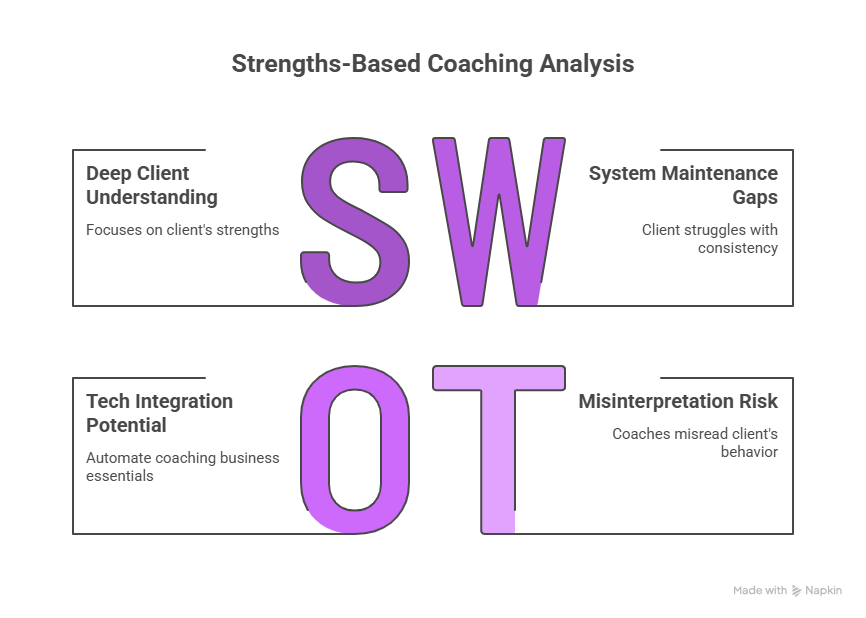
Consider the client who says, “I always fall off after a good start.” An average coach might say they need discipline. A strengths-based coach looks deeper. Perhaps the client is excellent at initiation but weak in system maintenance. That changes the intervention completely. You would not push harder. You would install review rituals, friction reduction, and lighter maintenance habits. That approach fits with automating your coaching business essential tech tools, essential CRM tools to manage your coaching client relationships, automated email sequences the ultimate 2026 guide for coaches, and client session recording tools the ultimate 2026 guide for coaches.
Now take the client who constantly criticizes themselves. Hidden inside that pattern is often high self-observation. They notice a lot. The problem is not awareness. The problem is hostile interpretation. Your job is to shift them from self-attack to self-data. That can be done through evidence logs, structured reflections, and carefully worded debriefs. It connects strongly with inner critic management techniques the ultimate 2026 guide for coaches, gratitude journal coaching the ultimate 2026 guide for coaches, daily journaling prompts the ultimate 2026 guide for coaches, and affirmation cards the ultimate 2026 guide for coaches.
A third common scenario is the client who “knows what to do” but does not follow through. Coaches often misread this as laziness. In many cases, the client is overwhelmed, overcommitted, or trying to execute a plan that does not match their behavioral style. Strengths-based coaching asks: what conditions make follow-through easier for this person? Do they thrive with accountability, novelty, autonomy, visual tracking, emotional meaning, or tight scheduling? That question is far more useful than moralizing. It also pairs well with the 10 best coaching apps every professional should know, virtual retreat platforms coaches are using successfully, zoom & video conferencing best practices the ultimate 2026 guide for coaches, and the radical simplicity coaches are loving.
Finally, strengths-based coaching is especially powerful with clients rebuilding identity after failure. They may need more than a plan. They may need proof that they are not broken. That is where your reflections, frameworks, and questions become transformational. Coaches who master this are often the ones clients describe as life-changing, which is exactly why articles like how to actually change your clients life in 2026, why it’s the hidden goldmine of coaching, why top coaches are obsessed, and the neuroscience-based method every coach needs now resonate so strongly.
5. Mistakes coaches make when applying strengths-based coaching
The first mistake is using strengths language to avoid hard truths. Clients still need honesty. If a client is inconsistent, the answer is not to pretend everything is fine. The answer is to tell the truth while preserving agency. “You are missing your commitments, but you also recover quickly and learn fast. Let’s use those strengths to build a system you can actually sustain.” That balance supports both trust and standards, much like how certification differentiates your health coaching business, how certification enhances your coaching credibility, understanding certification standards across organizations, and essential coaching skills for ICF credentialing.
The second mistake is overloading clients with too many strengths at once. That creates noise. Pick one or two that matter most for the current goal. Precision beats inspiration. The third mistake is failing to operationalize strengths. If the strength cannot be seen in the client’s calendar, habits, scripts, environment, or follow-up, it is still too abstract.
The fourth mistake is ignoring context. A strength in one environment may not transfer automatically to another. A client may be decisive at work and indecisive in health because work offers clear stakes and external accountability. Your role is to recreate the conditions that support the strength. This is where how technology is completely transforming the coaching industry - 1, how artificial intelligence is changing client interactions forever, digital marketing tools coaches need for explosive growth, and social media mastery for health and life coaches show the broader lesson: systems shape consistency.
The fifth mistake is making strengths-based work coach-centered instead of client-centered. Some coaches love their own reframes so much they stop listening. But the client must recognize the strength as true. If it does not resonate, keep exploring. The best strengths interventions feel like revelation, not imposition.
6. FAQs About Strength-Based Coaching Techniques
-
Strengths-based coaching is evidence-based and behavioral. It identifies real capabilities, patterns, and assets the client already demonstrates, then uses them to solve problems. Positive thinking without evidence can feel hollow. Strengths work says, “Here is what you have already shown you can do, and here is how we will use it.”
-
Yes, and often better than deficit-heavy coaching. Resistant clients are frequently exhausted by judgment, over-advice, or repeated failure. A strengths-based approach lowers defensiveness and rebuilds agency. The key is to be concrete, not fluffy.
-
Address them directly, but solve around them intelligently. You do not ignore limitations. You reduce their damage by leveraging existing strengths, simplifying execution, and designing better environments. The goal is not denial. The goal is effective change.
-
Ask for exceptions, past wins, admired qualities, stressful periods they survived, and things others rely on them for. Strengths usually appear in stories before they appear in labels. Listen for patterns, not compliments.
-
Create a strengths inventory inside your session notes. Track the strength, the evidence for it, the situations where it shows up, and the exact behavior change it can support. Over time, this becomes one of the most valuable parts of the client file.
-
Consistency, confidence, identity change, burnout recovery, habit formation, follow-through, and relapse recovery respond especially well. These areas often fail when the client feels defective, so restoring capability is critical.
-
Practice listening for assets in every client story. Instead of asking only what the problem is, ask what capacity the client already demonstrated in the middle of that problem. Then turn that capacity into an action plan for the next week. Over time, your sessions become more precise, more hopeful, and far more effective.
