
Technology’s Transformative Impact on the Coaching Profession
Technology has stopped being a “nice extra” in coaching. It now shapes how clients discover coaches, how trust is built before the first session, how progress is tracked between sessions, and how outcomes are proven when clients start asking harder questions about value, speed, privacy, and personalization. Coaches who still rely on memory, scattered notes, manual follow-ups, and vague accountability often feel overworked while clients quietly drift.
The deeper shift is not about replacing human coaching. It is about removing friction that weakens it. The coaches getting stronger results are using technology to sharpen delivery, protect boundaries, personalize support, reduce dropout, and create cleaner systems around the real work of behavior change. That is where the profession is moving, and it is where long-term relevance will be decided.

1. Why Technology Is Reshaping Coaching Faster Than Many Coaches Realize
Technology is changing coaching because clients no longer compare you only to other coaches. They compare your responsiveness, clarity, personalization, and convenience to every polished digital experience they use elsewhere. A client who can track workouts, finances, sleep, nutrition, and therapy support from their phone expects the same level of structure from coaching. That is why must-know client preferences shaping the future of coaching, state of coaching industry 2026-27 trends & opportunities revealed, future-proof your coaching practice: top trends to watch, and the future model every coach needs to adopt by 2026 matter so much now.
The first transformation is operational. Technology reduces coaching drag. Drag is everything that drains momentum without adding value: missed reminders, scattered action items, weak follow-up, lost notes, poor scheduling, inconsistent habit review, late emails, and vague progress updates. When that drag remains high, even talented coaches struggle to keep clients engaged. That is where automating your coaching business: essential tech tools, coaching automation: next-level tools to grow your business faster, essential CRM tools to manage your coaching client relationships, and best coaching software & platforms for client management in 2025 become central to client experience, not back-office trivia.
The second transformation is behavioral. Good technology makes change more visible. Clients often fail because insight feels meaningful in-session but disappears in real life. A strong system turns insight into reminders, prompts, micro-check-ins, habit streaks, reflection questions, dashboards, and trend signals. That strengthens follow-through. It also aligns with what is explored in interactive goal-tracking tools that boost client success, habit-formation tools helping clients achieve lasting change, interactive coaching exercises to keep clients motivated, and gamification strategies: keeping clients engaged and motivated.
The third transformation is competitive. Coaches who use technology well are easier to trust. They present clearer onboarding, better preparation, smoother delivery, better documentation, stronger boundaries, cleaner follow-up, and more measurable outcomes. That affects retention, referrals, testimonials, and premium positioning. You can see how this connects to how the world’s best coaches get results, how coaches reach mastery, benchmarking your coaching business: industry standards & insights, and why trust is the most valuable asset in coaching.
The fourth transformation is strategic. Technology helps a coach scale depth without becoming robotic. That distinction matters. Clients do not want canned coaching. They want a coach who remembers patterns, notices setbacks early, personalizes tools, and supports action between sessions. Smart systems support that. Weak systems fake it. That is why the real question is not whether technology belongs in coaching. The real question is whether your technology choices increase client agency, emotional safety, and measurable progress. Coaches who ignore that question are already behind, especially in a market shaped by how artificial intelligence is changing client interactions forever, balancing human touch with coaching automation for optimal results, how technology is completely transforming the coaching industry, and the 10 best coaching apps every professional should know.
2. Where Technology Creates the Biggest Real-World Gains for Coaches and Clients
The strongest gains happen where coaching usually leaks value. One leak is poor continuity between sessions. Clients forget what mattered, reinterpret commitments loosely, or lose momentum when life gets noisy. Technology solves this when coaches create a shared action environment instead of relying on memory. That is the logic behind creating custom coaching dashboards for enhanced client experience, using surveys and feedback tools to improve coaching outcomes, coaching session templates to boost your productivity instantly, and building your coaching toolkit: essential templates and checklists.
Another major gain comes from precision. Many coaches think they have an engagement problem when they really have a system problem. Clients do not act because goals are too broad, prompts arrive at the wrong time, actions are not visible, or the homework feels disconnected from daily life. Technology lets you shrink the gap between intention and execution. A coach can send one timed reminder, one reflection form, and one friction-reducing resource rather than a pile of advice. That fits with smart goals 2.0: how top coaches set & achieve client goals, powerful questioning techniques that transform coaching sessions, how to inspire clients to take immediate action, and effective strategies for reinforcing positive client behaviors.
Technology also improves visibility into client patterns. Coaches often hear the polished version of the week, not the accurate one. Mood trackers, check-ins, micro-surveys, journaling tools, and dashboards expose where stress rises, where routines collapse, where avoidance starts, and which commitments survive real life. That matters for coaches working around burnout, confidence, grief, or self-sabotage. It connects directly to powerful client journaling tools for deeper self-awareness, daily journaling prompts: the ultimate 2026 guide for coaches, helping clients manage work-life balance successfully, and effective strategies for coaching clients through burnout.
There is also a business-side gain that many underprice: technology protects coach energy. Without systems, a coach spends hours every week chasing forms, rescheduling, repeating instructions, searching for notes, writing recap emails from scratch, and answering preventable questions. That energy loss eventually shows up in session quality. The coaches who appear more present, more strategic, and more consistent are often simply less drained by avoidable admin. That is why 15 must-have coaching tools every professional needs in 2025, virtual coaching tools: boosting your remote session effectiveness, video conferencing hacks for flawless online coaching sessions, and zoom & video conferencing best practices: the ultimate 2026 guide for coaches are operational advantage pieces, not just software recommendations.
The final gain is proof. More buyers want evidence that coaching works. Technology helps coaches document baseline state, milestones, adherence, engagement, barriers, and results. That makes conversations sharper. It also improves testimonials, case studies, referrals, program refinement, and premium positioning. That is why coaching case study templates: demonstrating your value effectively, client testimonials capture: the ultimate 2026 guide for coaches, new data-proven coaching methods for maximum client success, and comprehensive analysis: the most profitable coaching niches today deserve a place in every modern coach’s thinking.
3. The Technologies Modern Coaches Should Prioritize First
The first priority should be systems that directly affect client continuity. That means a scheduling stack, reminder automation, notes workflow, shared action plan, and basic check-in infrastructure. Coaches often chase trendy tools before fixing these foundations. That creates a polished-looking business with sloppy delivery. Start with the tools that stop missed sessions, forgotten commitments, unclear next steps, and delayed follow-up. This is the practical layer behind automated email sequences: the ultimate 2026 guide for coaches, essential resources for coaching certification & credentialing, curating the perfect coaching toolkit for every niche, and creating a coaching resource library your clients will love.
The second priority should be visibility tools. These include client surveys, digital journals, dashboards, and habit tracking systems. Their purpose is not to flood clients with data. Their purpose is to help the coach see what ordinary conversation misses. When clients say, “I had a rough week,” technology helps define rough. Was it low sleep, high stress, poor adherence, emotional overload, schedule collapse, or identity resistance? That is where life mapping: the ultimate 2026 guide for coaches, gratitude journal coaching: the ultimate 2026 guide for coaches, affirmation cards: the ultimate 2026 guide for coaches, and mindfulness and meditation techniques for emotional coaching can become more powerful when embedded into a system instead of used randomly.
The third priority is communication infrastructure. Coaches need a clean way to share resources, session summaries, boundary rules, and support expectations. Clients should never have to guess where things live or how to reach you. Confusion weakens trust faster than many coaches understand. A clear portal, structured email flow, and defined messaging rules reinforce professionalism and reduce emotional spillover. This pairs naturally with the communication secret behind successful coaching, communication techniques every coach should master, building deep trust: how to strengthen your client relationships, and effective listening techniques that transform client conversations.
The fourth priority is selective AI. AI is valuable when it saves time on summaries, patterns, resource drafting, personalization support, or structured review. It becomes harmful when it starts impersonating coaching depth, over-automating reflection, or flattening emotionally nuanced work into generic scripts. Coaches should use AI where it increases clarity and consistency while preserving human discernment where trust, ethics, and complexity live. That is why how coaches avoid career-ending mistakes, why emotional consent matters in every coaching session, understanding ethical responsibilities as a health & life coach, and coaching integrity: building trust and credibility in your practice must stay in the same conversation as innovation.
4. The Risks, Mistakes, and Ethical Tensions Coaches Cannot Ignore
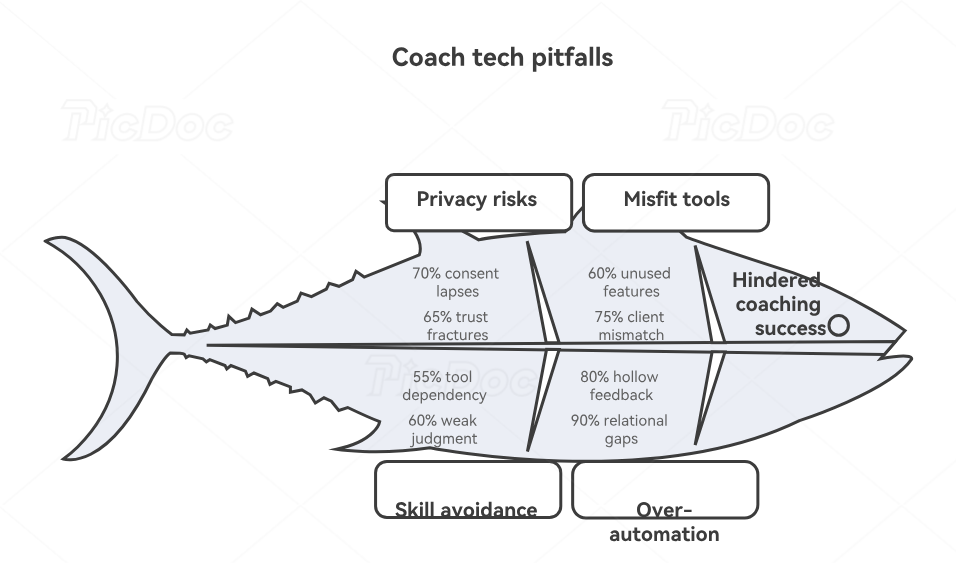
The biggest mistake is adopting tools because they look advanced rather than because they solve a real client problem. Coaches often buy platforms with dashboards, automations, communities, AI assistants, gamified streaks, and content libraries, then discover clients barely use them. The issue is not always the software. The issue is usually misfit. A tool can be excellent and still be wrong for your clients’ digital behavior, emotional capacity, or stage of change. This is exactly why why coaches must avoid this trap, the coaching skill you didn’t know you needed, how to make it work every time, and why top coaches are obsessed need to be interpreted through practical fit, not hype.
Another major risk is over-automation. Clients can feel managed instead of supported when every touchpoint becomes a template. Automated reminders, canned encouragement, instant summaries, and scheduled nurture emails are useful, but they can create emotional hollowness when overused. Coaching is relational work. People notice when presence is replaced by process. That is why balancing human touch with coaching automation for optimal results, managing difficult client conversations with ease, conflict resolution strategies every coach needs, and the art of powerful questioning in coaching remain more valuable than any stack.
Privacy and consent are another pressure point. Coaches handle vulnerable disclosures, emotional history, health goals, personal habits, family stress, and sometimes crisis-adjacent material. That makes sloppy tech use dangerous. Recording sessions, storing notes, syncing wearable data, using AI transcription, or collecting sensitive intake information all demand clear consent and careful boundaries. Trust can fracture quickly when a client feels watched, over-documented, or uncertain about how their data is used. This is why coaching confidentiality: how to protect your clients and your practice, the ultimate guide to ethical coaching principles you can’t ignore, how to set clear professional boundaries with coaching clients, and techniques for maintaining professional boundaries with clients belong in every tech rollout conversation.
There is also a subtler mistake: using technology to avoid coaching skill development. Some coaches lean on tools because they struggle with listening, behavior design, accountability, questioning, boundaries, or difficult conversations. Software cannot compensate for weak coaching judgment. It can only amplify what already exists. Strong coaches use tech to reinforce their craft. Weak coaches use tech to hide its gaps. That is why essential coaching skills for ICF credentialing, effective coaching communication for NBHWC certification, detailed review of NBHWC coaching competencies, and the non-negotiable standards every coach must know still sit underneath every durable transformation strategy.
5. How Coaches Can Build a Smarter Tech-Enabled Practice Without Losing Their Human Edge
Start by mapping your client journey, not your favorite tools. List the moments where clients most often get stuck: before signing, after onboarding, between sessions, during setbacks, around accountability, near program midpoint, and at testimonial or renewal stage. Then choose one technology upgrade for each friction point. This prevents random stacking and keeps your system outcome-centered. Coaches trying to modernize intelligently should study launch your successful health coaching career: complete roadmap, step-by-step guide: how to become a certified life coach, financial coaching career blueprint: essential steps for success, and mental health coaching: inside the fastest-growing niche of the decade because each career path places different pressure on tech choices.
Next, build around one core operating principle: fewer tools, deeper adoption. Most coaching businesses do not need a huge stack. They need a stable scheduling system, a communication system, a note and action system, a check-in system, and a lightweight analytics layer. Once those are working, then add community, course delivery, AI assistance, or wearable integration. This keeps the client experience clean. It also supports the logic behind free & premium coaching resources to boost your practice, how to leverage online courses for continuous coaching education, virtual retreat platforms coaches are using successfully, and best practices for creating interactive coaching workshops.
Then define your human edge on purpose. Decide where technology stops and coaching presence begins. For example, you may automate reminders, but write personalized recap insights. You may use AI to summarize a session, but manually identify the one emotional inflection point that matters most. You may track data trends, but interpret them through context rather than forcing a sterile conclusion. That is where coaches protect their distinct value. It connects naturally to strength-based coaching techniques that skyrocket client success, visualization & guided imagery: proven methods every coach needs, the neuroscience-based method every coach needs now, and how to actually empower clients: real results.
Finally, review your system monthly with brutal honesty. Which tech feature clients ignore? Which prompt gets useful responses? Which reminders improve adherence? Which forms produce noise instead of insight? Which automations feel cold? Which metrics actually predict success? A tech-enabled practice becomes excellent through iteration, not purchase. Coaches who stay disciplined here will look more modern, yes, but more importantly, they will coach with more clarity, less friction, better proof, and stronger trust. That is the real transformation, and it is consistent with how one method is revolutionizing coaching, the future of client engagement 2026, how technology is completely transforming the coaching industry - 1, and wearable technology: preparing your coaching business for the future.
6. FAQs
-
Technology strengthens coaching when it removes friction around scheduling, follow-up, reminders, resource delivery, and pattern tracking. It weakens coaching when it replaces deep listening, judgment, emotional nuance, and personalized challenge with canned workflows. Coaches who stay strong in core skill while using tech for structure will feel more personal, not less. That is the tension explored in how artificial intelligence is changing client interactions forever, balancing human touch with coaching automation for optimal results, the communication secret behind successful coaching, and why trust is the most valuable asset in coaching.
-
Begin with the tools that improve reliability: calendar booking, automated reminders, clean session notes, a shared action plan, and one weekly check-in mechanism. Those five elements solve more real coaching problems than most flashy platforms. Once those work, add dashboards, communities, content systems, or AI support. For a grounded path, review automating your coaching business: essential tech tools, best coaching software & platforms for client management in 2025, curating the perfect coaching toolkit for every niche, and 15 must-have coaching tools every professional needs in 2025.
-
Use AI for support functions, not relational substitution. Safe use cases include summarizing sessions after consent, organizing notes, drafting resource suggestions, identifying repeated themes, and speeding up admin. Risk rises when AI is used to simulate empathy, deliver mental-health-adjacent guidance beyond scope, store sensitive data carelessly, or obscure how client information is being processed. Coaches should define clear boundaries informed by understanding ethical responsibilities as a health & life coach, coaching confidentiality: how to protect your clients and your practice, why emotional consent matters in every coaching session, and how coaches avoid career-ending mistakes.
-
Measure whether it changes behavior, not whether it looks impressive. A tool is valuable when clients attend more consistently, complete more agreed actions, report clearer next steps, respond more often, stay longer, or show better self-awareness and adherence. Review outcomes at the behavior level first. That mindset is strengthened by using surveys and feedback tools to improve coaching outcomes, interactive goal-tracking tools that boost client success, new data-proven coaching methods for maximum client success, and coaching case study templates: demonstrating your value effectively.
-
Health coaching, preventive coaching, executive coaching, mental health-adjacent coaching, habit change work, group coaching, and hybrid course-plus-coaching models gain heavily because they benefit from between-session support, structured accountability, measurable progress, and resource delivery. The exact tech mix changes by niche, which is why preventative health coaching: how this shift will dominate the industry, gig economy coaching: capitalizing on emerging opportunities, mental health coaching: inside the fastest-growing niche of the decade, and comprehensive analysis: the most profitable coaching niches today are useful strategic reads.
-
They buy too much, too early, without redesigning the client journey. That leads to bloated stacks, confused clients, and a false sense of sophistication. A better approach is to identify one friction point at a time and deploy one tool that solves it clearly. Then measure adoption and impact before expanding. Coaches who want to avoid expensive chaos should revisit why coaches must avoid this trap, benchmarking your coaching business: industry standards & insights, future-proof your coaching practice: top trends to watch, and coaching automation: next-level tools to grow your business faster.
