
Creating a Safe Coaching Environment: Why It Matters and How to Do It
A coaching relationship only works when the client feels safe enough to tell the truth. Not the polished truth. Not the socially acceptable version. The real truth about fear, shame, resistance, relapse, resentment, confusion, and the patterns they are tired of hiding. When safety is missing, clients edit themselves, perform progress, avoid difficult disclosures, and protect themselves from judgment instead of engaging in change.
That is why a safe coaching environment is not a soft extra. It is the operating condition that makes trust, honesty, accountability, and sustainable results possible. Coaches who understand how to build safety create better conversations, stronger retention, cleaner boundaries, deeper client commitment, and far more useful sessions than coaches who focus only on technique.
1. Why Psychological Safety Is the Foundation of Effective Coaching
Clients do not make meaningful progress because a coach asks smart questions alone. They make progress when they feel secure enough to answer those questions without self-protection. A client who fears being judged will hide lapses, soften hard details, and present a cleaner version of events. A client who feels emotionally safe will admit they ignored the plan, lied to themselves, spiraled after one setback, or agreed to something they never wanted to do. That honesty is what gives coaching something real to work with.
This is exactly why coaches who study why trust is the most valuable asset in coaching, coaching integrity building trust and credibility in your practice, building deep trust how to strengthen your client relationships, and the communication secret behind successful coaching tend to outperform coaches who rely on charisma, energy, or rigid frameworks. They understand that technique lands differently when the client feels respected, emotionally protected, and free to be imperfect.
Safety matters because coaching often touches fragile territory even when it is not therapy. A client may arrive carrying embarrassment about their body, money, habits, confidence, relationships, ambition, grief, or lack of follow-through. They may have spent years being criticized, dismissed, interrupted, over-advised, or misunderstood. That history walks into the coaching room with them. Coaches who have learned from why emotional consent matters in every coaching session, understanding ethical responsibilities as a health & life coach, effective listening techniques that transform client conversations, and communication techniques every coach should master know that safety is built through how the coach responds to vulnerability, not through branding language about support.
A safe coaching environment also improves accountability. Many coaches think accountability works best when pressure is high. In reality, many clients become evasive under pressure. They start dodging questions, defending themselves, or disappearing after a bad week. Accountability only becomes useful when the client believes they can tell the truth without being shamed for it. That is why safety strengthens outcomes in ways directly connected to how to actually empower clients real results, how to inspire clients to take immediate action, effective strategies for reinforcing positive client behaviors, and gamification strategies keeping clients engaged and motivated.
Another reason safety matters is retention. Clients stay when sessions feel useful, but they also stay when they feel seen without being managed like a problem. A coach who creates emotional steadiness, clear expectations, and non-defensive space becomes easier to trust over time. That supports better continuation, referrals, and stronger case outcomes, which is why safety connects so closely to the future of client engagement 2026, must-know client preferences shaping the future of coaching, future-proof your coaching practice top trends to watch, and state of coaching industry 2026-27 trends and opportunities revealed.
Most importantly, safety helps clients access reality faster. When they no longer have to spend energy managing your perception of them, they can put that energy into change. That is when coaching stops being performative and starts becoming transformational.
| Area | What Safety Looks Like | Common Breakdown | Fix | Best Use |
|---|---|---|---|---|
| Session opening | Client settles before diving in | Coach starts with pressure | Use a grounding opener | New clients |
| Confidentiality | Limits are explained clearly | Assumed rather than stated | Review policy verbally and in writing | Intake |
| Tone | Warm, steady, non-performative | Forced positivity | Slow down and match reality | Sensitive topics |
| Questioning | Curious, not prosecutorial | Rapid-fire interrogation | Ask one deeper question | Shame-prone clients |
| Client pacing | Room for pause and thought | Coach fills all silence | Hold silence longer | Reflective clients |
| Accountability | Truth welcomed after setbacks | Missed actions framed as failure | Review friction, not blame | Habit coaching |
| Boundaries | Clear response windows | Always-on access confusion | Define message rules | Text support |
| Environment | Private, quiet, interruption-free | Distracting background or noise | Protect privacy on both sides | Virtual sessions |
| Validation | Emotion acknowledged without dramatizing | Jumping straight to fixing | Name the emotional reality first | Hard disclosures |
| Choice | Client can decline an exercise | Exercise pushed anyway | Offer opt-in language | Trauma-aware practice |
| Agenda setting | Client helps shape session focus | Coach dominates direction | Confirm priority together | Recurring clients |
| Goal design | Goals fit real capacity | Ambitious plans invite shame | Scale down immediately | Overwhelmed clients |
| Language | Non-shaming phrasing | Loaded labels like lazy | Use behavioral descriptions | All coaching niches |
| Repair | Coach acknowledges misattunement | Coach defends impact | Own it and recalibrate | Trust rupture |
| Check-ins | Short, low-pressure follow-up | Follow-up feels like surveillance | Use supportive prompts | Between sessions |
| Feedback | Invited regularly | Coach assumes all is well | Ask what is helping or not | Retention |
| Emotional intensity | Coach does not over-escalate | Intensity amplified unnecessarily | Stay regulated and grounded | Crisis-adjacent moments |
| Note-taking | Transparent and minimal | Typing creates distance | Explain what notes are for | Video calls |
| Advice | Offered with permission | Advice inserted too early | Ask before offering | Solution-seeking clients |
| Cultural humility | Client context explored respectfully | Assumptions flatten lived reality | Ask context-building questions | Diverse client base |
| Body language | Open, attentive presence | Visible distraction or multitasking | Remove split attention | Every session |
| Humor | Used carefully and relationally | Jokes minimize pain | Do not joke during exposure | Vulnerable moments |
| Structure | Client knows what to expect | Session feels unpredictable | Set a reliable flow | Anxious clients |
| Relapse response | Misses are treated as data | Coach expresses disappointment | Analyze breakdown kindly | Behavior change work |
| Session close | Client leaves steady, clear, not flooded | Heavy topic opened and dropped | Use a grounded closing | Emotionally loaded sessions |
| Referrals | Coach knows scope limits | Complex issues kept in coaching | Refer when appropriate | Ethical practice |
| Technology | Simple tools reduce client strain | Clunky systems increase stress | Reduce friction points | Remote coaching |
| Micro-support | Check-ins feel containing | Messages create pressure | Keep prompts brief and clear | Between-session support |
| Repair after ghosting | Re-entry is welcomed without shame | Client is scolded for absence | Use low-judgment return language | Retention recovery |
| Coach regulation | Coach stays steady under discomfort | Coach reacts from ego or urgency | Pause before responding | Every client relationship |
2. What an Unsafe Coaching Environment Actually Looks Like
Unsafe coaching does not always look dramatic. Sometimes it looks polished, high-energy, and “professional” from the outside. The damage often happens in subtler ways. The coach interrupts too quickly. The coach reframes pain before the client feels heard. The coach pushes for breakthroughs when the client needs steadiness. The coach makes every setback sound like a mindset flaw. The coach rewards visible action but has no skill for holding fear, grief, shame, ambivalence, or hesitation.
That kind of environment teaches clients to perform. They start bringing cleaner updates and less complex truths. They tell you what sounds coachable. They hide what feels embarrassing. Coaches who ignore the lessons inside managing difficult client conversations with ease, conflict resolution strategies every coach needs, the art of powerful questioning in coaching, and powerful questioning techniques that transform coaching sessions often mistake client compliance for trust. Those are not the same thing.
One major sign of unsafety is pressure disguised as accountability. The coach keeps saying the client is “capable of more” when the client is already overwhelmed. The action steps keep getting larger even after repeated non-completion. The client starts dreading check-ins because every conversation feels like a test they are failing. That is not motivation. That is a shame loop. Better coaching pulls from the radical simplicity coaches are loving, smart goals 20 how top coaches set and achieve client goals, how to make it work every time, and habit formation tools helping clients achieve lasting change to reduce resistance instead of moralizing it.
Another sign is emotional overreach. Some coaches try to create depth by pushing clients toward vulnerability before there is enough trust to hold it. They ask invasive questions too early, probe sensitive topics without consent, or keep digging after the client’s nervous system is clearly tightening. A safer practice is shaped by why emotional consent matters in every coaching session, techniques for maintaining professional boundaries with clients, the ultimate guide to ethical coaching principles you cant ignore, and managing dual relationships essential ethics for coaches. Safety grows when the client feels they have choice, pace, and space inside the process.
Unsafety also shows up through inconsistency. Maybe the coach is warm one week and impatient the next. Maybe response times are unpredictable. Maybe boundaries are unclear. Maybe there are private-message expectations the client never fully understands. An unstable container makes clients more vigilant. They start monitoring your mood, your availability, and your reactions instead of focusing on their own growth. That is why strong systems from essential CRM tools to manage your coaching client relationships, automating your coaching business essential tech tools, best coaching software and platforms for client management in 2025, and creating custom coaching dashboards for enhanced client experience can improve safety when they reduce ambiguity rather than adding coldness.
Unsafe coaching often costs the coach too. It creates more ghosting, more emotional misunderstandings, more fragile accountability, and more sessions where it feels like you are coaching around the truth rather than through it.
3. How to Build Safety From the First Interaction Forward
Safety starts before the first session. It begins with how you describe your work, what expectations you set, and whether your intake process creates clarity or tension. A client should understand what coaching is, what it is not, how confidentiality works, how communication works, and what kind of honesty is welcome. Coaches who think deeply about how coaches avoid career-ending mistakes, the non-negotiable standards every coach must know, essential resources for coaching certification & credentialing, and coaching confidentiality how to protect your clients and your practice build trust earlier because clients are not left guessing how the relationship operates.
In the first session, the coach’s job is not to impress. It is to create steadiness. That means listening more than demonstrating expertise, moving slowly enough for the client to orient, and establishing a tone that says difficult truth is workable here. Coaches can do this by normalizing mixed feelings, explaining that setbacks are discussable, and making it clear that the client does not need to sound polished to be respected. Lessons from the coaching skill you didnt know you needed, how the worlds best coaches get results, how coaches reach mastery, and the 1 coaching technique for client breakthroughs all point toward the same truth: mastery is often less about sounding brilliant and more about making the client safe enough to be real.
Language matters more than many coaches realize. Small wording shifts can change the emotional climate of a session. “Why didn’t you do it?” can feel prosecutorial. “What got in the way?” feels more collaborative. “You keep sabotaging yourself” creates identity-level shame. “There seems to be friction at this point in the process” keeps attention on behavior and context. That is why coaches benefit from effective coaching communication for nbhwc certification, detailed review of nbhwc coaching competencies, common pitfalls in the nbhwc certification exam, and essential coaching skills for icf credentialing, because careful communication is a credibility issue, not just a style choice.
Safety also depends on pacing. Some clients need time before discussing sensitive subjects. Others open fast but become flooded afterward. Skilled coaches pay attention to breath changes, tone shifts, abrupt laughter, over-explaining, withdrawal, and sudden compliance. Those signals help determine whether to continue, pause, simplify, or offer choice. This is where tools like powerful client journaling tools for deeper self-awareness, using surveys and feedback tools to improve coaching outcomes, interactive goal tracking tools that boost client success, and coaching session templates to boost your productivity instantly can support a safer process when used to clarify rather than control.
Most clients are not asking for a perfect coach. They are asking for a coach who is clear, steady, respectful, and capable of handling truth without making them regret sharing it.
4. Practical Techniques Coaches Can Use to Make Clients Feel Safer
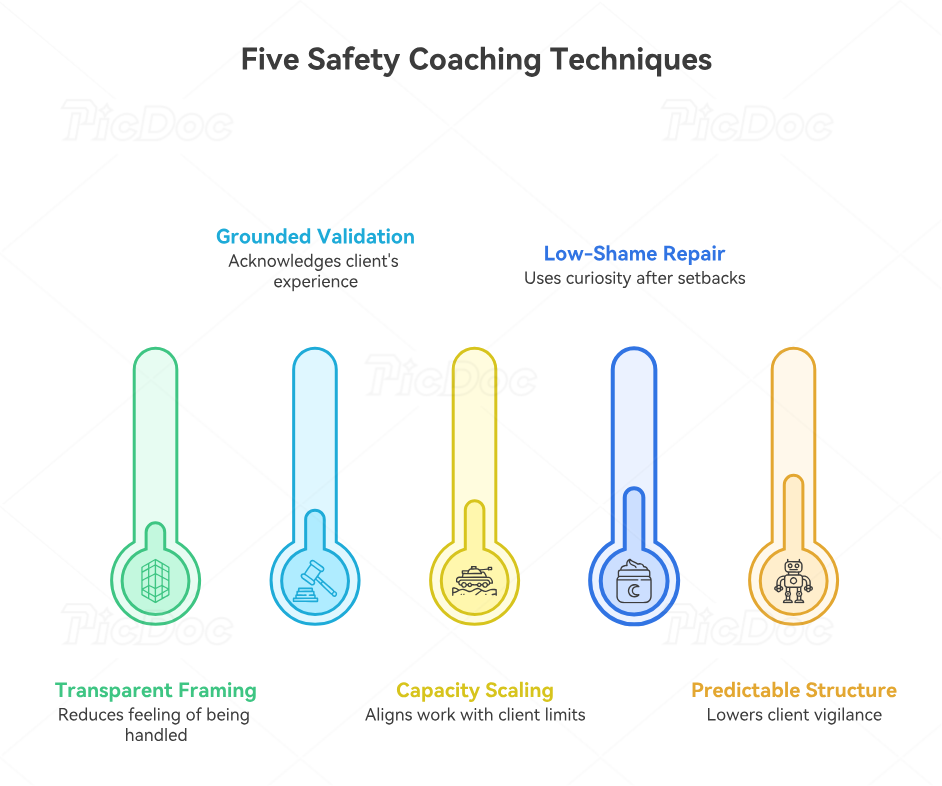
One of the strongest safety techniques is transparent framing. Before a hard question, explain why you are asking it. Before suggesting an exercise, ask whether the client wants to try it. Before offering perspective, check whether they want reflection or solutions. This sounds simple, but it dramatically reduces the feeling of being handled. Coaches who already use frameworks from appreciative inquiry the ultimate 2026 guide for coaches, solution-focused brief coaching sfbc the ultimate 2026 guide for coaches, transactional analysis ta the ultimate 2026 guide for coaches, and neuro-linguistic programming nlp techniques every coach should master get better results when they lead with consent and clarity rather than method intensity.
A second technique is grounded validation. Validation does not mean agreeing with every interpretation. It means acknowledging that the client’s inner experience makes sense in context. When a client says they shut down after one missed day, the coach does not need to approve the pattern. The coach needs to show they understand the pattern. That creates enough steadiness to examine it productively. This pairs well with mindfulness and meditation techniques for emotional coaching, inner critic management techniques the ultimate 2026 guide for coaches, gratitude journal coaching the ultimate 2026 guide for coaches, and daily journaling prompts the ultimate 2026 guide for coaches because the client can reflect more honestly once defensiveness drops.
A third technique is scaling the work to the client’s actual capacity. Safety disappears when the coach repeatedly assigns plans the client cannot realistically carry. It communicates that the client’s limitations are annoying rather than meaningful data. Safer coaching takes workload, season of life, emotional bandwidth, environment, and competing demands seriously. That thinking is strengthened by helping clients manage work-life balance successfully, effective strategies for coaching clients through burnout, stress management techniques every coach should know, and the importance of self-care coaching for client mental health.
A fourth technique is low-shame repair after a miss. The moment after a client falls off track is one of the highest-stakes moments in coaching. Many relationships weaken there because the coach becomes subtly disappointed, overly instructional, or too eager to recover progress. A safer response is calm curiosity. What changed. What got harder. What assumption broke. What support was missing. That approach aligns with how to actually change your clients life in 2026, new data proven coaching methods for maximum client success, how to set them and save your career, and why coaches must avoid this trap. Setbacks should generate insight, not identity damage.
A fifth technique is predictable structure. Some clients feel safest when there is space. Others feel safest when there is shape. A simple repeatable flow can help: arrival, check-in, main focus, action design, close. Predictability lowers vigilance. It helps anxious clients relax because they know what is coming. Even lighter-touch models like coaching automation next-level tools to grow your business faster, gamification tools coaches are using for maximum engagement, interactive coaching exercises to keep clients motivated, and how to build an interactive coaching community online work better when the emotional container is clear.
5. How Safety Improves Results, Boundaries, and Long-Term Client Trust
A safe coaching environment does not make coaching softer in the weak sense. It makes coaching more usable. Clients tell the truth sooner. They admit what they are avoiding. They reveal the friction points that actually matter. They stop wasting energy on impression management. That lets the coach intervene earlier and more precisely. In practical terms, that means better adherence, stronger self-awareness, cleaner action plans, and fewer fake wins. Coaches trying to improve both results and credibility should take seriously the overlap between safety and coaching case study templates demonstrating your value effectively, client testimonials capture the ultimate 2026 guide for coaches, benchmarking your coaching business industry standards and insights, and comprehensive guide to building a thriving coaching resource hub. Better trust usually produces better proof.
Safety also protects boundaries. That can sound counterintuitive, but it matters. When coaching feels unsafe, clients either withdraw or overattach. They may hold back until the session, then flood the space. Or they may seek extra reassurance outside agreed channels because the formal container feels emotionally unreliable. Clear, safe coaching reduces both extremes. That is why strong practice design should combine how to set clear professional boundaries with coaching clients, coaching confidentiality how to protect your clients and your practice, how technology is completely transforming the coaching industry, and balancing human touch with coaching automation for optimal results. Safety grows when warmth and clarity coexist.
It also improves referral quality. Clients do not usually refer coaches only because they got a result. They refer coaches because they felt deeply respected while getting that result. They remember how the relationship felt when they were discouraged, ashamed, confused, or slow to change. They remember whether your presence made honesty easier or harder. That emotional memory influences whether they recommend you to a friend, colleague, or family member.
On the coach side, safety reduces preventable burnout. Coaching becomes less draining when you are not forcing breakthroughs, managing unnecessary defensiveness, or repairing avoidable ruptures every week. A safer environment produces more direct conversations and fewer emotional landmines. That is valuable in every niche, from mental health coaching career guide building a thriving practice to financial coaching career blueprint essential steps for success to becoming a relationship coach your ultimate career pathway and launch your successful health coaching career complete roadmap.
The coaches who will keep winning are not just the ones with more tools. They are the ones who make clients feel safe enough to use those tools honestly.
6. FAQs About Creating a Safe Coaching Environment
-
A safe coaching environment feels clear, respectful, private, and emotionally steady. The client knows what to expect, understands the boundaries, feels heard before being guided, and trusts that setbacks or uncomfortable truths will not be met with shame, mockery, or impatience.
-
Not at all. Good coaching still challenges clients. The difference is that challenge is delivered inside trust rather than on top of fear. Safety makes honest challenge more effective because the client does not spend the whole conversation protecting themselves from the coach.
-
Common signs include surface-level updates, excessive people-pleasing, defensive explanations, frequent “I’m sorry” language, sudden compliance, ghosting after setbacks, and reluctance to discuss emotionally loaded situations. These often signal self-protection, not lack of motivation.
-
Repair it directly. Acknowledge what happened without defending your intent. Ask how the moment landed for them. Re-state their choice and pace. A simple, grounded repair often builds more trust than pretending nothing happened.
-
Safety comes from steadiness and clarity, not looseness. You can be warm while keeping strong boundaries. In fact, many clients feel safer when response times, communication channels, and scope are clearly defined.
-
Yes. Performance coaching still depends on honest disclosure. Clients need to admit what they are avoiding, where they are overcommitting, what they secretly resent, and which strategies are not working. Safety improves the quality of that information.
