
Life Purpose Coaching: Why It’s the Most Googled Coaching Topic
Life purpose questions rarely begin with a lack of ambition. They emerge when achievement, routine, identity, and wellbeing stop fitting together. Someone may have a respectable career, supportive relationships, and financial stability while still wondering why daily life feels directionless. Life purpose coaching converts that discomfort into structured exploration through emotional agility, strengths-based coaching, positive psychology, and behavior-change science. Its search appeal comes from addressing the question underneath countless career, relationship, health, and identity struggles: “What should I build my life around?”
1. Why Life Purpose Coaching Attracts Such Powerful Search Demand
“Most Googled” should be understood as a description of life purpose coaching’s unusually broad and persistent search appeal rather than a universally audited global ranking. Public search tools do not provide one permanent league table covering every coaching phrase, country, language, platform, and time period. Life purpose remains one of the strongest search themes because it sits above narrower concerns such as career direction, confidence, relationships, wellbeing, motivation, and personal growth.
A person searching for self-actualization coaching, life-balance guidance, mindset coaching, or emotional-intelligence development may ultimately be trying to resolve the same deeper problem. Their external life has developed faster than their internal definition of success. They can complete tasks, meet obligations, and chase milestones, yet they lack a meaningful principle for deciding which milestones deserve their energy.
This demand is intensified by life transitions. Graduation, career advancement, redundancy, entrepreneurship, parenthood, relocation, caregiving, divorce, illness, retirement, and bereavement can disrupt the identity that previously organized someone’s choices. The client may describe the experience as confusion, procrastination, low motivation, or burnout. A capable coach investigates the possibility that the person’s former direction has expired. Techniques from resilience coaching, transformational coaching, holistic coaching, and safe coaching practice can help clients rebuild direction without forcing premature certainty.
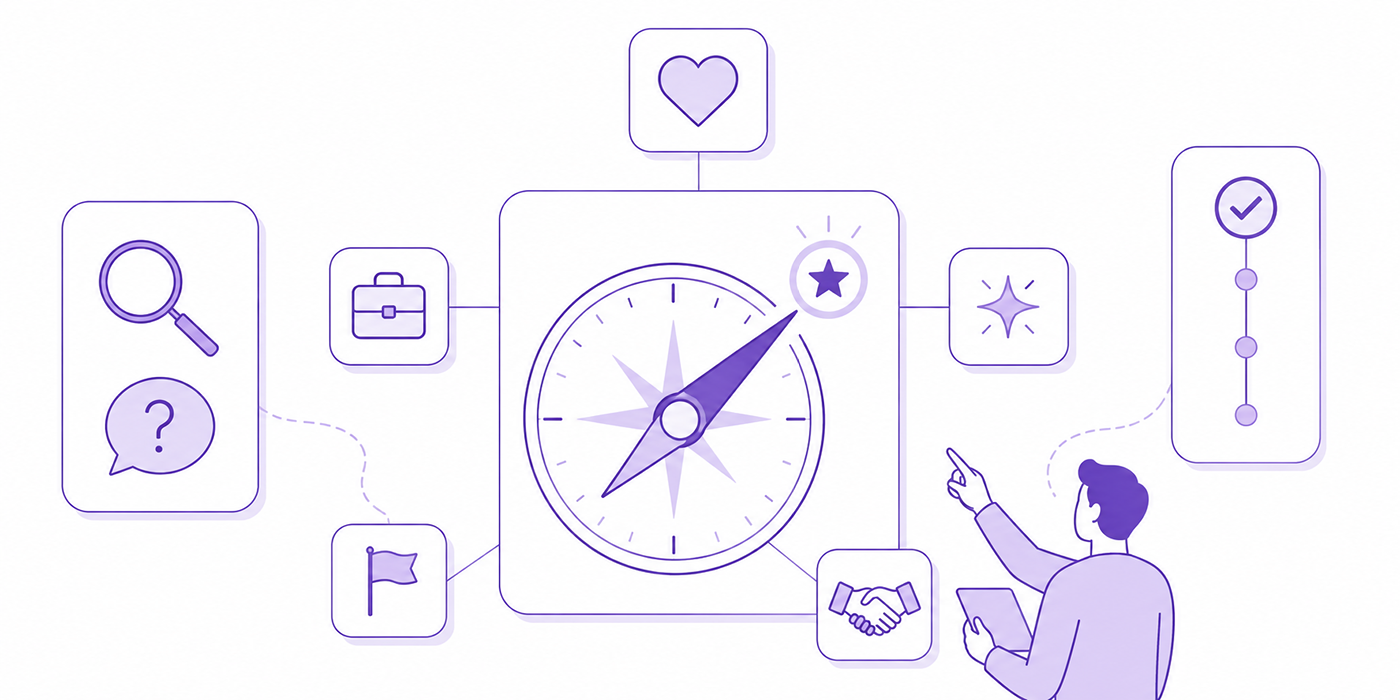
Modern culture also turns purpose into a performance standard. People are repeatedly told to find a calling, monetize a passion, create impact, build a legacy, and wake up inspired. This pressure can generate “purpose anxiety”: the fear that everyone else has discovered a defining mission while one’s own life remains scattered. Researchers and psychologists increasingly describe purpose as a flexible compass that can evolve through experience rather than a single hidden destiny that must be uncovered correctly.
That distinction changes the coaching process. Clients stop waiting for one dramatic revelation and begin gathering evidence from their values, strengths, frustrations, responsibilities, relationships, and energizing experiences. Micro-coaching can turn reflection into small experiments. Habit formation can stabilize meaningful activities. Accountability coaching can protect those activities from competing demands. Constructive feedback can help clients distinguish genuine alignment from temporary excitement.
Purpose also has relevance beyond personal development. Research connects a stronger sense of purpose with multiple dimensions of psychological, social, and physical wellbeing, although association alone does not prove that purpose directly causes every favorable outcome. Purpose can support identity, self-worth, belonging, self-concordant goals, and motivation to pursue health-supportive behaviors.
The commercial opportunity has expanded alongside the coaching profession. The International Coaching Federation’s 2025 study reported 122,974 coach practitioners globally and estimated annual industry revenue of $5.34 billion. Greater demand creates room for specialized offers, while the growing number of practitioners makes credibility, positioning, ethics, and measurable client value increasingly important. Coaches entering this niche need more than inspiring language. They need a repeatable method grounded in client-expectation management, certification portfolio development, professional accreditation, and scope-of-practice awareness.
2. What Clients Actually Need From Life Purpose Coaching
Clients frequently arrive asking for an answer. High-quality life purpose coaching gives them a process for producing better answers repeatedly. This matters because purpose evolves as responsibilities, abilities, relationships, health, and opportunities change. A fixed declaration may feel powerful during a session and collapse when it meets real life. A durable process helps clients use emotional agility, strengths-based reflection, positive psychology, and habit-based action whenever their direction needs recalibration.
The first client need is coherence. People experience coherence when their history, present choices, and desired future form an understandable story. Someone may feel scattered because their roles appear unrelated: parent, analyst, volunteer, athlete, caregiver, and aspiring entrepreneur. The coach can identify the values and capabilities connecting those roles. Perhaps the recurring theme is making complex situations understandable, creating safety, developing people, or restoring order. Transformational coaching, self-actualization work, life-balance tools, and constructive questioning help reveal that continuity.
The second need is significance. Clients want to know that their effort contributes to something they consider worthwhile. Significance can come through service, craftsmanship, care, creativity, learning, leadership, community, faith, family, problem-solving, or stewardship. Coaches should avoid ranking these sources according to visibility or income. Raising a child with emotional security may carry more purpose for one person than building a large company. Another client may need entrepreneurial creation to feel fully engaged. Holistic coaching, emotional-intelligence coaching, resilience coaching, and mindset development keep the definition client-owned.
The third need is direction. Values alone are too broad to organize a week. A client who values freedom, contribution, and family still needs to decide which opportunity to accept, which commitment to decline, and which project to pursue. Coaches can translate values into decision rules. “Family” might mean being emotionally available at dinner four evenings each week. “Contribution” might mean using analytical ability on problems affecting public health. “Freedom” might mean maintaining six months of savings before changing careers. Accountability coaching, behavior-change planning, expectation management, and micro-coaching turn inspiring concepts into observable choices.
The fourth need is agency. Some clients know what matters and feel unable to act on it. Financial obligations, family expectations, immigration status, caregiving, health limitations, workplace culture, discrimination, and limited access to opportunity can constrain their choices. Purpose coaching loses credibility when every barrier is reframed as mindset. The coach should distinguish controllable decisions, negotiable constraints, current realities, and structural limitations. Creating a safe coaching environment, handling difficult client situations, coaching through economic changes, and supporting emotional stress allow ambition to remain grounded.
The fifth need is belonging. Purpose often grows through relationship rather than solitary introspection. People discover meaningful roles when others trust them, need them, challenge them, or invite them into contribution. Coaches can examine which communities strengthen the client’s values, which relationships suppress growth, and where the client lacks meaningful participation. Networking for coaches, relationship-focused emotional intelligence, safe-environment design, and exceptional client experiences demonstrate how meaningful connection can support sustained development.
The sixth need is permission to evolve. Clients often remain attached to goals that once gave them status, identity, security, or parental approval. Releasing those goals can feel like wasting education, disappointing others, or admitting that years were spent on the wrong path. A coach can help the client recover the skills, relationships, and knowledge gained from the previous chapter while choosing a more suitable direction. Emotional agility, resilience coaching, transformational methods, and positive psychology help clients treat transition as development rather than personal collapse.
3. A Practical Framework for Helping Clients Build Purpose
The first stage is purpose-pressure reduction. Coaches should identify where the client learned that one perfect calling exists and what they fear will happen without it. This reveals whether the search is driven by curiosity, social comparison, panic, grief, career dissatisfaction, or a desire to escape current discomfort. A client trying to flee a difficult manager needs a different intervention from someone whose entire professional identity has lost meaning. Managing expectations, understanding anxiety and stress, creating psychological safety, and handling difficult conversations prevent the coach from solving the wrong problem.
The second stage is evidence collection. Ask the client to identify moments of absorption, pride, moral courage, usefulness, connection, learning, anger, envy, and sustained curiosity. Each emotion contains information. Anger may reveal a violated value. Envy may identify a suppressed aspiration. Pride may expose a strength the client wants to use more often. Absorption may show the type of challenge that engages them. Strengths-based coaching, emotional-intelligence development, positive psychology, and self-actualization coaching provide useful lenses for interpreting this evidence.
The third stage is pattern extraction. Coaches can sort the evidence into four categories: values the client wants to express, strengths they enjoy using, people or problems they care about, and conditions that support their best functioning. A purpose hypothesis can then be written as: “I want to use these strengths, in service of these people or problems, while expressing these values, under these conditions.” This remains a working hypothesis. Holistic coaching, life-balance assessment, behavior-change science, and constructive feedback help refine it through experience.
The fourth stage is purpose prototyping. Instead of asking the client to redesign their entire life, create small tests. Someone considering education could tutor one student, design a workshop, or interview three teachers. Someone drawn to community health could volunteer, complete a short course, or shadow a relevant professional. Someone seeking creative purpose could publish a small project before resigning from a stable job. Micro-coaching, habit stacking, accountability coaching, and transformational coaching make exploration affordable and measurable.
The fifth stage is constraint-aware planning. Every purpose experiment should specify time, cost, risk, support, skills, family impact, health considerations, and exit conditions. A financially responsible transition may involve keeping the current job while building evidence, savings, qualifications, and contacts. Coaches can support the behavioral and decision-making process while qualified financial, legal, medical, or mental-health professionals address issues within their fields. Financial forecasting principles, legal requirements, scope-of-practice guidance, and coaching through economic uncertainty protect clients from impulsive reinvention.
The sixth stage is integration. Purpose becomes credible when it appears in the calendar, budget, boundaries, relationships, and repeated choices. The client should identify one weekly action that expresses each central value. A person who values contribution might mentor someone for one hour. A client who values creativity might protect a Saturday morning project block. Someone prioritizing family connection might establish a device-free meal. Habit formation, coaching automation, accountability systems, and client feedback help convert meaning into consistent behavior.
The seventh stage is review and revision. Coaches should ask what gave energy, what created useful impact, what felt performative, what became unsustainable, and what deserves another test. Progress should include improved decision quality, stronger boundaries, increased engagement, clearer priorities, faster recovery after doubt, and more time spent on meaningful activity. Constructive feedback, client-expectation management, case-study development, and transformational behavior strategies support disciplined iteration.
4. How Life Purpose Coaching Influences Health, Work and Relationships
Purpose can shape health behavior by giving difficult actions a personally meaningful reason. Exercise may become a way to remain capable for parenting, travel, service, or creative work. Sleep may become preparation for leadership rather than a generic wellness obligation. Medical adherence may feel more relevant when connected to independence or family participation. Research has associated purpose with healthier behavior and several favorable wellbeing outcomes, although responsible coaches should avoid promising that purpose work will prevent or treat disease. Lifestyle medicine coaching, preventive health coaching, habit stacking, and metabolic health coaching can connect purpose with sustainable routines.
Career decisions also improve when purpose is translated into criteria. Clients can evaluate whether they need a new profession, a better organization, a different role, greater autonomy, more challenge, or meaningful activity outside employment. Many people burden their careers with the responsibility of supplying income, identity, community, creativity, impact, growth, and enjoyment simultaneously. Purpose coaching can diversify these needs across work, family, learning, service, relationships, and personal projects. Life-balance coaching, self-actualization coaching, strengths-based coaching, and mindset development support this broader architecture.
Relationships change when clients identify which values they want to express through connection. Someone who values honesty may need clearer communication. A client who values growth may seek relationships that support learning and challenge. Someone who values care may need boundaries that prevent care from becoming exhaustion or resentment. Emotional-intelligence coaching, constructive feedback, creating safe coaching environments, and handling difficult situations help clients align relationships with their values while respecting other people’s autonomy.
Purpose coaching can also improve resilience during disruption. A career loss, health limitation, or relationship ending may remove one expression of purpose while leaving the underlying values intact. A person who expressed contribution through management may later express it through teaching, mentoring, volunteering, or caregiving. The form changes while the central value survives. Resilience coaching, emotional agility, transformational coaching, and positive psychology help clients preserve meaning through changing circumstances.
Coaches must watch for situations requiring therapy or other licensed support. Persistent hopelessness, severe loss of interest, trauma symptoms, suicidal thinking, substance misuse, disordered eating, mania, psychosis, and major functional impairment require appropriate clinical assessment. Existential questions can appear inside both ordinary development and serious mental-health distress. Coaches need referral protocols, emergency procedures, informed consent, and a clear professional scope. Supporting clients during emotional crises, understanding anxiety and stress, NBHWC scope guidance, and ICF ethics preparation strengthen client safety.

5. How to Build a Credible Life Purpose Coaching Practice
A strong offer begins with a defined client transition. “Helping people find their purpose” is emotionally attractive and operationally vague. More credible positioning might support mid-career professionals who feel successful yet misaligned, entrepreneurs rebuilding direction after burnout, parents redefining identity after caregiving, or retirees designing a meaningful next chapter. Specificity improves referrals, messaging, program content, and outcome tracking. High-ticket coaching offer design, networking strategy, joint ventures, and case-study creation can strengthen positioning.
Your methodology should be visible. Prospective clients need to understand what happens between uncertainty and direction. A structured program might include a purpose-pressure assessment, identity timeline, values evidence audit, strengths analysis, meaning portfolio, purpose hypotheses, decision criteria, real-world experiments, and a 90-day integration plan. Certification portfolio development, CPD accreditation, certification maintenance, and accreditation comparison can help demonstrate professional development behind the method.
Program length should allow discovery, testing, and adaptation. A single clarity session may help a client organize thoughts, while deeper identity and career transitions usually require evidence gathered over time. An eight- to twelve-week program can provide enough space for experiments, reviews, and integration without creating indefinite dependence. Between-session support can include reflective prompts, short accountability check-ins, decision worksheets, and progress dashboards. Coaching automation, must-have coaching tools, micro-coaching, and client-retention strategies can support delivery without replacing thoughtful human judgment.
Pricing should reflect depth, specialization, access, preparation, administration, and the real delivery cost. Coaches who sell isolated hours may overlook assessment time, between-session review, technology, documentation, follow-up, and business overhead. Packages should state the outcome, process, boundaries, support level, duration, and client responsibilities. Financial forecasting, payment-system design, tax planning, and profitable practice scaling help coaches build financially sustainable services.
Marketing should speak to recognizable moments rather than abstract inspiration. “You achieved what you were told to want and still feel disconnected” addresses a concrete emotional experience. “You have several possible paths and keep delaying the decision” identifies an urgent behavioral problem. “Your old identity ended, and your next chapter has no structure” speaks to transition. Content can then demonstrate how the coach resolves each problem. Crafting credible case studies, turning feedback into growth, exceptional client experiences, and industry networking build trust more effectively than inspirational claims.
Outcome measurement should focus on decisions and behavior. Useful indicators include clearer priorities, reduced decision delay, stronger confidence, completed purpose experiments, values-aligned calendar changes, improved boundaries, greater engagement, and faster recovery after setbacks. A purpose statement alone provides weak evidence of change. Coaches can document the client’s starting barrier, methods used, experiments completed, adaptations made, and measurable outcomes with permission and appropriate confidentiality. Client-feedback systems, accountability methods, constructive feedback, and case-study development support ethical proof.
6. Frequently Asked Questions About Life Purpose Coaching
-
Life purpose coaching is a structured process that helps clients identify meaningful values, strengths, contributions, relationships, and life conditions, then convert those insights into decisions and action. The coach uses inquiry, reflection, experimentation, accountability, and review rather than supplying a predetermined calling. Effective practice can integrate self-actualization coaching, strengths-based coaching, positive psychology, and behavior-change science.
-
The client should retain ownership of meaning, values, and direction. A coach can identify patterns, challenge assumptions, reveal contradictions, and design experiments that produce better evidence. Declaring someone’s purpose can create dependence and pressure the client to accept an identity that feels impressive inside a session yet performs poorly in life. Creating a safe coaching environment, managing expectations, constructive feedback, and coaching ethics support client autonomy.
-
Purpose can include several evolving commitments rather than one permanent mission. A person may find meaning through parenting, work, creative expression, service, learning, relationships, spirituality, or community at different life stages. The most useful purpose provides direction while remaining adaptable. Emotional agility, resilience coaching, holistic coaching, and life-balance coaching help clients build a diversified meaning portfolio.
-
Career coaching concentrates primarily on professional direction, job-search strategy, advancement, performance, or workplace decisions. Life purpose coaching examines the broader system of values, identity, relationships, contribution, wellbeing, work, and lifestyle. Career may become one expression of purpose, while meaning can also come from family, community, learning, creativity, or service. Self-actualization coaching, mindset development, strengths-based coaching, and transformational coaching support the wider exploration.
-
Life purpose coaching usually focuses on client-led goals, present choices, future direction, experimentation, and accountability. Therapy can assess and treat mental-health conditions, trauma, severe distress, and complex psychological patterns within a licensed clinical relationship. Coaches should screen for concerns requiring qualified clinical support and maintain clear referral procedures. Emotional-crisis support boundaries, anxiety-aware coaching, scope-of-practice guidance, and legal requirements provide essential safeguards.
-
Clients may identify useful patterns within several sessions, while confident direction usually grows through real-world testing. The time required depends on the complexity of the transition, emotional readiness, available resources, current responsibilities, and opportunities for experimentation. Coaches should measure progress through decision quality and meaningful action rather than waiting for perfect certainty. Micro-coaching, habit formation, accountability coaching, and transformational behavior change can accelerate evidence gathering.
