
Health information rarely fails because clients lack another meal plan, sleep tip, or exercise target. Progress collapses when recommendations collide with exhaustion, family demands, limited budgets, unpredictable schedules, and years of reinforced habits. Lifestyle medicine gives health coaches a stronger framework for addressing that implementation gap. By connecting behavior-change science, habit formation, preventative health coaching, and client accountability, coaches can help clients turn clinically appropriate guidance into routines that survive real life.
1. What Lifestyle Medicine Means for Health Coaches
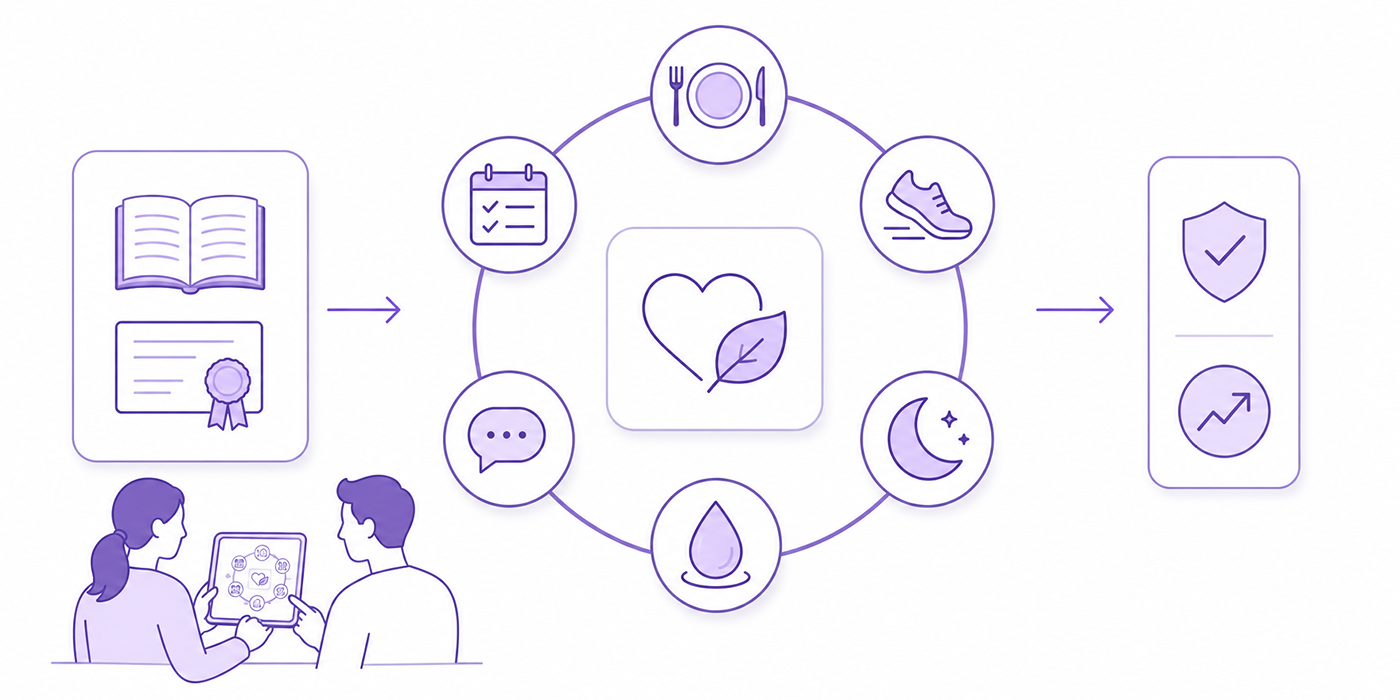
Lifestyle medicine is an evidence-based medical specialty that uses therapeutic lifestyle interventions to help prevent, treat, and, in appropriate clinical settings, place certain chronic conditions into remission. The American College of Lifestyle Medicine organizes the field around six interconnected pillars: nutrition, physical activity, restorative sleep, stress management, positive social connection, and avoidance of risky substances.
For health coaches, the central opportunity lies in implementation. A physician, registered dietitian, physiotherapist, psychologist, or another licensed professional may establish the clinical plan. The coach helps the client understand their own motivation, identify barriers, select realistic actions, review progress, and recover from setbacks. This role aligns with the NBHWC scope of practice, health-coaching accountability, client-centered habit formation, and safe coaching environments.
The National Board for Health & Wellness Coaching defines coaching as an evidence-based, client-centered process that supports people in developing self-determined health goals, committing to action, and establishing accountability. Its scope gives health coaches a powerful lane while reserving diagnosis, prescribing, treatment planning, and individualized clinical advice for appropriately licensed professionals.
That distinction matters because clients often arrive with a damaging pattern: they have collected information from appointments, apps, podcasts, social media, laboratory reports, and restrictive programs, yet they cannot convert it into consistent behavior. They may understand that sleep matters while answering work messages at midnight. They may own exercise equipment while fearing another failed routine. They may receive nutrition guidance while living in a household that resists every change.
A lifestyle-medicine-informed coach can investigate the behavioral system surrounding the recommendation. That system includes the client’s schedule, identity, confidence, environment, relationships, emotional triggers, financial limits, access to healthy options, previous experiences, and readiness for change. This wider analysis strengthens transformational coaching, emotional-intelligence coaching, stress-management coaching, and constructive client feedback.
Consider a client instructed by their healthcare professional to become more physically active. A weak coaching response produces a generic target and weekly reminder. A stronger response explores when movement previously felt enjoyable, which commitments consume the client’s energy, whether pain requires clinical review, how safe the local environment feels, what forms of movement are affordable, who can provide support, and what minimum action remains possible during a difficult week.
The coach might help the client establish three levels:
Baseline action: A five-minute walk after lunch.
Standard action: A 20-minute walk on four weekdays.
Expansion action: A longer weekend session approved for the client’s circumstances.
This structure protects continuity. One disrupted day no longer turns into a lost month. The same principle can be used with micro-coaching, gamification strategies, coaching automation, and client-retention systems.
| Lifestyle Area | Client Barrier | Coaching Response | Useful Progress Marker | Scope Safeguard |
|---|---|---|---|---|
| Nutrition | Client attempts a complete dietary overhaul and quits within days. | Select one repeatable meal, shopping, or food-preparation behavior. | Behavior completed on four or more days each week. | Use guidance already provided by a qualified clinician or dietitian. |
| Nutrition | Healthy ingredients are purchased and repeatedly wasted. | Audit storage, preparation time, household preferences, and meal timing. | Percentage of purchased ingredients actually used. | Avoid prescribing individualized therapeutic diets. |
| Nutrition | Client overeats during stressful evenings. | Map the trigger, emotional need, environment, and alternative response. | Number of evenings when the planned coping response is attempted. | Refer when eating-disorder symptoms or serious distress appear. |
| Nutrition | Family members resist dietary changes. | Design shared meals with optional modifications instead of separate systems. | Number of agreed family meals completed weekly. | Keep nutritional recommendations within the client’s clinical plan. |
| Nutrition | Client relies on convenience food during long workdays. | Create an emergency-food plan for predictable high-pressure periods. | Reduced unplanned purchases during identified risk windows. | Consider allergies and medical restrictions already documented. |
| Physical activity | Client chooses workouts that exceed current capacity. | Build baseline, standard, and expansion versions of the activity. | Weeks completed without abandoning the routine. | Request medical clearance when symptoms or risks warrant it. |
| Physical activity | Exercise is associated with embarrassment or punishment. | Explore enjoyable movement, privacy needs, and previous negative experiences. | Client-rated enjoyment and willingness to repeat the activity. | Refer pain, injury, dizziness, or mobility concerns appropriately. |
| Physical activity | The client claims to have no time for movement. | Use calendar evidence to locate brief movement opportunities. | Number of movement breaks completed during existing routines. | Do not design rehabilitation or injury-treatment programs. |
| Physical activity | Progress depends entirely on motivation. | Attach movement to a stable cue and prepare equipment in advance. | Percentage of cue-linked sessions started. | Adjust goals when clinical professionals change the activity plan. |
| Physical activity | One missed session leads to a week of avoidance. | Create a 24-hour restart rule and a minimum recovery action. | Average time required to resume after disruption. | Investigate persistent fatigue through appropriate referral. |
| Sleep | Client keeps an inconsistent bedtime. | Begin with a stable wake time and a short wind-down anchor. | Variation in sleep and wake timing across the week. | Refer suspected sleep disorders for clinical assessment. |
| Sleep | Late-night screen use repeatedly delays sleep. | Redesign charging locations, notifications, and evening cues. | Number of device-free wind-down periods completed. | Avoid diagnosing insomnia or recommending medication changes. |
| Sleep | Client sacrifices sleep to finish unfinished work. | Audit workload, perfectionism, boundaries, and shutdown routines. | Number of evenings ending at the planned work cutoff. | Refer severe anxiety, mania, or persistent sleep impairment. |
| Sleep | Sleep goals collapse during travel or caregiving. | Create a disruption plan with one protected sleep-supporting behavior. | Speed of returning to the normal routine. | Account for shift work, pregnancy, illness, and caregiving realities. |
| Sleep | The client tracks sleep obsessively and becomes more anxious. | Reduce measurement frequency and focus on daytime functioning. | Lower anxiety around imperfect tracking data. | Escalate distress or compulsive behavior to a qualified professional. |
| Stress management | The client notices stress only after becoming overwhelmed. | Identify early physical, emotional, and behavioral warning signs. | Earlier use of a selected regulation strategy. | Refer trauma symptoms or acute mental-health concerns. |
| Stress management | Relaxation practices feel like another obligation. | Choose a brief practice that fits the client’s preferences and environment. | Use of the practice during real stress rather than ideal conditions. | Avoid representing coaching exercises as psychotherapy. |
| Stress management | Workplace pressure continuously overrides health commitments. | Develop boundary language, escalation rules, and recovery blocks. | Protected breaks and workload conversations completed. | Respect employment, financial, and cultural constraints. |
| Stress management | The client uses productivity to avoid uncomfortable emotions. | Build awareness of avoidance patterns and create a pause before action. | Frequency of pausing and identifying the underlying need. | Refer persistent emotional distress beyond coaching competence. |
| Stress management | A setback triggers harsh self-criticism. | Use a factual debrief covering trigger, response, lesson, and restart. | Reduced time spent disengaged after setbacks. | Avoid making clinical claims about mood disorders. |
| Social connection | The client lacks support for health changes. | Map available allies and request one specific form of support. | Number of support requests made and received. | Respect confidentiality and relationship boundaries. |
| Social connection | Social events repeatedly disrupt planned behaviors. | Prepare flexible choices and a post-event return plan. | Ability to resume without compensatory extremes. | Avoid moral language around food, weight, or social participation. |
| Social connection | The client feels isolated while working remotely. | Schedule recurring low-friction contact and community participation. | Meaningful interactions completed each week. | Refer significant depression, withdrawal, or safety concerns. |
| Social connection | Household conflict weakens every health routine. | Clarify shared expectations and negotiate one practical agreement. | Adherence to the agreed household support behavior. | Refer abuse, coercion, or serious relationship instability. |
| Social connection | The client has many contacts and little emotional support. | Differentiate companionship, practical help, accountability, and intimacy. | Growth in the form of connection the client actually needs. | Maintain professional boundaries and avoid becoming the sole support. |
| Risky substances | Alcohol is embedded in the client’s social routine. | Explore triggers, values, alternatives, and support options. | Progress toward the goal established with qualified care providers. | Refer suspected dependence, withdrawal risk, or loss of control. |
| Risky substances | Nicotine use is connected to stress relief and work breaks. | Map cues and support adherence to an approved cessation plan. | Use of replacement break routines and clinical support. | Medication and cessation treatment remain with licensed professionals. |
| Risky substances | The client minimizes harmful behavior because it is socially accepted. | Use nonjudgmental discrepancy questions linked to the client’s values. | Greater accuracy and openness in self-monitoring. | Prioritize safety and urgent referral where necessary. |
| Whole-person integration | The client tries to improve all six pillars simultaneously. | Select the keystone behavior most likely to improve other areas. | One stable behavior maintained before expansion. | Coordinate priorities with the client’s clinical team when applicable. |
| Whole-person integration | Tracking becomes complicated and unsustainable. | Measure one behavior, one outcome, and one barrier each week. | Completion of the tracking process itself. | Protect health data and collect only what is genuinely necessary. |
This matrix supports behavior-change coaching. Clinical assessment, diagnosis, treatment, prescribing, rehabilitation, and therapeutic nutrition require appropriately qualified professionals.
2. The Six Lifestyle Medicine Pillars and Where Coaching Adds Value
Lifestyle medicine gives coaches a whole-person map. Clients experience these pillars as a connected system. Poor sleep can increase fatigue, weaken planning, reduce movement, intensify stress, and make food decisions more difficult. Isolation can reduce accountability and encourage risky coping behaviors. A coach trained to identify these relationships can find a smaller intervention with wider benefits.
Nutrition: Move from information overload to repeatable systems
Nutrition coaching within an appropriate scope focuses on implementing suitable guidance. The coach can help a client translate a clinician’s recommendation into shopping routines, meal-preparation decisions, household agreements, workplace strategies, and backup plans.
The most valuable question often concerns friction: What repeatedly makes the intended choice harder at the moment it must be made?
Possible answers include an empty refrigerator, rushed mornings, family resistance, limited cooking skills, emotional eating, social pressure, irregular income, or an exhausting commute. Each barrier requires a different response. Generic encouragement fails because it treats unequal problems as though they have one cause.
A coach can use habit-formation tools, behavioral coaching strategies, client accountability, and realistic expectation management to create a food environment that supports the approved plan.
Useful interventions include:
Creating a list of three dependable meals for demanding days.
Pairing grocery ordering with an existing weekly event.
Preparing one ingredient that reduces several later decisions.
Establishing a hunger, stress, and environment check before unplanned eating.
Designing a flexible social-event strategy.
Reviewing which part of the plan creates the most waste, cost, or resentment.
Physical activity: Design movement that clients can repeat
A client can intellectually accept the value of movement and still associate exercise with shame, pain, boredom, public scrutiny, or previous failure. The coach’s first task may involve rebuilding the client’s relationship with movement.
The goal should match the client’s clinical situation, preferences, access, and current capacity. The coach can help identify enjoyable options, develop cue-based routines, prepare lower-intensity alternatives, and establish a rapid restart protocol. International guidance commonly encourages adults to accumulate regular aerobic activity alongside muscle-strengthening work, with adjustments for health status and ability. Individual recommendations belong with qualified healthcare professionals.
Movement adherence improves when clients apply micro-coaching principles, gamified engagement, strength-based coaching, and automated coaching reminders.
Progress markers may include:
Sessions started rather than calories burned.
Minutes of movement accumulated.
Sedentary periods interrupted.
Enjoyment after activity.
Recovery after a missed session.
Confidence in adapting the routine during difficult weeks.
Restorative sleep: Coach the behaviors surrounding sleep
Sleep creates a distinctive coaching challenge because effort cannot force sleep directly. Clients can influence the conditions surrounding it: timing, light exposure, device use, caffeine decisions, work boundaries, wind-down routines, bedroom environment, and consistency.
A coach can help the client identify which evening behaviors are controllable. For someone working late from fear of falling behind, a sleep checklist will have limited impact until workload beliefs and shutdown boundaries are addressed. For a parent or shift worker, an idealized routine may be impossible. Their plan needs to respect actual responsibilities.
This work combines stress-management coaching, emotional intelligence, mindset shifts, and habit-change science. Persistent insomnia, suspected sleep apnea, severe daytime sleepiness, or unusual sleep behavior requires clinical assessment.
Stress management: Replace vague relaxation goals with usable responses
Clients frequently describe stress as one large, permanent condition. Coaching makes it more workable by separating stressors, warning signs, interpretations, automatic responses, available resources, and recovery practices.
A client may discover that their main issue involves a missing boundary rather than a missing breathing exercise. Another may require a shorter gap between noticing stress and using support. A third may need to redesign the environment producing repeated overload.
The coach can create a stress-response ladder:
Notice the earliest physical or behavioral signal.
Name the immediate stressor.
Distinguish controllable and uncontrollable elements.
Choose the smallest effective response.
Request support or escalation when required.
Review recovery rather than demanding perfect prevention.
This method can be strengthened by guided imagery, constructive feedback, safe coaching practices, and crisis-support boundaries.
Positive social connection: Treat relationships as health infrastructure
Social connection influences whether a client can sustain change. Households affect food availability, sleep routines, stress, substance use, and movement. Friends can normalize healthy behaviors or make every boundary feel socially expensive. Workplaces can provide support or reward chronic overextension.
A lifestyle-medicine-informed coach asks more precise questions:
Who benefits from the client staying the same?
Who can make the new behavior easier?
What support has the client expected without clearly requesting?
Which relationship repeatedly destabilizes the plan?
Does the client need emotional encouragement, practical assistance, companionship, or accountability?
Which community could make the desired behavior feel normal?
These questions connect naturally with relationship coaching, emotional-intelligence development, network-building strategies, and exceptional client experiences.
Avoidance of risky substances: Support change without exceeding scope
Risky-substance work requires exceptional scope awareness. A coach may help a client clarify motivation, notice triggers, follow a professionally established plan, prepare alternative coping behaviors, and use accountability. Suspected dependence, withdrawal risk, overdose risk, impaired control, or serious psychological distress requires prompt referral to qualified care.
The coach’s language should remain nonjudgmental. Shame can reduce honesty, and reduced honesty damages safety. The coach can explore discrepancies between the client’s behavior and stated values while preserving autonomy.
Relevant competencies include handling difficult client situations, understanding coaching boundaries, managing client expectations, and maintaining ethical professional practice.
3. Why Health Coaches Are Learning Lifestyle Medicine Now
The global burden of chronic disease creates an urgent implementation problem. The World Health Organization reports that noncommunicable diseases caused at least 43 million deaths in 2021 and accounted for 75% of non-pandemic-related deaths worldwide. Cardiovascular diseases, cancers, chronic respiratory diseases, and diabetes make up the majority of these deaths.
The pressure appears across healthcare systems. In the United States, chronic diseases remain leading causes of death and disability and major drivers of approximately $5.3 trillion in annual healthcare expenditure. Recent CDC analysis also found that chronic conditions affect adults across the life course, including roughly six in ten young adults, eight in ten midlife adults, and nine in ten older adults in the study population.
These numbers create demand for professionals who can support sustained behavior change. A medical appointment may identify risk, explain treatment, and set priorities. Daily implementation happens in kitchens, workplaces, bedrooms, supermarkets, family systems, commutes, and stressful moments. Health coaches operate inside that gap through preventative health coaching, behavior-change methods, accountability structures, and habit-support systems.
Clients are exhausted by fragmented wellness advice
One expert discusses food. Another addresses sleep. A third recommends exercise. An app records steps. A wearable reports recovery. Social media adds conflicting rules. The client becomes responsible for integrating everything while already overwhelmed.
Lifestyle medicine provides an organizing framework. Coaches can help clients sequence priorities, identify a keystone behavior, and understand how one change affects the remaining pillars. A consistent sleep-supporting routine may improve energy for movement. Greater social support may strengthen meal preparation. Better stress awareness may reduce several impulsive behaviors.
This whole-person structure supports holistic coaching decisions, future-proof coaching practices, client-experience improvement, and personalized coaching technology.
Healthcare increasingly needs behavior-change partners
NBHWC describes credentialed health and wellness coaches as behavior-change agents who help clients create lasting, self-directed changes aligned with their values. Its recent materials also position coaches as potential supporters of nutrition, movement, stress management, sleep, medication adherence, and overall wellbeing while remaining inside their professional scope.
This makes lifestyle-medicine knowledge valuable in multidisciplinary settings. A coach who understands the language of the six pillars can communicate more effectively with physicians, dietitians, therapists, physiotherapists, nurses, and wellness teams. They can document barriers with greater precision, recognize referral needs earlier, and support the client without contradicting clinical guidance.
The American College of Lifestyle Medicine currently provides education specifically for coaches and offers lifestyle-medicine learning pathways for health professionals, reflecting the field’s movement toward interprofessional delivery.
Health coaching must deliver more than motivation
Clients can obtain generic motivation free of charge. They pay for accurate interpretation, strong questions, realistic planning, careful accountability, and a method that identifies why previous attempts collapsed.
Lifestyle-medicine education gives coaches a richer problem-solving vocabulary. Instead of labeling a client “unmotivated,” the coach can investigate sleep debt, stress load, social resistance, low confidence, environmental friction, unrealistic targets, poor sequencing, or a goal chosen for the wrong reason.
This depth improves coaching case studies, client-feedback analysis, coaching-business differentiation, and high-value program design.
Digital tools require human interpretation
Wearables, food logs, sleep trackers, online portals, digital scales, remote monitoring, and AI-generated recommendations can produce more data than clients know how to use. Excessive measurement can also create guilt, confusion, or obsessive checking.
A trained coach can help the client select a useful metric, connect data with context, and prevent a disappointing number from becoming an identity judgment. The coach might ask what happened before the low-activity day, which barrier can be adjusted, and what action remains realistic today.
This creates opportunities for coaching automation, technology-enabled coaching, micro-coaching support, and gamified client engagement. Technology supplies signals. Skilled coaching turns those signals into decisions.
Votes are stored anonymously in this browser and contain no personal or health information.
4. How to Build a Lifestyle Medicine Coaching Program Clients Can Follow
A lifestyle medicine program should resist the temptation to cover all six pillars equally from the first session. Clients rarely need six simultaneous goals. They need the right starting point, a manageable action, and a system for learning from the result.
A practical program can follow a 12-week structure combining behavior-change science, habit-building methods, accountability coaching, and client feedback.
Week 0: Screening, scope, and readiness
Before setting goals, confirm that coaching is appropriate. Collect only information needed to support the engagement, explain privacy and confidentiality, describe the coaching scope, and document relevant clinical guidance the client has received.
The readiness conversation should explore:
Why the client wants change now.
Which professional recommendations they are already following.
What previous attempts looked like.
Which symptoms or conditions require clinical oversight.
What support is available.
Which life pressures may limit capacity.
How the coach and client will measure progress.
Which developments will trigger referral.
This phase protects coaching ethics, strengthens client expectations, reduces difficult coaching situations, and creates a safe coaching environment.
Weeks 1–2: Complete a six-pillar lifestyle audit
The audit should reveal patterns rather than generate judgment. Review each pillar through behavior, environment, confidence, support, and current clinical guidance.
For every pillar, ask:
What is working already?
What creates the most difficulty?
What consequence does the client feel most strongly?
Which action has been attempted before?
What caused the attempt to collapse?
What resources are available now?
Which change might improve several areas at once?
The coach may discover that sleep is the keystone. Improving the evening shutdown process could increase morning energy, lower stress, and make movement easier. Another client may benefit more from social support because isolation is undermining every other plan.
The audit works best with strengths-based coaching, emotional-intelligence tools, guided visualization, and mindset coaching.
Weeks 3–4: Select one keystone behavior
A keystone behavior provides wider benefits or makes other behaviors easier. It must be meaningful to the client, achievable with current capacity, and connected with approved clinical priorities.
Examples include:
Preparing tomorrow’s breakfast after dinner.
Walking for ten minutes after a regular meal.
Ending work at a defined time three evenings each week.
Charging the phone outside the bedroom.
Contacting one supportive person every Sunday.
Following a clinician-approved medication reminder routine.
Using a two-minute pause before a known stress-triggered behavior.
Define the behavior with six elements:
Action: What the client will do.
Cue: When or where it begins.
Frequency: How often it will occur.
Minimum version: What counts on a difficult day.
Evidence: How completion will be recorded.
Recovery rule: How the client restarts after disruption.
This structure turns habit theory into practical action, strengthens coaching accountability, supports micro-coaching, and reduces the pressure addressed through client-anxiety coaching.
Weeks 5–7: Remove friction from the environment
Motivation becomes less decisive when the environment makes the behavior easier. The coach should examine physical layout, timing, access, reminders, social expectations, competing behaviors, and preparation.
A movement goal may require shoes by the door, a protected calendar block, a safe indoor alternative, and an agreement with a family member. A nutrition goal may require ordering groceries before the week becomes chaotic. A sleep goal may require changing where devices charge and clarifying when colleagues can expect a response.
Use a simple friction audit:
What must happen before the behavior can begin?
Which step is most likely to fail?
Can that step be removed, simplified, automated, or completed earlier?
Which competing behavior is currently easier?
What reward follows the desired behavior?
Who needs to cooperate?
Environmental design pairs effectively with coaching technology, business and client automation, gamification techniques, and exceptional client experiences.
Weeks 8–9: Add a connected pillar
Expansion should occur after the first behavior has enough stability. Choose a second pillar that supports the first.
Examples include:
Pairing a walking routine with social connection.
Pairing meal preparation with an earlier work shutdown.
Pairing stress regulation with sleep preparation.
Pairing substance-use support with alternative social activities.
Pairing morning light exposure with a short outdoor walk.
The purpose is integration. Clients learn to build a mutually reinforcing lifestyle rather than collecting isolated habits.
Weeks 10–11: Prepare for predictable disruptions
A routine tested only under ideal conditions remains fragile. Coaches should rehearse common disruptions: travel, illness, deadlines, caregiving, celebrations, financial pressure, poor sleep, low motivation, and family conflict.
Create three plans:
The minimum plan preserves continuity during difficult periods.
The return plan specifies the first action after a lapse.
The escalation plan identifies when the client should contact a clinician or another qualified professional.
This preparation builds resilient habit formation, improves client retention, prevents expectation-related discouragement, and supports constructive coaching feedback.
Week 12: Transfer ownership to the client
The final session should demonstrate that the client can manage the system without dependence on the coach. Review which interventions worked, what the client learned about their barriers, which warning signs predict difficulty, and how future goals will be selected.
A useful graduation package includes:
Six-pillar baseline and final review.
The client’s keystone-behavior formula.
Environmental supports that proved effective.
A disruption and restart plan.
A list of clinical and personal support contacts.
A 90-day maintenance scorecard.
Criteria for returning to coaching.
This creates stronger coaching case studies, clearer client transformation evidence, more useful client feedback, and healthier long-term retention strategies.

5. Training, Scope and Business Strategy for Lifestyle Medicine Coaches
Learning lifestyle medicine should increase a coach’s precision and humility. A course can improve understanding of health behaviors, chronic-disease risk factors, interdisciplinary care, and the six pillars. It does not automatically authorize the coach to diagnose, prescribe, interpret laboratory results, treat illness, provide medical nutrition therapy, or modify medication.
Build a written scope map
Every coach should create a three-column document:
The Coach Can SupportRequires CollaborationRequires ReferralGoal clarificationImplementing an existing clinical recommendationNew or worsening symptomsHabit designAdherence to a clinician-led care planSuspected eating disorderAccountabilityProgress updates shared with consentSubstance dependence or withdrawal riskBarrier identificationCoordinated lifestyle goalsSevere psychological distressEnvironmental redesignClinician-approved trackingMedication questions or adverse effectsRecovery after setbacksTeam-based health educationDiagnosis or individualized treatment
The scope map should appear in onboarding, agreements, internal procedures, and referral decisions. It strengthens NBHWC scope awareness, legal preparation for coaches, credentialing accuracy, and professional ethics.
Develop an interdisciplinary referral network
Lifestyle medicine spans several domains that may require specialist care. Coaches should build relationships before a complex case appears.
A useful network may include:
Primary-care physicians.
Lifestyle-medicine physicians.
Registered dietitians.
Licensed mental-health professionals.
Physiotherapists.
Exercise specialists.
Sleep-medicine professionals.
Tobacco-cessation and substance-use services.
Pharmacists.
Social workers and community-resource coordinators.
Referral quality becomes part of the client experience. The coach should understand what each professional handles, how clients access them, expected costs, and how information can be shared with consent. This network supports mental-health coaching boundaries, crisis-support decisions, professional networking, and joint-venture opportunities.
Package the outcome rather than the six pillars
“Six-pillar lifestyle coaching” describes content. Buyers respond more strongly to a clear transition.
Possible offers include:
A 12-week sleep-and-energy implementation program for exhausted professionals.
A physician-referred habit program for clients managing cardiometabolic risk.
A post-burnout lifestyle rebuilding program delivered alongside appropriate clinical care.
A healthy-routine program for remote workers.
A lifestyle adherence program for clients using a prescribed weight-management treatment.
A stress, sleep, and movement program for midlife leaders.
A group program for employees struggling with sustainable wellbeing habits.
Specific positioning improves high-ticket coaching offers, coaching-business benchmarks, financial forecasting, and profitable practice scaling.
Measure behavior, capacity, and continuity
A lifestyle program should avoid depending entirely on body weight or laboratory outcomes, especially when the coach does not control clinical treatment and many factors influence those measures.
Track indicators that reflect coaching work:
Percentage of agreed behaviors completed.
Time required to restart after a lapse.
Confidence in managing predictable barriers.
Number of environmental changes implemented.
Consistency of sleep-supporting routines.
Frequency of movement.
Use of stress-management responses.
Support conversations completed.
Attendance and engagement.
Client ability to plan independently.
Clinical outcomes may be discussed when the client shares them and appropriate professionals interpret them. The coaching record should clearly separate behavioral progress from medical claims.
This approach produces stronger coaching case studies, better feedback-driven improvement, more accurate client expectation management, and a more credible coaching certification portfolio.
Avoid the mistakes that destroy trust
Health coaches weaken their credibility when they:
Present one dietary pattern as universally appropriate.
Imply that determination can overcome every medical or socioeconomic barrier.
Recommend stopping medication.
Interpret laboratory results outside their qualifications.
Treat weight as the only meaningful outcome.
Overload clients with six simultaneous goals.
Use fear to increase program enrollment.
Promise disease reversal.
Ignore pain, severe fatigue, disordered eating, addiction, or mental-health warning signs.
Collect excessive health data without adequate protection.
Continue working when the client’s needs exceed coaching competence.
Describe a short course as equivalent to medical training.
The strongest professionals combine continuing education, ongoing certification maintenance, careful accreditation comparison, and responsible coaching-business systems. Their value comes from helping clients implement change safely, consistently, and in coordination with appropriate care.
6. Frequently Asked Questions About Lifestyle Medicine and Health Coaching
-
Lifestyle medicine is a medical specialty centered on therapeutic lifestyle interventions. Health coaching is a client-centered behavior-change process. The two fields overlap around health behavior, motivation, goal setting, and long-term adherence, while their professional authority differs.
A lifestyle-medicine physician may assess, diagnose, treat, prescribe, and manage disease within their license. A health coach helps clients develop self-determined goals, build routines, identify barriers, and establish accountability.
The fields work well together because clinical knowledge alone does not guarantee consistent execution. A health coach trained in lifestyle-medicine principles can understand the wider context of recommendations and support implementation through habit formation, behavior-change coaching, client accountability, and safe coaching practice.
-
A health coach’s authority depends on their underlying licenses, qualifications, location, and scope. A coach acting solely as a health coach should avoid diagnosing conditions, prescribing therapeutic diets, recommending medication changes, treating injuries, or designing individualized medical treatment.
The coach can support a client in following guidance from licensed professionals. They can clarify the client’s own reasons for change, convert recommendations into actions, troubleshoot practical barriers, and maintain accountability.
Clear documentation helps. Record the source of clinical recommendations, the behavior the client selected, the coaching support provided, and any referral decisions. This strengthens legal compliance, NBHWC scope awareness, ethical coaching practice, and client expectation management.
-
Begin with the pillar that combines clinical relevance, client readiness, and leverage. The best starting point often improves several other behaviors or removes the barrier blocking them.
For one client, sleep may improve energy, food preparation, stress tolerance, and movement. For another, social support may make every goal easier. A third may need stress-management skills before tackling an emotionally charged behavior.
Use four filters:
Which issue creates the greatest current consequence?
Which priority has been identified by the client’s clinical team?
Where does the client feel most ready?
Which small behavior could produce useful momentum?
This approach applies strengths-based coaching, micro-coaching methods, habit-building tools, and constructive feedback.
-
Knowledge may be only a small part of the problem. The coach should investigate the moment when intention breaks down.
Ask:
What happens immediately before the intended behavior?
Which emotion, person, place, or time creates difficulty?
What does the competing behavior provide?
Is the planned action too large?
Does the client possess the necessary resources?
Is the goal personally meaningful?
What happened after the last lapse?
Which environmental change would reduce dependence on motivation?
The answer may reveal fatigue, shame, low confidence, social pressure, perfectionism, pain, financial barriers, unrealistic planning, or an absent recovery process.
A coach can then redesign the system through transformational behavior strategies, accountability coaching, client-anxiety support, and gamified engagement.
-
Use a small scorecard covering behavior, capacity, and recovery.
Behavior measures show whether the selected action occurred. Examples include walks completed, planned bedtimes followed, meals prepared, or support conversations initiated.
Capacity measures show whether the client is becoming more capable. These may include confidence, planning skill, boundary-setting ability, or awareness of triggers.
Recovery measures show how the client responds to disruption. Track how quickly they restart, whether they use the minimum version, and what they learn from setbacks.
Use trends over time. A single difficult day offers context rather than a verdict. Pair numerical data with the client’s explanation of what changed and why.
This system supports client feedback, credible coaching case studies, client-retention planning, and coaching automation.
-
Useful education should cover the six pillars, chronic-disease context, health equity, behavior change, motivational communication, scope, ethics, interdisciplinary care, referral, and the interpretation of reputable public-health guidance.
The coach should examine:
Who created the training.
Which professionals teach it.
Whether claims are evidence-based.
Whether scope distinctions are explicit.
Whether the course includes case application.
Whether continuing education is recognized.
Whether completion represents education, certification, or board eligibility.
Whether marketing accurately describes the credential.
The American College of Lifestyle Medicine currently offers education for coaches and health professionals, while NBHWC provides separate standards for health and wellness coaching practice. These credentials and educational pathways serve different functions and should be represented accurately.
Coaches can strengthen their professional pathway through CPD accreditation, certification maintenance, accreditation comparison, and credentialing-error prevention.
