
Many clients can set goals; their deeper struggle is choosing goals worthy of their time, talent, and attention. Self-actualization coaching addresses this gap by aligning identity, values, strengths, work, relationships, health, and contribution. Its commercial potential sits at the intersection of transformational coaching, mental health coaching, behavior change science, and future coaching trends. The opportunity belongs to coaches who can convert purpose into observable decisions, sustainable habits, and measurable life changes.
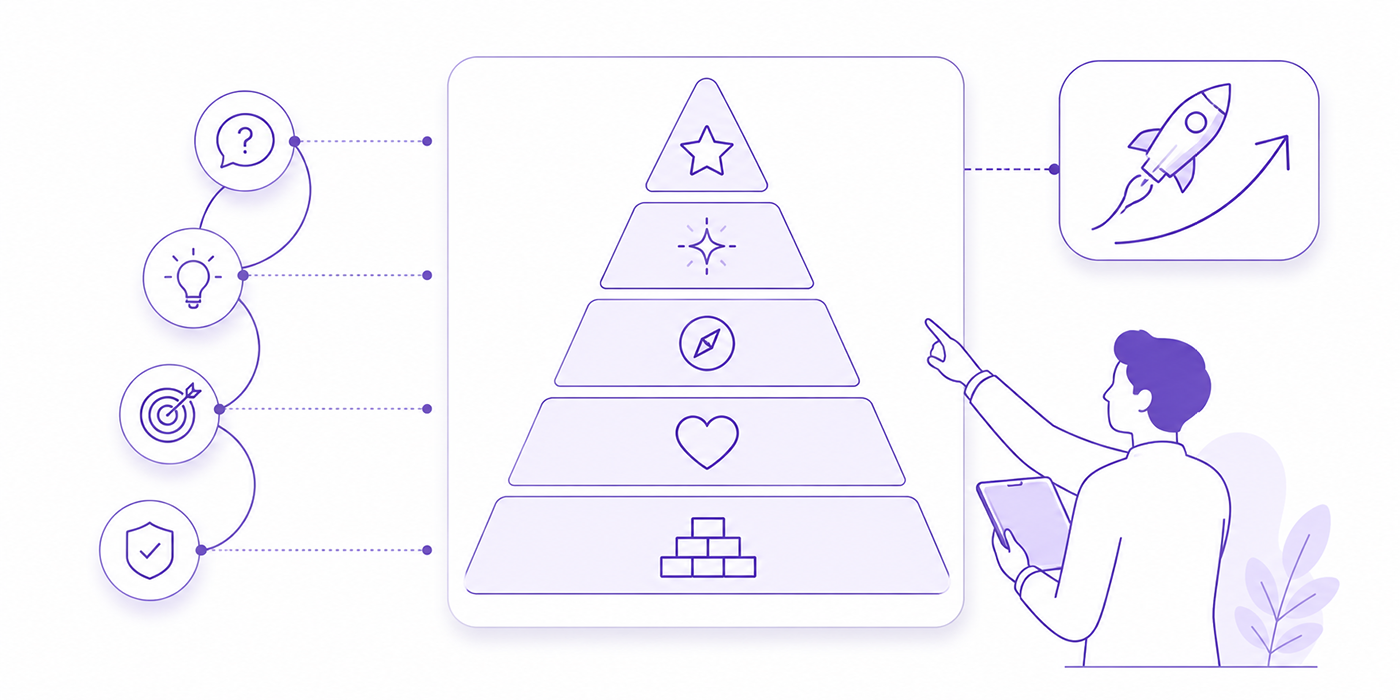
1. What Self-Actualization Coaching Actually Solves
Self-actualization coaching is a structured process that helps capable adults create greater alignment between who they are, what they value, how they spend their time, and what they are building. The work combines strengths-based coaching, guided visualization, emotional intelligence development, and habit formation into a coherent life-design process.
Its highest-fit clients often appear successful from the outside. They may have stable income, respected careers, supportive relationships, and impressive responsibilities. Their pain comes from internal incoherence: they keep achieving goals that no longer feel personally significant. A promotion produces temporary satisfaction. A business milestone creates another expectation. A carefully planned life begins to feel inherited rather than chosen.
That misalignment can show up as decision paralysis, chronic overcommitment, weak boundaries, recurring career dissatisfaction, or a constant urge to start over. Effective stress coaching strategies help regulate pressure, while mindset coaching identifies beliefs keeping the client attached to outdated definitions of success. Accountability coaching then converts insight into behavior, and client expectation management keeps the process realistic.
The niche serves several adjacent client groups:
High achievers who have reached a professional plateau.
Founders whose businesses have outgrown their original identity.
Professionals considering a high-stakes career transition.
Parents rebuilding identity after a major family transition.
Retirees seeking contribution, connection, and intellectual challenge.
Creatives whose commercial work has displaced meaningful expression.
Leaders whose public responsibilities conflict with private priorities.
Clients emerging from burnout after receiving appropriate clinical care.
Adults who have completed therapy and want structured forward movement.
People whose options have expanded faster than their decision-making ability.
The coaching objective can be expressed through a practical equation:
Self-actualization progress = personal alignment × agency × behavioral evidence.
Alignment asks whether the client’s choices fit their values. Agency measures their willingness to act despite uncertainty. Behavioral evidence shows whether the change has reached calendars, conversations, spending, relationships, and routines. Without that final element, the program risks becoming an expensive collection of insights.
Self-actualization coaching therefore needs the same rigor found in professional feedback systems, safe coaching environments, client transformation case studies, and exceptional client experiences. Meaning remains personal; progress still requires evidence.
| Client Signal | Underlying Actualization Need | Best Coaching Intervention | Evidence of Progress | Related ANHCO Resource |
|---|---|---|---|---|
| “I have achieved my goals and still feel unfulfilled.” | Separate inherited success standards from personally meaningful ambitions. | Values audit and peak-experience review. | Client defines three self-authored success criteria. | Strengths-based coaching |
| “I could pursue five different careers.” | Reduce possibility overload without prematurely closing valuable options. | Weighted decision matrix and reversible experiments. | One 90-day career experiment begins. | Coaching mindset shifts |
| “My career looks good on paper.” | Reconnect daily work with identity, autonomy, mastery, and contribution. | Role-energy audit and job-crafting plan. | Two responsibilities redesigned or renegotiated. | Mental health coaching insights |
| “I keep saying yes to everything.” | Create boundaries that protect high-value commitments. | Commitment inventory and boundary scripts. | Calendar reflects defined priority limits. | Expectation management |
| “I know what matters, yet I rarely act on it.” | Close the gap between intellectual values and lived behavior. | Environmental redesign and implementation intentions. | Weekly value-aligned actions increase. | Habit formation tools |
| “I no longer recognize the person I became.” | Integrate earlier identities with present responsibilities. | Identity timeline and narrative reconstruction. | Client articulates a coherent current identity. | Transformational coaching |
| “I overthink every major decision.” | Build confidence in judgment under uncertainty. | Decision rules, deadlines, and pre-mortems. | Average decision time decreases. | Guided visualization methods |
| “My work drains every part of my life.” | Restore energy before pursuing expansive goals. | Energy ledger and recovery architecture. | Protected recovery blocks become consistent. | Stress coaching strategies |
| “I start personal projects and abandon them.” | Create a completion system suited to the client’s motivational pattern. | Milestone design and weekly accountability. | Completion rate improves over 30 days. | Accountability in coaching |
| “I have lost confidence in my own choices.” | Rebuild self-trust through small, verifiable commitments. | Commitment ladder and evidence journal. | Promises kept to self increase weekly. | Constructive feedback |
| “My relationship and ambitions keep competing.” | Integrate attachment, independence, and shared priorities. | Needs clarification and relationship agreements. | Recurring conflict receives a shared protocol. | Relationship coaching |
| “I cannot explain what I truly want.” | Develop emotional vocabulary and distinguish desire from obligation. | Emotion labeling and future-self interviews. | Client expresses specific wants without borrowed language. | Emotional intelligence coaching |
| “Motivation disappears after the first week.” | Design engagement around progress visibility and meaningful rewards. | Progress scoring and challenge design. | Four-week participation remains stable. | Coaching gamification |
| “A promotion made me feel strangely empty.” | Reassess the psychological contract between achievement and fulfillment. | Achievement debrief and success-definition reset. | Next goal includes intrinsic success criteria. | Mental health coaching niche |
| “My life needs change, yet I cannot disappear for months.” | Create meaningful progress through low-risk, compact interventions. | Two-week micro-experiments. | One tested insight is implemented quickly. | Micro-coaching |
| “I edit myself around everyone.” | Build psychological safety and strengthen authentic communication. | Relational mapping and graduated honesty practice. | Client completes one previously avoided conversation. | Safe coaching environments |
| “Every role in my life wants a different version of me.” | Create an integrated identity across work, family, and community. | Role alignment map and non-negotiable standards. | Role conflicts are resolved through defined principles. | Modern client preferences |
| “Perfectionism keeps delaying everything.” | Replace flawless performance standards with learning standards. | Minimum viable action and exposure ladder. | Client ships work at a defined quality threshold. | Behavior change science |
| “My energy cannot support my ambitions.” | Align goals with sleep, movement, nutrition, and recovery capacity. | Wellbeing baseline and sustainable workload design. | Energy stability improves across tracked weeks. | Preventative health coaching |
| “I have outgrown my social circle.” | Build belonging around emerging values and interests. | Relationship portfolio and community experiments. | Client develops two aligned connections. | Purposeful networking |
| “I cannot tell whether coaching is working.” | Translate subjective growth into trackable leading indicators. | Baseline scorecard and weekly evidence review. | Progress is visible across five chosen metrics. | Transformation case studies |
| “Technology fragments my attention.” | Reclaim intentional focus from reactive digital behavior. | Attention audit and device-boundary design. | Deep-work and presence blocks increase. | Technology and coaching |
| “I never have time for the changes I want.” | Expose hidden time allocation and automate low-value friction. | Calendar audit and workflow automation. | Two weekly hours are recovered and reassigned. | Coaching automation |
| “Change could threaten everything I built.” | Separate reversible experiments from irreversible commitments. | Risk ladder and downside containment plan. | Client tests change without destabilizing core needs. | Difficult coaching situations |
| “Money keeps controlling every life decision.” | Clarify the financial floor required for greater autonomy. | Freedom-number calculation and staged transition plan. | Client funds a defined decision runway. | Financial coaching principles |
| “I want my success to help someone else.” | Convert achievement into contribution without creating martyrdom. | Contribution thesis and impact portfolio. | One sustainable service commitment begins. | Social responsibility in coaching |
| “My goals keep changing with every trend.” | Create stable principles while preserving strategic adaptability. | Personal operating principles and trend filter. | Opportunities are assessed through a consistent rubric. | Future-proof coaching |
| “Charging for this work makes me uncomfortable.” | Connect price with depth, responsibility, access, and client value. | Value architecture and delivery-cost analysis. | Coach presents the offer without apologetic discounting. | High-ticket coaching offers |
| “My expertise is too broad to package.” | Build one transformation pathway from multiple capabilities. | Method extraction and signature-framework design. | A repeatable program journey is documented. | Coaching joint ventures |
| “I improve during coaching and slide back afterward.” | Transfer gains into self-managed systems and relationships. | Relapse planning, support map, and alumni check-ins. | Core behaviors survive beyond the program. | Client retention strategies |
Use this map during discovery calls to identify the client’s actual transformation need, the most suitable intervention, and the evidence that would demonstrate progress.
2. Why Self-Actualization Coaching Has Billion-Dollar Potential
Self-actualization coaching does not yet appear as a separately measured global market category. Its billion-dollar potential comes from capturing a focused share of several markets that have already reached substantial scale: professional coaching, personal development, life coaching, mental wellbeing, leadership development, and digital health coaching.
The International Coaching Federation reported approximately 122,974 coach practitioners and $5.34 billion in global coaching revenue in its 2025 study. The practitioner population had grown by 15% since 2023, while many coaches were expanding into training, consulting, facilitation, and mentoring. That diversification creates ideal conditions for an integrative service combining coaching industry trends, client preference research, micro-coaching delivery, and scalable coaching models.
The wider personal-development market strengthens the case. Grand View Research valued it at $51 billion in 2025 and projected growth to $79.8 billion by 2033. Personal coaching and training represented the largest instrument segment in its earlier 2024 analysis, with a share exceeding 37%. A specialist category only needs to capture a modest percentage of that spending to develop into a billion-dollar market.
The surrounding wellness economy adds another demand engine. The Global Wellness Institute valued wellness at $6.8 trillion in 2024 and forecast growth to $9.8 trillion by 2029. Self-actualization coaching fits this shift because clients increasingly connect wellbeing with purpose, relationships, career design, emotional health, and sustainable performance. Preventative health coaching, emotional intelligence coaching, relationship coaching, and mental health coaching already address individual parts of this integrated demand.
Digital delivery provides the scale mechanism. The global digital health coaching market was estimated at approximately $10.99 billion in 2024 and projected to exceed $22 billion by 2030. Digital assessments, asynchronous reflection, habit tracking, automated recaps, virtual communities, and remote group programs allow a coach’s methodology to reach far beyond weekly one-to-one sessions.
Several structural pressures could accelerate the category:
Achievement has become easier to display and harder to interpret. Clients can track promotions, revenue, followers, credentials, and productivity while remaining uncertain about whether those achievements support the life they genuinely want.
Information has become abundant. Artificial intelligence can generate plans, prompts, options, and summaries instantly. The premium human service shifts toward interpretation, contextual judgment, emotional challenge, and accountable action. This supports technology-enabled coaching, coaching automation, gamified engagement, and high-quality client experiences.
Careers are becoming less linear. Professionals may move between employment, entrepreneurship, portfolio work, caregiving, retraining, and independent consulting. Each transition forces identity decisions alongside financial ones. Coaches who understand gig-economy coaching, economic-change strategies, financial forecasting, and behavioral transformation can support the whole transition.
Longevity creates additional life chapters. More clients will need frameworks for second careers, contribution, relationships, learning, and identity after traditional milestones have been completed. Self-actualization coaching can serve these chapters through repeat engagements rather than a single short-term intervention.
The commercial thesis is therefore credible: the industry already has billions in adjacent demand, a growing practitioner base, digital distribution, repeatable program formats, and clients with expensive unresolved problems. The category will mature when coaches give it clear scope, measurable outcomes, ethical safeguards, and specialized offers.
3. How Self-Actualization Coaching Produces Measurable Change
A premium self-actualization program needs an operating system. Inspirational conversations create temporary clarity; a defined methodology creates transferable results. Coaches can build that methodology from behavior-change principles, habit-building tools, accountability structures, and constructive feedback.
Stage 1: Establish readiness and scope
Begin by determining whether the client has sufficient stability, capacity, and autonomy for future-focused coaching. Explore their current pressures, support system, decision authority, health constraints, and expectations. A client facing an acute crisis may require another form of support before undertaking identity or purpose work.
The coach should also define the engagement boundary. Clarify what coaching will address, what success could look like, how confidentiality works, how progress will be measured, and when referral may be necessary. This foundation strengthens coaching safety, reduces difficult client situations, improves expectation management, and protects the client experience.
Stage 2: Conduct a life-congruence audit
Audit how the client allocates time, energy, money, attention, and emotional labor. Compare those allocations with the values they claim are important. The gaps reveal where their life is operating through habit, fear, social expectation, or outdated identity.
A useful audit covers:
Roles that create energy and roles that continuously drain it.
Commitments retained through guilt, image, or sunk-cost thinking.
Activities associated with absorption, curiosity, and voluntary effort.
Decisions delayed despite adequate information.
Relationships that support growth and relationships that reward stagnation.
Calendar patterns that contradict stated priorities.
Financial obligations limiting experimentation.
Strengths the client uses frequently and strengths left dormant.
Recurring emotional signals around work, belonging, autonomy, and contribution.
Personal ambitions repeatedly postponed for an undefined “later.”
This phase becomes more powerful when paired with strengths-based techniques, emotional-intelligence coaching, client anxiety strategies, and guided imagery.
Stage 3: Build identity architecture
Values such as freedom, integrity, creativity, family, or service remain too broad for reliable decisions. The coach must help the client convert values into operational standards.
A client who values freedom might define it as control over location, schedule, client selection, and intellectual direction. A client who values family might define it through protected evenings, emotional presence, shared rituals, and financial stability. These standards give the client a usable decision filter.
The coach can create a personal operating charter containing:
Three defining values.
The behaviors that express each value.
The trade-offs the client accepts.
The trade-offs the client refuses.
The environments where the client performs best.
The relationships required for support and challenge.
The warning signs that indicate renewed misalignment.
The rules used for high-stakes decisions.
This charter supports mindset development, relationship coaching, social responsibility, and long-term behavioral change.
Stage 4: Create a possibility portfolio
Prematurely choosing one grand purpose can create unnecessary pressure. A possibility portfolio gives the client three or four credible future directions and turns each into a low-risk experiment.
A professional considering independent work might test one paid advisory project, interview five established consultants, calculate a minimum financial runway, and reserve one day per week for market validation. A client seeking greater contribution might volunteer in two settings, mentor one person, or design a small community initiative.
Experiments produce evidence about motivation, competence, demand, fit, energy, and trade-offs. They reduce dependence on imagination alone. Micro-coaching can support rapid reviews, gamification can keep experiments visible, automation tools can collect reflections, and accountability systems can prevent avoidance.
Stage 5: Integrate the chosen direction
The final phase transfers insight into systems. The client adjusts their calendar, boundaries, environment, relationships, finances, and habits to support the chosen direction. Every meaningful change should appear somewhere observable.
Useful outcome indicators include:
Time required to make a previously avoided decision.
Percentage of weekly time connected to top values.
Number of protected boundaries maintained.
Frequency of energy-producing activities.
Completion rate for planned experiments.
Number of unresolved commitments closed.
Self-rated confidence in major decisions.
Consistency of health-supporting routines.
Quality of key relationship conversations.
Progress toward an identified contribution goal.
Ability to recover after disruption.
Percentage of client-created commitments completed.
Measurement should support reflection rather than create another performance obsession. The coach can use weekly check-ins, client feedback systems, transformation case studies, and retention strategies to strengthen the method over time.
Results are stored anonymously in this browser and contain no personal information.
4. How to Build and Monetize a Credible Self-Actualization Coaching Offer
The weakest possible positioning is “I help people become their best selves.” It provides no defined buyer, urgent problem, decision context, or observable result. Strong positioning connects self-actualization to a specific transition with financial, emotional, relational, or professional consequences.
A useful positioning formula is:
I help [specific client] move through [high-cost transition] so they can [observable result] using [named method].
Examples include:
Helping senior professionals decide whether to redesign, leave, or replace an unfulfilling career.
Helping founders rebuild identity and relationships after rapid business growth.
Helping high-achieving parents reclaim meaningful ambitions without destabilizing family priorities.
Helping professionals in midlife build a financially responsible second-act career.
Helping executives convert achievement into contribution, wellbeing, and long-term significance.
This degree of specificity improves coaching-business benchmarking, strengthens high-ticket offer design, supports client retention, and produces clearer case studies.
Build a signature 12-week pathway
A credible flagship program could follow this structure:
Week 0: Readiness and baseline. Complete informed consent, define coaching scope, assess readiness, select five progress indicators, and document the client’s starting position.
Weeks 1–2: Congruence audit. Examine roles, obligations, strengths, values, energy, time allocation, finances, relationships, and unresolved decisions.
Weeks 3–4: Identity architecture. Translate values into standards, build a personal operating charter, and identify outdated success definitions.
Weeks 5–7: Possibility design. Develop several viable future pathways, evaluate trade-offs, and identify assumptions requiring evidence.
Weeks 8–10: Real-world experiments. Test career, creative, relational, community, or lifestyle possibilities through low-risk actions.
Weeks 11–12: Integration. Select the strongest direction, redesign supporting systems, establish accountability, and create a 90-day continuation plan.
The client should leave with tangible assets: an alignment map, a personal operating charter, a decision rubric, a possibility portfolio, an experiment tracker, a boundary plan, and a 90-day actualization roadmap. These deliverables make the service easier to explain, sell, review, and improve through client feedback, behavior-change systems, habit tracking, and coaching automation.
Price from capacity and delivery economics
Pricing should reflect delivery intensity, coach expertise, client access, personalization, measurement, support between sessions, and the commercial value of the transition. A coach can calculate the minimum sustainable average client value through this formula:
Required monthly revenue + delivery costs + business reserves ÷ active client capacity = minimum monthly client value.
Suppose a coach wants $18,000 in monthly business revenue, expects $3,000 in operating costs and reserves, and can responsibly support 10 active clients. The minimum average value becomes $2,100 per client each month. A three-month flagship program would therefore require an average price of at least $6,300 before discounts, payment defaults, or acquisition costs.
This calculation is more reliable than copying another coach’s fee. It connects pricing with financial forecasting, coaching tax planning, payment-system design, and profitable practice scaling.
Build an offer ladder around the flagship program
A billion-dollar category requires several delivery formats. Coaches can create a value ladder that serves different readiness levels:
Diagnostic workshop: A focused session that identifies the client’s primary misalignment and recommends a next step.
Four-week decision sprint: A compact offer for one urgent career, relationship, or life-design decision.
Twelve-week flagship program: The complete self-actualization pathway.
Group cohort: A structured program for professionals experiencing similar transitions.
Alumni membership: Monthly integration sessions, experiments, peer accountability, and updated planning.
Corporate program: Purpose, identity, career sustainability, and contribution for senior talent.
Practitioner training: Education for qualified coaches who want to license or learn the methodology.
The ladder allows clients to enter at an appropriate commitment level while creating recurring revenue and intellectual-property value. Micro-coaching formats can serve early-stage clients, community platforms can support cohorts, joint ventures can open corporate distribution, and franchising principles can guide method licensing.
Build proof around specific changes
Testimonials such as “I feel more aligned” provide weak evidence. Stronger proof identifies the client’s starting constraint, coaching intervention, decision, behavior change, and maintained outcome.
A useful case-study structure includes:
The costly decision the client had delayed.
The belief or constraint maintaining the delay.
The assessment that revealed the real issue.
The experiment used to test a new direction.
The observable decision or behavior that followed.
The result maintained after 30, 60, or 90 days.
The limits of the result and factors outside the coach’s control.
This approach strengthens coaching credibility, produces more persuasive client transformation stories, improves referral-generating experiences, and turns client feedback into method refinement.

5. The Ethical Standards That Will Separate a Real Industry From Hype
Self-actualization coaching carries unusual influence because it touches identity, purpose, relationships, career choices, money, spirituality, and meaning. A poorly bounded coach can encourage major life changes without understanding the client’s mental health, dependency risks, financial exposure, or family responsibilities. Professional credibility therefore depends on disciplined scope.
The coaching agreement should explain the service, coach qualifications, confidentiality limits, data handling, cancellation terms, between-session access, outcome measurement, referral process, and client responsibilities. Coaches should also understand relevant legal requirements, establish an appropriate business entity, maintain a strong certification portfolio, and avoid common credentialing mistakes.
The International Coaching Federation advises coaches to recognize when a client’s needs exceed their competence and to refer the client to therapy or another qualified helping professional. Its referral guidance identifies mental-health concerns and crisis indicators that may require specialized support. A coach should have a written referral protocol and an established network of licensed mental-health, medical, legal, financial, and nutrition professionals.
Self-actualization coaching should never depend on the coach claiming superior knowledge of the client’s “true purpose.” The coach’s role is to improve reflection, expose contradictions, challenge avoidance, design experiments, and support informed choice. The client retains ownership of the direction.
Serious practitioners should avoid:
Diagnosing psychological conditions without appropriate credentials.
Encouraging abrupt resignations, divorces, relocations, or financial commitments.
Presenting intuition as certainty.
Creating emotional dependency on the coaching relationship.
Guaranteeing happiness, wealth, healing, or permanent fulfillment.
Using spiritual language to dismiss practical constraints.
Treating every discomfort as evidence that the client must make a dramatic change.
Collecting sensitive client data without clear security and retention policies.
Sharing transformation stories without explicit informed permission.
Continuing an engagement after the client’s needs exceed the coach’s competence.
Ethical discipline supports safe coaching relationships, improves responses during emotional crises, strengthens professional feedback, and protects the long-term reputation of the coaching industry.
The strongest competitive moat will come from six assets:
A defined client category. A coach serving midlife physicians, second-generation founders, senior women leaders, or post-exit entrepreneurs can develop deeper pattern recognition than a generalist.
A documented method. Every stage should have a purpose, tool, deliverable, success indicator, and escalation rule.
A proprietary measurement system. A well-designed alignment scorecard turns subjective progress into reviewable evidence.
A credible case library. Anonymized cases reveal which interventions work for which client conditions.
A professional referral network. Clients facing complex transitions may need therapists, physicians, lawyers, accountants, financial planners, or relationship specialists.
A delivery ecosystem. Digital tools, cohort programs, communities, facilitator training, and licensed materials create scale beyond the founder’s calendar.
These assets support coaching-business growth, practice automation, industry leadership, and future-proof service design. They also explain how self-actualization coaching can progress from an appealing label into a defensible professional category.
6. Frequently Asked Questions About Self-Actualization Coaching
-
Self-actualization coaching is an emerging specialization rather than a universally standardized credential category. Its underlying methods already exist across transformational coaching, strengths-based coaching, mindset coaching, and emotional-intelligence coaching.
A coach can use the label credibly when the service has a defined audience, clear scope, repeatable methodology, measurable outcomes, and responsible referral practices. The name alone creates little value. The professional category becomes meaningful when clients can understand the exact problem addressed, the decisions they will work through, the evidence used to review progress, and the coach’s relevant qualifications.
Coaches should also avoid implying that a self-actualization certification grants clinical authority. Their marketing should accurately represent their education, experience, professional boundaries, and the type of client work they are prepared to handle.
-
Life coaching can cover almost any personal goal, from routines and confidence to relationships and career planning. Self-actualization coaching uses a narrower organizing question: How can the client build a life that expresses their values, strengths, identity, and desired contribution?
The engagement therefore examines how several domains interact. Career decisions affect relationships, finances, health, autonomy, and belonging. A lifestyle change can alter identity and social connection. Purpose becomes practical only when it influences calendars, commitments, boundaries, and resource allocation.
The coach may draw from habit formation, guided imagery, client accountability, and behavior-change science. The difference comes from the integration of these tools around identity alignment and life direction.
-
Therapy can assess and treat mental-health conditions, psychological distress, trauma, and dysfunctional patterns within the therapist’s qualifications. Self-actualization coaching generally serves clients who have sufficient stability for future-focused exploration, decision-making, experimentation, and behavioral implementation.
Some clients may work with a therapist and coach at the same time when roles are clearly defined and both professionals operate within their competence. A therapist may address trauma, depression, anxiety, or clinical symptoms, while a coach supports career experiments, accountability, routines, and values-based planning.
Coaches should understand mental health coaching boundaries, create a safe coaching environment, prepare for emotional crises, and refer clients when their needs exceed coaching competence. Transparent boundaries protect the client and increase professional trust.
-
The ideal client has enough stability to examine long-term direction and enough dissatisfaction to act. They can reflect on their behavior, take responsibility for experiments, tolerate uncertainty, and make changes within their actual authority.
Common high-fit clients include senior professionals considering a career redesign, founders whose identity has become fused with their company, high achievers experiencing post-success emptiness, parents entering a new life chapter, and adults seeking greater contribution after financial stability.
Readiness matters more than status. A client may have money and ambition while lacking the capacity required for intensive change. Discovery should assess emotional stability, available time, decision authority, financial constraints, support systems, and willingness to complete between-session work.
Using client expectation techniques, stress-coaching strategies, constructive feedback, and client preference insights helps identify fit before enrollment.
-
The coach should translate each subjective concept into client-defined indicators and observable behavior. “Greater freedom” might mean two unscheduled evenings, control over project selection, remote-work flexibility, and a six-month financial runway. “More contribution” might mean mentoring, community service, teaching, or building a mission-aligned business.
A useful scorecard can track:
Weekly time allocated to top values.
Decisions completed within agreed deadlines.
Promises kept to self.
Boundaries maintained.
Meaningful experiments completed.
Energy before and after important activities.
Frequency of avoided conversations.
Relationship quality in selected areas.
Progress toward financial or career transition requirements.
Client confidence in handling future decisions independently.
Combine numerical ratings with written evidence and periodic narrative reviews. Client feedback systems, accountability processes, habit tools, and credible case studies make the measurement system stronger.
-
The coach should have robust coach training, supervised practice, ethical education, clear scope awareness, and skill in behavior change, questioning, feedback, goal design, and referral. Additional education may be valuable in strengths, wellbeing, leadership, relationships, career development, motivational interviewing, or group facilitation.
Professional development should continue after initial certification. Coaches can strengthen their practice through CPD accreditation, ongoing CPD certification maintenance, careful accreditation comparison, and consistent study of coaching ethics.
Personal experience with reinvention can add empathy, though experience alone does not establish professional competence. Clients deserve a coach whose methodology, boundaries, evidence, and qualifications can withstand careful scrutiny.
