
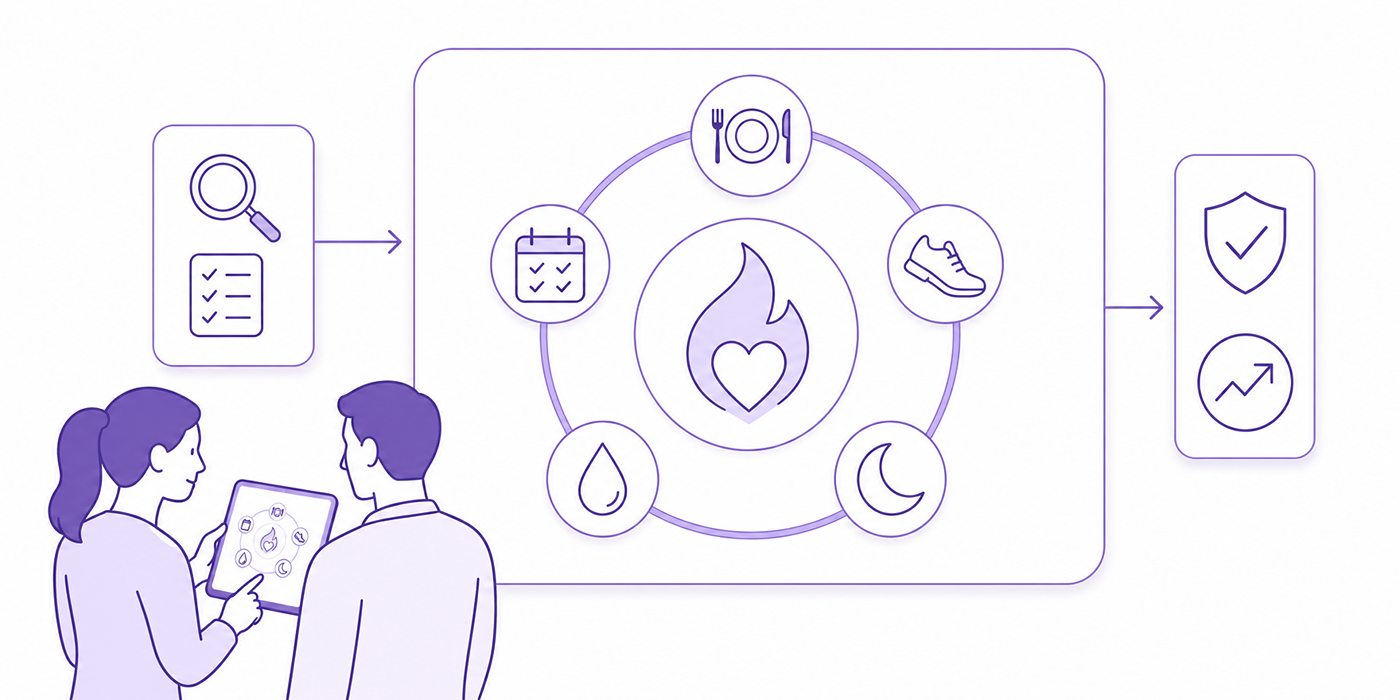
Metabolic health coaching is gaining serious momentum because clients need more than another restrictive diet or temporary fitness challenge. They need help turning medical guidance into routines that survive stress, travel, family pressure, demanding jobs, and unpredictable energy. By combining behavior-change science, habit-formation tools, preventative health coaching, and client accountability, qualified coaches can help clients follow clinician-approved plans while maintaining firm boundaries around diagnosis, treatment, nutrition therapy, and medication.
1. Why Metabolic Health Coaching Is Becoming a High-Demand Niche
Metabolic health describes how effectively the body manages processes involving blood glucose, blood pressure, blood lipids, energy storage, and energy use. The World Health Organization identifies raised blood pressure, overweight or obesity, elevated blood glucose, and abnormal blood lipids as major metabolic risk factors connected with noncommunicable diseases. These risks rarely emerge from one isolated decision. They develop through interactions among genetics, medical conditions, food access, sleep, movement, stress, medication, work patterns, and the wider environment.
That complexity creates a valuable role for coaches trained in preventative health strategies, behavioral transformation, habit development, and stress-management coaching. A physician may tell a patient to become more active, improve dietary patterns, monitor blood pressure, or follow a prescribed treatment plan. The client still has to translate that guidance into shopping decisions, workday routines, family conversations, travel plans, reminders, and repeated actions.
The number of people needing lifestyle support is enormous
The CDC’s 2026 National Diabetes Statistics Report estimates that 115.2 million American adults have prediabetes. That represents more than two in five adults, and approximately eight in ten people with prediabetes remain unaware of it. Prediabetes raises the risk of type 2 diabetes, cardiovascular disease, and stroke, making early detection and qualified medical guidance essential.
These figures explain why metabolic health can support a substantial coaching niche. Millions of people may receive a warning during a routine appointment and leave with broad instructions that feel urgent but difficult to implement. They may understand the importance of lasting behavior change, yet struggle with consistent accountability, realistic habit formation, and effective expectation management.
The pain point appears after the appointment. The client returns home, opens the refrigerator, checks their calendar, remembers three upcoming dinners, and realizes that “improve your lifestyle” contains hundreds of decisions. Metabolic health coaching can organize those decisions into a manageable sequence.
Clients are exhausted by short-term weight-loss cycles
Many clients have spent years moving between strict plans and complete disengagement. They follow rigid rules for several weeks, experience schedule disruption, abandon the plan, regain confidence slowly, and eventually search for another program. The recurring damage extends beyond weight. Each failed attempt can weaken self-trust and strengthen all-or-nothing thinking.
A metabolic health coach can redirect attention toward repeatable behaviors, clinician-identified markers, energy stability, sleep routines, movement consistency, stress responses, and recovery after setbacks. This approach benefits from strength-based coaching, mindset development, micro-coaching interventions, and constructive client feedback.
Weight can remain clinically relevant, especially when a healthcare professional has discussed it with the client. The coach’s role is to prevent the entire engagement from becoming a weekly judgment about the scale. A client may improve meal planning, movement, medication adherence, sleep preparation, and appointment follow-through before a dramatic physical change becomes visible.
Coaching already has a place in evidence-based diabetes prevention
The CDC-led National Diabetes Prevention Program uses a yearlong lifestyle-change program that includes a trained lifestyle coach, an approved curriculum, and group support. Participants learn skills related to healthier eating, physical activity, coping, goal setting, and sustainable change. CDC materials state that participation can cut the risk of developing type 2 diabetes in half.
This established model gives metabolic health coaches an important lesson. Meaningful prevention requires more than information. Clients benefit from structured education, repeated practice, social support, progress reviews, and enough time to build durable routines. Those elements align with accountability coaching, gamification strategies, client-retention planning, and a carefully designed coaching experience.
Independent coaches should never imply that their private program carries CDC recognition unless it has formally earned that status. They can still learn from the principle behind the model: consistent coaching support can help people implement qualified medical and public-health guidance.
Consumers have more health data and less clarity
Clients may arrive with laboratory reports, smart-watch trends, sleep scores, food logs, home blood-pressure readings, step counts, and weight histories. More data can create useful awareness, but it can also generate obsessive checking, confusion, and false conclusions.
A coach should help the client organize questions for their healthcare professional, identify which behavior they can influence, and select a small number of agreed indicators. The coach should avoid interpreting laboratory results, diagnosing insulin resistance, changing prescribed treatment, or presenting consumer-device readings as clinical conclusions.
This creates demand for coaches who can combine technology-aware coaching, responsible coaching automation, carefully managed client expectations, and strong ethical boundaries.
Medication developments increase the need for behavioral support
More clients are discussing prescription treatments for diabetes and obesity with qualified clinicians. Medication decisions belong to licensed prescribers, and clients need to follow professional instructions regarding suitability, dosage, side effects, and ongoing monitoring. Regulatory guidance also emphasizes that GLP-1 medicines are licensed for specific medical conditions and should be used under appropriate healthcare supervision.
Coaches can support behaviors surrounding a clinician-led plan. They may help clients prepare appointment questions, remember agreed routines, track experiences for discussion with the prescriber, build regular meal structures, protect hydration habits, maintain suitable movement, and develop a long-term maintenance strategy.
The distinction protects clients. Health-coaching scope, legal preparation, safe coaching practices, and awareness of emotional-crisis boundaries should shape every metabolic health offer.
The broader coaching industry is expanding
The 2025 ICF Global Coaching Study reported 122,974 coach practitioners worldwide, a 15% increase from 2023, and estimated annual industry revenue of $5.34 billion. A larger market creates opportunity while increasing competition for generalist coaches.
Metabolic health provides a defined problem space with urgent client needs, measurable behaviors, corporate applications, group-program potential, and strong referral opportunities. Coaches can strengthen their positioning through industry trend analysis, future-proof practice planning, changing client preferences, and relevant professional certification.
The opportunity belongs to practitioners who can deliver structured behavior support without pretending to be endocrinologists, physicians, registered dietitians, pharmacists, or therapists.
2. What Metabolic Health Coaching Covers and Where the Scope Ends
Metabolic health coaching focuses on the behavior surrounding medical care. The coach helps clients understand their own patterns, convert professional recommendations into actions, identify barriers, build routines, maintain accountability, and communicate effectively with their healthcare team.
The work can include habit architecture, stress-response coaching, client motivation, and behavioral accountability. Medical assessment, clinical nutrition therapy, medication management, and treatment remain with appropriately qualified professionals.
Coaches can support medical follow-through
Clients often leave appointments with several recommendations and remember only the most frightening sentence. A coach can help them organize the information they received, write down questions, schedule follow-up care, and decide which approved behavior to address first.
Useful questions include:
What did your healthcare professional ask you to do?
Which recommendation feels clearest?
Which part requires further explanation?
What practical barrier could prevent follow-through?
Which question should you take back to your clinician?
What evidence will show that you completed the agreed action?
This form of support connects accountability coaching, constructive feedback, safe coaching relationships, and client-centered planning.
Coaches can address routine and environmental barriers
A client may know that movement matters while living in an area without safe walking spaces. Another may understand meal planning while working rotating shifts with limited refrigeration. A parent may have clinician-approved goals and almost no uninterrupted time.
High-value coaching examines the client’s actual environment. The intervention might involve indoor movement options approved by the care team, a work-bag preparation routine, a family support request, calendar protection, or a minimum action for exhausting days.
This is where micro-coaching, behavior-change planning, habit cues, and technology-supported reminders become useful.
Coaches can help clients develop sustainable self-monitoring
Self-monitoring can create awareness when the client knows what to record and how the information will be used. A metabolic health coach may help clients track actions such as planned movement, sleep preparation, meal planning, appointment attendance, medication reminders, stress-management practice, or other clinician-approved behaviors.
A coach should ask three questions before introducing a tracker:
What decision will this information support?
How much effort will recording require?
Could the measurement increase anxiety, shame, or obsession?
A client drowning in seven dashboards may benefit from fewer metrics. Thoughtful monitoring supports coaching gamification, client feedback, technology integration, and effective progress case studies.
Coaches can work with motivation and identity
A metabolic diagnosis or warning can change how a client sees themselves. Some respond with fear, shame, anger, or fatalism. Others become highly motivated for two weeks and then collapse under an unsustainable plan.
The coach can help the client separate a health marker from their entire identity, recognize previous strengths, and build confidence from completed actions. Strength-based coaching, emotional-intelligence development, mindset shifts, and guided visualization can support this process.
The coach should remain alert to depression, severe anxiety, eating-disorder symptoms, trauma responses, and significant impairment. Those needs may require mental-health or medical care alongside coaching.
Coaches cannot diagnose metabolic conditions
Insulin resistance occurs when cells in the muscles, fat, and liver do not respond properly to insulin. Prediabetes involves blood glucose levels above the normal range and below the threshold used to diagnose diabetes. Both require appropriate medical assessment rather than conclusions based on fatigue, cravings, body shape, or a social-media checklist.
Metabolic syndrome also has clinical criteria. NIDDK describes it as a cluster involving factors such as large waist size, high triglycerides, low HDL cholesterol, elevated blood pressure, and higher-than-normal glucose or type 2 diabetes, with diagnosis generally based on the presence of at least three relevant traits.
A coach can encourage qualified evaluation, prepare the client for an appointment, and support the resulting care plan. Scope-of-practice knowledge, ethical coaching standards, legal awareness, and suitable professional referrals protect the client and the practice.
Coaches cannot prescribe individualized treatment
A metabolic health coach without the required clinical license should avoid:
Diagnosing insulin resistance, diabetes, metabolic syndrome, or hormonal disorders
Interpreting laboratory findings for the client
Prescribing therapeutic diets
Recommending supplement regimens to treat medical conditions
Changing medication dosage or timing
Advising clients to discontinue prescribed treatment
Guaranteeing lower A1C, cholesterol, blood pressure, or weight
Treating eating disorders or serious psychological conditions
Presenting wearable data as proof of disease
Discouraging medical investigation or follow-up
The coach can help clients implement professional recommendations, ask better questions, record concerns, maintain appropriate habits, and participate actively in care. This creates meaningful value through preventative coaching, client accountability, behavior-change methods, and a strong referral ecosystem.
3. The METRIC Framework for Metabolic Health Coaching
Metabolic health can become an overwhelming topic because clients may believe they must change every behavior immediately. The METRIC Framework gives coaches a disciplined process for narrowing the problem, respecting medical authority, and building one sustainable layer at a time.
M — Map the medical context
Begin with what is already known and who is responsible for the client’s care.
Ask:
Has a qualified professional identified a condition or risk?
What recommendations were provided?
Which medications or treatments has the client been prescribed?
Which follow-up appointments are pending?
Which concerns remain unclear?
Has the client been advised to limit certain activities?
Which professionals are currently involved?
The coach records the client’s understanding without independently interpreting clinical information. Any uncertainty returns to the healthcare professional.
This first step protects professional scope, supports ethical decision-making, strengthens the coaching contract, and creates a safe client environment.
E — Establish the behavioral baseline
Map what currently happens across a normal week. Focus on observable behavior rather than asking the client to label themselves as disciplined or undisciplined.
Explore:
Typical work and sleep schedule
Meal planning and food-access patterns
Movement and prolonged sitting
Stress peaks and coping responses
Medication and appointment routines
Family and social influences
Travel and weekend disruption
Previous change attempts
Available support
Financial and environmental constraints
The baseline should reveal patterns without turning the intake into an interrogation. Client preference research, stress-aware coaching, relationship coaching, and strength-based questioning improve the conversation.
T — Target one leverage behavior
Select the behavior that can create the greatest useful ripple effect.
A consistent evening shutdown may improve sleep preparation, reduce late-night snacking, support morning movement, and improve planning. A weekly grocery routine may reduce meal skipping, expensive convenience purchases, and stressful last-minute decisions. A protected medical follow-up block may resolve unanswered questions and clarify the entire care plan.
Use a leverage test:
Does this action support the clinician’s guidance?
Does it influence more than one problem?
Can the client control it?
Can it occur within seven days?
Does the client have sufficient readiness?
Can progress be measured simply?
This prioritization draws on behavior-change science, micro-coaching, habit formation, and realistic client expectations.
R — Reduce practical and emotional friction
Clients frequently know what they intend to do. The plan breaks at the point of inconvenience, fatigue, embarrassment, fear, conflict, or uncertainty.
Map five forms of friction:
Time friction: The action has no realistic place in the schedule.
Environmental friction: Equipment, food, transport, space, or access creates difficulty.
Emotional friction: Fear, shame, frustration, or resentment appears before the action.
Social friction: Family, colleagues, or cultural expectations interfere.
Cognitive friction: The next step remains unclear or requires too many decisions.
Then remove one barrier before increasing motivation pressure. The response may involve coaching automation, emotional-intelligence coaching, difficult-conversation preparation, or habit-environment redesign.
I — Install a feedback loop
The client needs a simple way to know whether the behavior happened and what affected it.
A useful weekly review asks:
What did you plan?
What happened?
What helped?
Where did the plan become difficult?
What did you learn about your environment?
Which concern belongs with your healthcare professional?
What adjustment will you test next?
The feedback loop should produce one of four decisions:
Continue the action unchanged
Simplify it
Increase it gradually
Replace it with a better behavior
This process supports client accountability, constructive feedback, coaching case studies, and client-retention strategies.
C — Coordinate care and continue independently
Metabolic health coaching should strengthen the client’s ability to communicate with healthcare professionals and manage their routines without permanent dependence on the coach.
Before the engagement ends, the client should have:
A clear list of healthcare contacts
A process for preparing appointment questions
A small set of sustainable routines
A response plan for disruption
A method for tracking agreed behaviors
A restart rule after missed actions
Defined warning signs requiring professional help
A monthly self-review process
This transition supports ethical client independence, sustainable habit maintenance, stronger client experiences, and credible coach-client transformations.
4. Who Metabolic Health Coaches Can Serve and How to Package the Offer
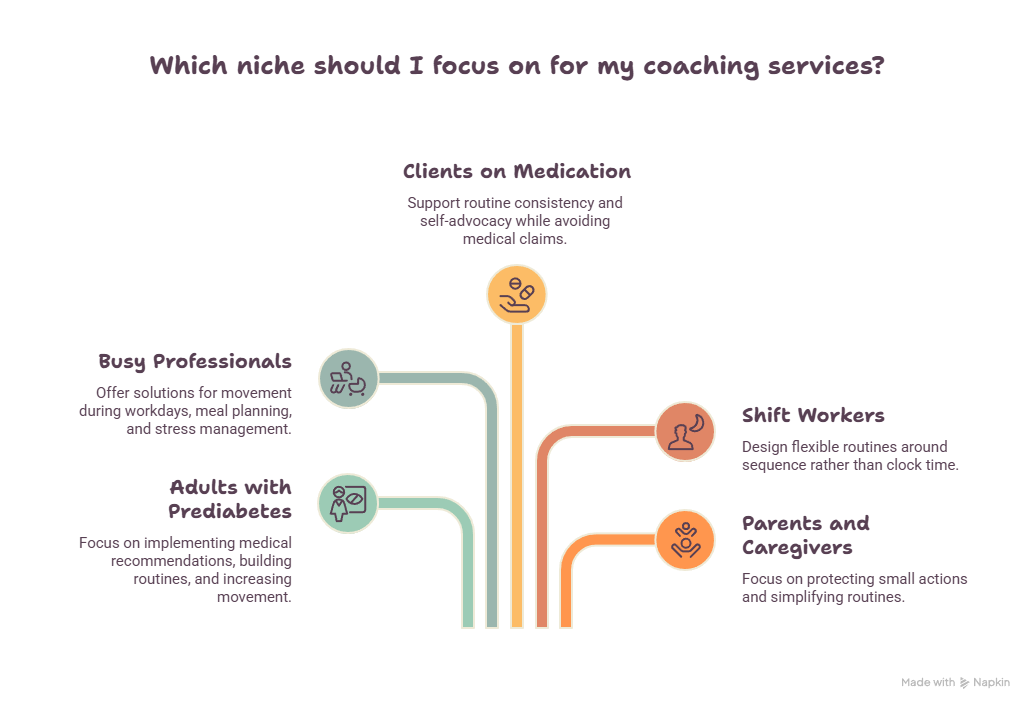
The niche becomes commercially valuable when the coach selects a defined audience and a specific implementation problem. “I improve metabolic health” sounds clinical and potentially misleading. “I help busy professionals follow their clinician-approved lifestyle plan through practical routines, accountability, and relapse prevention” communicates a responsible service.
Adults with prediabetes who need implementation support
A client diagnosed with prediabetes may feel frightened and uncertain about what to change first. The coach can help organize medical recommendations, build routines, increase appropriate movement, manage stress, prepare meals more consistently, and maintain follow-up appointments.
This audience aligns well with preventative health coaching, habit-formation science, client accountability, and behavioral transformation.
Coaches serving this group should understand referral pathways and consider formal training connected with recognized diabetes-prevention programs where appropriate. CDC-recognized programs have specific curriculum, staffing, reporting, and delivery requirements that independent coaches should review before making any affiliation claim.
Busy professionals with clinician-identified metabolic risks
Professionals may understand their health priorities while operating inside calendars that punish consistency. Long meetings, business travel, client dinners, stress, and late-night work can undermine every plan
A targeted offer might focus on:
Movement during sedentary workdays
Meal-planning systems
Medical follow-through
Sleep preparation
Stress recovery
Travel routines
Boundary conversations
Habit restart plans
This positioning connects workplace stress coaching, future coaching trends, technology-supported coaching, and micro-coaching delivery.
Clients using prescribed weight-management medication
Some clients seek coaching while receiving medical treatment for obesity or type 2 diabetes. The coach can support routine consistency, self-advocacy, appointment preparation, sustainable movement, stress management, and maintenance planning.
Marketing must be exceptionally careful. The coach should avoid claiming to supervise medication, manage side effects, prevent complications, or guarantee weight outcomes. Questions about dosing, symptoms, interactions, discontinuation, and suitability return directly to the prescriber or pharmacist.
This audience requires firm scope boundaries, strong ethical preparation, appropriate legal systems, and a reliable referral network.
Shift workers and healthcare professionals
Irregular schedules can destabilize sleep, movement, food access, medication routines, and recovery. Advice built around a predictable nine-to-five day often fails this audience immediately.
A specialist coach can help clients design flexible routines around sequence rather than clock time. “After waking” may become a more reliable cue than “at 7:00 a.m.” A three-level action plan can include full, reduced, and emergency-minimum versions.
This work can combine habit adaptation, client-expectation management, stress coaching, and a safe coaching environment.
Parents and caregivers with limited capacity
Caregivers often receive health advice that assumes unused time, spare money, and personal control. A responsible coach accounts for disrupted sleep, family meals, childcare, medical appointments, and emotional labor.
The first goal may involve protecting one ten-minute action, requesting practical help, or simplifying a routine. Larger changes can follow when the support system improves.
This audience benefits from relationship coaching, emotional-intelligence tools, realistic accountability, and client-centered service design.
A practical metabolic health coaching offer ladder
Metabolic Routine Audit: A 90-minute session that reviews the clinician’s recommendations, maps behavioral barriers, and creates a 14-day action plan.
Prediabetes Action Sprint: A four- to six-week program focused on implementing medical guidance, establishing routines, and building an independent tracking system.
Metabolic Foundations Program: A twelve-week package covering medical follow-through, movement habits, sleep preparation, stress regulation, environmental design, and relapse planning.
Shift-Worker Health Systems: A specialized program for clients whose work hours make conventional routines unrealistic.
Group Lifestyle Accountability: A structured cohort focused on approved lifestyle behaviors, shared problem-solving, progress reviews, and social support.
Maintenance Coaching: Monthly sessions for clients who have completed the main program and want periodic review during travel, work changes, or high-pressure periods.
Each offer should state what the coach provides, what remains with the healthcare team, how communication works, what information will be recorded, and which symptoms require urgent professional attention.
A strong offer can be developed through high-ticket coaching principles, payment-system planning, client-retention strategies, and responsible practice scaling.
5. How to Build a Credible Metabolic Health Coaching Practice
Metabolic health is a high-responsibility niche. The strongest practitioners build competence before marketing, write their scope before accepting clients, and establish referral relationships before an urgent situation appears.
Develop a relevant coaching foundation
Training should cover professional coaching skills, ethics, behavior change, motivational communication, habit formation, stress awareness, health literacy, cultural humility, progress measurement, and referral judgment.
Coaches can strengthen professional readiness through CPD-accredited education, ongoing CPD maintenance, a credible certification portfolio, and preparation for certification interviews.
A useful qualification should improve actual decisions. The coach should leave training able to identify scope boundaries, create behavior plans, recognize referral signals, handle sensitive data, and communicate without making medical claims.
Build a whole-client intake process
A metabolic health intake should collect enough information for safe coaching while avoiding unnecessary clinical detail.
Include:
The client’s stated goal
Relevant diagnosis as reported by the client
Current healthcare professionals
Medical recommendations the client wants help implementing
Physical restrictions or safety instructions
Medication-management boundaries
Daily schedule and responsibilities
Food, movement, sleep, and stress routines
Previous change attempts
Social and financial constraints
Current mental-health support
Emergency contact and escalation procedures where appropriate
Consent for any collaboration with other professionals
Explain why the information matters and how it will be protected. This supports legal readiness, ethical coaching, an effective client experience, and responsible business systems.
Establish written referral triggers
Referral criteria should be explicit. Depending on the situation, professional or emergency support may be needed for:
Symptoms suggesting an acute medical problem
Dangerous or unexpected home-monitoring results
Medication side effects
Severe restriction, bingeing, purging, or other eating-disorder indicators
Fainting, chest pain, breathing difficulty, confusion, or severe weakness
Pregnancy-related metabolic concerns
Suspected substance dependence
Suicidal thoughts or self-harm risk
Major deterioration in daily functioning
Requests for diagnosis, laboratory interpretation, or treatment
The coach should direct emergencies to appropriate local services rather than attempting to manage them through a coaching session. Preparation through emotional-crisis guidance, scope education, safe-environment practices, and legal compliance is essential.
Build an interdisciplinary referral network
Relevant contacts may include:
Primary-care physicians
Endocrinologists
Registered dietitians
Diabetes educators
Pharmacists
Exercise professionals with suitable clinical expertise
Mental-health professionals
Eating-disorder specialists
Sleep specialists
Physiotherapists
Community health programs
Emergency and crisis resources
Before referring, review qualifications, scope, availability, cost, location, and referral procedures. Obtain client consent before sharing information. A referral network can grow through professional networking, ethical joint ventures, socially responsible coaching, and clearly defined legal processes.
Measure behavior before claiming outcomes
Clinical markers may change for many reasons beyond the coaching intervention. Coaches should avoid claiming that their program directly caused a laboratory or medical outcome unless the evidence and professional context genuinely support that conclusion.
Track coaching-relevant indicators such as:
Medical appointments attended
Questions prepared for clinicians
Planned movement completed
Sleep routines followed
Meal-planning sessions completed
Medication reminders used
Stress-management actions practiced
Time required to restart after a lapse
Support requests made
Environmental barriers removed
Independent weekly reviews completed
These measures support accountability, more accurate client feedback, ethical case-study creation, and useful business benchmarking.
Use technology with restraint
A metabolic coaching practice may use secure scheduling, forms, progress dashboards, habit check-ins, reminders, resource libraries, and video calls. Tools involving health information require careful privacy review.
Evaluate each platform through:
Data security
Client consent
Accessibility
Ease of use
Storage policies
Export and deletion controls
Appropriate boundaries
Integration with existing systems
Actual benefit to the client
A simple weekly check-in can outperform a complex dashboard the client avoids. Review coaching automation, technology’s coaching impact, business automation, and must-have practice tools before building the system.
Follow a 90-day launch plan
Days 1-15: Select one metabolic-health audience, study its daily barriers, review your legal scope, and identify the qualifications you still need.
Days 16-30: Build the METRIC worksheets, coaching agreement, intake form, privacy process, referral policy, and emergency escalation language.
Days 31-45: Interview qualified healthcare professionals and potential clients. Learn where medical recommendations most frequently break during implementation.
Days 46-60: Deliver a carefully screened beta program. Track behavior completion, confusion points, dropout risks, referral needs, and client feedback.
Days 61-75: Refine the offer, remove clinically risky language, simplify tracking, and create educational content around specific behavior barriers.
Days 76-90: Build professional referral relationships, publish ethical case studies, establish a controlled enrollment process, and review every marketing claim.
Growth should follow safe delivery. Use financial forecasting, coaching-business benchmarking, strategic industry networking, and disciplined practice scaling once the model becomes repeatable.
6. FAQs About Metabolic Health Coaching
-
Metabolic health coaching is a behavior-focused service that helps clients implement qualified medical and lifestyle guidance related to areas such as blood-glucose management, blood-pressure routines, movement, sleep, stress, medication adherence, and long-term habit maintenance.
The coach uses behavior-change methods, habit-formation tools, client accountability, and preventative coaching principles. Diagnosis, treatment, laboratory interpretation, medical nutrition therapy, and medication decisions remain with appropriately qualified healthcare professionals.
-
Nutrition behavior may form one part of metabolic health coaching, while the overall process can also address movement, sleep, stress, work patterns, medical follow-through, environment, relationships, and accountability.
A coach’s nutrition scope depends on their qualifications and local regulations. General support around planning, implementation, and clinician-approved goals may be appropriate. Individualized therapeutic diets, disease treatment, and medical nutrition therapy require suitably credentialed professionals.
Coaches should understand NBHWC scope principles, nutrition and lifestyle foundations, ethical coaching standards, and relevant legal requirements.
-
A metabolic health coach cannot diagnose insulin resistance unless they separately hold a professional license that legally permits diagnosis. Insulin resistance requires appropriate clinical assessment.
The coach can help a concerned client arrange medical care, document questions, prepare a symptom history, and follow the resulting plan. This approach supports safe coaching, responsible client expectations, appropriate referral judgment, and clear professional boundaries.
-
Coaching can help a person implement lifestyle recommendations provided by qualified professionals. Useful areas may include movement routines, meal planning, sleep preparation, stress-management practices, appointment follow-through, self-monitoring habits, and relapse recovery.
The CDC’s National Diabetes Prevention Program demonstrates how trained lifestyle coaches, structured curricula, and sustained group support can contribute to evidence-based prevention efforts.
Independent coaches should make accurate claims about their own qualifications and program status. Relevant tools include preventative health coaching, habit formation, accountability systems, and micro-coaching support.
-
Laboratory and clinical interpretation belongs with qualified healthcare professionals. A coach can ask what the client’s clinician explained, help record questions, and support agreed next steps.
For example, the coach may help the client schedule follow-up care, create a reminder system, track clinician-approved behaviors, or prepare an accurate summary of routine barriers. The process can use coaching automation, client accountability, constructive feedback, and a safe coaching environment.
-
A coach can support behaviors surrounding a treatment plan prescribed by a qualified clinician. That may include appointment preparation, routine building, movement, stress management, hydration reminders, long-term habit planning, and communicating concerns to the prescriber.
Medication suitability, dosage, side effects, interactions, discontinuation, and treatment decisions remain with licensed healthcare professionals. A responsible program should include scope-of-practice controls, ethical standards, legal preparation, and a trusted professional network.
