
High-Ticket Coaching Offers: 5 Secrets to Selling Premium Packages Easily
Premium coaching sells when the client can clearly see the cost of staying stuck, the value of expert guidance, and the safety of a structured path. High-ticket offers work best when they combine deep diagnosis, practical accountability, strong boundaries, and proof that the coach can guide real change. A coach who understands client trust, professional boundaries, coaching integrity, and client transformation can sell premium packages with confidence instead of pressure.

1. High-Ticket Coaching Starts With a Sharper Outcome, Not a Higher Price
The fastest way to make a premium coaching offer feel valuable is to stop selling “sessions” and start selling a specific shift the client deeply wants. A client rarely pays a premium because they want twelve calls, a PDF workbook, or unlimited messaging. They pay because they want a painful pattern interrupted, a personal goal made realistic, and a trusted expert who can help them move through resistance without wasting another year. This is why strong premium offers begin with the same thinking behind how top coaches get results, the science of behavior change, transformational coaching strategies, and client accountability.
A weak offer says, “Three months of coaching.” A stronger offer says, “A 12-week reset that helps burned-out professionals rebuild energy, boundaries, food routines, and follow-through without relying on motivation.” That second version gives the buyer a mental picture. It shows who the offer is for, what problem it solves, what changes, and why guidance matters. Coaches who understand managing client expectations, habit formation, burnout coaching, and work-life balance support can make the outcome concrete enough for premium pricing.
The first secret is outcome compression. Your package should shorten the distance between confusion and action. A premium buyer wants fewer false starts, fewer scattered resources, fewer emotional spirals, and fewer weeks spent “thinking about it.” That means your offer must include assessment, prioritization, action planning, feedback, accountability, and adjustment. This is where powerful questioning, effective listening, constructive feedback, and safe coaching environments become commercial assets.
The second secret is pain precision. Premium clients usually have tried advice already. They have watched videos, downloaded trackers, bought planners, joined communities, and promised themselves they would change on Monday. The issue is rarely missing information. The issue is a pattern they cannot solve alone: inconsistent follow-through, emotional eating, overwork, avoidance, low self-trust, relationship friction, stress overload, or unclear goals. A premium package earns attention when the coach can name those invisible barriers with the accuracy found in client anxiety coaching, stress management techniques, emotional intelligence coaching, and inner critic management.
2. Build Premium Packages Around Diagnosis, Depth, and Decision Support
Premium buyers want to feel that your package was built from experience, not stitched together from random bonuses. A high-ticket offer should have a visible pathway: diagnose the core pattern, select the highest-leverage behaviors, practice inside the client’s real life, review what breaks, and adjust until the new pattern becomes repeatable. This is where coaching case study templates, client feedback tools, goal tracking systems, and coaching dashboards help turn your method into a premium experience.
The third secret is architecture. A premium package needs more structure than “book a call and we’ll discuss what happened.” Structure reduces buyer anxiety. It also protects you from scope creep. Start with a diagnostic phase that uncovers habits, beliefs, schedule friction, stress triggers, support gaps, and motivation patterns. Then move into strategy, implementation, review, and sustainability. This approach pairs naturally with SMART goals, life mapping, daily journaling prompts, and strength-based coaching.
Your package should also have levels of access. A lower-ticket offer can be content-heavy. A high-ticket offer needs interpretation-heavy support. The premium client is paying for your eyes on their patterns, your ability to catch drift early, your judgment during messy weeks, and your skill in translating big goals into next actions. This is where effective communication, listening skills, powerful questioning techniques, and constructive feedback become part of the product.
Depth also means knowing what the package excludes. Premium coaching becomes dangerous when the coach tries to be endlessly available, emotionally responsible for every client reaction, or vague about boundaries. Buyers respect clear rules when those rules are framed as part of quality. Define message response time, rescheduling rules, emergency limits, expected client effort, confidentiality expectations, and the difference between coaching support and clinical care. That clarity aligns with coaching confidentiality, ethical dilemmas, dual relationship management, and professional boundaries.
Decision support is the hidden premium feature. Many clients know what they “should” do but freeze when life complicates the plan. The coach who can help them choose between competing priorities becomes valuable fast. For example, a client trying to improve health while managing grief, work overload, parenting stress, or relationship conflict needs a coach who can narrow the next step without shaming them. That requires sensitivity from grief coaching, emotional crisis support, PTSD and trauma awareness, and self-care coaching.
3. Sell the Transformation With Proof, Specificity, and Buyer Safety
The fourth secret is proof before persuasion. Premium sales become easier when the prospect can see evidence that your process works for people like them. Proof can include case studies, testimonials, sample dashboards, anonymized client journeys, before-and-after behavior maps, screenshots of check-in structures, or a clear explanation of your method. Strong proof is specific. “My clients feel better” is vague. “Clients use a weekly review system to identify missed habits, remove one barrier, and rebuild consistency before the next session” is stronger. This is the same credibility logic behind client testimonials capture, case study credibility, successful transformations, and coaching resources.
Specificity helps the buyer understand why your price is higher. A premium package can include personalized assessments, weekly implementation support, private check-ins, guided reflection, habit tracking, resource curation, session summaries, accountability reviews, and strategic recalibration. Each component must have a job. A bonus that does not improve the client’s decision-making, consistency, confidence, or follow-through simply makes the offer heavier. Coaches can use coaching toolkit resources, templates and checklists, interactive coaching exercises, and resource libraries to make the package feel rich without making it cluttered.
Buyer safety matters because a high-ticket decision creates emotional risk. The client may worry about wasting money, disappointing themselves again, telling a partner about the investment, or discovering that they are “too inconsistent” to succeed. Your job is to reduce uncertainty through clarity. Explain who the offer is for, who should wait, what results depend on, how support works, what happens when the client has a bad week, and how progress is measured. This level of honesty strengthens coaching integrity, ethical coaching principles, trust building, and client expectations management.
Your sales page should speak to the private fear behind the public goal. A client may say they want to “get healthy,” but the real fear might be feeling out of control, losing confidence, aging poorly, failing in front of family, or staying trapped in a cycle they already understand intellectually. The more accurately your offer names the emotional cost of inaction, the easier premium pricing becomes. That does not mean fear-based manipulation. It means honest problem recognition, supported by stress coaching, burnout strategies, anxiety and stress coaching, and immediate action coaching.
4. Make the Sales Conversation Feel Like Coaching, Not Convincing
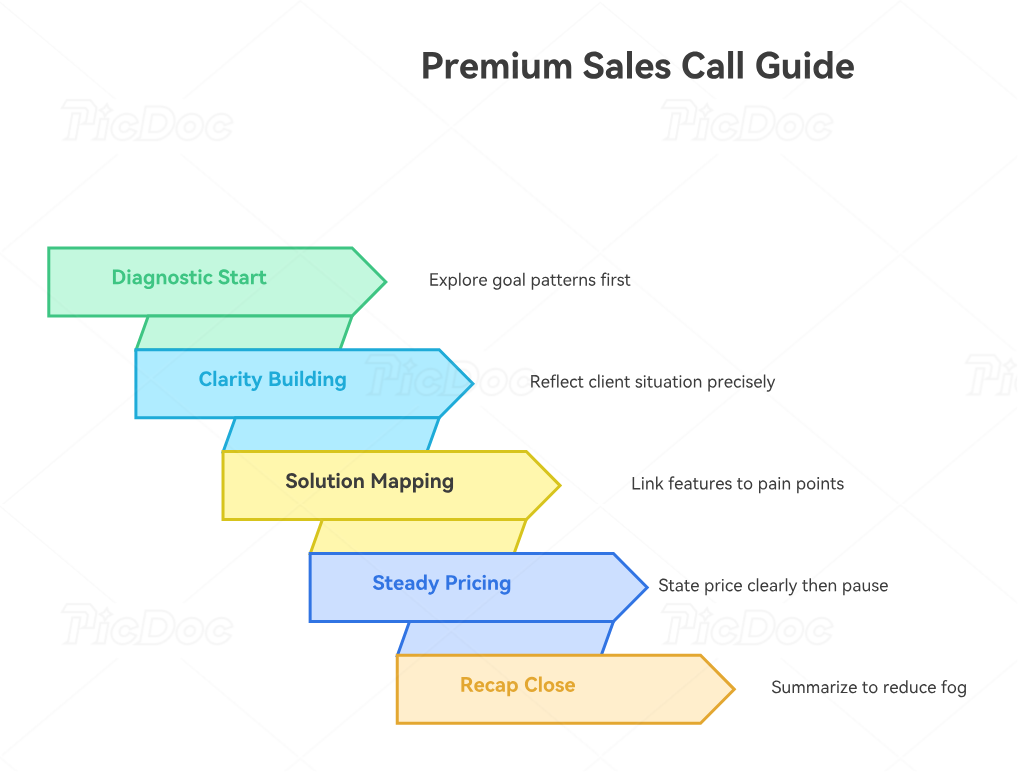
The fifth secret is a diagnostic sales conversation. A high-ticket sales call should feel like a high-quality coaching sample, because the prospect is silently asking, “Will this person understand me, challenge me safely, organize my chaos, and help me make a decision?” Start by exploring the pattern behind the goal. Ask what they have tried, where consistency breaks, what the problem is costing them, what they want life to look like, and what support has been missing. This approach connects naturally with powerful questioning, effective listening, coaching communication, and difficult conversations.
A premium sales call should create clarity before it creates an offer. Reflect the client’s situation back to them in precise language: the goal, the repeating pattern, the emotional cost, the practical obstacles, and the kind of support they likely need. This reflection builds trust because the prospect hears their own experience organized by someone competent. It also prevents you from pitching the wrong package. A coach trained in client preferences, client engagement, safe coaching environments, and expectation management can lead the call with authority and care.
When you present the package, connect every feature to a pain point already discussed. Weekly calls help with recalibration. Check-ins help with disappearing between sessions. Habit tracking helps identify patterns. A portal helps keep decisions, notes, and next steps in one place. Voice-note support helps the client avoid spiraling alone. This turns your offer into a solution map rather than a bundle of services. Use the same practical thinking behind best coaching software, virtual coaching tools, coaching automation, and habit tracking tools.
Handle price with steadiness. State the investment clearly, then stop talking. Nervous over-explaining can make the buyer feel your uncertainty. After the price, support the decision by asking what questions came up. The objection usually contains useful information: timing, trust, cash flow, partner approval, fear of failure, confusion about the process, or uncertainty about fit. Respond with honesty. A good premium coach can discuss payment, scope, and readiness while maintaining professional boundaries, ethical responsibility, conflict resolution, and trust-building communication.
The strongest close is a recap. Summarize what the client wants, what keeps blocking it, why the package fits, what will happen first, what commitment is required, and what next step they can take. This keeps the call grounded and reduces emotional fog. A premium client should leave the conversation feeling clearer, even before enrolling. That clarity builds authority more effectively than pressure tactics, especially when your broader brand already supports certification differentiation, health coach credentials, future-proof coaching trends, and coaching mastery.
5. Protect Delivery Quality So Premium Clients Stay, Renew, and Refer
Premium selling gets easier when delivery creates proof. Every high-ticket client should move through a clean client journey: enrollment, onboarding, diagnosis, plan design, weekly implementation, review, adjustment, milestone celebration, and next-phase planning. The experience must feel organized from the first payment onward. A buyer who pays premium rates and then receives scattered emails, unclear homework, or vague session notes will lose trust quickly. Coaches can protect the experience with payment systems, automated email sequences, client session recording tools, and custom dashboards.
Retention begins before renewal. During the package, show the client their progress repeatedly. Many clients adapt to improvement and forget how unstable things felt at the start. Use progress snapshots, behavior scorecards, reflection prompts, and midpoint reviews to make change visible. Track more than weight, income, or obvious metrics. Track self-trust, follow-through, emotional regulation, decision speed, boundary-setting, energy, consistency, and recovery after setbacks. This is where feedback tools, goal tracking, positive reinforcement, and client success strategies strengthen both outcomes and perceived value.
Premium clients also need relapse planning. A package that only works during perfect weeks is fragile. Build systems for travel, illness, stress spikes, family pressure, heavy workload, emotional triggers, and motivation dips. A premium coach helps the client recover faster instead of treating setbacks as failure. This makes the package feel realistic, humane, and durable. Coaches can borrow principles from burnout coaching, work-life balance coaching, mindfulness techniques, and behavior change science.
Renewals should grow from a real next phase, not an awkward end-of-package pitch. Around the final third of the program, review what changed, what remains unstable, and what deeper goal has emerged. Some clients need a maintenance package, some need advanced implementation, some need a lower-touch option, and some need a clean completion. Ethical renewal increases trust because the client sees that you are recommending the right support rather than chasing revenue. That fits the standards behind coaching ethics, coaching integrity, exceptional client experiences, and client loyalty.
Referrals come from language. When a client has a win, capture the exact words they use: “I stopped spiraling after work,” “I finally kept a promise to myself,” “I can plan meals without obsessing,” or “I handled a hard conversation without shutting down.” These phrases are stronger than polished marketing copy because they sound like the next client’s private problem. Use them ethically in testimonials, case studies, website copy, discovery calls, and offer pages. A referral engine becomes stronger with testimonial capture, case study templates, client feedback growth, and networking strategy.
6. FAQs: High-Ticket Coaching Offers and Premium Package Sales
-
A high-ticket coaching offer combines a valuable outcome, deeper access, stronger structure, tailored support, and a clear path to measurable change. The price rises because the coach is providing judgment, diagnosis, accountability, and implementation support rather than selling calls alone. The strongest offers connect coaching methods, client accountability, behavior change, and trust-building into one clear client journey.
-
Most premium packages need enough time for diagnosis, practice, review, and behavior stabilization. Eight to twelve weeks can work for a focused outcome, while four to six months may fit deeper identity, health, career, or lifestyle change. The right length depends on the client’s starting point, the complexity of the goal, and the level of support included. Coaches can design better timelines by using goal-setting systems, habit formation tools, progress tracking, and client expectation techniques.
-
Price the package by the depth of support, transformation value, delivery time, level of personalization, and cost of the client staying stuck. Guilt usually appears when the coach has unclear proof, weak structure, or shaky language around value. Build the offer first, define the outcome, map the support, and collect proof. Then the price becomes a business decision. Coaches can strengthen confidence through benchmarking insights, payment systems, coaching business growth, and professional credibility.
-
Include only components that help the client achieve, maintain, or understand the transformation. Useful elements may include intake assessment, private sessions, check-ins, habit tracking, worksheets, dashboards, recap notes, resource libraries, feedback loops, and renewal planning. Every feature should reduce confusion, increase action, or improve accountability. Coaches can build stronger packages with coaching dashboards, coaching toolkits, resource hubs, and session templates.
-
Lead with diagnosis, reflection, and decision support. Ask thoughtful questions, summarize the client’s pattern, explain the package only after understanding the problem, and connect each feature to a real obstacle they described. Pressure creates resistance, while clarity creates trust. A premium sales conversation should feel like the first proof of your coaching skill. This approach depends on effective listening, powerful questioning, constructive feedback, and communication mastery.
-
Prospects disappear when the offer feels unclear, the outcome feels vague, the price feels disconnected from value, or the buyer does not feel safe making the decision. They may also fear another failed attempt. Improve the sales process by naming the pain accurately, showing proof, explaining support, clarifying fit, and making the next step simple. Coaches can improve this through client trust, case study proof, client testimonials, and sales-safe ethics.
-
New coaches can sell premium packages when the offer is specific, ethical, well-structured, and matched to their current skill level. A new coach should avoid broad promises and focus on a narrower problem they can support responsibly. Certification, supervision, practice, templates, and strong boundaries can build trust faster. Helpful foundations include health coach certification, life coach certification, coaching competencies, and continuous education.
