
Payment Systems That Simplify Your Coaching Business (and Keep Clients Happy)
Payment friction quietly destroys coaching businesses. A client may love your work and still feel irritated by confusing invoices, limited payment options, failed charges, unclear policies, awkward reminders, or checkout steps that feel harder than booking the session itself. When the payment experience feels clumsy, trust drops before the coaching even begins.
The strongest coaching businesses make payment feel simple, clear, secure, and effortless. That keeps clients calm, protects cash flow, reduces admin chaos, and creates a more professional experience from the first touchpoint to the final package renewal. Payment systems are not back-office detail. They are part of client care.
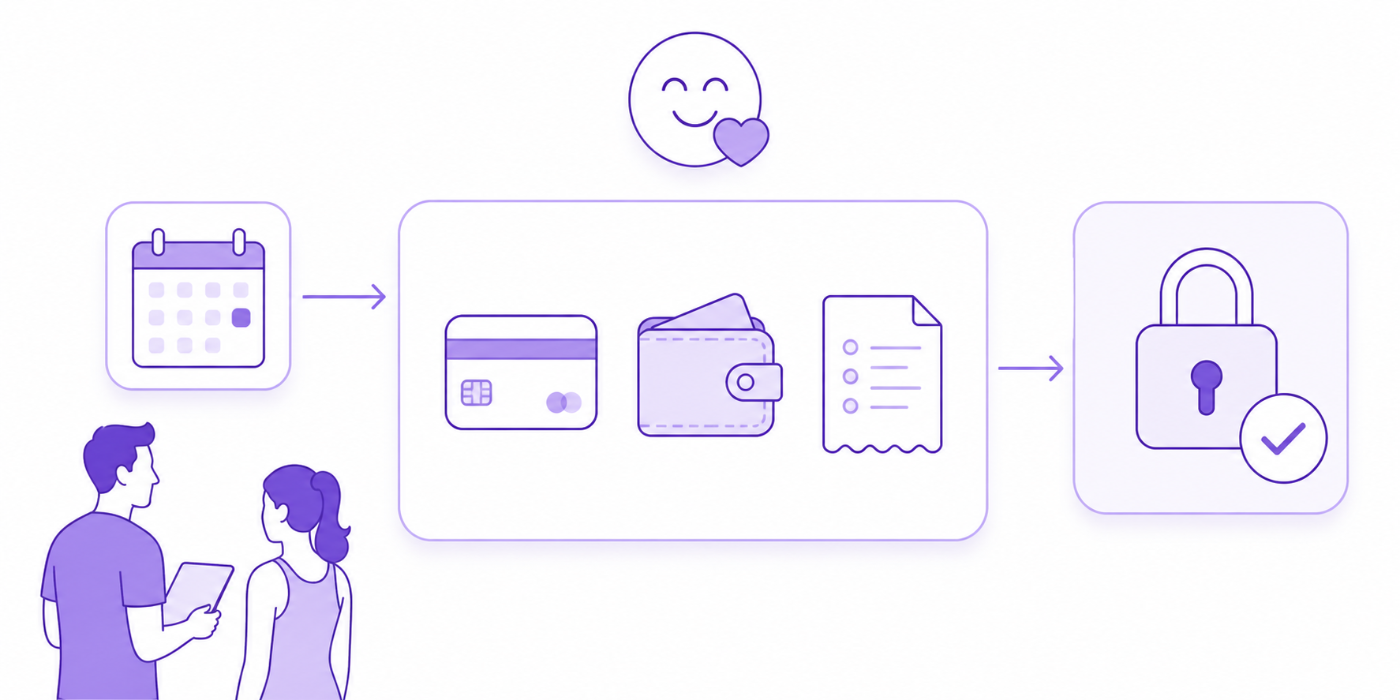
1. Why Payment Systems Matter More Than Most Coaches Realize
Many coaches treat payment as an administrative afterthought. They spend weeks refining offers, session structure, onboarding, and branding, yet the actual payment experience remains patched together with manual invoices, delayed follow-ups, unclear due dates, and inconsistent policies. That mismatch creates stress for both coach and client. A polished coaching promise followed by a messy payment process sends the wrong signal immediately.
Payment systems shape the client’s perception of professionalism. When a client can understand pricing, choose a convenient payment method, receive confirmation instantly, and know exactly what happens next, they feel safer. That sense of safety matters because coaching often requires emotional openness, long-term commitment, and financial trust. Coaches who care about the full client journey should think about payment with the same seriousness they bring to creating custom coaching dashboards for enhanced client experience, coaching session templates to boost your productivity instantly, essential CRM tools to manage your coaching client relationships, and best coaching software & platforms for client management in 2025.
Good payment systems also protect coach energy. Manual chasing drains attention and creates resentment. A coach should not have to remember who paid, who owes, who asked for an extension, whose card failed, which package is half-paid, or whether an invoice was even opened. That kind of mental load quietly steals time from delivery, growth, and client support. Coaches who want a more stable business often need the same operational clarity discussed in automating your coaching business: essential tech tools, coaching automation: next-level tools to grow your business faster, how technology is completely transforming the coaching industry, and balancing human touch with coaching automation for optimal results.
Client happiness is directly tied to payment clarity as well. Clients get frustrated when they do not know what they are paying for, when installment rules are fuzzy, when refunds are unclear, when reminders feel abrupt, or when rescheduling and package usage are disconnected from what they purchased. Coaches who want long-term retention should make payment feel like part of the service, not an obstacle inserted before the service. This fits naturally with why trust is the most valuable asset in coaching, coaching integrity: building trust and credibility in your practice, why emotional consent matters in every coaching session, and creating a safe coaching environment: why it matters and how to do it.
| Payment Element | What Clients Want | What Coaches Often Do Wrong | Business Risk | Smarter System Fix | Client Happiness Impact |
|---|---|---|---|---|---|
| Checkout page | Fast, clear, mobile-friendly payment | Overloaded form | Abandoned purchase | Use a short guided checkout | Less friction, more confidence |
| Accepted methods | Choice and convenience | Only one method offered | Lost sales | Offer card plus at least one alternative | Higher flexibility |
| Invoices | Easy-to-read details | Vague invoice language | Confusion and disputes | List package, timing, terms | Greater trust |
| Payment confirmation | Immediate reassurance | No instant receipt | Client uncertainty | Automate receipts and next steps | Feels professional |
| Installment plans | Affordability without confusion | Loose verbal agreements | Late or missed payments | Use scheduled auto-pay plans | Lower stress |
| Failed charges | Graceful recovery | Manually chasing every issue | Cash-flow instability | Enable smart retries and alerts | Less embarrassment |
| Refund policy | Clear expectations upfront | Policy hidden or unclear | Conflict | Show policy before purchase | More fairness perception |
| Session package tracking | Know what remains | Coach tracks manually | Usage disputes | Display package balance clearly | Reduces anxiety |
| Reminders | Gentle and timely notices | Abrupt manual nudges | Damaged rapport | Use branded reminder flows | Feels respectful |
| Security | Trusted handling of data | Ad hoc transfers and screenshots | Credibility damage | Use secure processors only | Higher trust |
| Contracts and payment | One coherent process | Separate disconnected steps | Drop-off before onboarding | Link payment with signed agreement | Smoother start |
| Renewals | Simple continuation options | Make clients restart from scratch | Lost renewals | Create one-click extension paths | Feels easy to stay |
| Pricing visibility | No surprises | Fees appear late | Checkout drop-off | Show total and schedule clearly | Reduces hesitation |
| Cancellation fees | Fair and predictable rules | Enforce inconsistently | Boundary erosion | Publish and automate policy logic | More confidence in fairness |
| International clients | Easy cross-border payment | Local-only setup | Blocked expansion | Use globally friendly processors | Broader accessibility |
| Tax handling | Professional receipts | Improvised documentation | Accounting issues | Standardize invoice records | Higher professionalism |
| Discovery call conversion | Easy next step after yes | Send scattered links later | Cooling momentum | Use instant payment and onboarding sequence | Stronger buying confidence |
| Subscription coaching | Predictable monthly billing | Manual monthly invoicing | Delayed revenue | Set recurring billing | Feels seamless |
| Bundles and upsells | Relevant options, not pressure | Cluttered add-ons | Buyer confusion | Offer a clean package ladder | Better decision-making |
| Late-payment policy | Known consequences | Handle case by case emotionally | Inconsistency | Use a written escalation process | Feels orderly |
| Client portal visibility | One place for billing and sessions | Info scattered across email and chat | Support overload | Centralize billing access | Reduces confusion |
| Coupons or promotions | Simple, honored discounts | Manual discount promises | Errors and awkwardness | Use coded offers properly | Feels organized |
| Group program payments | Easy enrollment | Manual lists and transfers | Admin chaos | Use event-style payment flows | Faster joining |
| Payment reminders tone | Firm but kind messaging | Cold collection-style text | Client discomfort | Write brand-aligned reminders | Protects relationship |
| Session access after non-payment | Clear rules | Ambiguous case-by-case choices | Boundary confusion | Define access rules in advance | Predictability |
| Deposit requirements | Reasonable commitment signal | No deposit on premium offers | No-shows and weak commitment | Use structured deposits | Higher seriousness |
| Corporate payments | Proper invoices and records | Consumer-style payment flow only | Lost B2B deals | Prepare professional invoicing options | Better enterprise readiness |
| Payment analytics | Reliable operations behind the scenes | Never review failures or delays | Hidden revenue leakage | Track payment performance monthly | Improves reliability |
| Client offboarding | Final clarity and receipts | End without billing closure | Loose ends and support emails | Use a clear completion sequence | Leaves a better last impression |
| Overall payment experience | Smooth, secure, respectful flow | Patchwork tools and manual fixes | Trust erosion | Design payment as part of client experience | Stronger satisfaction and retention |
2. The Best Payment System Features for a Smooth Coaching Experience
A strong payment system does not need to be complicated. It needs to remove friction at the exact moments where clients hesitate, forget, worry, or get confused. The best systems usually share a small set of core features, and coaches who get these right make their business feel far more established.
The first essential feature is flexible payment acceptance. Clients have different preferences, regions, and comfort levels. Some want cards. Some prefer bank transfer options. Some need installment plans because they are buying premium coaching while managing real financial limits. A rigid system narrows your client base immediately. Coaches designing smoother offers should think alongside best online health coach certification programs for busy professionals, health coach certification costs & hidden fees: a complete guide, life coach certification costs: full breakdown & hidden expenses, and certified health coaches reveal: is certification really worth it, because affordability and payment clarity shape buying decisions everywhere in coaching.
The second essential feature is recurring billing where appropriate. If your model includes monthly coaching, retainer access, ongoing accountability, or community subscriptions, manual invoicing becomes a liability. Recurring billing keeps revenue predictable and lowers the chance that a happy client churns simply because the renewal process was annoying. This operational stability complements the future model every coach needs to adopt by 2026, the future of client engagement 2026, virtual coaching tools: boosting your remote session effectiveness, and video conferencing hacks for flawless online coaching sessions.
The third feature is automated reminders and failed-payment recovery. Coaches often underestimate how much revenue disappears through simple forgetfulness, expired cards, inbox overload, and awkward manual chasing. Smart reminders solve ordinary human behavior without turning every issue into a personal conversation. This makes the business feel calmer and lets the coach stay focused on outcomes, much like the systems thinking behind interactive goal tracking tools that boost client success, using surveys and feedback tools to improve coaching outcomes, automated email sequences: the ultimate 2026 guide for coaches, and client session recording tools: the ultimate 2026 guide for coaches.
The fourth feature is strong integration with scheduling, contracts, packages, and client records. Payment works best when it is connected to the rest of the experience. A client should not pay in one place, sign in another, book elsewhere, and then email to ask what happens next. Integrated systems reduce drop-off and create a cleaner brand impression. Coaches building more cohesive operations should also consider the ecosystem around building your coaching toolkit: essential templates and checklists, curating the perfect coaching toolkit for every niche, comprehensive guide to building a thriving coaching resource hub, and free & premium coaching resources to boost your practice.
A final feature matters more than many coaches expect: client-facing clarity. The system should clearly show what was purchased, when payments happen, how many sessions are included, what the cancellation rules are, and where support questions go. Clarity reduces buyer’s remorse because it removes hidden ambiguity. It also prevents emotional payment conversations later.
3. How to Design a Payment Flow That Builds Trust Instead of Tension
Payment flow design starts before the invoice. The real experience begins when the client first sees your offer. If pricing is vague, package boundaries are fuzzy, or extra fees appear late, trust starts leaking immediately. Coaches often think tension appears because clients are “price sensitive,” when in reality many clients are clarity sensitive. People resist what feels uncertain.
A good payment flow begins with simple offer architecture. Name the package clearly. State what is included. Explain the length, support level, communication boundaries, payment schedule, renewal path, and cancellation rules. When clients can see the structure without hunting for details, they relax faster. That kind of clean communication fits well beside the non-negotiable standards every coach must know, how to set clear professional boundaries with coaching clients, managing client expectations: techniques to maintain motivation, and understanding ethical responsibilities as a health & life coach.
Next comes the actual payment moment. This is where many coaches unintentionally lose momentum. A prospect says yes on a discovery call, then receives three separate emails, a PDF, an invoice link, a scheduler, and a contract attached as a document they have to download later. Every extra step cools buying energy. Strong payment design compresses the next action. The client should be able to move forward while confidence is highest. This approach reinforces lessons from how to inspire clients to take immediate action, the communication secret behind successful coaching, powerful questioning techniques that transform coaching sessions, and how to actually empower clients for real results.
After payment, the experience should confirm safety and forward movement. Clients want an immediate receipt, a clear acknowledgment, and a next-step roadmap. Tell them what happens now. When is the first session? Where do they access forms? How do they communicate between sessions? What if they need support? The more complete the post-payment sequence, the less anxiety sits in the gap between purchase and delivery. Coaches who want better retention should combine this with the relational approaches inside building deep trust: how to strengthen your client relationships, effective listening techniques that transform client conversations, why emotional consent matters in every coaching session, and coaching confidentiality: how to protect your clients and your practice.
Payment flow also needs emotional intelligence. Failed charges, late payments, and extension requests are common. Coaches damage relationships when they handle these moments with either cold rigidity or blurry over-accommodation. The best systems carry the emotional load with professionalism. Policies are clear, reminders are respectful, and exceptions are handled intentionally instead of reactively. That balance is central to coaching integrity: building trust and credibility in your practice, techniques for maintaining professional boundaries with clients, managing difficult client conversations with ease, and conflict resolution strategies every coach needs.
4. Matching Payment Systems to Different Coaching Business Models
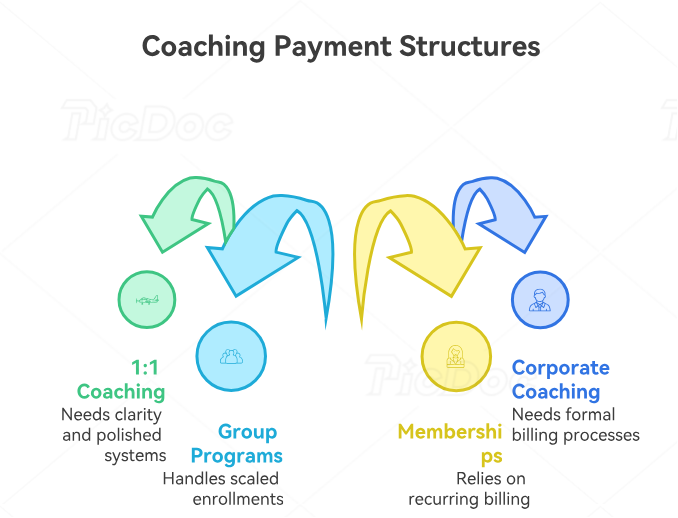
Not every coaching business needs the same payment structure. A one-to-one premium coach, a group program facilitator, a membership operator, and a corporate wellness coach all have different billing realities. Payment systems become truly useful when they match the delivery model rather than forcing every offer into the same workflow.
For one-to-one coaching, the key priorities are clarity, deposits or package commitments, installment plans where necessary, and a strong post-purchase onboarding path. These clients often invest more deeply and expect more personal attention, so the payment system should feel polished and private rather than transactional. This works well alongside launch your successful health coaching career: complete roadmap, step-by-step guide: how to become a certified life coach, executive coaching career path: certification to high-level success, and mental health coaching career guide: building a thriving practice.
For group programs, the system needs to handle enrollment at scale. That means streamlined checkout, instant confirmations, clear cohort start dates, recurring or split-payment options, and strong communication around access. When dozens of people join at once, manual handling becomes a bottleneck fast. Coaches running groups often benefit from the operational discipline seen in best practices for creating interactive coaching workshops, how to build an interactive coaching community online, virtual retreat platforms coaches are using successfully, and interactive coaching exercises to keep clients motivated.
Membership and subscription coaching models need recurring billing above all. These models depend on consistency. A monthly experience should not require monthly manual collection. The payment system must support predictable billing, easy renewals, card updates, pause policies, and churn visibility. This becomes especially important when the business leans into modern engagement formats discussed in the 10 best coaching apps every professional should know, digital marketing tools coaches need for explosive growth, YouTube channel growth for coaches: the ultimate 2026 guide for coaches, and SEO tools for coaching websites: the ultimate 2026 guide for coaches.
Corporate and organizational coaching requires a different level of formality. These buyers often need invoices, approval workflows, internal documentation, and payment timing that differs from direct-to-consumer offers. Coaches who want B2B growth need systems that can support professional billing without making every deal feel improvised. This matters for coaches looking at larger-scale opportunities through coaching market size forecast: massive growth opportunities by 2030, exclusive 2025 coaching industry report: key trends & insights, state of coaching industry 2026-27: trends & opportunities revealed, and future-proof your coaching practice: top trends to watch.
The right question is not “What payment system is best?” The right question is “What payment system best supports the promises, price points, client type, and delivery complexity of this coaching business?”
5. Common Payment Mistakes That Frustrate Clients and Hurt Revenue
One common mistake is hiding payment complexity under polished branding. A website may look strong, yet the actual purchase process still involves manual invoices, delayed replies, inconsistent due dates, and unclear session policies. Clients feel the difference immediately. Coaching businesses earn more trust when the operational reality matches the marketing polish.
Another mistake is offering payment plans without real structure. Coaches sometimes create installment options casually during sales calls, then track them manually in spreadsheets or memory. That almost guarantees confusion later. Payment plans need dates, automation, reminders, and rules for what happens if a payment fails. Coaches who want smoother client experience should bring the same seriousness to payment structure that they bring to smart goals 2.0: how top coaches set & achieve client goals, the role of accountability in coaching client success, how to make it work every time, and the radical simplicity coaches are loving.
A third mistake is unclear refund, reschedule, and access language. When clients do not know whether missed sessions count, whether unused sessions expire, whether refunds are partial, or whether support pauses after non-payment, tension builds quietly. The worst time to explain a policy is during a conflict. Strong coaching businesses communicate these rules before purchase. This protects both the relationship and the boundary. That clarity mindset also appears in how coaches avoid career-ending mistakes, why coaches must avoid this trap, the coaching skill you didn’t know you needed, and how to set them and save your career.
Another revenue-killing mistake is forgetting mobile experience. Many clients first open payment links on their phone. A checkout that is hard to read, slow to load, or cluttered with unnecessary steps loses buyers fast. Convenience affects conversion more than many coaches admit. So does the tone of payment communication. A client should feel supported, not collected from.
Finally, many coaches fail to review payment data at all. They do not know how many invoices go late, where clients drop off, how often installment plans fail, whether a specific offer creates more billing issues, or how much revenue is delayed each month by preventable friction. What gets ignored keeps leaking. Payment systems only become strategic when they are monitored, simplified, and improved over time.
6. FAQs About Payment Systems for Coaching Businesses
-
It should reduce friction without reducing clarity. The best payment system makes it easy for clients to say yes, easy to understand what they bought, easy to pay on time, and easy to know what happens next. For the coach, it should reduce manual chasing, protect boundaries, and make revenue more predictable. That kind of simplicity supports the broader business infrastructure discussed in best coaching software & platforms for client management in 2025, automating your coaching business: essential tech tools, building your coaching toolkit: essential templates and checklists, and comprehensive guide to building a thriving coaching resource hub.
-
Yes, when they are structured well. Payment plans can expand access and improve conversions for higher-ticket offers, yet they need clear dates, automated collection, written terms, and a process for failed payments. Casual verbal installment promises create confusion and stress later. Coaches considering flexible pricing should also think about trust, transparency, and long-term client fit, themes that align with health coach certification costs & hidden fees: a complete guide, health coaching certification: how to choose the right program, which certification is right for you, and top 5 internationally recognized life coaching certifications.
-
Use respectful automation with clear wording. Reminders should sound like supportive operational notices, not emotional confrontations. State the amount, due date, payment link if needed, and what happens next. Keep tone aligned with your brand. Professional reminders protect the relationship because they remove awkward improvisation. Coaches who care about communication quality can apply the same standards found in communication techniques every coach should master, how to give constructive feedback clients actually listen to, managing difficult client conversations with ease, and building deep trust: how to strengthen your client relationships.
-
A recurring billing system with strong dunning support, card-update prompts, easy receipt delivery, and clear cancellation or pause rules usually works best. Ongoing coaching becomes much more stable when monthly billing happens automatically and clients can see their billing status without confusion. This is especially useful in modern coaching models shaped by the future model every coach needs to adopt by 2026, the future of client engagement 2026, coaching automation: next-level tools to grow your business faster, and how technology is completely transforming the coaching industry.
-
They affect it more than most coaches think. Smooth payment reduces uncertainty, embarrassment, delay, and admin fatigue. Clients feel taken care of when checkout is easy, receipts are instant, terms are clear, reminders are respectful, and package usage is visible. Payment becomes part of the emotional experience of working with you. That connection to trust and safety fits naturally with why trust is the most valuable asset in coaching, creating a safe coaching environment: why it matters and how to do it, why emotional consent matters in every coaching session, and coaching integrity: building trust and credibility in your practice.
-
Upgrade when payment admin is eating time, clients are getting confused, reminders are manual, renewals are clunky, failed payments are common, or your offers have become too complex for your current setup. Growth often breaks informal systems first. A coach should not wait for repeated tension before improving the infrastructure. This becomes especially important for businesses growing into more sophisticated offers and audiences through digital marketing tools coaches need for explosive growth, how to leverage online courses for continuous coaching education, free & premium coaching resources to boost your practice, and future-proof your coaching practice: top trends to watch.
