
Financial Forecasting Secrets: Predict Your Coaching Income Accurately
A coaching business becomes much easier to grow when income stops feeling mysterious. Financial forecasting helps you see how many clients you need, which offers carry the business, when cash may tighten, and which decisions deserve attention before pressure builds. A strong forecast connects coaching business growth, client retention, digital marketing tools, and client relationship systems into one clear operating picture.

1. Why Financial Forecasting Gives Coaches Control Before Cash Gets Tight
Most coaching income problems begin weeks before the bank account feels stressful. A coach may have full sessions this month, weak discovery calls next month, renewals ending in six weeks, and an expensive tool renewal coming due. Without a forecast, those signals stay scattered. With a forecast, the coach can adjust client acquisition, improve client engagement, strengthen coaching automation, and protect professional boundaries before panic creates rushed decisions.
The core secret is simple: forecast behavior before revenue. Revenue is the result of lead flow, conversion, retention, session capacity, pricing, payment timing, refunds, pauses, expenses, and taxes. A coach who only tracks monthly income sees the finish line. A coach who tracks the drivers sees the road. That matters for online coaching platforms, coaching dashboards, client feedback systems, and growth-focused coaching tools.
Start by dividing your income into predictable and variable categories. Predictable income includes active retainers, recurring memberships, group programs with fixed payment schedules, and clients already under contract. Variable income includes new packages, single sessions, workshops, affiliate income, corporate contracts, referrals, and seasonal campaigns. This separation helps you understand whether your business is stable, opportunity-heavy, or too dependent on constant selling. It also connects directly to health coaching career planning, life coaching certification ROI, profitable coaching niches, and future-proof coaching practices.
A clean forecast also stops underpricing from hiding behind busyness. If you need 35 active clients to hit your target, and each client needs deep between-session support, your pricing or offer design may be draining capacity. If you need only eight clients to hit the same target, your delivery standards, proof, positioning, and retention must be strong enough to justify that value. This is where coaching case studies, client testimonials, coaching credibility, and certification differentiation become financial assets.
| Forecast Item | What To Track | What It Reveals | Growth Action |
|---|---|---|---|
| Active clients | Number of paying clients this month | Current revenue base | Improve client relationship tracking |
| Average client value | Total revenue divided by clients | Pricing strength | Refine certification positioning |
| Monthly recurring revenue | Committed recurring payments | Income stability | Build retention accountability |
| One-time sales | Single packages, intensives, workshops | Campaign dependency | Strengthen marketing systems |
| Discovery calls booked | Calls scheduled weekly | Pipeline health | Improve client magnet strategy |
| Discovery call show rate | Booked calls that attend | Lead quality and urgency | Clarify communication before calls |
| Close rate | Calls converted into clients | Sales message strength | Use client testimonials |
| Renewal rate | Clients who continue after package | Result satisfaction | Track visible progress |
| Referral rate | Clients sending prospects | Trust and word-of-mouth strength | Document case study proof |
| Refunds | Refund amount and reason | Expectation mismatch | Improve client expectation management |
| Payment delays | Late or failed payments | Cash timing risk | Use business automation |
| Program completion rate | Clients finishing the process | Delivery effectiveness | Improve client results systems |
| Session capacity | Available paid sessions per week | Revenue ceiling | Protect professional boundaries |
| Admin hours | Non-client hours weekly | Hidden cost of delivery | Use session templates |
| Marketing spend | Ads, tools, creative, software | Acquisition cost | Track SEO tools |
| Software costs | Monthly coaching tech subscriptions | Operational drag | Audit coaching apps |
| Tax reserve | Percentage saved from profit | Future cash protection | Plan with hidden expense awareness |
| Education spend | Courses, certification, mentorship | Skill investment load | Use continuous education |
| Content output | Posts, emails, videos, workshops | Lead generation effort | Improve coaching content |
| Email list growth | New subscribers monthly | Future buyer pool | Build automated email sequences |
| Lead source mix | Referral, SEO, social, events, partnerships | Channel risk | Expand through networking |
| Churn reason | Why clients stop | Offer weakness | Use feedback tools |
| Group program fill rate | Seats sold versus capacity | Cohort demand | Improve community engagement |
| Workshop conversion | Attendees who buy next offer | Event sales strength | Build interactive workshops |
| Corporate inquiries | Business or organization leads | B2B opportunity | Strengthen executive coaching positioning |
| Seasonal low months | Months with weaker sales | Cash flow vulnerability | Plan future-proof campaigns |
| Upsell acceptance | Clients buying next-level support | Depth of demand | Create micro-coaching entry points |
| Net profit margin | Revenue after expenses | True business health | Benchmark industry trends |
| Owner pay | Money actually paid to the coach | Personal sustainability | Protect career sustainability |
| Cash runway | Months covered by reserves | Decision-making safety | Reduce risk with growth automation |
2. Build Your Coaching Revenue Forecast From Real Income Drivers
A useful forecast begins with current committed revenue. List every active client, package price, payment date, remaining payments, renewal date, and likelihood of renewal. Then separate clients by offer type: one-on-one, group program, membership, corporate contract, workshop, course, and intensive. This gives you a clean view of which offers create dependable income and which offers require constant promotion. The same structure supports coaching resource hubs, online course leverage, client dashboards, and coaching toolkit planning.
Next, calculate your lead-to-income path. If 100 people see your content, 10 join your email list, 4 book calls, 3 attend, and 1 becomes a client, you can forecast revenue by improving each stage. A coach who improves call attendance may grow income without posting more. A coach who improves testimonial quality may increase conversion without lowering price. This is why testimonial capture, coaching content creation, SEO for coaching websites, and YouTube growth for coaches belong inside the financial forecast.
The strongest forecast uses weighted probabilities. A signed client is 100% expected revenue. A client who verbally plans to renew may be 70%. A strong discovery call prospect may be 40%. A cold lead from social media may be 5%. This stops wishful thinking from inflating the month. It also helps you prioritize the right next action: follow up with warm prospects, repair client friction, launch a workshop, improve onboarding, or create stronger proof. These moves connect with client expectation management, interactive coaching exercises, case study templates, and coaching integrity.
A coach should also forecast capacity. If you can sustainably coach 18 one-on-one clients, then a forecast showing 25 clients is a burnout warning disguised as growth. Capacity includes session hours, prep time, recap writing, check-ins, admin, marketing, sales calls, and professional development. Financial forecasting becomes more accurate when it respects professional boundaries, burnout prevention, virtual coaching tools, and coaching productivity templates.
3. Forecast Expenses, Capacity, Taxes, and Cash Timing Before They Surprise You
Income forecasting gets dangerous when expenses are treated as background noise. A coaching practice can look profitable while subscriptions, payment processing, advertising, contractor support, software, insurance, continuing education, certifications, website tools, and taxes quietly shrink take-home pay. A smart forecast separates fixed expenses, variable expenses, growth expenses, and owner pay. This supports better decisions around coaching software, technology transformation, business automation, and digital marketing investments.
Fixed expenses repeat every month. These include website hosting, scheduling tools, CRM systems, video conferencing, email marketing, course platforms, bookkeeping tools, and professional memberships. Variable expenses rise with activity, such as payment fees, assistant hours, workshop materials, platform fees, advertising, and referral incentives. Growth expenses include courses, mentorship, branding, new tech, photography, SEO, and paid campaigns. Each category should be linked to a business outcome: more leads, better retention, smoother delivery, stronger proof, or more capacity. This mindset pairs well with coaching apps, CRM tools, automated email sequences, and coaching dashboards.
Cash timing deserves its own forecast. A coach may sell a $3,000 package, collect $500 today, and receive the rest over five months. Revenue confidence and cash availability are different realities. Monthly payment plans can increase accessibility, but they require stronger cash visibility. Forecast deposit dates, installment dates, failed payment risk, refunds, pauses, and renewal timing. This helps protect delivery quality, especially when clients need accountability support, goal tracking, safe coaching environments, and consistent client communication.
Taxes also need a reserved lane. Coaches should avoid treating gross income as available cash. A practical forecast creates a tax reserve category, tracks deductible business expenses, stores receipts, and schedules periodic reviews with a qualified tax professional. The exact tax strategy depends on location, structure, income, and regulations, so the coach’s job is to keep clean records and avoid last-minute chaos. This habit supports business sustainability, professional development planning, coaching ethics, and long-term coaching credibility.
4. Use Scenarios to Predict Best-Case, Base-Case, and Danger-Case Income
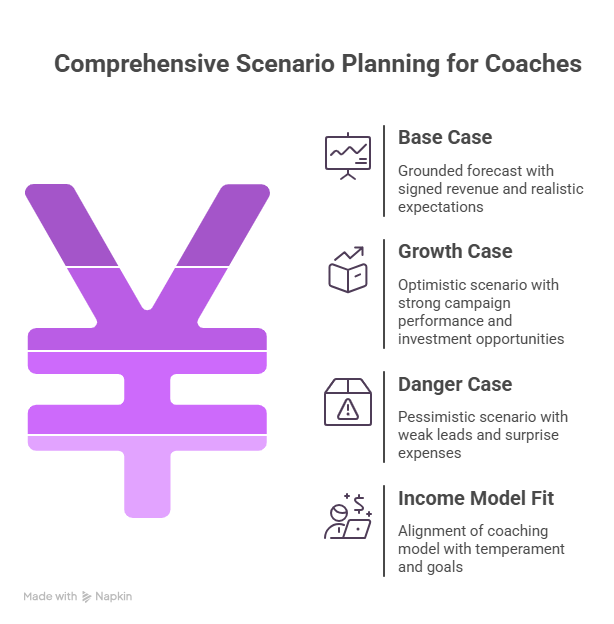
A forecast becomes useful when it shows more than one future. Build three scenarios every month: base case, growth case, and danger case. The base case includes signed revenue, likely renewals, and realistic new client expectations. The growth case includes strong campaign performance, improved conversion, more referrals, or a workshop that fills well. The danger case includes weak leads, delayed payments, lower renewals, and surprise expenses. Scenario planning supports better decisions across future coaching trends, industry benchmarking, client preference shifts, and coaching market opportunities.
The base case should feel grounded enough to run the business. Use signed contracts, current payment plans, conservative renewal estimates, and a normal close rate. The growth case helps you decide where to invest. If an email sequence could realistically add two clients, it may deserve attention. If a new tool saves ten admin hours per month, it may increase capacity. If a referral system improves qualified calls, it may reduce marketing pressure. This is where automated emails, referral-friendly testimonials, client experience dashboards, and growth automation matter.
The danger case is the most emotionally useful scenario because it removes surprise. Ask: What happens if two renewals fail? What happens if a launch fills at 40%? What happens if three payment plans are delayed? What happens if a family obligation reduces session capacity for two weeks? These questions help coaches create cash reserves, improve pipeline consistency, reduce tool clutter, and design offers with better margin. They also strengthen boundary management, work-life balance coaching, burnout-aware planning, and career sustainability.
Scenario planning also reveals which income model fits your temperament. Some coaches thrive with premium one-on-one work. Others need group programs, memberships, corporate workshops, online courses, retreats, or micro-coaching. The forecast should expose whether the model creates stability, quality outcomes, and enough energy to keep marketing consistently. This connects financial planning to micro-coaching, virtual retreats, interactive workshops, and online coaching education.
5. Turn Your Forecast Into Weekly Business Decisions
A forecast should guide action every week. On Monday, review booked revenue, expected revenue, open leads, renewal risks, and upcoming expenses. On Wednesday, review client progress, missed check-ins, stalled goals, and satisfaction signals. On Friday, review content output, discovery calls, follow-ups, and cash timing. This rhythm keeps the coach connected to both money and delivery quality. It supports client feedback tools, goal tracking systems, client engagement strategy, and coaching automation tools.
Weekly forecasting also helps coaches stop confusing activity with progress. Posting every day may feel productive, while warm lead follow-up may create more revenue. Building another worksheet may feel useful, while improving onboarding may increase completion. Buying another course may feel responsible, while documenting client outcomes may create better proof. A forecast points attention toward the highest-leverage move. This is especially valuable for case study development, coaching resource libraries, client journaling tools, and positive behavior reinforcement.
Use a four-number weekly scorecard: cash collected, revenue expected, leads in motion, and renewal risk. Cash collected shows reality. Revenue expected shows short-term stability. Leads in motion show future pipeline. Renewal risk shows delivery health. If cash is low but leads are strong, follow-up timing may be the issue. If revenue is high but renewal risk is high, delivery needs attention. If leads are weak, marketing needs a focused push. These decisions become easier with CRM systems, marketing tools, coaching content strategy, and networking systems.
Finally, review your forecast quarterly and look for structural patterns. Are you always underestimating admin time? Are group programs more profitable than one-on-one? Are referrals converting better than social leads? Are clients renewing after visible progress checkpoints? Are expenses rising faster than revenue? Those answers should shape pricing, offer design, marketing focus, delivery systems, and professional development. This makes forecasting part of coaching mastery, behavior change delivery, client transformation systems, and long-term business growth.
6. FAQs: Financial Forecasting Secrets for Coaching Income
-
A coach can forecast monthly income by listing signed client payments, likely renewals, open prospects, expected discovery calls, average close rate, and upcoming expenses. Signed payments should be counted at full value. Likely renewals and prospects should be weighted by probability. Expenses, payment delays, refunds, and taxes should be included before estimating take-home pay. This process becomes stronger with coaching dashboards, CRM tracking, client feedback systems, and business benchmarking.
-
The most important number is expected collected cash, because it shows what will actually arrive in the business during the forecast period. Total sales can look impressive while payment plans, delayed invoices, refunds, taxes, and expenses reduce usable cash. Coaches should also track lead flow, close rate, renewal rate, average client value, and session capacity. Together, these numbers connect client acquisition, retention systems, marketing tools, and professional boundaries.
-
Coaches should keep a rolling 90-day forecast and a lighter 12-month view. The 90-day forecast helps with payment timing, renewals, launches, workshops, expenses, and capacity. The 12-month view helps with seasonal patterns, education investments, annual software renewals, certification expenses, and growth goals. This planning works well alongside future-proof coaching strategy, industry trend analysis, continuous coaching education, and coaching market forecasting.
-
Forecasts often fail because they count hoped-for revenue as committed revenue, ignore expenses, underestimate admin time, overestimate renewals, and forget cash timing. A coach may also forecast based on motivation instead of historical behavior. Strong forecasts use real numbers from past lead flow, conversion, retention, client capacity, and delivery costs. They also improve when coaches track client testimonials, case study proof, client engagement, and coaching automation.
-
Forecasting shows whether current pricing supports delivery quality, admin time, marketing costs, taxes, professional development, and owner pay. If a coach needs too many clients to reach a sustainable income, pricing and offer design need review. A price increase becomes easier to defend when the coach has clear outcomes, testimonials, case studies, strong onboarding, and visible progress tracking. This connects pricing confidence to certification differentiation, coaching credibility, client progress dashboards, and coaching case studies.
-
A new coach can start with a one-page forecast that tracks target monthly income, package price, number of clients needed, leads needed, discovery calls needed, expected close rate, monthly expenses, tax reserve, and available coaching hours. This simple version gives immediate clarity without needing complex software. As the practice grows, the coach can add renewal rates, referral rates, group program seats, workshop conversions, and client lifetime value. This foundation supports new coach career planning, health coaching career roadmaps, coaching toolkit building, and business growth systems.
