
Exceptional Client Experiences: Secrets to Boost Loyalty and Referrals
Exceptional client experience begins long before the first session and continues long after the client logs off. In coaching, loyalty grows when clients feel understood, organized, emotionally safe, and able to see proof that their effort is working. A coach who combines trust-building standards, clear professional boundaries, strong accountability, and client-centered communication creates an experience clients remember, renew, and recommend.

1. What an Exceptional Client Experience Really Means in Coaching
An exceptional coaching experience is the feeling a client gets when every interaction makes their life easier, clearer, and more possible. The client does not leave wondering what mattered, what to do next, or whether the coach remembers their context. They leave with emotional relief, practical next steps, and a sense that the process has been built around their real life.
This matters because many clients arrive after years of broken promises to themselves. They may have tried habit apps, meal plans, wellness challenges, therapy-adjacent content, workplace programs, and generic advice that sounded inspiring for two days. When a coach can connect behavior change science with habit formation, emotional intelligence coaching, and stress-aware support, the client begins to feel that this time has a different structure.
The experience also has to be consistent. A brilliant discovery call followed by scattered notes, vague homework, slow replies, or messy rescheduling destroys confidence quickly. Clients measure quality through small signals: whether you remember what they said, whether your follow-up matches the session, whether your tools feel useful, whether your energy feels grounded, and whether their progress is being tracked with care. That is where coaching dashboards, goal tracking tools, feedback systems, and session templates become experience assets rather than admin extras.
| Client Experience Moment | Hidden Client Pain Point | Coach Move That Builds Loyalty | Start With This ANHCO Resource |
|---|---|---|---|
| Discovery call | The client fears being sold a package before being understood. | Ask about their failed attempts, decision pressure, and ideal support style before explaining your offer. | Powerful questioning techniques |
| Intake form | The client worries their story will be reduced to a checklist. | Use open prompts that capture goals, barriers, energy patterns, stress triggers, and support preferences. | Coaching toolkit design |
| Onboarding email | The client feels anxious about what happens next. | Send a simple welcome path with schedule, portal access, response times, and first-session expectations. | Automated email sequences |
| First session opening | The client may feel exposed, embarrassed, or behind. | Name the pace, permissions, confidentiality, and emotional consent rules before diving into goals. | Emotional consent in coaching |
| Goal setting | The client fears another unrealistic plan they will abandon. | Translate goals into small behaviors, friction points, and proof markers. | SMART goals 2.0 |
| Session notes | The client forgets insights once daily stress returns. | Send a short recap with the decision, behavior, obstacle, and next action. | Session templates |
| Action plan | The client receives too many tasks and shuts down. | Give one anchor habit, one backup version, and one rescue plan for hard days. | Habit formation tools |
| Midweek follow-up | The client disappears between sessions because support feels too far away. | Send one targeted check-in tied to the exact behavior they chose. | Accountability in coaching |
| Progress tracking | The client feels nothing is changing because progress is invisible. | Track wins, confidence, consistency, decision quality, and emotional recovery. | Goal tracking tools |
| Feedback request | The client may stay polite while quietly disengaging. | Ask what feels useful, what feels heavy, and what should change next. | Surveys and feedback tools |
| Boundary moment | The client may test access when anxiety rises. | Respond with warmth and structure, using clear support windows and escalation guidance. | Clear coaching boundaries |
| Client resistance | The client feels judged for struggling. | Treat resistance as data about fear, friction, identity, or overload. | Avoiding coaching traps |
| Emotional session | The client may need support beyond the coaching scope. | Stay grounded, clarify scope, and refer when emotional crisis requires clinical care. | Supporting emotional crises |
| Diet conversation | The client has shame around food and consistency. | Coach the environment, cues, preparation, and decision patterns around food. | Changing client diets |
| Stress conversation | The client’s plan collapses when life becomes intense. | Build a low-energy version of the plan before stress hits. | Anxiety and stress coaching |
| Burnout support | The client confuses exhaustion with personal failure. | Separate capacity rebuilding from performance pressure. | Coaching through burnout |
| Work-life balance | The client feels trapped between achievement and personal health. | Map tradeoffs, recovery gaps, schedule leaks, and boundary scripts. | Work-life balance coaching |
| Relationship challenge | The client’s environment keeps pulling them back into old patterns. | Coach communication, requests, repair, and support conversations. | Relationship coaching pathway |
| Confidence drop | The client believes one bad week erased all progress. | Use evidence reviews that show identity shifts and recovered consistency. | Strength-based coaching |
| Client win | The client may rush past progress without absorbing it. | Turn wins into proof: what changed, why it worked, and how to repeat it. | Client testimonials capture |
| Renewal conversation | The client may see coaching as a cost instead of a growth system. | Review outcomes, next-level goals, remaining friction, and support options. | Case study templates |
| Referral ask | The coach fears sounding needy or transactional. | Ask after a documented win and make the referral path simple. | Credibility-building case studies |
| Community touchpoint | The client feels alone after session momentum fades. | Create peer encouragement around small wins, shared challenges, and weekly prompts. | Interactive coaching community |
| Resource delivery | The client receives too many PDFs and uses none of them. | Send the exact resource that solves this week’s friction. | Coaching resource library |
| Tech setup | The client feels overwhelmed by platforms and passwords. | Use fewer tools, clearer instructions, and one central client hub. | Client management software |
| Video session | The client gets distracted by friction, lag, or poor preparation. | Use a predictable online session ritual and a simple backup plan. | Video conferencing best practices |
| Client dashboard | The client cannot see the full arc of their transformation. | Show goals, actions, wins, patterns, barriers, and upcoming focus in one view. | Custom coaching dashboards |
| Ethical concern | The client senses confusion around confidentiality, advice, or scope. | Explain your coaching role, records, privacy limits, and referral standards clearly. | Ethical responsibilities |
| Long-term alumni care | The client loses momentum after the program ends. | Offer check-ins, maintenance plans, resource updates, or alumni group support. | Coaching automation systems |
| Client story capture | The coach forgets to document transformation while it is fresh. | Capture baseline, turning point, behavior shift, measurable proof, and client language. | Successful client transformations |
2. Build the Client Journey Around Moments of Relief, Proof, and Progress
A strong client experience has three emotional checkpoints: relief, proof, and progress. Relief happens when the client feels organized and safe. Proof happens when they can see that their actions are creating visible change. Progress happens when the client starts making better decisions without needing constant rescue from the coach.
Relief starts with clean onboarding. Clients should know where to find resources, how to reschedule, how to contact you, what happens during sessions, what happens between sessions, and how success will be tracked. A coach who uses coaching automation tools, client relationship systems, virtual coaching tools, and resource libraries removes the mental clutter that makes clients feel unsupported.
Proof is where many coaches lose referrals. Clients may feel better, yet they cannot explain why the coaching worked. That creates a weak referral story. Instead of “my coach was great,” you want clients saying, “My coach helped me stop skipping meals during work stress,” “My coach helped me rebuild consistency after burnout,” or “My coach helped me set boundaries without guilt.” This requires measurable evidence through interactive goal tracking, feedback tools, case study templates, and client testimonials.
Progress needs to feel personal. Generic goals create generic loyalty. A client trying to rebuild their health after burnout needs a different experience than a client working on confidence, relationship patterns, emotional regulation, nutrition consistency, or career direction. Strong coaches use niche-specific coaching toolkits, mental health coaching strategy, financial coaching pathways, and relationship coaching frameworks to make support feel precise rather than packaged.
The client journey should also reduce shame. People stay loyal when they can struggle honestly without feeling downgraded in your eyes. A missed habit, emotional setback, food slip, conflict, or anxious week should become coaching data. When the coach responds with skill instead of disappointment, the client learns to return after hard weeks instead of disappearing. That is where transformational coaching, constructive feedback, safe coaching environments, and professional ethics become retention tools.
3. Turn Every Session Into a Loyalty-Building Experience
A loyalty-building session has a clear shape. It opens with emotional orientation, moves into evidence, identifies the real friction, builds one realistic action, and closes with certainty. Clients should never leave a session with a motivational fog. They should leave knowing exactly what changed in their thinking, what action matters most, and how to recover if the week becomes messy.
Start with the client’s lived reality. Ask what felt heavy, what felt easier, what surprised them, what they avoided, and where they made a better decision than usual. These questions uncover the real coaching material. They also show the client that you are tracking more than surface compliance. Skilled use of powerful questions, appreciative inquiry, solution-focused brief coaching, and positive psychology coaching helps clients see their own capacity more clearly.
Then make progress visible. A client who walked twice, paused before reacting, prepared one healthy meal, asked for help, slept earlier, or said no to a draining demand may dismiss it as “small.” Your job is to show why that small behavior matters. It may reveal self-trust, self-regulation, identity change, environmental design, or better emotional recovery. That is why strength-based coaching, habit formation coaching, behavioral reinforcement, and immediate action strategies work so well inside exceptional client experiences.
Great sessions also protect the client from overcommitment. Many clients want to impress the coach by agreeing to more than they can realistically do. That creates a loyalty problem because the client later feels ashamed, overwhelmed, and tempted to cancel. The better move is to scale the action down until it can survive a stressful weekday. Use “minimum viable action” thinking, build a backup plan, and rehearse the exact moment the client usually fails. Tools like daily journaling prompts, gratitude journal coaching, visualization and guided imagery, and inner critic management can support the emotional layer behind follow-through.
Close the session with a clean recap. The client should hear their win, their insight, their next action, their obstacle plan, and the reason this week’s focus matters. A recap creates memory, and memory creates trust. If your session ends with warmth but no structure, the client may appreciate you while still failing to act. If your session ends with warmth and precision, the client can move. This is why session recording tools, coaching dashboards, client check-in systems, and coaching templates belong inside the client experience.
4. Design Follow-Up Systems That Make Clients Feel Held Between Sessions
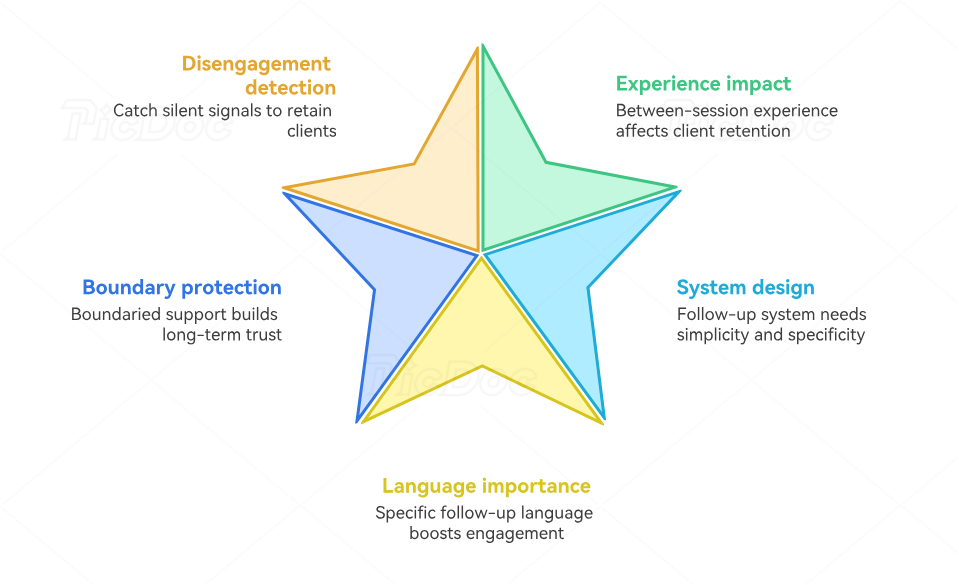
Between-session experience often decides whether a client stays, renews, or refers. A session can be powerful, yet the client’s real test begins later: when work gets busy, family stress rises, cravings hit, self-doubt returns, or the old pattern offers comfort. If your coaching support disappears during that window, the client may interpret struggle as failure instead of part of the process.
The follow-up system should be simple enough to sustain and specific enough to feel personal. A strong model includes a same-day recap, one midweek check-in, one progress prompt, and one pre-session reflection. The same-day recap captures clarity. The midweek check-in catches friction early. The progress prompt helps the client notice evidence. The pre-session reflection prepares deeper coaching. Coaches can support this through automated email sequences, coaching automation, client management tools, and digital coaching platforms.
The language of follow-up matters. A weak check-in says, “How is it going?” A stronger check-in says, “You chose the 10-minute walk after dinner as your anchor habit. What made it easier or harder this week?” The second version brings the client back to the actual agreement. It also reduces hiding because the client can answer with useful data instead of a vague update. That kind of specificity aligns with accountability coaching, client expectation management, habit tools, and behavior change strategy.
Follow-up should also protect boundaries. Exceptional experience does not mean unlimited access. It means clients know exactly what kind of support is available, when they will receive it, and what to do during urgent situations. Coaches who blur access may create short-term gratitude and long-term resentment. Boundaried support builds trust because the client knows the relationship has a safe container. Use professional boundary techniques, confidentiality standards, dual relationship guidance, and ethical dilemma frameworks to keep care sustainable.
Great follow-up also catches silent disengagement. Clients rarely announce, “I am losing confidence in this process.” They cancel once, answer late, stop filling forms, downplay wins, or avoid hard topics. A skilled coach treats those signals as experience data. Maybe the client feels overwhelmed. Maybe the plan is too ambitious. Maybe the value is unclear. Maybe the client needs more emotional safety. Feedback tools, check-ins, and repair conversations help the coach respond before loyalty breaks. This is where safe coaching environment design, constructive feedback skills, client anxiety support, and burnout coaching become experience safeguards.
5. Convert Results Into Referrals Without Feeling Salesy
Referrals grow when clients can easily explain what changed. The coach’s job is to help clients name the transformation in concrete terms. “I feel better” has emotional value, yet it gives a friend very little reason to act. “I finally created a morning routine that works with my anxiety,” “I stopped quitting every time I missed a workout,” or “I learned how to manage stress eating during deadline weeks” creates a story people understand.
Build referral language during the program, not only at the end. After a win, ask: “What would you call this shift?” “What is different about how you handled this week?” “What would your past self have done?” “What would someone close to you notice?” These prompts help the client articulate value. They also feed ethical marketing assets such as client testimonials, coaching case studies, transformation stories, and credibility-building resources.
The referral ask should feel like service. Try language such as: “If someone in your life is facing the same pattern we worked through, I am happy to be a resource. I can send you a simple note that explains who I help and when coaching is a good fit.” That removes pressure from the client and makes sharing easy. The strongest referral systems include a clear niche, a simple forwarding message, a short consultation path, and a thoughtful thank-you process. Coaches can strengthen this with digital marketing tools, SEO tools for coaching websites, content creation strategy, and networking systems.
Retention and referrals also depend on perceived professionalism. A client may love your personality, yet still hesitate to refer if your systems feel messy. People refer when they believe their friend will be treated well. That means your booking page, welcome emails, forms, resource hub, response windows, session flow, renewal process, and testimonial request all need polish. Useful support can come from coaching software, business automation, interactive workshops, and community-building tools.
Client experience also connects to certification credibility. When clients refer, they are putting their reputation beside your work. They want to feel that you are trained, ethical, and serious. Coaches who can clearly communicate credentials, scope, standards, and continuing education earn more confidence from both clients and referral partners. Strengthen that layer through health coach certification guidance, credential listing strategy, certification differentiation, and continuous coaching education.
The best loyalty strategy is simple: make the client feel seen, make the next step clear, make progress visible, make setbacks workable, and make sharing easy. When those pieces come together, your coaching business stops depending only on constant outreach. Your client experience becomes a growth engine because people remember how safe, focused, and supported they felt while changing.
6. FAQs: Exceptional Client Experiences, Loyalty, and Referrals
-
The fastest improvement is a better post-session recap. Send every client a concise summary with their main insight, chosen action, likely obstacle, backup plan, and next check-in point. This single habit improves clarity, accountability, and trust immediately. It also strengthens your overall system when paired with coaching session templates, goal tracking tools, client dashboards, and feedback systems.
-
Satisfied clients may still fail to refer because they lack clear language for the result, forget the right moment to share, or feel unsure who is a good fit for your work. A referral system should give them simple words, a clear audience, and an easy next step. Coaches can improve this through client testimonial capture, case study development, marketing tools, and networking strategy.
-
Loyalty comes from consistency, clarity, emotional safety, and visible progress. It does not require unlimited messaging or constant availability. Set clear communication windows, use structured check-ins, and explain what support looks like between sessions. This protects the client and the coach. Useful foundations include professional boundaries, coaching confidentiality, ethical coaching principles, and expectation management.
-
A premium onboarding experience should include a warm welcome email, intake form, client agreement, scheduling instructions, communication expectations, confidentiality notes, tech access, first-session preparation, and an early-win focus. The goal is to reduce anxiety before coaching begins. Coaches can build this with automated email sequences, CRM tools, resource hubs, and coaching toolkit templates.
-
Measure client experience through renewal rates, referral rates, session attendance, check-in completion, client confidence scores, testimonial quality, progress visibility, and feedback themes. Also watch soft signals: late replies, repeated cancellations, vague goals, and reduced energy. Measurement becomes easier with surveys and feedback tools, custom dashboards, goal tracking systems, and coaching automation.
-
Ask after a meaningful win, connect the request to service, and make sharing easy. A good referral ask might say, “If you know someone dealing with a similar challenge, I would be glad to offer a short fit conversation.” Then provide a simple message they can forward. The ask feels natural when backed by documented client transformation, clear certification credibility, ethical marketing habits, and strong client trust.
