
How Coaches Can Support Clients During Emotional Crises
Supporting a client during an emotional crisis is one of the moments that exposes whether a coach truly understands safety, scope, trust, and real behavior change. Clients do not arrive in neat categories. They arrive flooded, ashamed, numb, panicked, grieving, angry, exhausted, and often unable to think clearly enough to use the tools that worked last week. In those moments, the coach who helps most is the one who knows how to slow the room down, protect the client, stay inside scope, and move from emotional chaos to safe next steps.
1. What Emotional Crisis Looks Like Inside A Coaching Relationship
An emotional crisis in coaching is rarely just “a hard day.” It is the moment when a client’s stress response is overpowering their ability to think, choose, regulate, or follow through. The client may be crying uncontrollably, spiraling into catastrophic thinking, dissociating, speaking in extremes, unable to settle their breathing, or reacting to a breakup, diagnosis, job loss, relapse, betrayal, grief event, panic episode, family rupture, or major identity shock. Coaches who have studied why emotional consent matters in every coaching session, understanding ethical responsibilities as a health & life coach, coaching integrity: building trust and credibility in your practice, and why trust is the most valuable asset in coaching usually handle these moments with more precision.
The biggest mistake is treating crisis as a motivation problem. A dysregulated client does not need a better productivity hack. They need containment. They need the coach to recognize that this session has shifted from growth work to stabilization work. That is where effective listening techniques that transform client conversations, the communication secret behind successful coaching, communication techniques every coach should master, and managing difficult client conversations with ease become practical, not theoretical.
A coach should know the difference between emotional intensity and clinical danger. Intensity may sound like, “I can’t stop crying,” “I’m falling apart,” or “I don’t know what to do.” Clinical danger involves warning signs that require immediate escalation, such as disorientation, inability to care for basic safety, serious impairment, or comments suggesting self-harm or harm to others. In those cases, coaching alone is the wrong container. Coaches need the judgment taught by the ultimate guide to ethical coaching principles you can’t ignore, ethical dilemmas coaches face and how to solve them gracefully, coaching confidentiality: how to protect your clients and your practice, and techniques for maintaining professional boundaries with clients.
Clients in crisis often test the hidden weaknesses in a coaching practice. Weak intake forms, vague boundaries, poor referral networks, no emergency protocol, and overconfident “I can handle anything” thinking create risk fast. Coaches who have worked through how to set clear professional boundaries with coaching clients, how coaches avoid career-ending mistakes, building deep trust: how to strengthen your client relationships, and the non-negotiable standards every coach must know are far less likely to freeze, overstep, or say something that makes the client feel more abandoned.
| Client Signal | What It Often Means | Coach’s Best Immediate Move | Start With | Avoid |
|---|---|---|---|---|
| Rapid crying | Nervous system overload | Slow pace and anchor attention | “Let’s pause and breathe slowly.” | Jumping into advice |
| Panic language | Threat perception is high | Reduce cognitive load | “One next step at a time.” | Long explanations |
| Blank stare | Shutdown or dissociation risk | Orient to present environment | “What do you see around you?” | Pushing for insight |
| Repeating same fear | Looping thought pattern | Reflect and simplify | “This feels overwhelming and urgent.” | Arguing with the fear |
| Fast speech | Escalation and poor regulation | Use short, calm sentences | “I’m with you. Slow it down.” | Matching their speed |
| Self-blame | Shame spiral | Separate event from identity | “What happened is not your whole story.” | Moralizing |
| Hopeless tone | Collapsed agency | Shrink focus to immediate safety | “What helps the next hour feel safer?” | Big goals |
| Anger spike | Threat, hurt, or boundary injury | Name emotion without judgment | “You sound deeply hurt and activated.” | Defensiveness |
| Silence after disclosure | Fear, shame, or overwhelm | Hold steady and invite choice | “We can sit here for a moment.” | Filling every pause |
| Sleep collapse | Stress load is unsustainable | Support immediate stabilization habits | “Let’s protect tonight first.” | Performance talk |
| Appetite swings | System dysregulation | Focus on simple nourishment plan | “What is easiest to eat today?” | Rigid food rules |
| Social withdrawal | Isolation risk | Map one safe contact | “Who feels safest to text today?” | “You just need support” without specifics |
| Grief flooding | Loss has exceeded coping bandwidth | Permit grief and reduce demands | “You do not need to perform today.” | Forced positivity |
| Trauma trigger reaction | Past threat is surfacing in present | Stabilize, then refer when needed | “Let’s come back to right now.” | Deep processing beyond scope |
| Catastrophic future talk | Mind is outrunning evidence | Contain timeline | “What is true today?” | Future stacking |
| Decision paralysis | Cognitive overload | Offer limited options | “Choose option A or B.” | Open-ended complexity |
| Constant reassurance seeking | Safety feels unstable | Create a short grounding script | “Use this when your mind spins.” | Becoming the only regulator |
| Missed sessions after crisis | Shame or avoidance | Re-engage gently and specifically | “No pressure—one next step is enough.” | Guilt-based outreach |
| Overfunctioning | Collapse is being delayed | Assess cost of constant coping | “What is carrying you right now?” | Praising burnout |
| Conflict at home or work | Emotional bandwidth is leaking fast | Identify one stabilizing boundary | “What must stop today?” | Multi-layer conflict analysis |
| Physical agitation | Fight-or-flight activation | Use body-based grounding | “Press your feet into the floor.” | Purely cognitive coaching |
| Emotional numbness | Protective shutdown | Stay gentle and concrete | “What feels hardest to do today?” | Demanding vulnerability |
| Family crisis spillover | Client lost normal capacity | Reduce coaching agenda | “Today we focus on stabilization.” | Normal session structure |
| Client asks for therapy-like processing | Need may exceed coaching scope | Clarify role and refer strategically | “This deserves clinical support too.” | Pretending coaching covers all needs |
| Mentions immediate danger | Urgent safety issue | Move to emergency escalation | “Your safety comes first right now.” | Continuing a normal coaching session |
| Post-crisis fatigue | System is recovering | Build recovery plan, not growth sprint | “Let’s rebuild capacity slowly.” | Immediate stretch goals |
2. The First Priority Is Stabilization, Not Transformation
When a client is emotionally flooded, coaching goals need to shrink. This is not the session to force mindset breakthroughs, challenge every limiting belief, or push a dramatic action plan. It is the session to create enough safety that the client can think again. Coaches who understand stress management techniques every coach should know, mindfulness and meditation techniques for emotional coaching, effective strategies for coaching clients through burnout, and helping clients manage work-life balance successfully know that regulation comes before strategy.
Start by changing your pace. Slow your voice. Use shorter questions. Remove performance pressure. Tell the client what you are doing in simple language: “We do not need to solve everything right now. Let’s make this moment feel safer and clearer first.” That sentence matters because crisis often makes clients feel they are failing the session. The coach’s calm structure can interrupt that shame. This is where building deep trust, effective listening techniques, the art of powerful questioning in coaching, and powerful questioning techniques that transform coaching sessions need to be used with far more restraint than usual.
A practical stabilization sequence works well. First, orient the client to the present: what happened, what is happening now, and what feels most urgent in the next hour. Second, reduce complexity: one feeling, one need, one next step. Third, restore agency: ask what would help them feel 5% safer or steadier. Fourth, support regulation through breath, posture, contact with the chair or floor, hydration, a short walk, or contacting one safe person. Coaches who studied interactive goal tracking tools that boost client success, habit formation tools helping clients achieve lasting change, coaching session templates to boost your productivity instantly, and building your coaching toolkit: essential templates and checklists can turn this into a repeatable protocol.
What coaches say in these moments matters. Bad language increases pressure. “You know what to do.” “Try to stay positive.” “Everything happens for a reason.” “What’s the lesson here?” These lines often land as abandonment dressed up as wisdom. Better language sounds like this: “Let’s slow down.” “You do not have to sort out your whole life in this hour.” “What is the safest next step?” “Which part of this is hitting you hardest?” Coaches working from coaching clients through grief and loss: compassionate strategies, how coaches can support clients with PTSD and trauma, the importance of self-care coaching for client mental health, and how to inspire clients to take immediate action tend to choose language that reduces pressure instead of adding more.
3. Scope, Safety, And Referral: The Line Great Coaches Do Not Cross
One of the hardest truths in coaching is that compassion alone does not create competence. A coach may care deeply and still handle a crisis poorly by moving outside scope. Emotional crises can include trauma activation, severe anxiety, major depressive patterns, domestic abuse concerns, addiction relapse, or suicidal thinking. A coach can support, stabilize, and guide immediate next steps. A coach cannot act like a licensed mental health provider when the client needs clinical care. That boundary protects both people. It is reinforced in understanding ethical responsibilities as a health & life coach, techniques for maintaining professional boundaries with clients, managing dual relationships: essential ethics for coaches, and the ultimate guide to ethical coaching principles you can’t ignore.
The cleanest way to stay in scope is to ask, “Am I helping this client regulate, choose, and access support, or am I trying to diagnose, treat, interpret trauma, or become their emergency service?” The second path creates danger fast. Coaches should have a written escalation framework before they ever need it. That framework should include emergency contacts when appropriate, informed-consent language, documentation standards, a referral list, session boundaries, and a plan for what happens if a client presents with imminent risk. Coaches who have learned from coaching confidentiality: how to protect your clients and your practice, how to set clear professional boundaries with coaching clients, how coaches avoid career-ending mistakes, and the non-negotiable standards every coach must know build these systems before they are emotionally cornered into improvising.
Referral does not have to feel cold. Poorly done referral sounds like rejection. Well-done referral sounds like care with structure: “What you are carrying deserves more support than coaching alone can provide. I want to help you connect with the right level of care while staying supportive in the areas coaching can still serve.” That language honors dignity. It also protects the alliance. The strongest coaches know how to coordinate support without becoming clinically performative. Resources like essential resources for coaching certification & credentialing, curating the perfect coaching toolkit for every niche, comprehensive guide to building a thriving coaching resource hub, and free & premium coaching resources to boost your practice become especially useful when you need to move from empathy to a real support pathway.
4. What To Do In The Session: A Practical Crisis Support Framework
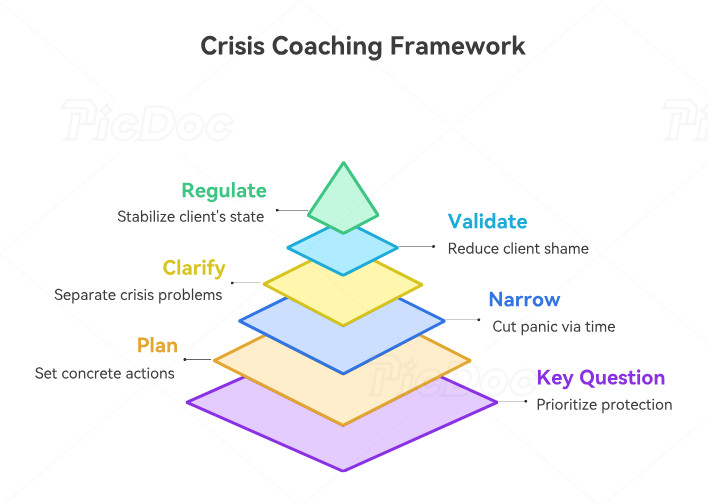
A useful coaching crisis framework has five moves: regulate, validate, clarify, narrow, and plan. Regulate first. Validation second. Clarification third. Narrowing fourth. Planning last. Coaches who reverse that order usually create more overwhelm. This is why how the world’s best coaches get results, the 1 coaching technique for client breakthroughs, strength-based coaching techniques that skyrocket client success, and solution-focused brief coaching: the ultimate 2026 guide for coaches matter most when adapted to a client’s bandwidth.
Regulate. Help the client return to the room. Ask them to feel their feet, hold a glass of water, name three things they can see, or slow their exhale. Do not overcomplicate it. When a client is flooded, simplicity is mercy. Validate. Reflect what is real without exaggeration: “This hit you hard.” “You are carrying too much at once.” “Anyone under this much pressure would feel shaken.” Good validation lowers shame. It does not intensify collapse. Coaches who study appreciative inquiry, transactional analysis, inner critic management techniques, and gratitude journal coaching know that technique must serve the moment, not dominate it.
Clarify. Once the client is a little steadier, identify what actually happened, what meaning they attached to it, and what feels most urgent now. Emotional crises often contain ten problems mashed together. Your job is not to solve all ten. Your job is to separate them. Narrow. Ask the client what would matter most in the next hour, tonight, or by tomorrow morning. Narrowing time horizon reduces panic. Plan. End with one to three concrete actions: text one safe person, cancel one nonessential commitment, eat something simple, book the referred professional, write a grounding note, avoid the triggering interaction for tonight, or move into a calmer environment. Coaches who use interactive coaching exercises to keep clients motivated, creating custom coaching dashboards for enhanced client experience, using surveys and feedback tools to improve coaching outcomes, and powerful client journaling tools for deeper self-awareness can turn these into structured follow-through.
The best end-of-session question is often not “What did you learn?” It is “What do you need to protect in the next 24 hours?” That question respects the biology of crisis. Insight can come later. Immediate safety, sleep, nourishment, support, and reduced exposure to fresh triggers usually matter more right now. Coaches who keep reaching for “growth” language too early can make clients feel unseen. Coaches who understand how to actually empower clients: real results, how to make it work every time, how coaches can actually change client diets, and the future of client engagement 2026 know that lasting change depends on meeting the nervous system where it is.
5. What Happens After The Crisis Session Matters Just As Much
A strong crisis-support session can still fail if the follow-up is weak. Clients often leave emotionally intense sessions with temporary relief, then crash again when they are alone. This is where good coaches become dependable rather than merely comforting. A short follow-up message, a written recap, one-page grounding plan, referral reminder, or pre-agreed check-in can make the difference between a client who feels held and a client who feels dropped. Coaches using client portal systems, automated email sequences, client session recording tools, and automating your coaching business: essential tech tools can create humane follow-up without becoming constantly available.
Documentation matters too. Coaches should record what happened, what was observed, what support was provided, what referrals were suggested, what commitments were made, and any safety-related concerns. Documentation is not bureaucracy for its own sake. It protects memory, boundaries, consistency, and professional judgment. It also reveals patterns across time. Some clients present with one-off crises. Others cycle through recurring collapse driven by the same relational, health, financial, or environmental stressors. Coaches who have worked through coaching case study templates: demonstrating your value effectively, benchmarking your coaching business: industry standards & insights, state of coaching industry 2026-27: trends & opportunities revealed, and must-know client preferences shaping the future of coaching usually build stronger systems instead of relying on memory and instinct.
Coaches must also manage their own nervous systems. Emotional crises can pull a coach into rescuer mode, fear mode, guilt mode, or overfunctioning mode. That is dangerous. If the session lives in your body all day, your clarity will erode across clients. Debriefing, supervision, peer consultation, documented protocols, recovery rituals, and realistic access boundaries are not luxuries. They are competence tools. This is where the importance of self-care coaching for client mental health, balancing human touch with coaching automation for optimal results, future-proof your coaching practice: top trends to watch, and coaching automation: next-level tools to grow your business faster intersect with ethics more than most coaches realize.
Ultimately, clients remember how safe they felt with you when life stopped making sense. They remember whether you stayed calm, whether you respected their dignity, whether you reduced confusion, and whether your next steps actually matched their reality. That is why coaches who commit to coaching integrity, building deep trust, effective strategies for reinforcing positive client behaviors, and how coaches reach mastery create stronger outcomes in the moments that matter most.
6. FAQs About Supporting Clients During Emotional Crises
-
Yes, when the coach stays focused on regulation, immediate safety, practical next steps, and appropriate referral. Coaching can help a client slow down, organize the next few hours, reconnect with agency, and access better support. Coaching should not drift into diagnosing mental health conditions, deep trauma processing, or acting as emergency care. The safest foundation comes from understanding ethical responsibilities as a health & life coach, why emotional consent matters in every coaching session, coaching confidentiality, and how to set clear professional boundaries with coaching clients.
-
Start with calm, simple containment. Good first lines include: “Let’s slow this down together,” “You do not need to solve everything right now,” or “Tell me what feels most urgent in this moment.” These reduce pressure and create space. They work far better than fast advice or forced optimism. Strong communication in these moments is sharpened by effective listening techniques that transform client conversations, communication techniques every coach should master, managing difficult client conversations with ease, and the communication secret behind successful coaching.
-
A coach should escalate when there are signs of immediate danger, serious impairment, or risk that exceeds the coaching container. That includes situations where the client’s safety appears unstable or they may need urgent professional or emergency support. Every coach should have a written escalation protocol before this ever happens. Preparation improves with the ultimate guide to ethical coaching principles you can’t ignore, ethical dilemmas coaches face and how to solve them gracefully, the non-negotiable standards every coach must know, and how coaches avoid career-ending mistakes.
-
Use structured support instead of limitless access. Send a short recap, confirm the next step, remind them of the plan, and reinforce the boundary around communication windows. A follow-up should create stability, not dependency. Tools from automated email sequences, interactive goal tracking tools, creating custom coaching dashboards, and automating your coaching business can help coaches stay caring and clear at the same time.
-
Recurring crises usually point to deeper patterns, unaddressed stressors, weak boundaries, repeated triggers, insufficient outside support, or a coaching scope mismatch. The coach should track patterns, tighten structure, revisit readiness, and assess whether referral or co-support is now necessary. Repeated instability is a signal to become more precise, not more vague. This gets easier when coaches study how coaches can support clients with PTSD and trauma, coaching clients through grief and loss, effective strategies for coaching clients through burnout, and stress management techniques every coach should know.
-
They rush to fix. That usually comes from anxiety, not mastery. Flooded clients need regulation, containment, clarity, and safe next steps before they need insight or accountability. The coach who can tolerate intensity without becoming frantic does far more good than the coach who produces a fast-looking plan that the client cannot use. The most durable improvement comes from the mindset behind how the world’s best coaches get results, how to actually empower clients: real results, why trust is the most valuable asset in coaching, and how coaches reach mastery.
