
Harnessing the Power of Habit Formation in Coaching
When clients fail to follow through, the problem usually sits deeper than motivation. Most do not need another inspiring session. They need a repeatable system that turns intention into behavior under stress, distraction, fatigue, travel, emotional setbacks, and ordinary life friction. That is where habit formation changes coaching outcomes.
Coaches who understand habit architecture create far more durable results than coaches who rely on encouragement alone. When small actions are tied to cues, tracked visibly, reviewed honestly, and adjusted quickly, clients stop starting over. They build momentum, identity, and trust in themselves.

1. Why Habit Formation Is One of the Most Valuable Coaching Levers
Habit formation gives coaching a structure that survives the week between sessions. A client may leave a call feeling clear, hopeful, and committed, yet still do nothing when Monday becomes chaotic. That is why many strong conversations fail to produce strong outcomes. Real progress demands a bridge between insight and execution, and that bridge is behavior design.
In coaching, habits matter because they reduce decision fatigue. A client who must negotiate every workout, every meal choice, every bedtime, every journaling session, and every stress response burns out quickly. A client with a simple repeatable rhythm preserves energy for the harder parts of change. That is why smart coaches often combine the relational depth of transformational coaching behavioral strategies for lasting change with the practical consistency found in interactive goal tracking tools that boost client success, how to inspire clients to take immediate action, and the role of accountability in coaching client success.
The biggest mistake many coaches make is assigning habits that are too ambitious for the client’s real life. A client with two children, an unpredictable shift schedule, poor sleep, and high stress does not need an ideal morning routine copied from a wellness influencer. That client needs one behavior that can survive exhaustion. This is where coaching judgment becomes valuable. The coach identifies the smallest action that still creates movement. That approach aligns closely with the radical simplicity coaches are loving, how to make it work every time, why top coaches are obsessed, and how coaches reach mastery.
Habit formation also protects clients from all-or-nothing thinking. When behavior change depends on a perfect week, clients collapse after one bad day. When coaching is built around tiny recoverable behaviors, the client learns how to reset instead of quit. This matters deeply in nutrition, stress management, emotional regulation, and boundary work. Related ANHCO resources such as how coaches can actually change client diets, stress management techniques every coach should know, mindfulness and meditation techniques for emotional coaching, and techniques for maintaining professional boundaries with clients all point to the same truth: sustainable change depends on repeatable behavior, not emotional intensity.
| Client Goal | Habit to Build | Best Trigger | Start Small Version | Common Breakdown | Coach Fix |
|---|---|---|---|---|---|
| Better hydration | Drink water on waking | Alarm off | 5 sips | Bottle not nearby | Set bottle by bed nightly |
| Healthier eating | Protein at breakfast | First meal prep | One protein source | Morning rush | Pre-decide two fast options |
| Weight management | Pause before snacking | Kitchen entry | Three breaths | Stress autopilot | Use visual cue on pantry |
| Better sleep | Phone off before bed | Night alarm | 5 minutes early | Scrolling loop | Charge phone outside room |
| Lower stress | Midday reset | Lunch finish | 60-second pause | Forgot entirely | Calendar block reminder |
| Exercise consistency | Movement after work | Arrive home | 5-minute walk | Sit on couch first | Shoes at entry door |
| Emotional regulation | Name feeling aloud | Stress spike | One-word label | Reaction too fast | Use scripted pause phrase |
| Boundaries | Delay non-urgent yes | Incoming request | Say “Let me check” | People-pleasing reflex | Practice response in session |
| Confidence | Daily win log | End of workday | Write one win | Thinks it is trivial | Explain identity reinforcement |
| Relationship repair | Check tone before hard talks | Conflict cue | One calming breath | Escalation speed | Role-play first 20 seconds |
| Energy | Morning sunlight | Coffee start | 2 minutes outside | Weather excuse | Window fallback plan |
| Focus | Single-task block | Start of work sprint | 10 minutes | Notifications | Activate focus mode |
| Self-awareness | Reflect after triggers | Emotion settles | One sentence note | Too drained later | Use voice memo instead |
| Meal planning | Plan top 3 meals | Saturday morning | 3 meals only | Overplanning | Keep rotating meal list |
| Reduced burnout | Mini recovery breaks | Task completion | 90 seconds | Feels unproductive | Tie breaks to performance |
| Journaling | Morning check-in | Tea or coffee | Two lines | Perfectionism | Ban long-form entries |
| Financial control | Expense review | Friday shutdown | 3 transactions | Avoidance | Use no-judgment review script |
| Morning stability | Prepare night before | Kitchen close | Lay out one item | Late-night fatigue | Shrink prep checklist |
| Better communication | Repeat key point before replying | Hard conversation | One reflective sentence | Defensiveness | Practice reflective listening |
| Screen control | App-free first hour | Wake-up | 10 minutes | Reflex grab | Move phone across room |
| Follow-through | Daily top priority | Desk setup | Write one task | Too many priorities | Use one-task rule |
| Social connection | Reach out weekly | Sunday planning | One text | Overthinking wording | Prepare message templates |
| Mindful eating | Sit for meals | Plate served | First 3 bites seated | Eating while standing | Clear eating space first |
| Career growth | Learning block | Calendar opening | 8 minutes study | No clear material | Pre-select resource list |
| Reduced reactivity | Response delay | Provoking message | Wait 2 minutes | Instant reply habit | Draft but do not send |
| Session preparation | Pre-call reflection | 15 minutes before coaching | Answer 2 prompts | Client forgets | Automate reminder form |
| Gratitude | Name one good thing | Dinner end | One sentence | Feels forced | Make it specific and concrete |
| Decluttering | Reset one zone | Before bed | 2 minutes | Starts too much | Assign one tiny area |
| Walking habit | Post-meal walk | Lunch finish | 4 minutes | Work interruption | Indoor fallback route |
| Recovery after setbacks | Reset next action | Missed habit | Do smallest version | Shame spiral | Normalize repair, not perfection |
2. The Core Mechanics of Habit Formation Every Coach Should Understand
A useful coaching habit has four parts: cue, action, reward, and repetition. If one part is weak, the habit usually leaks. Coaches who grasp these mechanics stop blaming clients for inconsistency and start redesigning the behavior loop.
The cue tells the brain when to act. Vague intentions fail here. “Drink more water” is not a cue. “Drink water after brushing teeth” is a cue. “Journal sometime tonight” is not a cue. “Write two lines after putting the kids to bed” is a cue. This is why coaches who build strong results often pull from tools discussed in coaching session templates to boost your productivity instantly, powerful client journaling tools for deeper self-awareness, daily journaling prompts the ultimate 2026 guide for coaches, and life mapping the ultimate 2026 guide for coaches.
The action must be easy enough to start under imperfect conditions. Many clients can complete a two-minute version of a habit even when they cannot complete the full version. That matters. Starting is often the actual bottleneck. Once a client starts, continuation becomes easier. This is one reason interactive coaching exercises to keep clients motivated, gamification strategies keeping clients engaged and motivated, why micro-coaching is the next big thing for rapid client results, and effective strategies for reinforcing positive client behaviors can become powerful supports rather than gimmicks.
The reward closes the loop. Coaches sometimes ignore reward because it sounds superficial, yet the brain pays attention to what feels satisfying. Reward does not have to mean a treat or external prize. It can be visible progress, emotional relief, a checked box, a message sent to a coach, a win recorded in a tracker, or the pride of keeping a promise. Habit systems often become stronger when paired with creating custom coaching dashboards for enhanced client experience, using surveys and feedback tools to improve coaching outcomes, creating a coaching resource library your clients will love, and free amp premium coaching resources to boost your practice.
Repetition creates identity. That is where the real transformation happens. A client who repeats a tiny action long enough stops saying, “I’m trying to be healthy,” and starts feeling, “I am someone who follows through.” Coaching becomes far more durable when the coach is helping build identity, not merely compliance. That philosophy fits naturally with strength-based coaching techniques that skyrocket client success, how to actually empower clients real results, the 1 coaching technique for client breakthroughs, and why trust is the most valuable asset in coaching.
3. How Coaches Should Build Habits That Clients Actually Keep
The first step is choosing the right habit target. Many coaches make the session feel productive by choosing a dramatic goal. Skilled coaches choose a strategic one. The right habit sits close to the client’s real pain point, delivers a visible benefit quickly, and fits the client’s current capacity. A client struggling with emotional eating may not need a full nutrition overhaul first. They may need a pause habit between urge and action. A client drowning in overwhelm may not need a full productivity system first. They may need a nightly reset ritual and a one-task morning plan.
Next, attach the habit to an existing routine. This is called habit stacking, and it works because the brain already recognizes the anchor. After coffee, take supplements. After sitting at the desk, write the top task. After the lunch break, walk for five minutes. After closing the laptop, review tomorrow’s priorities. Coaches can strengthen this method by borrowing from smart goals 20 how top coaches set amp achieve client goals style planning, powerful questioning techniques that transform coaching sessions, effective listening techniques that transform client conversations, and the art of powerful questioning in coaching.
Then, reduce friction aggressively. Every extra click, every missing tool, every vague instruction, every social complication, and every environmental obstacle will kill adherence. If the habit is journaling, the notes app must already be open or the journal must already be visible. If the habit is a morning walk, shoes must be placed at the door. If the habit is a weekly meal plan, the client needs a short list format instead of a complicated spreadsheet they will never use. This is where coaches can integrate support from curating the perfect coaching toolkit for every niche, building your coaching toolkit essential templates and checklists, automating your coaching business essential tech tools, and best coaching software amp platforms for client management in 2025.
Finally, create a recovery plan before the client slips. This is crucial. Most habit plans assume success and say nothing about disruption. Real life includes illness, travel, grief, conflict, parenting chaos, workload spikes, low mood, and unexpected schedule collapse. A strong coaching plan answers one question in advance: “What will you do when the full habit is not possible?” That is how coaches protect momentum. A one-minute version still counts. A recovery version keeps identity intact. This approach becomes even more important in harder client situations addressed in effective strategies for coaching clients through burnout, helping clients manage work-life balance successfully, how coaches can support clients during emotional crises, and coaching clients through grief and loss compassionate strategies.
4. Using Accountability, Tracking, and Reflection to Lock Habits In
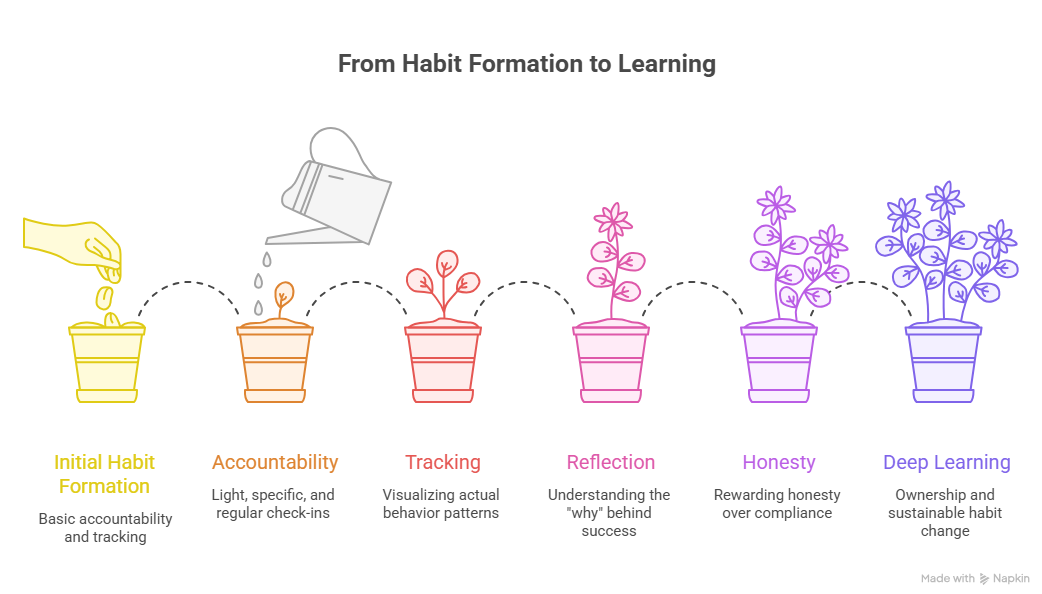
Habit formation improves sharply when clients know someone or something will notice whether the behavior happened. Accountability does not have to feel heavy. In fact, heavy accountability often creates avoidance. The most effective systems are light, specific, and regular. A short weekly check-in form, a visible habit tracker, a single message after completion, or a scorecard reviewed during sessions often produces stronger compliance than long reflective homework nobody finishes.
Tracking matters because memory lies. Clients often say they “basically did okay” or “had a bad week,” yet the actual pattern is far more useful than the feeling. Maybe they completed the habit four days out of seven. Maybe mornings fail but evenings work. Maybe weekends collapse. Maybe the habit works during low-stress weeks and disappears during family conflict. Once the pattern is visible, coaching gets sharper. Coaches can refine this process with using surveys and feedback tools to improve coaching outcomes, interactive goal tracking tools that boost client success, coaching case study templates demonstrating your value effectively, and creating custom coaching dashboards for enhanced client experience.
Reflection is the layer that converts repetition into learning. Instead of asking, “Did you do it?” skilled coaches ask, “What made it easier on the days it happened?” “What friction showed up?” “What time, mood, or environment supported success?” “What identity did this behavior reinforce?” Questions like these deepen ownership and prevent dependency on the coach. They also fit naturally with communication techniques every coach should master, the communication secret behind successful coaching, building deep trust how to strengthen your client relationships, and creating a safe coaching environment why it matters and how to do it.
One more point matters here: coaches should reward honesty, not just compliance. If a client admits the habit failed, that honesty is valuable data. Punishing failure with disappointment teaches clients to hide. Honest coaching cultures create better outcomes. That principle aligns with coaching integrity building trust and credibility in your practice, why emotional consent matters in every coaching session, understanding ethical responsibilities as a health amp life coach, and the ultimate guide to ethical coaching principles you cant ignore.
5. Common Habit Formation Mistakes Coaches Must Catch Early
One common mistake is confusing knowledge with readiness. Clients often know what to do. They still do not do it. More information rarely solves a behavior gap. Coaches need to diagnose whether the issue is friction, timing, emotional resistance, identity conflict, low confidence, unclear cues, or unrealistic habit size. Articles like how coaches avoid career-ending mistakes, why coaches must avoid this trap, the coaching skill you didnt know you needed, and the non-negotiable standards every coach must know all reflect this larger truth: the right intervention depends on the real obstacle.
Another mistake is making the habit emotionally or logistically expensive. A client who feels guilt, inadequacy, or dread around the habit will resist it even if they agree with it intellectually. A client who needs ten setup steps will also resist it. Coaches should regularly ask whether the habit feels lighter or heavier over time. If heavier, redesign it. Supportive resources can include how to give constructive feedback clients actually listen to, managing difficult client conversations with ease, conflict resolution strategies every coach needs, and how to set clear professional boundaries with coaching clients.
A third mistake is treating relapse like failure instead of information. Habit breakdowns reveal where the design is weak. Did the cue disappear? Did stress hijack the routine? Did the client secretly dislike the action? Did the reward feel too distant? Did the habit clash with family systems, work conditions, or emotional realities? Coaches who study breakdowns build smarter plans. Coaches who moralize them create shame. That difference is often what separates short-term enthusiasm from lasting transformation, a theme that also shows up in new data proven coaching methods for maximum client success, inspiring case studies of successful coach client transformations, how the worlds best coaches get results, and future-proof your coaching practice top trends to watch.
6. FAQs About Harnessing Habit Formation in Coaching
-
Start with the smallest habit that sits closest to the client’s most painful daily friction point. That could be a two-minute morning reset, a water habit, a nightly planning habit, a post-lunch walk, or a one-line reflection. The key is choosing something that produces quick proof of follow-through. Early wins matter because they build self-trust. Coaches often support this well through launch your successful health coaching career complete roadmap, how to actually change your clients life in 2026, must-know client preferences shaping the future of coaching, and preventative health coaching how this shift will dominate the industry.
-
There is no single timeline that fits every client. Habit strength depends on simplicity, emotional resistance, environmental support, frequency, and how tightly the action is linked to an existing cue. A daily two-minute behavior tied to a stable routine can feel natural fairly quickly. A complex habit that depends on energy, time, and emotional regulation often takes much longer. Coaches get better results when they focus less on a magic number and more on consistency design, using ideas from coaching automation next-level tools to grow your business faster, virtual coaching tools boosting your remote session effectiveness, video conferencing hacks for flawless online coaching sessions, and the future model every coach needs to adopt by 2026.
-
Stop repeating the same advice and audit the loop. Examine the cue, the action size, the environment, the emotional cost, the timing, and the reward. Look for hidden resistance. Sometimes the habit is too large. Sometimes it is attached to the wrong time of day. Sometimes the client agreed verbally but never believed it fit their life. Coaches can diagnose more effectively by using effective coaching communication for nbhwc certification, detailed review of nbhwc coaching competencies, essential coaching skills for icf credentialing, and coaching confidentiality how to protect your clients and your practice.
-
They are worth using when they reduce friction, improve visibility, and make follow-through easier. They become a problem when they add complexity, notifications clients ignore, or dashboards nobody opens. The best tools support one clear behavior at a time and fit the client’s actual tech comfort. Strong options often connect well with the 10 best coaching apps every professional should know, automated email sequences the ultimate 2026 guide for coaches, essential crm tools to manage your coaching client relationships, and how technology is completely transforming the coaching industry.
-
Use collaboration, not compliance. Let the client help choose the habit, the trigger, the minimum version, the tracking method, and the recovery plan. Ask what feels realistic, what feels annoying, what usually gets in the way, and what kind of support creates pressure versus progress. Coaching stays empowering when the client experiences the habit as self-authored. That mindset fits well with building deep trust how to strengthen your client relationships, why trust is the most valuable asset in coaching, how to actually empower clients real results, and the communication secret behind successful coaching.
-
Almost all of them. Health coaching, stress management, burnout recovery, relationship coaching, executive coaching, financial coaching, emotional coaching, and lifestyle change work all depend on repeated action between sessions. Habit formation becomes especially powerful wherever clients struggle with inconsistency, avoidance, or relapse. ANHCO’s broader content ecosystem shows this clearly across mental health coaching career guide building a thriving practice, becoming a relationship coach your ultimate career pathway, financial coaching career blueprint essential steps for success, and helping clients manage work-life balance successfully.
