
Food sensitivity coaching is gaining traction because clients want clear answers for bloating, fatigue, headaches, unpredictable digestion, and meals that leave them feeling worse. Strong coaches turn that frustration into structured observation, appropriate referrals, and sustainable action through nutrition and lifestyle coaching, behavior-change science, client accountability, and personalized habit formation. The opportunity is growing quickly, and credibility depends on resisting questionable tests, unnecessary restriction, and promises that exceed coaching scope.

1. Why Food Sensitivity Coaching Is Growing So Fast
Clients rarely seek food sensitivity support because they enjoy tracking meals. They arrive after months of bloating, abdominal discomfort, inconsistent bowel habits, fatigue, headaches, skin concerns, or an uncomfortable sense that food has become unpredictable. Some have received reassuring medical results while their daily symptoms continue. Others have removed several foods after following social-media advice and now feel trapped inside a shrinking diet. Food sensitivity coaching appeals to these clients because it offers structure through client-centered coaching, focused nutrition education, supportive accountability systems, and practical behavior-change planning.
The phrase “food sensitivity” also feels personal. It appears to explain why one person tolerates a meal comfortably while another experiences symptoms. That promise fits the wider demand for individualized wellness, measurable routines, and health plans built around real life. The problem emerges when personalization becomes a substitute for valid assessment. Food allergy, lactose intolerance, celiac disease, irritable bowel syndrome, medication effects, eating patterns, stress, gastrointestinal disease, and several other conditions can produce overlapping complaints. Responsible coaches combine preventative health coaching, safe coaching environments, appropriate scope-of-practice boundaries, and timely professional referral.
Direct-to-consumer testing has accelerated interest further. Commercial IgG panels can produce long lists of foods marked with different reactivity levels, giving clients the sense that a hidden cause has finally been discovered. The American Academy of Allergy, Asthma & Immunology explains that food-specific IgG testing lacks scientific validation for diagnosing food allergy, intolerance, or sensitivity. IgG may simply reflect normal exposure to a food, while higher IgG4 levels may even be associated with tolerance. Coaches who understand this distinction can provide constructive feedback, manage client expectations, protect professional credibility, and prevent expensive restriction based on weak evidence.
Symptom overlap adds another powerful driver. Bloating can arise from lactose malabsorption, fermentable carbohydrates, constipation, meal size, rapid eating, swallowed air, or other digestive conditions. Fatigue may relate to inadequate intake, disrupted sleep, chronic stress, anemia, medication, illness, or a demanding schedule. A headache following a meal can involve hydration, caffeine changes, meal timing, migraine triggers, or coincidence. The coach’s greatest value comes from organizing the problem through anxiety and stress coaching, habit-based observation, careful client feedback systems, and a decision process that reduces guesswork.
Food sensitivity coaching also solves an implementation problem. A clinician or dietitian may recommend a temporary dietary experiment, symptom record, lactose reduction, fiber adjustment, or structured reintroduction. Clients still need help shopping, preparing meals, handling restaurants, communicating with family, maintaining routines, and recovering after difficult weeks. These practical barriers sit directly inside health coaching behavior change, micro-coaching support, habit stacking, and sustainable client accountability.
The strongest market opportunity therefore belongs to coaches who offer clarity rather than another miracle explanation. Clients need help distinguishing evidence from marketing, preparing useful questions for healthcare professionals, following an approved plan, and expanding food variety whenever possible. This approach strengthens exceptional client experiences, improves client retention, creates credible coach-client transformation stories, and positions the service within emerging coaching industry trends.
Food Sensitivity Coaching Decision Map: 30 Client Patterns and Safe Next Steps
| Client Report | Question to Investigate | Coach-Safe Action | Progress Measure | Referral or Safety Trigger | Common Coaching Error |
|---|---|---|---|---|---|
| Immediate hives after eating | Could this involve an allergic reaction? | Stop dietary experimentation and direct the client toward medical assessment | Referral completed and emergency plan clarified | Breathing trouble, swelling, faintness, or rapidly progressing symptoms | Calling the response an intolerance |
| Throat or tongue swelling | Is urgent allergy care required? | Follow emergency guidance immediately | Emergency response activated | Any airway symptom | Continuing the coaching conversation |
| Bloating after milk | Does amount, product type, or timing change the response? | Help the client document patterns and seek appropriate assessment | Symptoms by portion and product | Weight loss, bleeding, persistent diarrhea, or severe pain | Removing all dairy indefinitely |
| Symptoms after ice cream but not hard cheese | Could lactose quantity explain the pattern? | Track dose and product differences under professional guidance | Personal tolerance range identified | Symptoms continue across unrelated foods | Labeling every dairy product harmful |
| Digestive symptoms after wheat | Has celiac disease been medically evaluated? | Encourage testing before gluten removal | Medical evaluation completed | Anemia, weight loss, family history, or persistent symptoms | Starting a gluten-free diet before testing |
| Client already removed gluten | Was diagnostic testing completed first? | Prepare questions for the client’s clinician | Clear medical plan established | Long-term restriction without diagnosis or dietetic support | Interpreting symptom relief as proof of celiac disease |
| Bloating after onions, garlic, or beans | Could fermentable carbohydrates contribute? | Refer for an appropriate IBS or dietetic assessment | Structured symptom and portion record | Severe or progressive gastrointestinal symptoms | Creating a permanent low-FODMAP diet |
| Alternating constipation and diarrhea | Has the client received a medical evaluation? | Support appointment preparation and routine tracking | Bowel pattern, pain, and medical follow-through | Blood, fever, nighttime symptoms, or unexplained weight change | Diagnosing IBS from a questionnaire |
| Symptoms appear after large meals | Do meal size and eating speed matter? | Test pacing and portion distribution with consent | Symptoms after comparable meals | Pain or vomiting persists despite adjustments | Blaming one ingredient immediately |
| Symptoms occur during rushed workdays | Are stress, speed, and irregular timing involved? | Create a calmer meal routine and track context | Eating speed, stress rating, and symptoms | Ongoing impairment requiring clinical assessment | Assuming the symptoms are purely psychological |
| Headaches after missed meals | Could timing, hydration, or caffeine changes contribute? | Stabilize routine and encourage medical review when needed | Meal timing, fluid intake, and headache frequency | Sudden, severe, or neurologically concerning headache | Assigning a food sensitivity label |
| Fatigue after eating | What else affects energy across the day? | Track sleep, meal timing, stress, activity, and symptoms | Energy pattern across comparable days | Persistent fatigue, anemia signs, or major functional decline | Removing foods before assessing basic routines |
| Symptoms after restaurant meals | Are portions, ingredients, alcohol, fat, or timing different? | Compare restaurant and home contexts systematically | Patterns across several exposures | Possible allergic reaction | Guessing the hidden ingredient |
| Client has a 40-food IgG list | Does the client understand the test’s limitations? | Encourage qualified medical or dietetic review | Unnecessary restrictions safely reversed | Nutritional deficiency, fear, or severe weight loss | Treating every flagged food as harmful |
| Client fears every meal | Has food anxiety become the primary problem? | Reduce tracking burden and discuss mental health support | Distress, flexibility, and social participation | Restriction, panic, rapid weight loss, or eating-disorder signs | Adding more elimination rules |
| Client eats only a few “safe” foods | What caused the diet to narrow? | Coordinate with a registered dietitian and clinician | Food variety and nutritional adequacy | Deficiency risk or significant weight change | Celebrating restriction as discipline |
| Symptoms improve during elimination | Which change produced the improvement? | Support structured reintroduction under professional guidance | Response to individual challenges | History of severe allergic reaction | Keeping every removed food out forever |
| Symptoms return during reintroduction | Were portion, timing, and background diet controlled? | Document the response and follow the approved protocol | Dose-response pattern | Immediate allergy-type symptoms | Testing several foods together |
| Symptoms vary from one exposure to another | Did sleep, stress, exercise, portion, or meal composition change? | Track contextual variables without excessive monitoring | Consistency of the pattern | Increasing severity or broader reactions | Forcing certainty from inconsistent data |
| Client reacts only above a certain portion | Is there an individual tolerance threshold? | Help document the lowest comfortable amount | Comfortable portion range | Any suspected allergy requiring specialist guidance | Using total avoidance when dose matters |
| Client tolerates a food alone but not in mixed meals | Could cumulative load or meal composition contribute? | Compare meals carefully and refer for interpretation | Symptoms by total meal context | Significant or unexplained symptoms | Assuming the single food caused everything |
| Symptoms began after an infection | Does the client need gastrointestinal evaluation? | Encourage medical assessment and support recovery routines | Appointment follow-through and symptom course | Dehydration, bleeding, fever, or persistent diarrhea | Starting multiple supplements |
| Symptoms began after medication changes | Could timing overlap with a medication effect? | Help the client prepare observations for the prescriber | Medication timeline and reported symptoms | Severe reaction or urgent medication concern | Advising the client to stop medication |
| Client suspects preservatives or additives | Is there a reproducible pattern? | Use a limited, structured record and clinical referral | Repeated response under comparable conditions | Allergic or severe symptoms | Removing every packaged food |
| Skin symptoms follow certain meals | Has an allergist or dermatologist assessed the pattern? | Document timing and encourage specialist review | Photographs, timing, and exposure record | Swelling, breathing problems, or rapid progression | Diagnosing the skin condition |
| Client wants a “detox” after reactions | What outcome does the client expect? | Redirect toward hydration, regular meals, rest, and medical advice | Return to normal routine | Severe or persistent symptoms | Promoting cleanses or fasting |
| Client removes dairy and gluten together | How will the trigger be identified? | Encourage one professionally guided variable at a time | Interpretability of results | Celiac testing or nutritional concerns | Changing several categories simultaneously |
| Client feels better while eating very little | Is symptom relief coming from reduced volume? | Assess adequacy and refer for dietetic support | Energy, intake, weight stability, and symptoms | Undernutrition or eating-disorder risk | Assuming restriction identified the trigger |
| Symptoms disappear during vacations | What changed besides the food? | Compare sleep, stress, activity, pacing, and meal environment | Contextual patterns identified | Symptoms still require medical assessment | Concluding the usual diet is toxic |
| No clear pattern after several weeks | Is the tracking method useful and manageable? | Stop uncontrolled experimentation and refer appropriately | A clear next clinical step | Progressive symptoms or declining intake | Extending elimination indefinitely |
2. How to Separate Food Allergy, Intolerance, Celiac Disease, IBS, and Sensitivity
A food allergy involves an abnormal immune response to a food and can become severe or life-threatening. Symptoms may include hives, itching, swelling, vomiting, breathing difficulty, or reactions involving several body systems. Diagnosis relies on clinical history and appropriate medical testing. Skin-prick or food-specific IgE blood tests can support evaluation, while false-positive results remain possible. A medically supervised oral food challenge may confirm a diagnosis; home challenges create unacceptable risk when allergy is suspected. Coaches protect clients through safe coaching practice, scope awareness, crisis-response boundaries, and clear legal preparation.
Food intolerance usually involves difficulty digesting or processing a food component. Lactose intolerance, for example, results from lactose malabsorption caused by low lactase activity in the small intestine. Symptoms can include gas, bloating, diarrhea, nausea, and abdominal discomfort. Many people with lactose intolerance can tolerate some lactose, meaning portion, product type, and meal context may matter. Coaches can support nutrition routines, habit-based meal planning, practical client accountability, and adherence to guidance supplied by a clinician or registered dietitian.
Celiac disease is a chronic immune-mediated digestive disorder triggered by gluten that can damage the small intestine and impair nutrient absorption. Symptoms alone cannot diagnose it because they may resemble IBS or lactose intolerance. Doctors commonly use blood tests and small-intestinal biopsies, and the NIDDK advises against beginning a gluten-free diet before diagnostic testing because gluten removal can affect the results. A coach should therefore connect gluten concerns with preventative health support, client expectation management, appropriate professional referrals, and careful constructive feedback.
IBS commonly involves recurring abdominal pain and changes in bowel movements, including diarrhea, constipation, or both. Dietary strategies may include gradual fiber adjustments, a medically appropriate gluten trial, or a low-FODMAP approach. Different changes suit different clients, and NIDDK recommends professional guidance because these diets may require several weeks of structured observation. Effective support combines stress-management coaching, behavior-change techniques, personalized client preferences, and realistic habit formation.
The low-FODMAP diet illustrates why structured reintroduction matters. Its three-step model moves from temporary restriction to planned reintroduction and then a personalized long-term diet containing tolerated foods. The stricter phase is generally intended as a short-term intervention, while reintroduction identifies which FODMAP groups and portions the person can manage. Coaches can support implementation through micro-coaching, gamified tracking, client feedback systems, and a clear referral relationship with an appropriately qualified dietitian.
“Food sensitivity” functions as a broad everyday label. Clients may use it for digestive discomfort, fatigue, headaches, skin changes, brain fog, or symptoms they associate with particular ingredients. The term provides a starting point for inquiry while leaving the mechanism unresolved. AAAAI notes that no single test can identify every food responsible for this wide range of complaints. Coaches should use the client’s language respectfully, then guide the work toward evidence-informed coaching, safe client conversations, professional scope, and measurable everyday outcomes.
The distinction between categories changes the entire plan. Suspected allergy requires medical assessment and emergency preparedness. Celiac concerns require testing before gluten withdrawal. Lactose intolerance may involve identifying a tolerable amount. IBS interventions often require structured dietary trials and reintroduction. Unexplained symptoms may require broader medical investigation. A coach who understands these pathways can prevent months of ineffective restriction while strengthening client trust, coaching credibility, client retention, and interdisciplinary professional networking.
3. The CLEAR Framework for Safe Food Sensitivity Coaching
The CLEAR framework gives coaches a repeatable process: Clarify the pattern, Locate clinical needs, Establish a baseline, Act on an approved experiment, and Reintroduce and review. It keeps sessions focused on decisions the client can use while protecting health-coaching scope, supporting behavior-change science, strengthening client accountability, and creating a safe coaching environment.
Clarify the pattern
Begin with the symptom itself. Ask what the client experiences, when it begins, how long it lasts, how severe it becomes, and how it affects daily function. “Bread makes me feel bad” offers little usable information. “Abdominal pressure begins one to two hours after a large pasta dinner and lasts through the evening” creates a pattern worth investigating. Clarification also improves constructive coaching feedback, client expectation management, habit-based tracking, and the quality of information shared with healthcare professionals.
Record dose, preparation, mixed-meal context, time of day, stress, sleep, bowel pattern, medications, menstrual-cycle timing where relevant, activity, and previous tolerance. A client may tolerate a small portion at lunch and react after a large evening meal eaten quickly during a stressful day. That difference may matter more than the ingredient name. Focused observation supports emotional intelligence coaching, anxiety and stress strategies, client preference assessment, and more accurate behavior-change planning.
Locate clinical needs
Screen for unresolved medical questions before changing the diet. Ask whether the client has discussed symptoms with a clinician, whether testing has occurred, whether a diagnosis exists, and whether food allergy, celiac disease, inflammatory disease, medication effects, or another condition has been considered. Symptoms involving breathing difficulty, throat swelling, faintness, rapidly spreading hives, or several body systems require urgent care. Persistent bleeding, unexplained weight loss, severe pain, recurrent vomiting, dehydration, fever, or major functional decline also warrant prompt evaluation. This step protects legal coaching practice, ethical decision-making, client safety, and professional scope boundaries.
Prepare the client for referral rather than ending the conversation with “see a doctor.” Help them create a concise timeline, list repeated patterns, collect relevant photographs, record current restrictions, and write the questions they want answered. This reduces appointment overwhelm and strengthens client accountability, constructive feedback, exceptional client experiences, and productive collaboration between the coach and healthcare team.
Establish a simple baseline
Track enough information to reveal a pattern while avoiding a diary so complicated that the client abandons it. A useful baseline includes meal or food exposure, approximate portion, symptom, onset time, severity, duration, bowel pattern when relevant, and one contextual factor such as stress or sleep. Use a short observation period agreed with the client’s care team. This approach supports coaching automation, manageable habit formation, clear client feedback, and data-informed coaching benchmarks.
Track function alongside symptoms. A symptom score may improve while the client becomes afraid to eat outside the home, stops attending social events, spends hours planning meals, or loses energy because intake has fallen. Useful functional measures include food variety, meal confidence, social participation, cooking burden, energy, bowel regularity, and time spent thinking about food. This wider view supports mental health coaching boundaries, relationship coaching, client retention strategies, and whole-person preventative health coaching.
Act on an approved experiment
A dietary experiment should have a defined target, duration, success measure, nutritional plan, and reintroduction strategy. The coach supports actions already approved by the appropriate clinician or dietitian. Implementation may involve finding replacements, reading labels, preparing work meals, creating restaurant scripts, organizing shopping, or building a symptom check-in. These are ideal applications of habit stacking, micro-coaching, gamification strategies, and practical coaching automation.
Change one interpretable variable whenever the professional protocol allows it. Removing gluten, dairy, eggs, soy, caffeine, alcohol, additives, and several FODMAP groups simultaneously may reduce symptoms, yet the client learns little about the true trigger. Broad changes also raise grocery costs, preparation demands, and nutritional risk. A focused experiment produces stronger client feedback, clearer coaching case studies, better client expectations, and more useful evidence for the healthcare team.
Reintroduce and review
Reintroduction answers the question that elimination alone cannot: whether the removed food actually produces a repeatable response and whether quantity changes tolerance. A structured challenge should follow the plan supplied by the qualified professional, especially when the client has complex symptoms. Suspected allergy requires specialist oversight, and food challenges for allergy belong in a medical setting. Coaches can support client motivation, accountability check-ins, calm anxiety management, and accurate documentation.
Review the outcome through four questions: Did symptoms change meaningfully? Did the change repeat? Did the client’s quality of life improve? Did the plan create nutritional, financial, emotional, or social costs? The long-term objective is the broadest comfortable and nutritionally adequate diet the client can maintain. This standard supports strength-based coaching, client-centered experiences, sustainable habit formation, and responsible client transformation outcomes.
Poll: What Is the Biggest Barrier in Your Food Sensitivity Coaching?
4. Why Food Elimination and Sensitivity Plans Fail
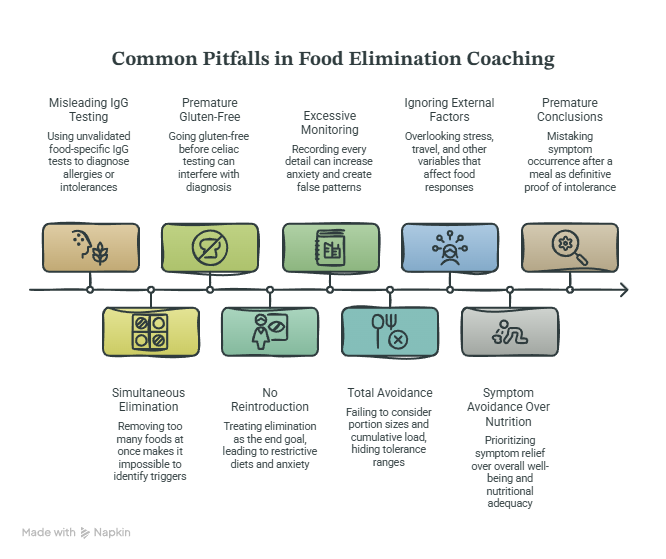
The first failure is beginning with an unreliable test. A colorful report can feel more authoritative than a symptom history, especially when it marks dozens of familiar foods as reactive. AAAAI states that food-specific IgG testing has not been scientifically validated for diagnosing allergy, intolerance, or sensitivity, and professional organizations recommend against its use for that purpose. Coaches preserve trust by offering evidence-informed feedback, respecting client emotions, managing expectations carefully, and guiding the client toward qualified assessment.
The second failure is removing too many foods simultaneously. When symptoms improve, the client cannot tell whether one food, total meal volume, alcohol, fat content, fermentable carbohydrates, irregular timing, or reduced restaurant eating produced the change. The plan becomes difficult to interpret and even harder to reverse. Coaches should promote behavioral experimentation, focused micro-coaching, simple accountability measures, and professional coordination through a strong coaching referral network.
The third failure is missing diagnostic timing. A client may remove gluten after reading that fatigue and bloating can indicate sensitivity. If celiac disease remains a possibility, gluten withdrawal can interfere with diagnostic testing. NIDDK advises completing evaluation before beginning a gluten-free diet. Coaches should make this sequencing clear through preventative coaching, responsible scope management, strong client education, and practical appointment preparation.
The fourth failure is treating elimination as the final destination. Symptom relief can make reintroduction feel dangerous, especially after a client has spent weeks worrying that food is causing inflammation or damage. The client may keep removing categories whenever a symptom returns. Over time, the diet becomes narrower while confidence declines. Structured approaches such as the low-FODMAP process include reintroduction and personalization so tolerated foods can return. Coaches can build readiness through anxiety coaching, strength-based support, visualization techniques, and a clear review plan.
The fifth failure is tracking everything. Clients sometimes record every ingredient, gram, symptom, mood, bowel movement, sleep detail, supplement, and activity. The diary may consume more attention than the actual meal. Excessive monitoring can increase anxiety, create false patterns, and make normal fluctuations feel medically significant. Track variables that influence a decision, then reduce the burden once the required information is available. This protects mental health coaching boundaries, improves client experiences, supports client preferences, and maintains sustainable habit formation.
The sixth failure is ignoring dose. Many digestive responses depend on quantity, frequency, or cumulative load. A client who feels comfortable after a small serving and symptomatic after a much larger one may have a usable tolerance range. Total avoidance can hide that information. Lactose intolerance provides a clear example: many affected people can tolerate some lactose while experiencing symptoms at higher amounts. Portion-based observation supports client autonomy, realistic habit change, careful client feedback, and less restrictive nutrition coaching.
The seventh failure is underestimating context. Stress can change eating speed, appetite, food choices, sleep, bowel patterns, and symptom awareness. Travel changes meal timing and ingredients. Menstrual-cycle shifts, illness, medication, physical activity, and constipation may alter the same person’s response from one week to another. Contextual assessment strengthens emotional intelligence coaching, stress-management strategies, relationship support, and more precise behavior-change experiments.
The eighth failure is replacing nourishment with symptom avoidance. Clients may feel less bloated because they are eating less food overall, skipping meals, or relying on a handful of low-volume options. Symptom scores improve while energy, concentration, strength, social life, and nutritional adequacy deteriorate. Coaches should review client well-being, nutrition and lifestyle patterns, safe coaching boundaries, and referral needs before celebrating the result.
The ninth failure is interpreting correlation as proof. A symptom occurring after a meal creates a hypothesis. Repeated patterns, controlled reintroduction, dose information, and clinical assessment provide stronger evidence. Coaches who state conclusions too early may reinforce fear and make future challenges emotionally difficult. Accurate language strengthens coaching credibility, client trust, professional ethics, and durable client retention.
5. How to Build a Credible Food Sensitivity Coaching Service
Position the service around outcomes the coach can deliver. “I identify your hidden food sensitivities” creates a diagnostic promise. A credible offer might help clients organize symptom patterns, implement clinician-approved dietary experiments, build nutritionally practical routines, and regain confidence around meals. Clear positioning strengthens high-ticket coaching offers, improves client expectation management, supports legal coaching foundations, and creates a stronger certification portfolio.
Build intake around symptoms, medical status, current restrictions, nutritional concerns, emotional impact, and implementation barriers. Ask whether the client has experienced allergy-type reactions, completed celiac testing, received an IBS diagnosis, changed medications, lost weight unintentionally, or become afraid of eating. Record the professionals already involved and the recommendations already provided. This intake creates a safe coaching environment, supports scope-of-practice decisions, prevents common credentialing mistakes, and improves client experiences.
Create a written referral map. Allergists handle suspected immune-mediated reactions and appropriate allergy testing. Gastroenterology professionals evaluate persistent digestive symptoms and conditions such as celiac disease or inflammatory disorders. Registered dietitians assess nutritional adequacy and lead complex elimination or reintroduction work. Licensed mental health professionals become essential when food fear, compulsive checking, body-image distress, or restrictive eating emerges. A defined network supports professional networking, responsible joint ventures, mental health coaching boundaries, and stronger client retention.
Package the service around a decision cycle. Week one can clarify patterns and referral needs. Week two can establish the baseline. Later sessions can focus on shopping, meal preparation, workplace routines, family communication, approved dietary experiments, and reintroduction support. The closing phase should create a maintenance plan and rules for seeking further care. This structure integrates habit formation tools, coaching automation, gamified engagement, and profitable practice scaling.
Measure success beyond symptom reduction. Track symptom frequency, severity, and duration alongside food variety, nutritional confidence, social participation, cooking burden, restaurant comfort, energy, and time spent worrying about meals. A client who reduces discomfort while regaining several foods has achieved a stronger result than someone whose symptoms improve through indefinite restriction. Broad measurement supports coaching benchmarks, credible case-study development, valuable client feedback, and more accurate financial forecasting.
Use technology carefully. A secure form can capture a brief symptom record, a shared dashboard can show trends, and automated check-ins can support adherence. The system should collect only information required for decisions. Coaches should establish privacy, access, retention, and deletion procedures for health-related data. These systems strengthen coaching automation, responsible technology use, essential coaching business tools, and a legally sound coaching practice.
Marketing language needs equal discipline. Avoid promises to heal the gut, identify hidden inflammation, diagnose sensitivities, reverse immune reactions, or cure chronic symptoms. Describe education, structured observation, implementation support, accountability, and referral coordination. Transparent claims attract better-fit clients and reduce conflict later. This approach supports future-proof coaching, sustainable business growth, stronger client loyalty, and credible premium coaching packages.
The most valuable food sensitivity coach becomes the person who helps clients regain clarity. That means fewer unsupported conclusions, fewer unnecessary restrictions, better medical conversations, stronger routines, and a more varied diet whenever safely possible. Coaches who deliver that standard can build authority through continuing professional development, maintain their CPD certification, strengthen their professional portfolio, and remain relevant as coaching trends continue evolving.
6. Frequently Asked Questions About Food Sensitivity Coaching
-
A food sensitivity coach helps clients organize symptoms, identify behavioral and environmental patterns, prepare for professional appointments, implement clinician-approved plans, and build sustainable food routines. The coach may support shopping, preparation, label-reading habits, restaurant communication, symptom tracking, and reintroduction adherence. Diagnosis and medical testing remain with qualified healthcare professionals. This model combines nutrition coaching, behavior-change science, client accountability, and clear scope-of-practice boundaries.
-
Food-specific IgG panels lack scientific validation for diagnosing food allergy, intolerance, or sensitivity. IgG often indicates exposure to a food, and IgG4 may be associated with tolerance. AAAAI and other professional organizations recommend against using these panels for diagnosis. Coaches should avoid interpreting test results or building elimination plans around them. A safer process uses clinical evaluation, structured history, appropriate testing, and professionally guided dietary experiments supported by constructive feedback, ethical coaching, client expectation management, and responsible referral systems.
-
Food allergy involves an immune response and may cause serious reactions. Food intolerance commonly involves difficulty digesting or processing a food component and often causes symptoms such as gas, bloating, abdominal pain, or diarrhea. Allergy evaluation may involve history, skin-prick testing, food-specific IgE testing, and a medically supervised oral challenge. Understanding the distinction protects client safety, improves health coaching scope, supports client trust, and prevents inappropriate dietary behavior change.
-
Diagnostic evaluation should usually occur while the client is still eating gluten. NIDDK explains that beginning a gluten-free diet before testing can affect blood-test and biopsy results. A coach should encourage the client to speak with a clinician before changing gluten intake. This sequencing strengthens preventative health coaching, responsible nutrition education, appropriate client referrals, and accurate client expectation management.
-
The answer depends on the coach’s credential, jurisdiction, insurance, training, and the complexity of the client’s health needs. The safest role involves implementing a plan created or approved by an appropriately qualified clinician or registered dietitian. Coaches can support routines, substitutions, shopping, tracking, adherence, and reintroduction logistics. Complex dietary assessment, diagnosis, and therapeutic nutrition require suitable credentials. This approach supports health-coaching scope, legal requirements, ethical certification practice, and stronger professional portfolios.
-
The duration depends on the suspected condition, protocol, symptoms, and professional guidance. For IBS, a stricter low-FODMAP phase is generally temporary and followed by reintroduction and personalization. Monash University describes the initial phase as roughly two to six weeks rather than a lifelong restriction. Coaches should begin with a defined endpoint and review date while supporting habit formation, client accountability, anxiety management, and professional nutrition guidance.
