
Habit stacking gives health coaches a practical way to close the gap between good intentions and daily action. By attaching a small behavior to a routine the client already performs, coaches can strengthen habit formation, improve client accountability, support lasting behavior change, and reduce the overwhelm that destroys ambitious wellness plans. The method becomes especially powerful when each stack has a reliable cue, a realistic minimum version, a friction-reduction strategy, and a clear measurement system.
1. What Habit Stacking Means and Why It Works
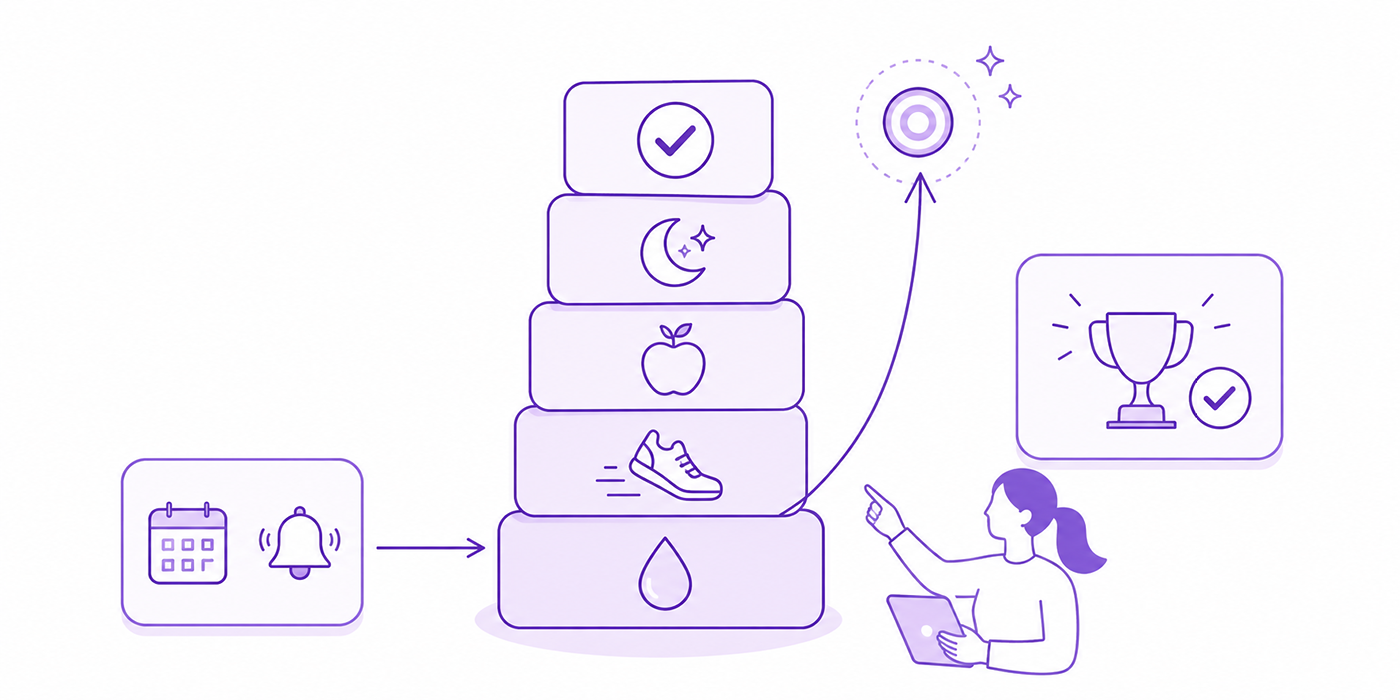
Habit stacking connects a new behavior to an existing action that already occurs reliably. The completed routine becomes the cue for the new action. A client might drink water after switching on the coffee machine, complete five calf raises after brushing their teeth, or take three slow breaths after closing their laptop. The method supports habit formation tools, strengthens micro-coaching interventions, improves client motivation, and creates stronger behavioral coaching plans.
The scientific mechanism involves repeated cue-behavior pairing. When a person performs the same behavior in a stable context, the surrounding cue can gradually trigger the action with less deliberate effort. Habit strength tends to develop through repeated performance rather than one burst of motivation. Context consistency has also been associated with stronger automaticity and better goal attainment during intentional habit building.
For coaches, the useful structure is:
After I complete [existing routine], I will perform [specific behavior].
“After I finish breakfast, I will take my medication as prescribed.”
“After I place my lunch plate in the sink, I will walk for five minutes.”
“After I plug in my phone, I will prepare tomorrow’s water bottle.”
This structure gives the client a clear moment for action. It complements accountability coaching, visualization techniques, gamification strategies, and practical coaching automation.
Habit stacking shares important features with implementation intentions, commonly expressed as “if-then” plans. Research suggests these plans can support physical activity, healthy eating, medication adherence, and other health behaviors, although their effectiveness depends on factors such as motivation, self-efficacy, plan quality, and reinforcement. A plan becomes stronger when it identifies a precise situation and an achievable response.
Tiny actions matter because they lower the amount of energy required to begin. A client who repeatedly abandons a 45-minute workout may successfully maintain two minutes of movement after lunch. That small action creates a repeatable entry point. Coaches can later expand duration once the cue-behavior relationship is reliable. This progression supports preventative health coaching, strength-based coaching, effective client feedback, and sustainable coaching outcomes.
A tiny stack still needs to be meaningful. “Take one step” may be easy while producing little practical value. The coach should locate the smallest version that preserves the purpose of the behavior. For stress regulation, three deliberate breaths may create a genuine pause. For nutrition planning, placing fruit beside the work bag may influence tomorrow’s choice. For movement, one set of chair stands may preserve functional strength practice. The coach can then connect the stack with nutrition and lifestyle coaching, client preference assessment, emotional intelligence coaching, and personalized habit-building systems.
Health coaches should also challenge the popular expectation that a habit becomes automatic after exactly 21 days. A 2024 systematic review found substantial variation between people and behaviors, with median estimates commonly falling around two months and some habits requiring much longer. Early repetition, timing, enjoyment, behavior complexity, and context can all influence the process. A missed day provides information about the system and does not erase previous repetitions.
The central coaching question is therefore: What routine already survives this client’s difficult days? A morning alarm may be reliable for one person and chaotic for another. Lunch may occur at a fixed time in an office and move constantly for a shift worker. Toothbrushing, school pickup, medication, prayer, pet care, and device charging may offer stronger anchors than clock time. This level of personalization improves client experiences, protects client retention, supports difficult coaching situations, and makes client feedback more actionable.
30 Health-Coaching Habit Stacks With Anchors, Minimum Versions, and Progress Measures
| Client Goal | Reliable Anchor | Habit Stack | Minimum Version | Progress Measure | Coaching Caution |
|---|---|---|---|---|---|
| Drink more water | Starting the coffee machine | Drink one glass of water while the coffee brews | Three sips | Morning completions per week | Adapt fluid goals to medical guidance |
| Take prescribed medication consistently | Finishing breakfast | Take medication according to the prescription after breakfast | Place the medication beside the breakfast setting | Prescribed doses completed | Coaches should never change dosage or timing |
| Increase daily movement | Putting away the lunch plate | Walk for five minutes after lunch | Walk for one minute | Walks completed and duration | Respect pain, mobility, and clinical restrictions |
| Reduce prolonged sitting | Ending a video call | Stand and stretch after each scheduled call | Stand for 20 seconds | Sitting interruptions per workday | Avoid setting a frequency the client cannot sustain |
| Build lower-body strength | Brushing teeth | Complete five supported chair stands afterward | One controlled repetition | Repetitions completed safely | Refer pain or balance concerns appropriately |
| Improve mobility | Waiting for the kettle | Perform a short clinician-approved mobility drill | One gentle movement | Frequency and comfort rating | Movement should match professional guidance |
| Create a bedtime routine | Plugging in the phone | Dim the lights and begin the wind-down routine | Turn off one bright light | Wind-down starts per week | Address persistent sleep symptoms through referral |
| Maintain a consistent wake routine | Turning off the alarm | Open the curtains immediately after the alarm | Sit upright and place feet on the floor | Wake routine completion | Account for shift work and sleep deprivation |
| Prepare a healthier breakfast | Cleaning the evening kitchen | Set out one breakfast ingredient for tomorrow | Place a bowl or container on the counter | Prepared breakfasts per week | Keep choices affordable and culturally appropriate |
| Eat more fruit | Unpacking groceries | Place ready-to-eat fruit at eye level | Wash one piece | Servings selected during the week | Avoid moral labels around food |
| Increase vegetable intake | Starting dinner preparation | Add one available vegetable before cooking the main dish | Add two bites to the plate | Dinners containing vegetables | Work within budget, access, and digestive needs |
| Reduce impulsive snacking | Opening the snack cupboard | Pause and rate hunger before choosing | Take one slow breath | Number of deliberate snack choices | Avoid encouraging restriction or food anxiety |
| Practice portion awareness | Sitting down to eat | Notice hunger, fullness, and satisfaction before the first bite | Name the current hunger level | Meals with a completed check-in | Keep the exercise neutral and nonjudgmental |
| Plan meals | Checking the weekly calendar | Select three realistic meals for the busiest days | Plan one meal | Planned meals prepared or purchased | Include convenience options |
| Reduce workday stress | Closing the laptop | Complete three slow breaths before standing | One deliberate exhale | Stress rating before and after | Breathing exercises do not resolve unsafe workloads |
| Create a work-to-home transition | Entering the home | Place belongings down and spend two minutes decompressing | Pause for ten seconds | Evenings with a deliberate transition | Coordinate the routine with household responsibilities |
| Practice gratitude authentically | Turning off the bedside lamp | Name one specific source of support from the day | Recall one helpful moment | Specific reflections completed | Avoid using gratitude to silence distress |
| Strengthen self-compassion | Noticing a self-critical thought | Replace the attack with one accurate coaching statement | Label the thought as self-criticism | Recovery time after mistakes | Preserve responsibility and corrective action |
| Improve emotional awareness | Opening the journal | Name the emotion, trigger, and immediate need | Name one emotion | Check-ins completed | Refer distress that exceeds coaching scope |
| Reduce reactive communication | Receiving a difficult message | Draft the reply and wait ten minutes before sending | Take one breath before typing | Messages reviewed before sending | Urgent or unsafe situations need different protocols |
| Strengthen social connection | Finishing Sunday breakfast | Send one meaningful check-in message | Send one sentence | Supportive contacts initiated | Prioritize safe relationships |
| Ask for practical support | Reviewing the week ahead | Identify one task that can be shared or delegated | Write the request | Specific requests made | Account for power dynamics and relationship safety |
| Improve appointment preparation | Receiving a medical reminder | Write down one question for the appointment | Save a note titled “Questions” | Questions prepared and discussed | The coach should not interpret clinical findings |
| Track symptoms usefully | Taking evening medication | Record one agreed symptom and its severity | Select one rating | Usable entries completed | Avoid excessive monitoring that increases anxiety |
| Prepare for exercise | Changing out of work clothes | Put on walking shoes before deciding on duration | Place the shoes beside the door | Exercise starts per week | The anchor should occur near the intended activity |
| Recover after a missed workout | Recognizing the missed session | Schedule the minimum version within the next 24 hours | Complete one minute of movement | Time required to restart | Avoid punishment workouts |
| Reduce evening screen drift | Starting phone charging | Place the phone outside arm’s reach | Turn on focus mode | Evenings with the boundary maintained | Keep emergency access available when required |
| Practice brief mindfulness | Waiting for an application to load | Notice three physical sensations | Notice one sensation | Mindful pauses completed | Mindfulness may require adaptation for some clients |
| Review daily progress | Setting the morning alarm | Record one completed action and one adjustment | Mark the day complete | Days reviewed without judgment | Keep tracking brief enough to maintain |
| Prepare for setbacks | Completing the weekly check-in | Choose the minimum habit version for the hardest upcoming day | Name one expected obstacle | Recovery plans used successfully | Update plans as the client’s context changes |
2. How Health Coaches Can Build a Habit Stack That Survives Real Life
A strong stack begins with an anchor audit. Ask the client to identify routines that occur at least five days each week, happen in a predictable setting, and end with a clearly recognizable moment. “During the morning” remains too broad. “After I put my breakfast plate in the sink” provides a distinct completion point. The anchor audit supports client-centered coaching, improves coaching feedback, strengthens behavior-change planning, and reduces preventable client frustration.
Evaluate each possible anchor through five questions:
Does the anchor already happen reliably?
Does it happen near the place where the new action must occur?
Does it happen at a useful time?
Does it remain stable on difficult days?
Can the client recognize exactly when it ends?
A client may brush their teeth daily, yet that anchor offers little value for a habit requiring kitchen equipment. Finishing lunch may be a better anchor for a short walk. Opening a work calendar may suit schedule planning. Plugging in a phone may suit a bedtime boundary. This selection process improves habit formation strategies, practical micro-coaching, client accountability, and personalized coaching experiences.
The new behavior should pass the low-friction test. The client should understand what to do, where to do it, what materials are needed, and how long the minimum version takes. “Make healthier choices after work” fails this test. “After I enter the kitchen, I will place one prepared option on the counter before deciding what to eat” gives the client an executable action. Clear actions support nutrition coaching, constructive feedback, habit-building science, and reliable client progress tracking.
Next, define three versions of the stack:
Minimum version: the action the client can perform during a difficult day.
Standard version: the realistic target for an ordinary day.
Expanded version: an optional longer action when time and energy allow.
A movement stack may include one minute, ten minutes, and twenty minutes. A food-preparation stack may include washing one item, preparing tomorrow’s lunch, and preparing several meals. A stress-regulation stack may include one breath, two minutes of breathing, and a longer decompression routine. This tiered structure supports client motivation, strengthens mindset shifts, protects client retention, and reduces all-or-nothing collapse during economic or lifestyle disruption.
Environment design should happen before the client relies on memory. Place the water bottle beside the coffee machine. Keep prescribed medication in an appropriate visible location permitted by storage instructions and household safety. Put walking shoes beside the work bag. Prepare the journal and pen before bedtime. Remove unnecessary setup steps and add visible cues only where they remain useful. Digital behavior-change research frequently uses prompts, self-monitoring, goal setting, and cue design to support repetition.
Health coaches should examine the emotional cost of the stack as carefully as its physical difficulty. A calorie-tracking stack may increase food anxiety. A daily weighing routine may intensify body preoccupation. A symptom log may increase vigilance and fear. A gratitude routine may feel invalidating during grief. The coach must check how the behavior affects the client and adjust accordingly. This assessment strengthens safe coaching environments, responsible mental health coaching, effective anxiety support, and ethical scope-of-practice decisions.
Every stack also needs a disruption rule. The client should know what happens during travel, illness, overtime, caregiving pressure, low mood, or a missed anchor. A useful rule may be: “When the normal anchor disappears, I will use the minimum version after the next available meal.” Another may be: “After one missed day, I restart with the minimum version rather than adding extra repetitions.” This recovery planning protects lasting behavior change, supports difficult client situations, strengthens coaching accountability, and produces better client transformation outcomes.
A coach should introduce one stack at a time when the client has a history of abandoning complex plans. Several small behaviors can still produce a large cognitive burden when each one has a separate cue, tracking method, and standard. Begin with the behavior that offers the strongest combination of health relevance, feasibility, confidence, and spillover value. Once that behavior becomes dependable, the client can expand the action or add a second stack. This sequencing improves client retention, strengthens coaching case studies, supports practice benchmarks, and creates more accurate client feedback data.
3. How to Apply Habit Stacking Across Major Health-Coaching Goals
For physical activity, the stack should reduce the distance between intention and movement. Useful anchors include finishing lunch, changing clothes, ending a meeting, arriving home, or starting a familiar television program. The coach can attach a brief walk, balance practice, mobility exercise, or clinician-approved strength action. The behavior should reflect the client’s capacity and medical guidance. Habit-based physical-activity research emphasizes repeated cue-behavior pairing, while public-health recommendations encourage adults to accumulate regular activity and reduce sedentary time according to ability.
The coaching conversation should focus on the entry point. A client may know that regular movement is valuable and still fail to begin after a draining workday. Putting on walking shoes after changing clothes may become the first stack. Walking for two minutes becomes the minimum version. The coach can later build duration through habit formation tools, gamified progress, client accountability, and carefully timed coaching automation.
For nutrition, habit stacks should improve availability, preparation, and decision quality. Coaches can help clients place nourishing options within reach, prepare ingredients after cleaning the kitchen, pack food after checking tomorrow’s schedule, or add a planned component before serving a meal. The method should respect culture, cost, medical needs, time, family preferences, and food access. It can strengthen nutrition and lifestyle coaching, client preference planning, preventative health coaching, and sustainable behavior-change strategies.
Coaches should pay particular attention to restrictive stacks. Rules such as “after I eat, I must exercise” or “after a high-calorie meal, I skip breakfast” can reinforce guilt, compensation, or disordered behavior. A safer stack might focus on regular meals, advance preparation, internal cues, or a clinician-approved nutrition plan. Clear boundaries support safe coaching practice, responsible mental health coaching, ethical client expectation management, and appropriate health-coaching scope.
For sleep routines, useful stacks often begin before the client enters bed. Plugging in the phone can cue dimmer lighting. Finishing the final household task can cue preparation for the next morning. Brushing teeth can cue a short relaxation practice. The coach should assess shift work, caregiving, bedroom conditions, caffeine timing, pain, medication effects, and symptoms that require clinical evaluation. This approach connects stress coaching, guided imagery, client feedback, and personalized habit formation.
For stress regulation, the stack should occur close to a predictable pressure point. A slow breathing exercise after ending a meeting may reduce carryover into the next task. A two-minute transition after arriving home may protect family interactions. A brief body scan after sitting in the car may help the client notice tension. These actions support regulation while the coach continues examining workload, boundaries, conflict, caregiving pressure, or unsafe circumstances. They integrate well with emotional intelligence coaching, relationship coaching, constructive feedback, and emotional-crisis support.
Medication adherence may also benefit from stable routines, reminders, and existing anchors. Research has found an association between stronger habit strength and greater medication adherence. Coaches can support organization, reminders, question preparation, and adherence to the prescribed plan. Medication selection, dosage, timing changes, side effects, and clinical interpretation belong with qualified healthcare professionals.
A coach might help the client place an approved reminder beside a breakfast item, use a pill organizer recommended by the care team, or prepare questions after noticing a concern. This protects scope-of-practice boundaries, supports client accountability, strengthens legal coaching practices, and improves client experiences.
For emotional well-being, the stack needs readiness and consent. Journaling after dinner may help one client and intensify rumination for another. Gratitude after bedtime may create perspective for one person and feel forced for someone processing loss. Coaches should ask what the exercise is intended to change, how the client responds, and whether another form of support is required. This protects mental health coaching boundaries, strengthens client trust, supports emotional intelligence, and improves client retention.
Poll: Why Do Your Clients’ Healthy Habits Usually Collapse?
4. Why Habit Stacks Fail and How Coaches Can Repair Them
The first failure point is an unreliable anchor. “After breakfast” collapses when the client skips breakfast, eats at different times, or rushes out of the house. The coach should review actual behavior instead of designing around an ideal routine. A more stable anchor may be turning off the alarm, entering the workplace, collecting a child from school, or plugging in a device. This repair strengthens client preference assessment, habit formation, constructive feedback, and client retention.
The second failure point is anchor-behavior distance. A client may intend to stretch after breakfast while the exercise mat remains upstairs. The cue occurs in one location and the action requires a separate transition, equipment, and decision. Move the action closer, place the equipment beside the anchor, or select a new cue. Environmental redesign improves behavior-change coaching, strengthens micro-coaching, supports coaching automation, and creates more dependable accountability systems.
The third failure point is an oversized action. Clients often agree to a plan while energized during the session and encounter a completely different reality on Wednesday evening. The minimum version should fit a tired, busy, imperfect day. Coaches can ask, “What version would still feel possible with half your usual energy?” A realistic answer may be one minute of movement, preparation of one ingredient, or one sentence in a journal. This scaling supports client motivation, mindset coaching, difficult-client support, and sustainable client transformations.
The fourth failure point is stacking several actions onto one anchor. A client finishes breakfast and expects to take supplements, journal, meditate, stretch, pack lunch, review goals, and walk. The routine becomes a morning project. One delayed action can derail the entire chain. Keep the first stack short and clear. Additional behaviors should earn their place through relevance and feasibility. This discipline strengthens client experiences, supports practice benchmarks, improves client feedback, and reduces avoidable coaching mistakes.
The fifth failure point is an invisible reward. The client completes the behavior and experiences inconvenience, discomfort, or no immediate sign of progress. Coaches can strengthen reinforcement through visible completion, brief self-recognition, enjoyable music, social support, or an immediate functional benefit. Rewards should support the behavior without undermining the health goal. Research suggests that reward may influence habit formation, although its role varies and remains connected to repetition, intention, and context.
The sixth failure point is excessive reminder dependence. A prompt can help initiate repetition, while permanent reliance on a notification may prevent the natural anchor from gaining control. Coaches should observe whether the client responds to the existing routine, the reminder, or both. Once the stack becomes stable, unnecessary prompts can be reduced gradually. This process improves coaching technology, automated coaching systems, gamified engagement, and long-term habit formation.
The seventh failure point is treating a missed repetition as a character flaw. Coaches should investigate what changed: Did the anchor disappear? Was the minimum version still too large? Did the environment add friction? Did the client experience pain, distress, shame, or competing responsibilities? This investigation turns missed actions into design evidence. It supports safe coaching conversations, strength-based coaching, constructive feedback, and stronger client accountability.
The eighth failure point is expecting automaticity too quickly. A client may complete a behavior for three weeks and still need deliberate effort. Habit development varies considerably, and complex or infrequent behaviors may require a longer period of consistent repetition. The coach should measure growing ease rather than demand a fixed deadline. Useful signs include less internal negotiation, faster initiation, fewer reminders, and quicker recovery after disruption.

5. How to Measure, Expand, and Maintain Habit Stacks
Measure the stack through behavior and outcome. The behavioral measure records whether the action occurred after the intended anchor. The outcome measure records whether the client’s desired result improved. A walking stack may achieve 90 percent completion while energy remains unchanged. A breathing stack may occur only four times during the week while substantially reducing post-meeting tension. Both findings guide the next decision. This method supports coaching benchmarks, client feedback systems, coaching case studies, and data-informed client retention.
A useful weekly review can cover six questions:
How often did the anchor occur?
How often did the new behavior follow it?
Which version did the client complete?
How much effort did initiation require?
What changed in the intended outcome?
What interference appeared?
These questions distinguish an anchor problem from an action problem. They also strengthen client accountability, improve constructive feedback, support coaching automation, and create more credible client transformation evidence.
Track automaticity through experience rather than elapsed days. Ask the client how much thought the behavior required, whether they noticed the cue naturally, how often they started without a reminder, and how strange it felt when they missed the action. Habit strength can increase quickly during early repetitions and then level off gradually. Stable contexts and repetition remain central to this process.
Expand a stack only when the minimum version feels dependable. Increase one variable at a time: duration, frequency, difficulty, or the number of connected actions. A five-minute walk can become eight minutes. Three chair stands can become five. Preparing one ingredient can become preparing an entire breakfast. Changing several variables simultaneously makes it difficult to identify which adjustment created friction. Controlled expansion supports behavior-change science, habit formation, gamified coaching, and stronger client experiences.
Maintenance requires periodic anchor checks. Travel, job changes, parenthood, retirement, illness, relocation, and seasonal schedules can remove the routine that originally supported the behavior. A habit may weaken when the context changes, even when the client remains committed. Coaches should help clients identify upcoming transitions and select replacement anchors in advance. This preparation supports future-proof coaching, coaching through economic changes, client retention strategies, and resilient mindset shifts.
Automation can support measurement through brief check-ins, scheduled reminders, shared dashboards, or app-based tracking. The system should reduce administrative burden and preserve client autonomy. Collect only information that influences coaching decisions. A client rarely needs twelve daily data points to improve one bedtime stack. Thoughtful systems strengthen coaching automation, improve practice scalability, support client feedback, and enhance coaching technology.
Coaches should also monitor tracking fatigue. Clients may complete the healthy behavior and abandon the logging process. In that case, the tracking system has become more burdensome than the habit. Reduce frequency, use a weekly summary, or stop tracking once enough information has been gathered. This adjustment supports client preferences, preserves client motivation, strengthens exceptional client experiences, and protects long-term client retention.
The final goal is client ownership. The client should be able to identify a stable anchor, shrink an action, reduce friction, create a recovery rule, and evaluate whether the behavior helps. A coaching relationship becomes more valuable when clients leave with a reusable method for future change. That capability strengthens coaching credibility, supports premium coaching offers, improves client loyalty, and creates sustainable coaching-business growth.
6. Frequently Asked Questions About Habit Stacking for Health Coaches
-
Habit stacking is the practice of attaching a new health behavior to an existing routine that already occurs reliably. The existing routine becomes the cue for action. A client may stretch after brushing their teeth, prepare water after starting the coffee machine, or complete a breathing exercise after closing their laptop. The method combines well with habit formation science, accountability coaching, micro-coaching, and practical behavior-change strategies.
-
The minimum version should remain achievable during a low-energy, busy, or disrupted day while preserving the behavior’s purpose. One minute of walking, one prepared ingredient, one mobility repetition, or one deliberate breath may provide an effective starting point. The standard version can be larger, and an expanded version can remain optional. This structure supports client motivation, strengthens habit-building tools, improves client feedback, and reduces failure during difficult coaching periods.
-
There is no universal deadline. Research shows wide variation across people and behaviors. Some habits begin feeling easier within several weeks, while others require several months. Frequency, context stability, behavior complexity, timing, enjoyment, and personal circumstances can influence the process. Coaches should track ease of initiation, reminder dependence, cue recognition, and recovery after missed repetitions instead of promising a fixed 21-day result.
-
A good anchor occurs reliably, has a recognizable ending, happens near the intended behavior, and remains reasonably stable during difficult days. Brushing teeth, finishing lunch, shutting down a computer, plugging in a phone, taking prescribed medication, and returning home can work when they match the client’s real routine. Anchor selection strengthens client-centered coaching, habit formation, client accountability, and consistent behavior-change results.
-
Several actions can form a chain after the first behavior becomes dependable. Beginning with one stack usually gives coaches clearer information and reduces overload. Once the cue reliably triggers the action, the coach can expand duration or add one connected behavior. The client should still have a minimum version for difficult days. This sequencing supports micro-coaching, gamified engagement, client retention, and efficient coaching automation.
-
Investigate the cue before increasing reminders. The anchor may occur inconsistently, lack a clear endpoint, or happen too far from the behavior. The action may also require equipment, preparation, or decisions that create friction. Move materials closer, choose a stronger anchor, shrink the behavior, and use a temporary prompt while the association develops. This repair process strengthens habit formation, coaching technology, constructive feedback, and practical client accountability
