
Life Visioning: The Technique That’s Changing Lives Overnight
A person can spend years moving efficiently in a direction they never consciously chose. Life visioning interrupts that drift by connecting values, strengths, relationships, health, work, and contribution inside one decision framework. Coaches are combining guided visualization, strength-based coaching, behavior-change science, and accountability coaching to create rapid clarity. The “overnight” shift usually appears when a client finally sees which goals deserve pursuit, which commitments need renegotiation, and which first action can begin immediately.

1. What Life Visioning Is—and Why the Shift Can Feel Immediate
Life visioning is a structured coaching process that helps clients define a desirable future, understand why it matters, identify the reality standing between them and that future, and convert the vision into testable decisions. It brings together transformational coaching, guided imagery techniques, mindset development, and habit formation within one coherent pathway.
Clients rarely arrive with a complete absence of ambition. They usually arrive with competing ambitions. One part wants career growth. Another wants health, family presence, creative expression, financial security, or freedom from constant responsibility. Every option carries a cost, and indefinite postponement becomes the default decision. Client anxiety, weak expectation management, unresolved relationship pressures, and limited emotional intelligence can intensify that paralysis.
A strong visioning session gives those competing priorities a visible structure. The client can examine how they want to work, live, relate, recover, contribute, and grow. They also define the sacrifices attached to each direction. This trade-off analysis prevents a vision from becoming a fantasy assembled from attractive outcomes with none of their costs.
The immediate shift often comes from five discoveries:
The client identifies borrowed goals. A promotion, income target, lifestyle, or professional title may have been inherited from family expectations, workplace culture, social comparison, or an earlier version of the client.
The client names the real cost of remaining unchanged. Chronic indecision consumes time, confidence, money, energy, and relationship goodwill.
The client creates an anti-vision. They describe the future created by repeating present patterns for another three to five years.
The client defines decision criteria. Future opportunities can be evaluated against clear standards rather than mood, pressure, or prestige.
The client chooses an early experiment. A reversible action produces evidence before a high-risk commitment is made.
These discoveries become more productive when the coach uses constructive feedback, creates a safe coaching environment, establishes clear client accountability, and applies behavior-change methods.
The coach should also separate a destination vision from a directional vision. A destination vision describes exact outcomes: a particular job, house, income, business, or location. A directional vision identifies the qualities the client wants more consistently: autonomy, creativity, stability, connection, vitality, mastery, or contribution.
Directional visions survive changing circumstances more effectively. A desired position may disappear, while the need for autonomy and meaningful responsibility remains. A planned relocation may become impractical, while the desire for nature, community, or a slower schedule can be expressed through other choices. This flexibility supports future-proof coaching, client-centered transformation, strength-focused development, and realistic motivation.
Life visioning becomes valuable when the vision reaches observable life systems. The client’s calendar, spending, boundaries, applications, conversations, routines, and environment should begin reflecting the chosen direction. A beautiful description of the future produces limited value while Tuesday afternoon continues operating exactly as before.
| Life Area | Hidden Client Tension | High-Value Visioning Prompt | First 72-Hour Action | Related ANHCO Resource |
|---|---|---|---|---|
| Career | The client has advanced professionally while losing interest in the work. | Which responsibilities would you retain if status and title became irrelevant? | Complete an energy audit of the previous ten working days. | Strength-based coaching |
| Career | Several attractive career paths create decision paralysis. | Which option deserves a reversible 30-day experiment? | Arrange one informational interview in each leading field. | Mindset shifts |
| Career | The client wants change while fearing loss of income and identity. | What conditions would make exploration financially and emotionally responsible? | Calculate the minimum transition runway. | Financial coaching |
| Business | The company has grown beyond the founder’s desired role. | Which decisions should still require your attention three years from now? | List five responsibilities suitable for delegation. | Profitable scaling |
| Business | The client keeps adding offers without a coherent direction. | Which transformation should your business become known for delivering? | Remove one offer that weakens positioning. | High-ticket offers |
| Time | The calendar contains urgent obligations and little meaningful work. | Which three activities deserve protected time before requests arrive? | Reserve two recurring calendar blocks. | Habit-formation tools |
| Energy | The client’s ambitions exceed their current physical and emotional capacity. | What would sustainable progress look like at 70% capacity? | Create minimum and standard versions of one priority. | Stress coaching |
| Health | Health remains important in theory and negotiable in practice. | Which future opportunities depend on protecting your health now? | Schedule one overdue health-supporting action. | Preventive health coaching |
| Sleep | Late-night work is eroding recovery and judgement. | Which ambition would improve through greater recovery rather than additional hours? | Test one firm work-shutdown time. | Behavior-change science |
| Relationships | Personal goals and relationship expectations continuously compete. | Which shared future has never been discussed explicitly? | Schedule a structured future-planning conversation. | Relationship coaching |
| Relationships | The client edits ambitions to avoid disappointing other people. | What truth would you express with greater emotional safety? | Draft a respectful boundary statement. | Safe coaching environments |
| Family | The client’s vision ignores caregiving realities. | How can your vision include responsibility without erasing personal identity? | Identify one weekly block for an individual priority. | Expectation management |
| Friendship | The client’s social environment reinforces an outdated identity. | Which relationships support the person you are becoming? | Reconnect with one growth-aligned person. | Purposeful networking |
| Community | The client has many contacts and little belonging. | Where could your contribution and sense of community meet? | Attend one relevant community event. | Social responsibility |
| Money | Income goals lack a connection to an intended life. | What choices should additional income make possible? | Assign each financial target a defined purpose. | Financial forecasting |
| Money | The client delays every meaningful decision until reaching “enough.” | Which parts of the desired life can begin before the final financial target? | Start one low-cost version this week. | Financial systems |
| Home | The physical environment supports distraction and unfinished tasks. | How should your environment make the desired behavior easier? | Redesign one high-friction space. | Habit formation |
| Location | The client romanticizes relocation as the answer to every problem. | Which needs belong to the location, and which require personal change? | Test one desired lifestyle quality locally. | Guided imagery |
| Creativity | Creative work is postponed until conditions become perfect. | What would a serious creative practice look like within current constraints? | Complete one 30-minute creative session. | Micro-coaching |
| Learning | The client keeps collecting courses without applying them. | Which skill would change an actual decision or opportunity? | Apply one existing lesson before purchasing another course. | Continuing development |
| Identity | The client is maintaining a version of success that no longer fits. | Which identity has completed its purpose? | Write a one-page identity transition statement. | Transformational coaching |
| Confidence | The client waits to feel certain before taking action. | What evidence could a small experiment provide? | Complete one reversible decision. | Strengths-based action |
| Boundaries | Other people’s priorities continuously occupy the client’s time. | Which commitment requires a limit, renegotiation, or ending? | Communicate one specific boundary. | Constructive communication |
| Purpose | The client searches for one permanent life purpose. | Which meaningful problem deserves your attention in this life chapter? | Conduct one small contribution experiment. | Future-proof coaching |
| Contribution | The client wants impact while already overcommitted. | Which form of contribution can remain sustainable for three years? | Define a monthly contribution limit. | Responsible impact |
| Technology | Digital distraction prevents reflection and focused action. | Which technology behaviors are incompatible with your desired life? | Create one device-free decision block. | Technology and coaching |
| Accountability | The client repeatedly creates inspiring plans and abandons them. | Which evidence will prove that the vision has entered daily life? | Choose three weekly behavioral indicators. | Accountability systems |
| Decision-making | The client revisits the same decision without gathering new evidence. | What information would genuinely change your choice? | Set a decision deadline and evidence list. | Decision mindset |
| Resilience | A disrupted week causes the entire vision plan to collapse. | Which minimum action preserves identity during a difficult period? | Create a low-capacity version of the plan. | Sustainable habits |
| Legacy | The client wants to be remembered positively yet lacks a present contribution. | What could you begin giving, teaching, building, or protecting now? | Start one recurring act of contribution. | Emotional intelligence |
Use this diagnostic to move a client from broad aspiration toward one precise question, one immediate experiment, and one observable measure of progress.
2. Why Life Visioning Influences Decisions So Powerfully
Life visioning works through several psychological and behavioral mechanisms. A vivid future gives abstract priorities emotional weight. Values-based selection improves ownership. Reality testing exposes obstacles. Specific plans reduce the number of decisions required when action time arrives. These mechanisms connect naturally with behavior-change coaching, habit architecture, guided visualization, and client accountability.
Future-self connection makes distant consequences feel relevant
People vary in how connected they feel to their future selves. Research has associated stronger future-self continuity with more future-oriented decisions and better self-reported health behavior. Other studies have found that making a future self more vivid can influence decisions involving long-term resources.
A coach can strengthen this connection by helping clients describe an ordinary future day in concrete terms. Where do they wake? How does their body feel? Which responsibilities receive their best attention? Who is present? What work occupies the day? Which pressures have disappeared? What new responsibilities have emerged?
Specificity matters because “I want freedom” offers limited decision guidance. “I want control over my first three working hours, four evenings protected for family, and the ability to decline misaligned projects” provides a usable standard. That standard strengthens expectation management, relationship decisions, habit design, and financial planning.
Self-chosen goals generate stronger commitment
A vision becomes more durable when its goals reflect the client’s values and interests. Research examining autonomous motivation has found a substantial relationship between self-directed motivation and goal progress. Work on self-concordant goals has also shown that values-aligned goals can work particularly well when paired with implementation plans.
The coach should test every major goal with questions such as:
Would the client still want this without public recognition?
Which value does the goal express?
Which discomfort is the client willing to tolerate for it?
Who originally taught the client that this outcome represented success?
Which competing value could the goal damage?
What would enough look like?
These questions deepen strengths-based coaching, improve emotional intelligence, support constructive feedback, and expose unrealistic client expectations.
Contrasting the vision with reality activates useful tension
Positive visualization can generate inspiration. Life visioning becomes operational when the client also examines present obstacles. Mental contrasting asks a person to imagine a desired future and then identify the internal or external reality preventing it.
A meta-analysis covering 21 studies and 15,907 participants found that mental contrasting with implementation intentions had a small-to-medium positive effect on goal attainment. The combination matters because the obstacle leads directly into a response plan.
A client might state:
Desired future: I consistently protect time for creative work.
Primary obstacle: I accept last-minute requests to avoid disappointing people.
Implementation intention: If a non-urgent request enters my protected block, I will offer the next available time instead.
Evidence: Three protected sessions remain intact each week.
This method combines mindset coaching, constructive communication, accountability systems, and behavioral transformation.
Immediate experiments replace endless speculation
Clients often attempt to think their way into complete certainty. Visioning gives them a direction, while experiments provide real-world evidence. A career vision can be tested through a project, shadowing opportunity, course application, paid pilot, informational interview, or reduced-hours arrangement. A community vision can be tested through volunteering. A creative vision can be tested through a six-week production schedule.
Small experiments also create opportunities for micro-coaching, gamified progress, automated coaching support, and feedback-driven refinement.
3. A Step-by-Step Life Visioning Process That Produces Action
A life visioning session requires enough imagination to expand the client’s options and enough discipline to expose trade-offs. The following process can be delivered as a focused workshop, a multi-session intensive, or the opening phase of a longer transformational coaching program, mental health coaching pathway, relationship coaching engagement, or behavior-change program.
Step 1: Stabilize the starting point
Begin with the client’s current reality. Review energy, time, finances, responsibilities, health, support, unresolved commitments, and decision authority. Visioning becomes more useful when the coach understands which constraints are temporary, negotiable, structural, or safety-related.
Ask:
Which part of life currently demands the most attention?
Which unresolved decision consumes the most mental energy?
What is already working and deserves protection?
Which commitments can the client genuinely change?
What professional support may be required?
This stage supports a safe coaching environment, reduces difficult client situations, strengthens expectation management, and clarifies professional scope.
Step 2: Identify inherited definitions of success
Ask the client to list the outcomes they have pursued during the previous five years. For each outcome, explore its source: personal desire, financial necessity, family expectation, workplace reward, cultural prestige, fear, or genuine curiosity.
The goal is greater authorship. A client may choose to retain a conventional goal after examining it. The difference lies in conscious ownership.
Useful prompts include:
Which achievement produced less satisfaction than expected?
Which goal would lose importance without social visibility?
Which responsibilities still express your values?
Which version of yourself created the current plan?
Which goal has survived several life chapters?
This exploration combines mindset shifts, strength-based reflection, emotional-intelligence coaching, and guided imagery.
Step 3: Construct the anti-vision
Ask the client to imagine repeating their current patterns for three years. Examine work, health, relationships, finances, energy, confidence, and lost opportunities. The anti-vision reveals the trajectory created through inaction.
The coach should keep the exercise grounded. The purpose is informed urgency. Ask the client to identify consequences they can reasonably anticipate from existing patterns.
An anti-vision might include:
Remaining in a role that no longer develops valuable strengths.
Repeatedly postponing health-supporting behavior.
Allowing an important relationship to receive only leftover attention.
Losing confidence through another year of indecision.
Accumulating financial commitments that reduce future flexibility.
Abandoning a meaningful project through perpetual preparation.
This process can expose stress patterns, reveal missing accountability, support habit change, and create stronger client motivation.
Step 4: Design the desired ordinary day
A vision built only from milestones can ignore daily experience. Ask the client to describe an ordinary Tuesday three years into a desirable future.
Cover:
Wake and sleep times.
Physical energy.
First hour of the day.
Work type and pace.
Level of autonomy.
People involved.
Location and environment.
Financial responsibilities.
Family and relationship rhythms.
Learning and creative activity.
Community participation.
Evening recovery.
Problems the client is willing to manage.
The last point is essential. Every desirable future contains problems. Entrepreneurship may bring autonomy alongside uncertainty. Leadership may bring influence alongside difficult decisions. Relocation may bring novelty alongside distance from existing support. The vision becomes credible when the client selects a preferred set of responsibilities.
This detail improves future-focused coaching, relationship planning, financial forecasting, and habit architecture.
Step 5: Extract vision principles
Convert the future-day description into five to seven principles. Examples include:
Protect the first two working hours for high-value creation.
Maintain a financial runway before major career experiments.
Keep two evenings free from professional commitments.
Choose roles that use strategic thinking and teaching.
Live within regular access to nature and community.
Maintain a small number of deep relationships.
Build work that allows meaningful contribution.
Principles make the vision portable. They can guide decisions when specific opportunities change. They also strengthen constructive feedback, client expectation management, behavioral transformation, and future-proof decision-making.
Step 6: Identify the decisive obstacle
Ask which obstacle creates the greatest gap between the present and the vision. The answer may involve fear of disapproval, low energy, financial exposure, skill gaps, poor boundaries, missing support, perfectionism, or excessive commitments.
Choose one obstacle for the first intervention. Addressing every gap simultaneously recreates the overload the session was meant to resolve.
Then create an if-then plan:
If [predictable obstacle] occurs, I will [preselected response].
Implementation intentions specify when, where, and how a goal-directed response will occur, reducing reliance on in-the-moment deliberation.
The coach can reinforce the plan through accountability check-ins, coaching automation, gamification, and micro-coaching support.
Step 7: Choose a 72-hour move and a 30-day experiment
The 72-hour action should create momentum or evidence. It might involve scheduling a conversation, submitting an application, blocking time, calculating a budget, declining a commitment, contacting a mentor, or registering for a trial experience.
The 30-day experiment should test one important assumption. Define:
The assumption being tested.
The smallest credible experiment.
The behavior required.
The resources needed.
The evidence collected.
The review date.
The criteria for continuing, adjusting, or stopping.
This structure turns inspiration into measurable transformation, supports client retention, improves the coaching experience, and produces useful client feedback.
This poll provides a practical coaching prompt and stores no personal information.
4. How Coaches Can Turn Life Visioning Into a Premium Offer
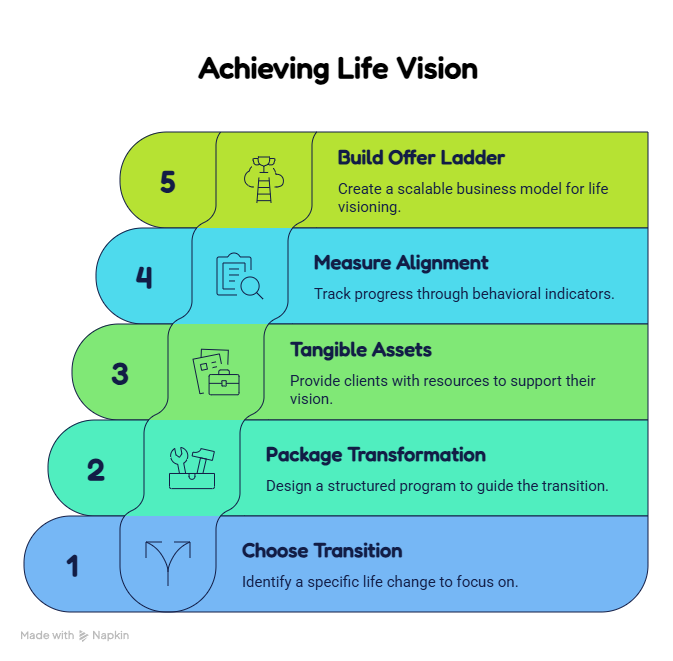
Life visioning solves a valuable decision problem. Clients can lose years to misaligned careers, vague goals, weak boundaries, postponed transitions, and repeated plans that never reach implementation. A premium offer should connect the visioning process to one defined client transition and several observable outcomes.
The broader coaching profession continues to expand. The International Coaching Federation’s 2025 study estimated 122,974 coach practitioners and $5.34 billion in annual industry revenue, representing continued growth in practitioners and revenue since the previous study. A life-visioning offer can stand out when it combines a compelling experience with the rigor found in coaching-industry benchmarking, high-ticket offer design, behavior-change coaching, and credible case studies.
Choose a specific life transition
“Create your dream life” leaves the buyer with too much interpretation. Stronger positioning might focus on:
Senior professionals preparing for a second career.
Founders redesigning life after rapid growth or a business exit.
Parents rebuilding identity after an intensive caregiving chapter.
Executives who have achieved professional success and lost personal direction.
Creatives trying to build a financially sustainable practice.
Couples aligning individual ambitions with a shared future.
Professionals relocating across countries or industries.
Retirees designing a meaningful chapter around contribution and connection.
Coaches developing a clear professional and business vision.
Clients rebuilding forward direction after appropriate therapeutic support.
Audience specificity strengthens client preference alignment, improves marketing case studies, supports networking and referrals, and clarifies client expectations.
Package a defined transformation
A six-week life visioning intensive could include:
Week 1: Present-life audit
Review roles, energy, values, obligations, finances, health, relationships, and unresolved decisions.
Week 2: Anti-vision and identity review
Identify the future created by current patterns and the identities the client has outgrown.
Week 3: Desired future design
Build an ordinary-day vision across work, health, relationships, environment, contribution, and recovery.
Week 4: Vision principles and decision criteria
Convert imagery into standards that can guide real opportunities.
Week 5: Obstacle and experiment design
Identify the decisive barrier and create a 30-day test.
Week 6: Integration and accountability
Translate the vision into calendar blocks, conversations, financial actions, habits, and a 90-day roadmap.
This program can integrate guided visualization, strength-based techniques, accountability coaching, and habit-formation tools.
Give the client tangible assets
A premium offer should leave the client with materials they can continue using:
Current-life alignment audit.
Anti-vision statement.
Three-year ordinary-day narrative.
Five to seven life principles.
Personal decision scorecard.
Trade-off analysis.
Constraint map.
Possibility portfolio.
30-day experiment plan.
If-then obstacle responses.
Weekly alignment scorecard.
Ninety-day implementation roadmap.
Disruption and restart protocol.
Support and referral directory.
These deliverables create a stronger client experience, improve program retention, support feedback collection, and generate clearer transformation evidence.
Measure alignment through behavior
Life visioning outcomes can be measured without pretending that purpose or fulfillment has one universal score. Ask the client to define what alignment would look like behaviorally.
Useful indicators include:
Percentage of weekly time directed toward stated priorities.
Number of protected boundaries maintained.
Speed of completing a previously delayed decision.
Progress on the first real-world experiment.
Frequency of energy-producing work.
Number of misaligned commitments removed.
Confidence in evaluating new opportunities.
Consistency of agreed health and recovery routines.
Completion of important relationship conversations.
Ability to restart after a disrupted week.
These indicators strengthen accountability, improve client feedback, support case-study credibility, and make premium pricing easier to explain.
Build an offer ladder
A scalable life visioning business can include:
A 90-minute vision clarity session.
A four-week decision intensive.
A six- or twelve-week flagship program.
A small-group life visioning cohort.
A couples or leadership-team visioning workshop.
A quarterly life-alignment review.
An alumni implementation membership.
A corporate career-visioning program.
A licensed workshop methodology for trained coaches.
The offer ladder combines micro-coaching, group gamification, business automation, and responsible practice scaling.
5. The Mistakes and Ethical Boundaries Coaches Must Understand
Life visioning can influence career changes, relationships, relocation, finances, health priorities, and identity. That influence requires disciplined coaching boundaries. The coach should create space for exploration while the client retains ownership of every decision.
A responsible agreement should define confidentiality, data handling, scope, session structure, communication access, cancellation terms, outcome limits, referral procedures, and client responsibilities. Coaches should also understand legal requirements, maintain an appropriate business structure, strengthen their certification portfolio, and follow applicable coaching ethics.
Avoid prescribing the client’s future
A coach may notice a promising direction, while the client possesses context the coach cannot fully know. Questions, reflections, experiments, and decision frameworks preserve client agency. Statements claiming knowledge of the client’s true calling can create pressure and dependency.
The coach can ask:
Which option fits your stated principles?
Which assumption needs testing?
What cost are you prepared to accept?
Who will be affected by this decision?
Which professional advice is required?
What would make the experiment responsible?
How will you recognize that the direction needs adjustment?
This approach supports constructive feedback, strengthens emotional intelligence, protects the coaching environment, and reduces difficult client situations.
Treat major decisions as staged commitments
A visioning session can generate emotional energy. High-impact decisions deserve financial, relational, legal, medical, or clinical input where relevant. The coach can encourage staged experiments, decision deadlines, downside analysis, and appropriate consultation.
A client considering resignation might first calculate a runway, test paid work, clarify insurance implications, and speak with affected family members. A client considering relocation could conduct an extended trial stay. A client considering major relationship changes may require qualified relationship or mental-health support.
Staged decisions integrate financial coaching principles, relationship coaching, expectation management, and professional referral practices.
Recognize when referral is needed
Visioning may surface grief, trauma, severe anxiety, depression, substance-related concerns, relationship danger, or other needs requiring appropriately qualified support. The coach should maintain a referral network and a written escalation process.
Useful referral partners can include licensed mental-health professionals, physicians, registered dietitians, financial advisers, lawyers, career specialists, and relationship professionals. Referral strengthens the service by matching the client with the expertise their situation requires.
Clear boundaries protect mental health coaching practice, improve responses during emotional crises, support ethical credentialing, and preserve long-term client trust.
Avoid promises of overnight transformation
The session may create rapid clarity, relief, or motivation. Lasting change requires decisions, repeated behavior, feedback, environmental support, and adjustment. Marketing should describe the immediate outcome accurately: a clearer direction, an identified obstacle, a decision framework, and a first implementation plan.
Credible claims improve coaching case studies, strengthen client retention, support feedback-driven improvement, and protect the coach’s industry reputation.
6. Frequently Asked Questions About Life Visioning
-
Life visioning is a structured process for clarifying how a client wants to live, work, relate, develop, and contribute. The coach helps the client examine current reality, imagine a desirable future, identify trade-offs, expose obstacles, and choose actions that provide evidence.
The process may use guided imagery, strength-based coaching, behavior-change science, and accountability methods. Its practical output is a decision framework and implementation plan that connect the desired future with present behavior.
-
A single session can rapidly change how a client interprets their options. They may identify a borrowed goal, recognize the cost of continued delay, define a missing boundary, or choose an experiment that ends months of circular thinking.
Longer-term change develops through habit formation, transformational coaching, client accountability, and constructive feedback. Coaches should describe the overnight benefit as accelerated clarity and direction. The client’s subsequent decisions determine how deeply that clarity reshapes daily life.
-
A vision board usually represents desired experiences through images, words, or symbols. Life visioning adds structured inquiry, trade-off analysis, obstacle identification, decision criteria, behavioral planning, and progress measurement.
A client may place entrepreneurship on a board. The coaching process investigates the kind of business, desired role, income requirements, risks, lifestyle implications, family impact, skills, and first market test. Financial forecasting, mindset coaching, habit design, and accountability systems turn the image into an informed pathway.
-
A three-year horizon often provides enough distance for meaningful change while remaining concrete enough for practical planning. Clients can also create a ten-year directional vision and a 90-day implementation plan.
Different horizons serve different purposes:
Ten years identifies broad direction.
Three years creates a credible lifestyle picture.
One year identifies major milestones.
Ninety days organizes experiments.
One week establishes behavioral proof.
Seventy-two hours creates momentum.
This layered approach supports future-proof planning, micro-coaching, behavior change, and expectation management.
-
Keep the strongest possibilities open long enough to test them. Build a possibility portfolio containing two or three directions and design a low-risk experiment for each.
A client comparing employment, consulting, and entrepreneurship could interview practitioners, complete a paid project, calculate financial requirements, and track energy after each experience. Evaluate every option through the same criteria: values alignment, strengths, demand, cost, risk, lifestyle fit, relationship impact, and willingness to continue.
This method combines strength-based coaching, financial coaching, client feedback, and accountability.
-
Connect every desirable outcome with responsibilities, costs, constraints, and evidence. Ask what the client must learn, stop, fund, communicate, tolerate, or repeatedly practise.
The coach should also separate fixed constraints from assumptions. Caregiving responsibilities may be fixed during the current season. The belief that a career experiment requires immediate resignation may be an untested assumption.
Reality-based visioning uses constructive feedback, client expectation management, financial forecasting, and behavior-change experiments to convert imagination into responsible progress.
