
Life Balance Wheel: The Tool Every Successful Coach Uses Daily
A client can describe feeling “stuck” for an entire session without identifying where the pressure actually begins. The Life Balance Wheel turns that fog into a visible pattern. It helps coaches connect client preferences, habit formation, emotional intelligence, and behavior change science within one practical conversation.
Used properly, the wheel reveals competing priorities, hidden energy drains, unrealistic expectations, and the life areas most likely to undermine progress. It gives both coach and client a shared map for choosing the next meaningful action.
1. What the Life Balance Wheel Reveals That Ordinary Goal Setting Misses
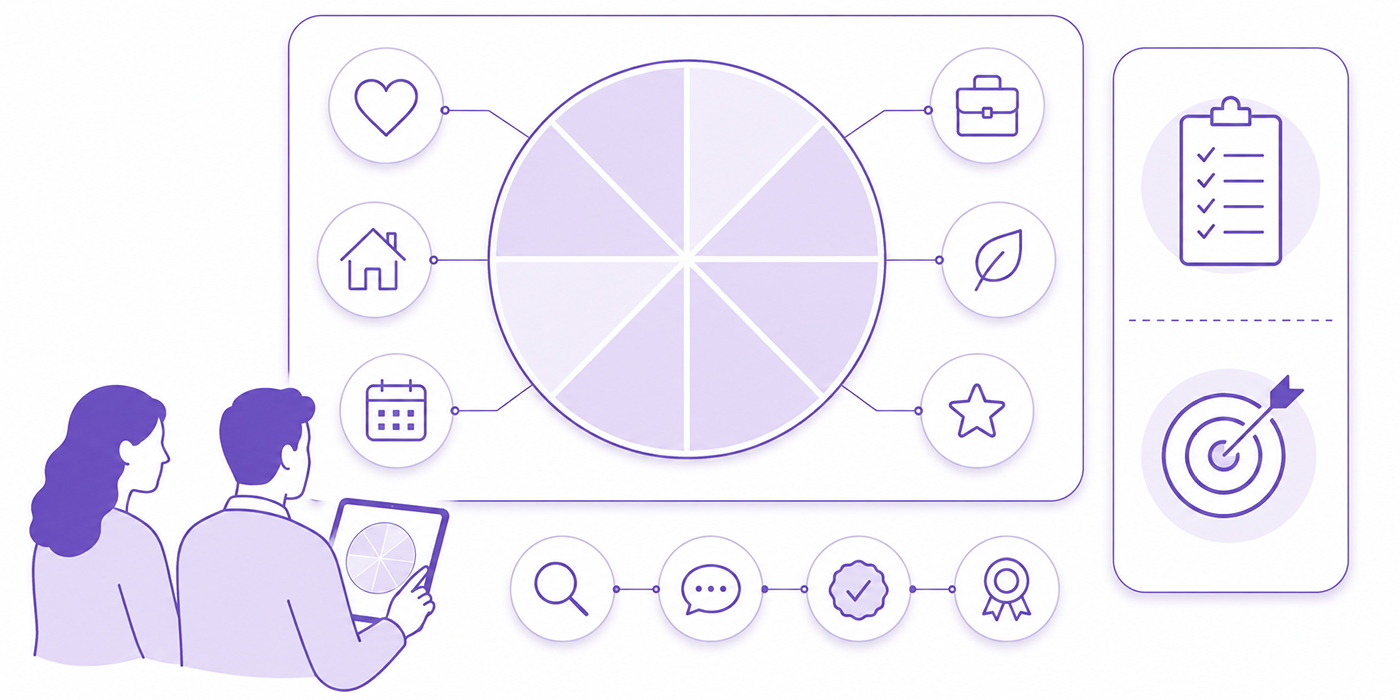
The Life Balance Wheel is a circular self-assessment divided into life areas such as health, career, finances, relationships, personal growth, recreation, home environment, and purpose. Clients score their current satisfaction in each area, usually from 1 to 10. Connecting those scores creates a visual shape that immediately exposes imbalance, instability, and neglected needs.
Its real value goes far beyond producing an attractive diagram. Traditional goal setting often begins with the client’s loudest complaint. A client may say they need better productivity when chronic exhaustion is the actual barrier. Another may request career coaching while unresolved relationship stress consumes the attention needed for career decisions. The wheel slows premature problem-solving and supports the kind of strength-based coaching, safe coaching environment, constructive feedback, and expectation management that prevents coaches from treating symptoms as root causes.
The scores also reveal relationships between life domains. A low recreation score may contribute to irritability at home. Financial uncertainty may affect sleep, confidence, and professional risk tolerance. Poor boundaries may appear across career, family, and emotional wellbeing at the same time. These patterns help the coach move from isolated goals toward a connected change strategy grounded in transformational coaching, client accountability, anxiety and stress coaching, and lasting habit development.
A score is still a conversation starter rather than a diagnosis. Two clients who rate career satisfaction at four may require completely different coaching approaches. One may feel underpaid, another may lack autonomy, while a third may enjoy the work but feel overwhelmed by workload. Effective coaches investigate what the number means, what evidence supports it, and what the client would notice if the score improved by one point.
This interpretation protects the client from generic advice. It also protects the coach from pushing a solution before understanding readiness, resources, emotional capacity, and scope. That discipline becomes particularly important when the wheel touches areas connected to mental health coaching, emotional crises, legal coaching requirements, or the professional boundaries explained in the NBHWC scope of practice.
| Life Area | Signal to Explore | High-Value Coaching Question | First Practical Experiment |
|---|---|---|---|
| Career | Persistent overload | Which responsibility consumes energy without creating meaningful value? | Remove, delegate, or renegotiate one recurring task. |
| Career | Professional stagnation | Which capability would create the greatest increase in opportunity? | Schedule one focused skill-building block. |
| Career | Values misalignment | Where does your work require you to act against your priorities? | Document one boundary or role adjustment. |
| Finances | Income unpredictability | Which financial uncertainty creates the most emotional pressure? | Build a 30-day essential-expense forecast. |
| Finances | Money avoidance | Which financial number have you been reluctant to examine? | Review one account for ten minutes. |
| Finances | Spending-value conflict | Which expense repeatedly competes with a more important goal? | Redirect one expense toward the priority. |
| Physical Health | Low daily energy | At what point in the day does your energy decline most sharply? | Track sleep, meals, movement, and energy for seven days. |
| Physical Health | Disrupted sleep | Which evening behavior most often delays recovery? | Create a consistent 20-minute wind-down routine. |
| Physical Health | Unsustainable routines | What is the smallest version of this habit you could repeat? | Reduce the habit to a five-minute minimum. |
| Relationships | Social isolation | Which relationship would benefit most from intentional contact? | Arrange one meaningful conversation. |
| Relationships | Recurring conflict | What need remains unspoken during the disagreement? | Prepare one calm, specific request. |
| Relationships | Chronic over-giving | What are you providing that has never been openly agreed? | Set one respectful limit. |
| Family | Caregiving exhaustion | Which responsibility could be shared, simplified, or paused? | Request one concrete form of support. |
| Family | Weak boundaries | Which family expectation creates resentment when you accept it? | Use one prepared boundary statement. |
| Personal Growth | Learning plateau | What have you outgrown but continued out of familiarity? | Choose one new challenge with a deadline. |
| Confidence | Fear-driven delay | What evidence would make the next step feel safer? | Gather one missing piece of evidence. |
| Recreation | Guilt around rest | What belief makes recovery feel unproductive? | Protect one hour of deliberate enjoyment. |
| Recreation | Passive escape | Which activity leaves you restored rather than merely distracted? | Replace one scrolling period with active recreation. |
| Home Environment | Persistent clutter | Which physical area creates the greatest daily friction? | Reset one high-use surface. |
| Environment | Draining commute | Which part of the journey can be changed or reclaimed? | Test one schedule, route, or remote-work adjustment. |
| Emotional Wellbeing | Reactive behavior | What usually happens immediately before the reaction? | Record the trigger, feeling, and response. |
| Emotional Wellbeing | Anxiety spikes | Which uncertainty are you trying to solve without enough information? | Separate controllable actions from uncontrollable outcomes. |
| Purpose | Lack of direction | Which contribution would make this season feel worthwhile? | Complete one values-aligned action. |
| Purpose | Excessive commitments | Which commitment belongs to an earlier version of your life? | Release or renegotiate one obligation. |
| Community | Weak belonging | Where do you feel useful, understood, and welcomed? | Attend one relevant group or community activity. |
| Meaning | Disconnection from beliefs | Which practice previously helped you feel grounded? | Reintroduce it in a manageable form. |
| Time | Constant urgency | Which urgent task repeatedly displaces important work? | Reserve one protected priority block. |
| Digital Wellbeing | Attention fragmentation | Which notification creates interruption without real value? | Disable one nonessential alert category. |
| Self-Care | Inconsistent recovery | What makes self-care disappear during demanding weeks? | Create a minimum recovery plan for busy days. |
| Overall Balance | Frequent score volatility | Which recent change affected several areas simultaneously? | Stabilize the highest-leverage pressure point first. |
2. How to Build a Life Balance Wheel That Produces Useful Coaching Data
A useful wheel begins with relevant categories. The familiar eight-area model works as a starting point, though coaches should avoid forcing every client into identical labels. A business owner may need separate categories for leadership, operations, income, and recovery. A parent may need family connection, personal identity, partnership, household responsibilities, and physical energy. Customization makes the wheel more compatible with individual client preferences, micro-coaching, relationship coaching, and preventative health coaching.
Start by asking the client which life areas currently determine their quality of life. Keep the final wheel between six and ten categories. Too few categories conceal important distinctions. Too many create decision fatigue and produce a diagram the client cannot interpret quickly.
Define the scoring scale before the client rates anything. A score of 10 should represent realistic satisfaction within the client’s present season, resources, and responsibilities. It should never imply perfection. A score of 1 indicates severe dissatisfaction or dysfunction from the client’s perspective. This definition reduces inflated standards, shame-based scoring, and comparisons with other people.
Next, ask the client to score present satisfaction rather than effort, importance, or social approval. Someone may work extremely hard on health while remaining dissatisfied with the outcome. Another client may possess a stable career that looks impressive externally while feeling deeply disconnected from it. Clarifying the measurement prevents distorted conclusions and supports mindset shifts, client-centered case analysis, emotional intelligence development, and difficult-client conversations.
After scoring, ask for one piece of evidence behind each number. “I scored health at five because I sleep six hours, skip lunch three days a week, and have stopped exercising” gives the coach usable information. “Health feels bad” remains too broad. Evidence makes future reassessment more reliable because the client can compare observable conditions rather than depending entirely on mood.
Then ask the client to choose a desired score for the next 30 to 90 days. A realistic increase from four to six is usually more actionable than a jump from four to ten. The coach can translate that two-point improvement into behaviors, boundaries, support, and environmental changes through habit tracking, accountability structures, gamification strategies, and coaching automation.
Finish the first assessment by capturing the date, category definitions, scores, evidence, and chosen focus area. A wheel without written context becomes difficult to compare later. A client who scores relationships at six this month may use a different internal standard when rating the same category next month. Brief notes create continuity and make progress visible.
3. How to Interpret the Wheel Without Chasing the Lowest Score
The lowest score often attracts immediate attention, though it may not represent the best starting point. A client could score finances at three while feeling emotionally ready to improve health from five to six. Early success in health may increase energy, confidence, and decision-making capacity, eventually making financial action easier. Effective prioritization considers leverage, urgency, readiness, risk, and personal meaning.
Use five questions when selecting the first coaching focus:
Which area causes the greatest daily friction?
Which area influences several other scores?
Which improvement feels meaningful to the client?
Which change is achievable with current resources?
Which area presents a risk requiring referral or specialist support?
This process avoids the common mistake of treating every low score as a coaching emergency. It also creates a more disciplined bridge between assessment and behavioral coaching strategies, client retention practices, exceptional client experiences, and feedback clients can use.
Look for clusters rather than isolated dips. Low scores in health, recreation, emotional wellbeing, and relationships may point toward depleted capacity. Low career, finances, and personal growth scores may reflect professional uncertainty. Strong scores in purpose and relationships may provide resources the client can use to strengthen weaker areas.
Differences between importance and satisfaction are equally revealing. Ask the client to rate how important each category is, then compare that score with current satisfaction. A life area rated 10 in importance and four in satisfaction contains a six-point gap. That gap often creates more distress than an area rated four in importance and two in satisfaction. The gap analysis helps coaches identify values conflict without assuming that every category deserves equal attention.
Rapid score changes also need investigation. An improvement from three to seven may represent genuine progress, temporary relief, a changed definition, or optimistic scoring before new habits have stabilized. A drop may reflect increased self-awareness rather than failure. Clients often score themselves more critically once they understand what healthy boundaries, sustainable routines, or satisfying relationships could look like.
Ask what changed in the client’s environment, interpretation, behavior, or expectations. This reflective process works especially well with visualization techniques, future-focused coaching trends, client feedback systems, and coaching case studies.
The final interpretation should produce one priority, one measurable result, and one immediate experiment. Multiple simultaneous goals may make the client feel productive during the session while increasing the likelihood of failure afterward. The wheel should narrow attention rather than expand the client’s burden.
4. How Successful Coaches Use the Life Balance Wheel in Daily Practice
Daily use does not require completing an entire wheel with every client every day. Skilled coaches use elements of the framework to organize preparation, ask sharper questions, and notice when a client’s stated goal conflicts with pressures elsewhere.
Before a session, review the client’s previous wheel, selected priority, evidence, and agreed action. Ask whether another life area could interfere with the plan. A client working on career development may have a family commitment that limits available time. Someone improving health routines may face unpredictable shift work. This two-minute review strengthens client follow-through, personalized coaching experiences, habit formation support, and realistic expectation management.
During the session, use the wheel as a navigation system. When the conversation moves repeatedly between career stress, sleep loss, and family tension, acknowledge the connection and ask which area currently creates the greatest leverage. This prevents a scattered session in which the client discusses everything and commits to nothing.
At the end of the session, connect the chosen action to the wheel. Ask which score the action is intended to influence, how the client will recognize progress, and what barrier could prevent completion. A useful commitment might be, “I will protect a 30-minute lunch break on three workdays to support my health score and reduce afternoon exhaustion.” The action is specific, connected to a meaningful category, and measurable.
Between sessions, coaches can use a three-question check-in:
Which wheel area received the most attention this week?
What increased or reduced your satisfaction in that area?
What adjustment would make next week more sustainable?
These questions fit easily into weekly check-in systems, micro-coaching methods, coaching technology, and gamified accountability. They maintain awareness without requiring the client to complete a full assessment repeatedly.
Complete the full wheel at meaningful intervals such as onboarding, every 30 or 90 days, after a major transition, and near the end of a coaching engagement. Too-frequent rescoring can make the client obsess over minor fluctuations. Infrequent reassessment can hide progress, changed priorities, and emerging risks.
Coaches can also use a personal Life Balance Wheel as a professional self-management tool. Score areas such as client delivery, administration, income stability, professional development, marketing, recovery, relationships, and purpose. A coach with strong client results and weak financial systems may need financial forecasting, payment systems, business automation, or a more sustainable practice-scaling strategy.
This daily self-check protects coaches from building a practice that succeeds commercially while damaging their health, relationships, or professional judgement. It also helps them model the reflective discipline they ask clients to develop.

5. Advanced Strategies and Mistakes That Reduce the Wheel’s Value
The first major mistake is presenting the wheel as an objective measurement of a client’s life. Scores are subjective snapshots influenced by mood, recent events, expectations, cultural values, and the client’s interpretation of each category. Treating a seven as scientifically superior to a six can create false precision. The coach’s task is to explore the story, evidence, and behavior behind the rating.
A second mistake is turning the wheel into a deficit inventory. Clients may leave the exercise feeling that every imperfect score represents failure. Use strengths deliberately. Ask which high-scoring area contains skills, support, or routines that could strengthen a lower-scoring area. A client who maintains strong friendships may already possess communication skills that can support workplace boundaries. This transfer approach connects the wheel with strength-based techniques, confidence-building mindset work, relationship development, and successful transformation patterns.
The third mistake is demanding equal scores across all categories. Balance rarely means identical investment. A client launching a business, caring for a newborn, completing a qualification, or supporting a family member may intentionally give one area more attention for a limited period. The better question is whether the present distribution is conscious, sustainable, and aligned with values.
The fourth mistake is creating too many action plans. A wheel containing eight categories can tempt coaches to assign eight goals. That approach often produces shallow commitment and rapid disengagement. Choose one primary area and identify any secondary area that must be protected. A client focusing on career advancement may need to protect sleep so professional effort remains sustainable.
The fifth mistake is crossing professional boundaries. A low emotional wellbeing score may lead to useful coaching around routines, support, values, communication, and stress management. Signs of trauma, severe depression, suicidality, abuse, addiction, or psychiatric crisis require an appropriate referral process. Coaches should understand emotional-crisis support, mental health coaching boundaries, legal responsibilities, and the NBHWC professional scope.
Advanced coaches add trend tracking. Instead of studying only the current shape, record scores across several review points and look for patterns. Which category improves first when the client establishes structure? Which score declines during demanding seasons? Which area remains stable and can serve as an anchor? Trend data can reveal repeated cycles that a single wheel cannot show.
Another advanced method is the “one-point definition.” For every priority area, ask the client to describe the observable difference between the current score and the next score. Moving career satisfaction from five to six might mean completing one difficult conversation, protecting two focused work blocks, or applying for three suitable roles. This creates a precise target for behavior-change planning, accountability coaching, client feedback, and constructive review conversations.
Finally, separate maintenance from improvement. High-scoring areas still require protection. A client who focuses entirely on fixing low scores may unintentionally neglect the relationships, routines, and strengths holding the rest of life together. Every plan should specify what the client wants to improve and what must remain stable.
6. Frequently Asked Questions About the Life Balance Wheel
-
Most clients benefit from completing the full wheel during onboarding and again every 30 to 90 days. The right interval depends on the coaching engagement, the speed of change, and the client’s circumstances. Major transitions such as a career change, relocation, relationship shift, health challenge, or business launch may justify an earlier reassessment.
Brief weekly questions can track movement without requiring constant rescoring. This rhythm works well with micro-coaching, automated coaching check-ins, client retention systems, and habit-tracking tools.
-
The strongest starting point is usually the area combining meaningful impact, client readiness, practical feasibility, and influence over other categories. The lowest score may require specialist support, may fall outside the client’s immediate control, or may feel less important than another gap.
Ask which improvement would create momentum and which problem is currently draining the client’s capacity. This decision process supports client-centered coaching, expectation management, strength-based action, and sustainable behavior change.
-
Low scores across the entire wheel may indicate severe overload, a major life disruption, unrealistic scoring standards, or emotional distress. Slow the process down. Ask which problem creates the most immediate pressure, what support is already available, and what would make the next seven days more manageable.
Avoid assigning a complete life redesign. Choose one stabilizing action and assess whether referral is appropriate. Knowledge of client anxiety and stress, safe coaching environments, emotional-crisis response, and professional scope becomes essential here.
-
Yes. Participants can complete individual wheels privately, identify one priority, and share only what feels appropriate. Group discussion can focus on patterns, strategies, and accountability without requiring disclosure of sensitive scores.
A facilitator can also create a themed wheel for leadership, wellbeing, career development, or relationships. Clear confidentiality expectations, voluntary sharing, and respectful discussion are crucial. The method can strengthen community-based coaching, gamified engagement, socially responsible coaching, and exceptional participant experiences.
-
Digital tools can calculate scores, display trends, send reminders, and store progress. They cannot independently understand why a score changed, whether a goal reflects the client’s own values, or whether the situation requires referral. Technology should improve continuity and visibility while the coach provides interpretation, challenge, empathy, and ethical judgement.
A balanced system combines the wheel with coaching technology, business automation, must-have coaching tools, and future-ready practice design.
-
Translate the selected score into a one-point improvement, define the evidence of progress, and choose the smallest behavior capable of creating movement. Identify a trigger, frequency, likely barrier, fallback version, and review date.
For example, “improve relationships” remains too broad. “Call my sister every Sunday after breakfast for the next four weeks” creates a visible behavior. Add accountability without creating dependence. This approach combines habit science, client accountability, constructive feedback, and lasting behavioral strategy.
