
T-GROW Coaching Model: Why It’s the Go-To Approach in 2026–2027
Clients rarely enter coaching with a perfectly defined objective. They bring competing priorities, emotional pressure, unfinished plans, and assumptions that blur the real issue. The T-GROW coaching model creates a disciplined path from confusion to commitment by clarifying the topic before setting the goal. Combined with the science of behavior change, effective accountability coaching, practical habit formation, and careful client expectation management, T-GROW gives coaches a repeatable structure without turning sessions into scripted conversations.
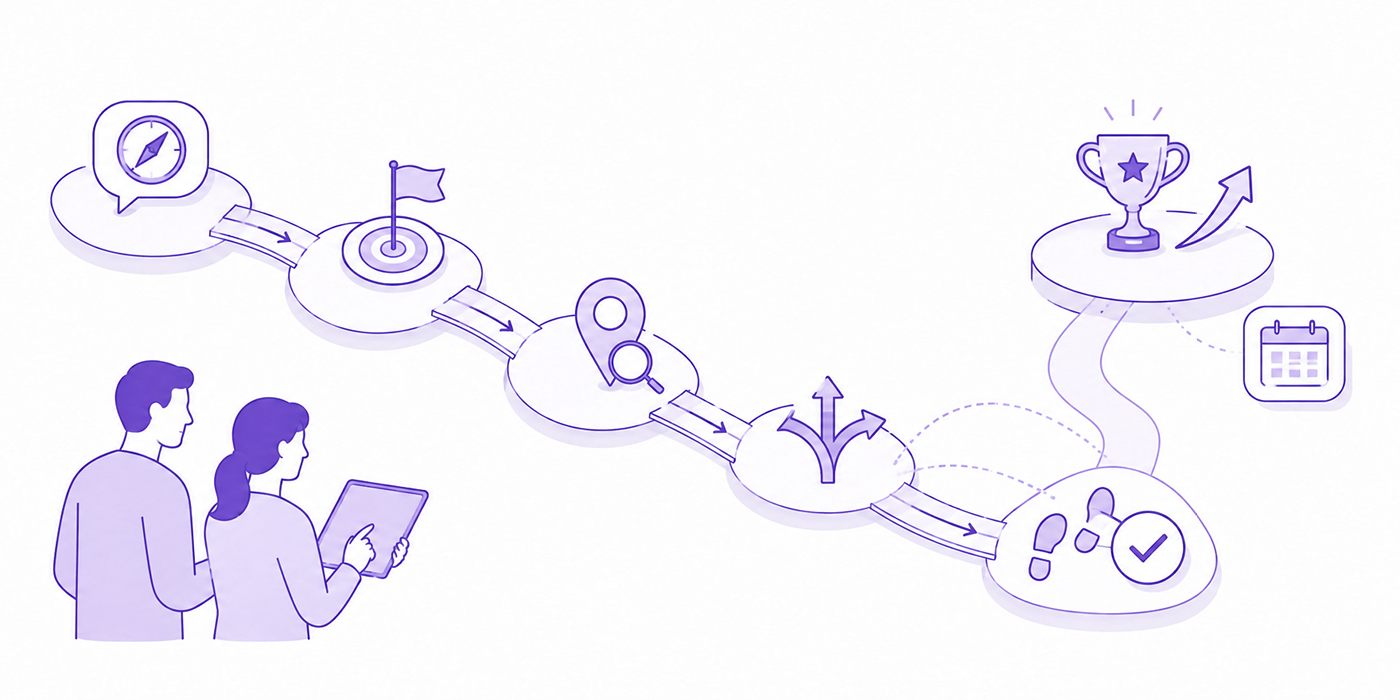
1. Why T-GROW Fits the Coaching Environment of 2026–2027
T-GROW stands for Topic, Goal, Reality, Options, and Will or Way Forward. It expands the traditional GROW framework by creating a deliberate topic-selection stage before the client defines an outcome. That first step may look simple, yet it solves one of the most expensive coaching problems: spending most of a session on the first issue mentioned instead of the issue that deserves attention.
A client may begin by complaining about time management. Careful topic exploration may reveal that unclear professional boundaries, fear of disappointing colleagues, or untreated exhaustion drives the scheduling problem. A coach who understands career burnout coaching, emotional agility, stress coaching strategies, and strengths-based coaching can use the Topic stage to locate the actual pressure point before building a plan.
This precision has become increasingly valuable as coaching sessions move across video calls, client portals, messaging platforms, brief check-ins, group programs, and hybrid services. Coaches need a framework that works during a sixty-minute leadership session and a fifteen-minute micro-coaching conversation. T-GROW gives each interaction a clear direction while leaving enough flexibility for emotion, reflection, challenge, and discovery.
The model also supports clients who feel mentally overloaded. Open-ended coaching can become frustrating when the client already struggles with decision fatigue. T-GROW narrows the conversation in stages. The client identifies the issue, defines a useful result, examines present conditions, creates choices, and selects a commitment. This progression complements life-balance assessment, life visioning, positive psychology coaching, and transformational coaching strategies.
T-GROW works especially well when the client has insight but struggles with execution. Many clients can explain their patterns in impressive detail. They understand why they procrastinate, overcommit, avoid conflict, or abandon routines. Progress remains limited because insight has never been translated into a specific behavior. The Will stage demands a decision: what will happen, when will it happen, what could interfere, and how will the client recover?
That execution focus makes the framework valuable for health behavior change, habit stacking, resilience coaching, and self-care coaching. The coach can move from “I need more energy” to a measurable action tied to sleep, meal preparation, movement, workload, or recovery.
The model also strengthens professional boundaries. A structured Reality stage helps coaches identify whether the issue sits within coaching scope. Persistent crisis symptoms, serious functional impairment, abuse, disordered eating, medical instability, or immediate safety concerns may require referral. Coaches who understand mental health coaching boundaries, emotional-crisis support, the NBHWC scope of practice, and the ICF Code of Ethics can use T-GROW responsibly without drifting into diagnosis or treatment.
T-GROW Coaching Diagnostic: 30 Client Situations, Questions, Risks, and First Moves
| Client Situation | T-GROW Stage to Emphasize | High-Value Coaching Question | Common Coaching Risk | Best First Move | Related ANHCO Resource |
|---|---|---|---|---|---|
| Client brings five competing problems | Topic | Which issue would make today’s conversation most valuable? | Following the first complaint without prioritization | List the issues, compare impact, and choose one focus | Life-balance assessment |
| Goal remains vague | Goal | What would be observably different after progress? | Accepting “feel better” or “be successful” as an outcome | Define one visible result and a realistic time frame | Expectation management |
| Client feels stuck in career | Reality | Which part of the current role creates the strongest dissatisfaction? | Treating every career concern as a job-search problem | Separate workload, culture, growth, values, and compensation | Career burnout coaching |
| Client repeatedly misses habits | Reality | What happens immediately before the habit is skipped? | Assuming motivation is the only barrier | Identify the cue, friction, environment, and competing behavior | Habit formation |
| Client wants rapid weight-loss results | Goal | Which sustainable health behavior deserves attention first? | Reinforcing extreme or medically inappropriate targets | Clarify scope and prioritize sustainable behavior | Health behavior change |
| Client feels constantly exhausted | Reality | Which daily demand consumes the most recoverable energy? | Prescribing generic productivity tactics | Map sleep, workload, recovery, health support, and boundaries | Lifestyle medicine |
| Client avoids a difficult conversation | Options | What are three respectful ways to begin the conversation? | Writing the client’s exact script too early | Explore desired outcome, risks, boundaries, and language | Constructive feedback |
| Client fears making the wrong choice | Options | Which decision criteria deserve the greatest weight? | Providing the coach’s preferred answer | Create criteria and compare each option consistently | Emotional agility |
| Client understands the problem but takes no action | Will | What exact action will you complete before our next session? | Ending with insight alone | Set a behavior, date, trigger, and accountability method | Coaching accountability |
| Client agrees too quickly | Will | On a scale of one to ten, how committed are you? | Confusing compliance with genuine commitment | Explore what would raise the commitment score | Safe coaching environment |
| Client blames every problem on external factors | Reality | Which part of this situation remains within your influence? | Invalidating genuine structural constraints | Separate limitations, influence, resources, and choices | Mindset shifts |
| Client sets an oversized goal | Goal | What smaller outcome would prove meaningful movement? | Building a plan the client cannot sustain | Define a minimum viable result | Micro-coaching |
| Client has low confidence | Reality | Where have you handled a similar challenge successfully? | Offering empty reassurance | Collect specific evidence of capability and transferable strengths | Strengths-based coaching |
| Client experiences a setback | Options | What would a useful recovery response look like? | Treating the missed action as total failure | Review learning and shorten the return path | Resilience coaching |
| Client lacks a sense of direction | Topic | Which part of your future currently feels least defined? | Jumping immediately into goal setting | Clarify values, desired identity, and life themes | Life visioning |
| Client questions their life purpose | Goal | What would greater purpose change in your ordinary week? | Treating purpose as one perfect career answer | Translate purpose into contribution, relationships, and routines | Life-purpose coaching |
| Client remains trapped in overthinking | Will | Which reversible experiment could create useful evidence? | Continuing analysis without real-world testing | Choose a low-risk experiment with a review date | Behavior-change science |
| Client struggles with food routines | Reality | Which situation produces the least intentional food choice? | Giving nutrition advice beyond scope | Examine environment, timing, stress, access, and support | Metabolic health coaching |
| Client feels overwhelmed by self-care | Options | Which five-minute action would create genuine relief? | Turning self-care into another demanding checklist | Select one restorative action with minimal preparation | Self-care coaching |
| Client wants better work-life balance | Topic | Which boundary is currently under the greatest pressure? | Treating balance as equal time in every area | Define the unsustainable pattern and desired allocation | Holistic coaching |
| Client struggles with relationships | Reality | Which repeated interaction creates the greatest disconnection? | Assigning blame before exploring the pattern | Map trigger, interpretation, response, and consequence | Emotional intelligence coaching |
| Client resists accountability | Will | What type of support would feel useful rather than controlling? | Using excessive reminders or pressure | Co-design the check-in method and frequency | Accountability coaching |
| Client frequently ghosts sessions | Reality | What makes continued engagement difficult right now? | Assuming the client lacks seriousness | Explore fit, capacity, expectations, friction, and value | Client retention |
| Client wants a complete life transformation | Topic | Which area would create the greatest practical improvement first? | Opening too many goals simultaneously | Choose one leverage point and one review period | Transformational coaching |
| Client struggles during economic uncertainty | Reality | Which current risk requires a decision within your control? | Offering financial or legal advice beyond competence | Clarify facts, scenarios, resources, and decision criteria | Economic-change coaching |
| Client has too many possible business ideas | Options | Which option best matches demand, capability, and capacity? | Encouraging excitement without validation | Score options against evidence-based criteria | High-ticket offers |
| Coach wants to automate follow-up | Will | Which reminder supports the client’s chosen action? | Replacing human judgment with excessive automation | Automate one useful prompt tied to the action plan | Coaching automation |
| Client needs a professional-development plan | Goal | Which capability would produce the strongest practical return? | Collecting credentials without applied competence | Link learning to a real project and evidence of skill | Continuous professional development |
| Client receives difficult feedback | Reality | Which part of the feedback is supported by observable evidence? | Rejecting or accepting every comment automatically | Separate data, interpretation, emotional reaction, and action | Using feedback for growth |
| Client reaches a goal and feels unfulfilled | Topic | Which need did the achievement fail to satisfy? | Immediately setting a larger version of the same goal | Explore meaning, values, identity, and contribution | Self-actualization coaching |
2. How Every Stage of the T-GROW Model Works
Topic: Identify the Conversation That Deserves the Session
The Topic stage determines what the session will examine. Ask the client what feels most important, what has changed since the previous meeting, and what would make the conversation worthwhile. When several concerns emerge, write them down and compare their urgency, emotional weight, potential consequences, and connection to the wider coaching agreement.
Useful Topic questions include:
“What would be most useful to explore today?”
“Which issue is occupying the greatest mental space?”
“What feels urgent, and what feels important?”
“Which conversation have you been avoiding with yourself?”
“How does this topic connect with the outcome of our coaching work?”
Topic exploration prevents session drift. It also helps the coach detect concerns requiring a different professional. Knowledge of ethical coaching practice, client-crisis support, certification standards, and safe coaching environments supports responsible decisions at this stage.
Goal: Define the Result of the Conversation
The Goal stage clarifies what the client wants from the session and from the broader situation. Coaches should distinguish between a session goal, a performance goal, and a development goal.
A session goal could be choosing between two job opportunities. A performance goal could involve completing three high-quality applications within two weeks. A development goal could involve building confidence in professional decision-making. These levels can support one another, yet combining them without clarification creates confusion.
Strong Goal questions include:
“What would you like to leave this session with?”
“What would progress look like in observable terms?”
“Which part of the outcome sits within your control?”
“How will you know this conversation was valuable?”
“What time frame makes sense for this result?”
The client’s goal should be specific enough to guide the session and flexible enough to change as new insight emerges. The coach can draw from behavior-change science, life-purpose coaching, positive psychology, and expectation management to shape goals that are meaningful and realistically actionable.
Reality: Examine What Is Happening Without Distortion
The Reality stage produces an accurate picture of current conditions. Ask about observable events, actions, beliefs, emotions, resources, previous attempts, environmental pressures, and consequences. Separate facts from interpretations. A client may say, “My manager has no confidence in me.” The evidence may consist of one critical comment, limited feedback, unclear responsibilities, or repeated removal from important work. Each reality requires a different response.
Valuable Reality questions include:
“What is happening specifically?”
“What evidence supports that conclusion?”
“What have you already attempted?”
“What tends to happen immediately before the problem?”
“Which resources are currently available?”
“What part of this situation can you influence?”
“What are you avoiding acknowledging?”
Coaches must resist the urge to rush through Reality. Weak diagnosis produces weak options. The client’s apparent motivation problem may involve an unrealistic plan, depleted energy, fear of conflict, poor environmental design, or a goal chosen to satisfy someone else. Methods from emotional intelligence coaching, stress management, health behavior change, and holistic coaching improve the quality of this investigation.
Options: Expand Choice Before Making a Decision
The Options stage helps the client generate possible responses. Begin with quantity, then evaluate quality. A client who sees only one acceptable path often feels trapped. Asking for five possible approaches can reveal experiments, conversations, boundaries, support systems, environmental changes, skill development, or revised expectations.
Useful Options questions include:
“What could you do?”
“What else becomes possible?”
“What would you try with greater confidence?”
“How might someone with your strengths approach this?”
“Which option requires fewer resources?”
“What could you test before making a permanent decision?”
“Who could provide useful support or information?”
The coach may share an observation or idea after the client has explored their own thinking. Permission protects autonomy: “May I offer an option for you to evaluate?” This approach supports strengths-based coaching, constructive feedback, resilience coaching, and emotional agility.
Will or Way Forward: Convert Choice Into Commitment
The final stage transforms the selected option into a concrete plan. Ask what the client will do, when they will do it, how success will be observed, which obstacle is most likely, and how accountability will work.
A strong Way Forward contains:
One clearly defined behavior
A date, time, trigger, or context
A realistic completion standard
A likely barrier
A response to that barrier
A support or accountability mechanism
A review date
The coach should test commitment directly. Ask the client to rate their intention from one to ten. A score below seven often signals that the action is too large, poorly timed, emotionally unsafe, externally imposed, or insufficiently valuable. Refine the action until the client can explain exactly how it will happen. This final discipline connects T-GROW with accountability systems, habit stacking, coaching automation, and client retention strategies.
3. How to Ask Better T-GROW Questions Without Sounding Scripted
T-GROW loses value when coaches treat it as a questionnaire. Clients can sense when the coach is waiting to reach the next stage instead of listening. The framework should organize the coach’s thinking while the conversation remains responsive to the client’s words, pace, emotional state, and readiness.
Use the client’s language in follow-up questions. When a client says, “I feel invisible at work,” asking “What does invisible look like during a normal week?” creates more depth than moving immediately to a generic goal question. Reflective listening strengthens client trust, supports emotionally intelligent coaching, improves constructive feedback conversations, and prepares the client for meaningful behavior change.
Questions should move between expansion and focus. Expansive questions reveal meaning, assumptions, and possibilities. Focused questions convert insight into decisions. Asking only expansive questions can create an intellectually rich session with no action. Asking only focused questions can feel mechanical and may overlook the emotional cause of the problem.
A useful questioning rhythm is:
Open: “What is happening?”
Clarify: “When does that occur most often?”
Deepen: “Why does that carry so much weight?”
Challenge: “Which assumption are you treating as a fact?”
Redirect: “What remains within your influence?”
Commit: “What will you do with this insight?”
The coach must also challenge with care. A client may repeatedly claim that they lack time while spending several hours each week on low-value obligations accepted through fear or guilt. The coach can say, “You have described time as the main constraint, and you have also identified three commitments you no longer consider valuable. What do you notice?” This invites reflection without humiliating the client.
Avoid stacked questions. “What happened, why did it happen, how did you feel, and what will you do next?” forces the client to choose which part to answer. One focused question followed by silence creates greater depth. Silence is especially useful during transformational coaching, self-actualization work, life visioning, and mindset coaching.
Coaches should also watch for leading questions. “Wouldn’t delegating solve this?” presents the coach’s conclusion as a question. A stronger prompt asks, “Which responsibilities require your direct involvement, and which could be handled differently?” The client remains responsible for the decision, which strengthens ownership and reduces dependence on the coach.
Another costly error involves asking “why” too aggressively. Why-questions can generate valuable insight, yet they may sound accusatory when the client already feels defensive or ashamed. “What influenced that decision?” and “What was important to you at that moment?” often produce better information. This sensitivity supports difficult-client conversations, safe coaching relationships, emotional-crisis awareness, and professional coaching ethics.
Poll: Which Part of T-GROW Creates the Biggest Challenge in Your Sessions?
4. How to Turn T-GROW Insight Into Reliable Client Follow-Through
The Way Forward stage determines whether the session produces change outside the coaching conversation. Clients often leave with intentions that sound responsible and remain behaviorally empty: “I will work on my confidence,” “I will set boundaries,” or “I will prioritize my health.” A useful commitment describes an action that another person could observe.
“Improve communication” could become: “Before Friday at 3 p.m., I will ask my manager for a twenty-minute role-clarification meeting and prepare three questions.” “Exercise more” could become: “After lunch on Monday, Wednesday, and Friday, I will walk for fifteen minutes.” This precision draws on habit formation, habit stacking, health behavior change, and accountability coaching.
Every commitment should include an obstacle forecast. Ask, “What is most likely to interfere?” The client may identify fatigue, schedule changes, emotional discomfort, perfectionism, family demands, or fear of another person’s reaction. The plan can then include a response. A missed morning walk could trigger a ten-minute evening walk. A postponed conversation could trigger a new calendar invitation within twenty-four hours.
This recovery planning prevents a single miss from becoming abandonment. It also supports resilience coaching, emotional agility, stress-management coaching, and positive psychology coaching. Progress depends heavily on how quickly the client returns after disruption.
Accountability must be designed with the client. Some clients want a weekly check-in form. Others prefer a shared tracker, text reminder, portal update, calendar prompt, or brief voice note. Ask what type of support increases responsibility without creating resentment. The goal is to preserve autonomy while making avoidance harder to hide.
Coaches can use coaching technology, business automation, must-have coaching tools, and coaching automation systems to capture actions, schedule reminders, and collect reflections. Each tool should solve a defined friction point. Too many dashboards, alerts, forms, and apps can overwhelm clients who already struggle with follow-through.
At the next session, review the action with curiosity. Ask what happened, what helped, what interfered, what the client learned, and what adjustment is required. Avoid turning the review into a pass-or-fail judgment. A missed commitment contains data about motivation, capacity, timing, emotional resistance, environmental friction, or goal fit.
Repeated non-completion deserves direct attention. The coach can say, “This action has been carried forward for three sessions. What are we failing to understand about it?” That question opens space for honest reassessment. The client may reveal that the goal belongs to a spouse, employer, family member, or idealized version of themselves. They may also need a smaller action or stronger support.
Document the final commitment in the client’s own words. Clear records strengthen continuity, support exceptional client experiences, improve client retention, create evidence for ethical coaching case studies, and make future client feedback more useful.

5. Advanced T-GROW Applications, Technology, and Common Mistakes
T-GROW can support one-to-one coaching, group programs, leadership development, health coaching, career transitions, business coaching, peer coaching, and self-reflection. The sequence remains stable while the depth, language, and tools change.
In group coaching, participants can identify one Topic privately, define an individual Goal, discuss shared Reality patterns, exchange Options, and state a personal commitment. This format creates peer learning while protecting individual choice. Coaches should establish confidentiality and participation boundaries through the same principles used in safe coaching environments, difficult-client management, emotional-intelligence coaching, and professional ethics.
In leadership coaching, T-GROW can structure conversations about delegation, stakeholder conflict, strategic priorities, communication, decision-making, and team performance. The Reality stage should include behavioral evidence and stakeholder perspectives. The Options stage can examine trade-offs, likely consequences, resource requirements, and leadership values. The Will stage should define the exact leadership behavior that will change.
In health coaching, the framework can help clients move from broad health concerns to sustainable behaviors. Coaches may explore sleep, stress, movement, meal structure, recovery, social support, and healthcare communication while respecting professional scope. Knowledge of lifestyle medicine, preventive health coaching, metabolic health coaching, and NBHWC scope requirements helps coaches avoid inappropriate advice.
Digital T-GROW worksheets can prepare clients before sessions. A short form may ask what topic they want to explore, what result they want, what has already happened, which options they see, and what support they need. The coach can review the responses before the meeting and spend more time on patterns requiring depth. This approach can improve efficiency when paired with coaching automation, technology-enabled coaching, scalable coaching systems, and client-experience design.
AI tools can assist with session summaries, action-plan formatting, reminder generation, and pattern review when privacy, consent, data security, and applicable rules are handled carefully. Human judgment remains essential for emotional nuance, ethical decisions, scope, challenge, and relationship. Coaches should evaluate every technological feature through client benefit, confidentiality, reliability, and operational necessity.
Several mistakes weaken T-GROW:
Rigid sequencing: Real conversations sometimes return to earlier stages. New Reality information may require a revised Goal. A newly discovered option may reveal that the Topic was defined too narrowly.
Premature action planning: Moving to Will before understanding the Reality often produces commitments built on false assumptions.
Coach-generated options: A client may comply with the coach’s idea during the session and abandon it afterward. Ownership improves when clients generate and evaluate their own possibilities.
Overloaded action plans: Five simultaneous commitments dilute attention. One high-leverage behavior usually produces stronger evidence.
Weak commitment testing: Agreement can hide low confidence, fear, or politeness. A numerical commitment rating reveals hesitation.
Ignoring emotional content: T-GROW provides structure while emotion often explains the behavior. Coaches should explore shame, grief, fear, anger, or identity conflict within their competence.
Poor documentation: Without a written action, deadline, obstacle, and review plan, both parties may remember the commitment differently.
Ongoing professional development improves the quality of T-GROW practice. Coaches can strengthen competence through CPD accreditation, maintaining coaching certification, certification portfolio development, and awareness of credentialing mistakes. A familiar model still requires skilled listening, ethical judgment, behavioral knowledge, and reflective practice.
6. FAQs About the T-GROW Coaching Model
-
GROW begins with Goal, followed by Reality, Options, and Will. T-GROW adds a Topic stage before goal setting. The additional stage helps clients choose the issue that deserves attention, especially when they bring several concerns or describe the problem vaguely. Topic clarification can prevent wasted session time and improve the quality of every later stage. Coaches who also use the Wheel of Life, life visioning, strengths-based coaching, and client expectation management can use Topic selection to identify the most valuable session focus.
-
T-GROW can structure sessions ranging from ten-minute check-ins to full sixty-minute conversations. A brief session may use two minutes for Topic and Goal, three minutes for Reality, two minutes for Options, and three minutes for commitment. Complex emotional, leadership, or career issues may require greater depth and flexible pacing. The framework adapts well to micro-coaching, coaching automation, transformational coaching, and longer client-retention programs.
-
Yes. The Topic and Goal stages can help clients move from uncertainty toward a workable direction. Begin with current dissatisfaction, desired changes, values, strengths, recurring concerns, and the cost of remaining in the same position. A useful session goal could involve clarifying decision criteria or identifying the next experiment. Resources on life-purpose coaching, self-actualization coaching, positive psychology, and emotional agility can support this exploratory work.
-
Explore the criteria behind the rejection. The client may face genuine constraints, fear the consequences of change, seek certainty, protect an identity, or pursue an outcome that conflicts with their values. Ask which cost they are unwilling to accept and whether a smaller experiment could create useful evidence. This approach draws from mindset coaching, resilience coaching, behavior-change science, and constructive feedback.
-
The Will stage requires the client to specify the action, time frame, success evidence, obstacle response, support method, and review date. This level of clarity makes follow-through easier to observe and discuss. Coaches can reinforce the commitment through accountability coaching, habit stacking, client portals and automation, and carefully designed client experiences.
-
T-GROW should be paused when immediate safety, crisis stabilization, clinical assessment, or emergency support takes priority. The framework may also feel restrictive during grief, trauma-sensitive conversations, or moments when the client needs space before problem solving. Coaches should use judgment, remain within competence, and follow appropriate referral procedures. Understanding emotional-crisis support, mental health coaching boundaries, the NBHWC scope of practice, and ICF ethical principles helps protect both the client and the coaching relationship.
