
Wheel of Life: The Essential Coaching Tool Every Professional Uses
Most clients enter coaching with tangled concerns rather than a clearly defined target. The Wheel of Life turns that confusion into a visual diagnosis of satisfaction, pressure, and neglected priorities. Used alongside the science of behavior change, a strong accountability process, and disciplined expectation management, it helps coaches identify the life area where a focused intervention can create the greatest practical improvement.

1. Why the Wheel of Life Creates Clarity So Quickly
The Wheel of Life is a circular coaching assessment divided into categories representing important parts of a client’s life. Common sections include health, career, finances, relationships, personal growth, recreation, home, and purpose. The client rates current satisfaction in each area, usually from 1 to 10, then connects the ratings to create a visible shape.
That shape gives the coach a structured entry point into conversations that might otherwise remain vague. A client may say, “Everything feels overwhelming,” while the wheel reveals strong relationships and finances alongside severe dissatisfaction with health, workload, and recreation. The coach can then explore client anxiety and stress through specific evidence instead of allowing the session to circle around generalized frustration.
The score itself has limited value until the coach explores the story underneath it. A rating of four in career satisfaction could reflect a hostile workplace, poor boundaries, boredom, stalled advancement, misaligned values, or exhaustion. Each cause requires a different intervention. Someone experiencing career burnout needs a different pathway from a client seeking life-purpose coaching or considering a major professional transition.
Strong coaches use the wheel to investigate four dimensions:
Satisfaction: How pleased is the client with the area today?
Importance: How strongly does this area affect the client’s overall quality of life?
Urgency: What consequences could occur if the issue remains unchanged?
Readiness: How willing and able is the client to act during the next few weeks?
This distinction prevents a common coaching mistake: automatically selecting the lowest score. A category rated three may feel less important to the client than an area rated six that creates daily distress. Effective prioritization combines the rating with the client’s values, available resources, immediate risks, and willingness to change. That approach fits naturally with strengths-based coaching, positive psychology coaching, and emotional agility.
The wheel also exposes dependencies between life areas. Poor sleep can reduce emotional regulation, productivity, exercise consistency, relationship patience, and confidence. Financial pressure can damage recreation, family communication, and professional decision-making. A coach trained in holistic coaching can identify these connections and locate the leverage point capable of improving several categories at once.
Wheel of Life Coaching Diagnostic: 30 Areas, Red Flags, and First Coaching Moves
| Life Area | High-Value Diagnostic Question | Warning Sign to Explore | First Coaching Move | Related ANHCO Resource |
|---|---|---|---|---|
| Physical energy | When during the day does your energy fall most sharply? | Dependence on caffeine, skipped meals, or constant fatigue | Track energy against sleep, meals, movement, and workload for seven days | Lifestyle medicine coaching |
| Sleep and recovery | Which evening behavior most often delays or disrupts recovery? | Irregular sleep, late work, or waking without restoration | Create one protected wind-down trigger and a consistent wake time | Habit stacking |
| Nutrition | Which situation causes your least intentional food decisions? | Restrictive cycles, emotional eating, or chaotic meal timing | Identify the recurring decision point and simplify the environment around it | Metabolic health coaching |
| Movement | Which form of movement feels realistic enough to repeat weekly? | All-or-nothing exercise plans and repeated restarts | Set a minimum viable movement target linked to an existing routine | Habit formation |
| Stress load | Which pressure is consuming the most mental bandwidth? | Irritability, racing thoughts, avoidance, or decision fatigue | Separate controllable demands from constraints requiring acceptance or support | Stress coaching strategies |
| Mental well-being | How is your current emotional state affecting daily functioning? | Persistent distress, hopelessness, crisis indicators, or impaired functioning | Clarify coaching scope and initiate an appropriate referral when required | Mental health coaching |
| Emotional regulation | Which emotion most often drives decisions you later regret? | Suppression, impulsive reactions, or prolonged emotional spirals | Name the trigger, bodily cue, interpretation, and chosen response | Emotional agility |
| Self-care | Which personal need is repeatedly postponed until exhaustion appears? | Guilt around rest or constant prioritization of other people | Schedule one replenishing activity before the week fills up | Self-care coaching |
| Romantic relationship | Which recurring interaction leaves you feeling unheard or disconnected? | Defensiveness, avoidance, contempt, or unresolved expectations | Define the unmet need and prepare a specific, respectful request | Relationship intelligence |
| Family relationships | Which family role creates the greatest emotional pressure? | Over-responsibility, guilt, resentment, or blurred boundaries | Map responsibilities and identify one boundary the client can communicate | Difficult situations |
| Friendships | Who provides reciprocal support, honesty, and emotional safety? | Isolation, one-sided relationships, or lack of meaningful contact | Reconnect with one supportive person through a specific invitation | Emotional safety |
| Community | Where do you currently experience belonging and shared purpose? | Social withdrawal or dependence on work for all connection | Choose one recurring community, group, or service activity to explore | Meaningful networking |
| Communication | Which conversation are you delaying because the outcome feels uncertain? | Passive communication, vague requests, or conflict avoidance | Prepare the observation, impact, need, and requested next step | Constructive feedback |
| Home environment | Which part of your environment creates daily friction? | Clutter, lack of privacy, unfinished tasks, or constant interruptions | Remove one repeated friction point from a high-use space | Micro-coaching |
| Career direction | Which part of your current role feels least aligned with your strengths? | Stagnation, boredom, underuse of ability, or unclear progression | Conduct a strengths, values, and opportunity gap review | Strengths-based coaching |
| Workload | Which responsibility consumes effort without producing proportionate value? | Chronic overtime, resentment, and inability to recover | Eliminate, delegate, reduce, or renegotiate one recurring demand | Burnout coaching |
| Leadership | How does your behavior affect the confidence and performance of others? | Micromanagement, poor delegation, avoidance, or inconsistent decisions | Select one leadership behavior and collect structured feedback | Using feedback for growth |
| Learning | Which capability would remove the largest current limitation? | Constant course consumption without applied practice | Define one skill, one use case, and one proof-of-competence project | Continuous professional development |
| Personal growth | Which repeated pattern are you finally ready to examine? | Insight without experimentation or behavior change | Convert the pattern into one observable replacement behavior | Transformational coaching |
| Purpose | Which activities leave you feeling useful, engaged, and internally aligned? | Achievement without fulfillment or dependence on external approval | Identify purpose themes across meaningful past experiences | Life-purpose coaching |
| Future vision | What would a satisfying ordinary week look like three years from now? | Goals based entirely on status, pressure, or comparison | Build a vision around routines, relationships, contribution, and environment | Life visioning |
| Meaning or spirituality | Which beliefs or practices help you interpret difficulty and responsibility? | Loss of meaning, inner conflict, or disconnection from values | Reintroduce one reflective or values-aligned practice | Self-actualization coaching |
| Finances | Which financial uncertainty creates the greatest emotional pressure? | Avoidance, uncontrolled spending, unclear debt, or unstable cash flow | Create a factual snapshot before setting any financial goal | Financial forecasting |
| Time management | Which weekly commitment repeatedly displaces your real priorities? | Overbooking, reactive scheduling, and constant task switching | Protect one priority block and create a clear stop-doing list | Coaching automation |
| Digital boundaries | Which device habit fragments your attention most often? | Compulsive checking, sleep disruption, or inability to focus | Attach a digital boundary to a location, time, or activity | Technology and coaching |
| Fun and recreation | When did you last do something enjoyable without productivity attached? | Rest treated as a reward earned only after exhaustion | Schedule low-pressure enjoyment with a defined time and place | Positive psychology |
| Creativity | Which idea or form of expression keeps returning to your attention? | Perfectionism, fear of judgment, or endless preparation | Create a deliberately small first version with a deadline | Coaching mindset shifts |
| Contribution | Where could your skills create a meaningful benefit for someone else? | Success that feels disconnected from service or impact | Choose one contribution experiment with a clear beneficiary | Collaborative impact |
| Confidence | Which situation consistently causes you to doubt your capability? | Avoidance, reassurance seeking, or dependence on perfect preparation | Design a graded exposure task supported by evidence of existing competence | Accountability coaching |
| Resilience | Which recovery resource disappears first when pressure increases? | Withdrawal, rigid thinking, or slow recovery after setbacks | Create a personal recovery plan covering support, rest, perspective, and action | Resilience coaching |
2. How to Run a Wheel of Life Coaching Session Professionally
A productive Wheel of Life session starts with category selection. Standard categories provide convenience, yet customized categories produce stronger relevance. A first-time manager may need leadership, delegation, confidence, workload, family, health, finances, learning, and recreation. A health-coaching client may need sleep, movement, food choices, stress, recovery, medical support, social connection, and self-care.
Ask the client to choose eight to twelve categories that genuinely influence their current life. This creates ownership and supports the collaborative atmosphere described in creating a safe coaching environment. Categories chosen entirely by the coach can steer the assessment toward the coach’s worldview and weaken trust.
Next, define the scale before collecting ratings. A vague ten-point scale encourages inconsistent scoring. Give the endpoints practical meaning:
1: This area causes significant distress, disruption, or risk.
5: Some foundations exist, although recurring problems remain.
10: This area feels deeply satisfying and requires sustainable maintenance.
Ask the client to rate their experience during a defined period, such as the past four weeks. A time boundary limits the influence of a single difficult day. It also creates a more dependable baseline for future comparison, especially when the wheel supports health behavior change or a longer transformational coaching process.
After each rating, use evidence-based prompts:
“What tells you this area is a six?”
“Which part is already working?”
“What keeps the score from being lower?”
“What would move it one point higher?”
“How important is that increase right now?”
“Which barrier has blocked previous attempts?”
The question about why the score is higher than a lower number uncovers strengths, support systems, and successful behaviors. This is particularly useful in strengths-based coaching, because the coach can build on existing capacity instead of treating every category as a deficit.
Once the wheel is complete, give the client time to observe it. Silence often produces more insight than immediate interpretation. Ask what surprises them, which categories appear connected, and where the shape differs from the life they present to other people. High achievers frequently maintain strong career scores while health, recreation, relationships, or recovery quietly deteriorate. That pattern can reveal early burnout risks before performance visibly collapses.
Professional boundaries remain essential. Severe emotional distress, safety concerns, disordered eating indicators, substance dependence, abuse, or impaired daily functioning require careful scope decisions. Coaches should understand how to support clients during emotional crises and when referral to a qualified healthcare or mental-health professional is appropriate. The wheel can reveal a concern; diagnosis and clinical treatment sit outside ordinary coaching scope.
End the assessment phase by asking the client to select no more than two areas for deeper exploration. Trying to repair eight categories simultaneously creates overwhelm, weak execution, and disappointing results. The strongest starting point usually combines high importance, meaningful leverage, manageable risk, and sufficient readiness.
3. How to Interpret the Wheel Without Oversimplifying the Client
A jagged wheel provides a useful visual, yet visual imbalance alone does not identify the correct goal. Perfectly even scores can still represent widespread dissatisfaction. A client with every area rated five has a balanced shape and may still feel chronically underfulfilled. A client with several nines and one four may have a rich, satisfying life alongside one urgent problem.
Begin interpretation by comparing satisfaction with importance. A low score in an unimportant category may require little attention. A moderate score in a deeply valued area can deserve immediate focus. This distinction strengthens client expectation management and prevents the coach from imposing a generic definition of balance.
Then look for clusters. Low health, energy, recreation, and emotional regulation scores may share a workload cause. Low confidence, career, learning, and finances may originate in professional stagnation. Low family, partnership, friendships, and self-care may reveal weak boundaries or caregiving overload. Exploring these patterns through emotional intelligence coaching helps clients understand how emotions, habits, environments, and relationships interact.
Three interpretation lenses add depth:
The leverage lens: Which improvement could positively influence several categories?
The constraint lens: Which issue will continue blocking progress elsewhere?
The readiness lens: Where does the client have enough motivation, control, and support to act?
A client may identify finances as the largest concern, while avoidance prevents them from reviewing actual numbers. Their first goal could involve tolerating financial discomfort for twenty minutes while creating an accurate snapshot. This small action reflects the logic of micro-coaching and can produce more momentum than an abstract goal such as “become financially secure.”
Pay attention to language during interpretation. Statements such as “I should,” “everyone expects,” “I have no choice,” and “I always fail” can expose external pressure, rigid beliefs, or low perceived agency. Mindset coaching can help challenge those assumptions, while emotional agility can help the client acknowledge discomfort without allowing it to control every decision.
Repeated low scores also require context. Some barriers are structural: poverty, discrimination, caregiving demands, disability, unsafe employment, limited healthcare access, or unstable housing. Coaching should never reduce structural constraints to a motivation problem. A credible coach identifies the client’s available sphere of influence, validates genuine limitations, and supports resourceful choices without assigning blame.
Poll: What Is Your Biggest Struggle When Using the Wheel of Life?
4. Turn Wheel of Life Insights Into an Actionable Coaching Plan
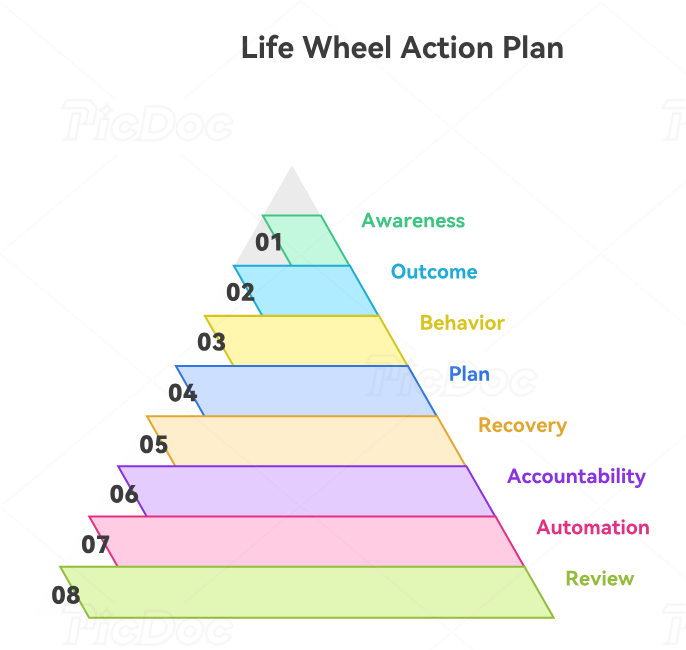
The Wheel of Life creates awareness. Client outcomes depend on the decisions made after that awareness. Many sessions lose value at this stage because the client leaves with broad intentions such as “take better care of myself,” “improve my relationships,” or “find more balance.” These goals lack a defined behavior, context, measurement method, and recovery plan.
Start by translating the selected life area into a specific outcome. Suppose the client rates health at four. “Improve health” remains too broad. Through deeper questioning, the coach may discover that irregular sleep is driving poor concentration, missed workouts, emotional eating, and irritability. The practical outcome could become: “Create a weekday recovery routine that supports at least seven hours in bed on four nights each week.”
Next, identify the smallest behavior capable of producing evidence. Habit formation coaching works best when the action is easy to recognize and repeat. “Relax more” cannot be measured clearly. “Place the phone outside the bedroom by 10:30 p.m. from Monday through Thursday” gives the client a precise behavioral target.
A strong Wheel of Life action plan should contain six elements:
Priority area: The selected life category.
Desired shift: The practical improvement the client wants.
Weekly behavior: The action within the client’s control.
Success evidence: The observable sign that progress occurred.
Likely obstacle: The situation most likely to interrupt execution.
Recovery response: The next action after a missed attempt.
The recovery response deserves special attention. Clients frequently interpret one missed action as proof that the plan has failed. A resilience-based plan defines success through return speed. For example: “When I miss the evening routine, I will restart the following night without adding punishment or extra tasks.” This approach aligns with resilience coaching and protects clients from all-or-nothing thinking.
Accountability should also match the client’s needs. Some clients benefit from weekly forms, visual trackers, calendar reminders, or short voice updates. Others experience heavy monitoring as pressure. The coach should agree on a system that supports autonomy and follows the principles of accountability coaching. A useful check-in asks about completion, barriers, learning, emotional response, and the next adjustment.
Coaches can strengthen follow-through through carefully selected coaching automation. Automated reminders can prompt a weekly reflection, while a client portal can preserve goals, notes, and next steps. Technology should reduce friction and support the coaching relationship. An overloaded platform with excessive notifications can create another source of avoidance, especially for clients already struggling with mental load.
Review progress through behavior and experience. A rating may remain unchanged even while meaningful foundations are forming. A client’s career score could stay at five during the first month, although they have clarified their strengths, updated their résumé, initiated three conversations, and established a decision deadline. These leading indicators deserve recognition. The later score may improve after external results catch up with the client’s actions.
Use constructive feedback when the client repeatedly avoids agreed actions. Explore whether the plan is too large, poorly timed, emotionally threatening, externally imposed, or disconnected from the client’s values. Avoid assuming laziness. Resistance often contains useful information about fear, identity, capacity, or an unacknowledged cost of change.
5. Advanced Wheel of Life Applications and Costly Coaching Mistakes
Experienced coaches can adapt the Wheel of Life for specific contexts. A career wheel might include compensation, leadership, autonomy, advancement, meaningful work, workload, workplace relationships, learning, and job security. A health wheel could include sleep, energy, nutrition, movement, stress, recovery, social support, self-care, and medical adherence. A coaching-business wheel might assess lead generation, sales, delivery, retention, referrals, finances, systems, brand authority, and professional development.
Customization increases relevance, although comparability requires consistency. When a coach plans to repeat the assessment, the same categories and scoring definitions should remain in place. Changing “health” into “physical fitness” halfway through a program alters the construct being measured. The result may look like progress while reflecting a narrower category.
Several advanced formats improve diagnostic depth:
Weighted wheel: The client assigns an importance score to every category. Satisfaction and importance can then be compared to identify the largest meaningful gaps.
Current-and-desired wheel: The client rates the present state and a realistic target for the next three to six months. This reduces pressure to aim for ten in every area.
Confidence overlay: The client rates confidence in improving each category. A high-priority area with low confidence may require smaller steps, stronger support, or preparatory work.
Resources wheel: Categories represent available resources such as time, knowledge, social support, money, energy, confidence, and access. This reveals why an apparently sensible goal remains difficult.
Quarterly comparison wheel: The client completes the same assessment every quarter and reviews patterns across time. This works well in long-term coaching programs where progress includes maintenance, setbacks, and changing priorities.
The first major mistake is treating balance as equal investment across every area. Life demands shift. A new parent, business founder, caregiver, student, or person recovering from illness may intentionally allocate more energy to one domain. The relevant question concerns sustainability and alignment. Does the current allocation reflect a conscious choice, or has one area expanded through pressure and neglect?
The second mistake is using the wheel as a performance scorecard. Clients may feel ashamed when they see several low ratings. A coach should frame the assessment as information about present experience. Low scores can identify unmet needs, overloaded systems, and opportunities for support. This framing supports the trust-building practices found in exceptional client experiences.
The third mistake is moving too quickly into solutions. A client who rates relationships at three may need space to clarify grief, resentment, loneliness, communication problems, or conflicting expectations. Premature advice can cause withdrawal. Skilled listening and a safe coaching environment help the coach understand the problem before designing the intervention.
The fourth mistake is recording ratings without preserving the client’s reasoning. A score of six means little several weeks later unless the coach documents why the client selected it, which behaviors supported it, and which conditions limited it. Accurate notes improve continuity, strengthen coaching case studies, and help the client recognize progress that memory may overlook.
The fifth mistake is repeating the assessment too frequently. Weekly scoring can create noise and encourage clients to react to temporary mood changes. Reassessment should occur after enough time has passed for meaningful behavior or circumstances to change. Many coaching engagements benefit from an initial wheel, a midpoint review, and a final comparison. Longer programs may use four-to-twelve-week intervals depending on the goal.
The sixth mistake is ignoring areas that score highly. Strong categories contain resources that can support weaker ones. A client with excellent friendships and low career confidence may ask a trusted contact for feedback or introductions. A client with strong discipline in fitness may transfer the same cue-and-routine structure to financial planning. This resource-transfer approach supports lasting behavior change and gives clients evidence that they already possess usable capabilities.
6. FAQs About the Wheel of Life Coaching Tool
-
Eight to twelve categories usually provide enough breadth without overwhelming the client. Fewer categories can work for a tightly focused session, such as a career or health review. More than twelve often creates category overlap and weakens prioritization. The coach should use the client’s goals, current roles, and pressure points to choose the categories. A specialized health wheel may include sleep, energy, movement, nutrition, stress, recovery, social support, and self-care, while a holistic coaching wheel may cover a wider range of physical, emotional, relational, and purpose-related domains.
-
The appropriate interval depends on the expected pace of change. Four to six weeks may suit a focused habit goal. Eight to twelve weeks may suit career, relationship, or identity-based work. Repeating the wheel after every session can magnify short-term mood fluctuations. Keep the category names, time frame, and scoring anchors consistent when comparing results. Pair each reassessment with evidence from habit tracking, completed actions, client reflections, and accountability check-ins.
-
Priority should reflect importance, urgency, leverage, readiness, and scope. A client may rate recreation at two and finances at five while financial uncertainty causes daily anxiety and blocks major decisions. Finances may deserve earlier attention. Ask which area creates the greatest cost, which improvement could support other areas, and where the client is prepared to act. This decision process fits well with managing client expectations and prevents the session from chasing every visible weakness.
-
Similar scores require deeper questioning. A flat wheel can indicate genuine stability, broad dissatisfaction, cautious self-disclosure, unclear scale definitions, or a tendency to avoid extremes. Ask for behavioral evidence behind each rating and explore which area occupies the most mental space. Questions about the client’s desired future can also reveal hidden priorities. Life visioning helps the client compare current routines with the life they want to build.
-
Yes. Group participants can complete individual wheels, identify one private priority, and discuss patterns they feel comfortable sharing. Coaches should avoid public comparison of scores, since personal circumstances differ greatly. Group use works best when confidentiality, participation boundaries, and discussion rules are established clearly. Participants can then learn from shared obstacles while creating individualized actions. This format can support micro-coaching, peer accountability, and structured progress reviews.
-
Depth comes from the conversation following each rating. Ask for evidence, emotional meaning, recent examples, previous attempts, environmental barriers, available strengths, and the cost of remaining unchanged. Connect insights to one measurable behavior and agree on a review process. Document the client’s reasoning so later comparisons capture genuine development. When combined with behavioral coaching strategies, thoughtful client feedback, and a reliable coaching accountability system, the Wheel of Life becomes a repeatable decision-making framework rather than a one-session exercise.
