
SMART Goals Model: The Timeless Method Coaches Still Swear By
Clients can leave a coaching session feeling energized and still return two weeks later with little evidence of progress. The gap usually begins with goals that sound meaningful yet lack behavioral precision, visible proof, and a realistic review point. The SMART goals model converts intention into a structured commitment that supports behavior change, strengthens habit formation, creates genuine accountability, and improves client expectation management.
1. Why the SMART Goals Model Still Produces Reliable Coaching Outcomes
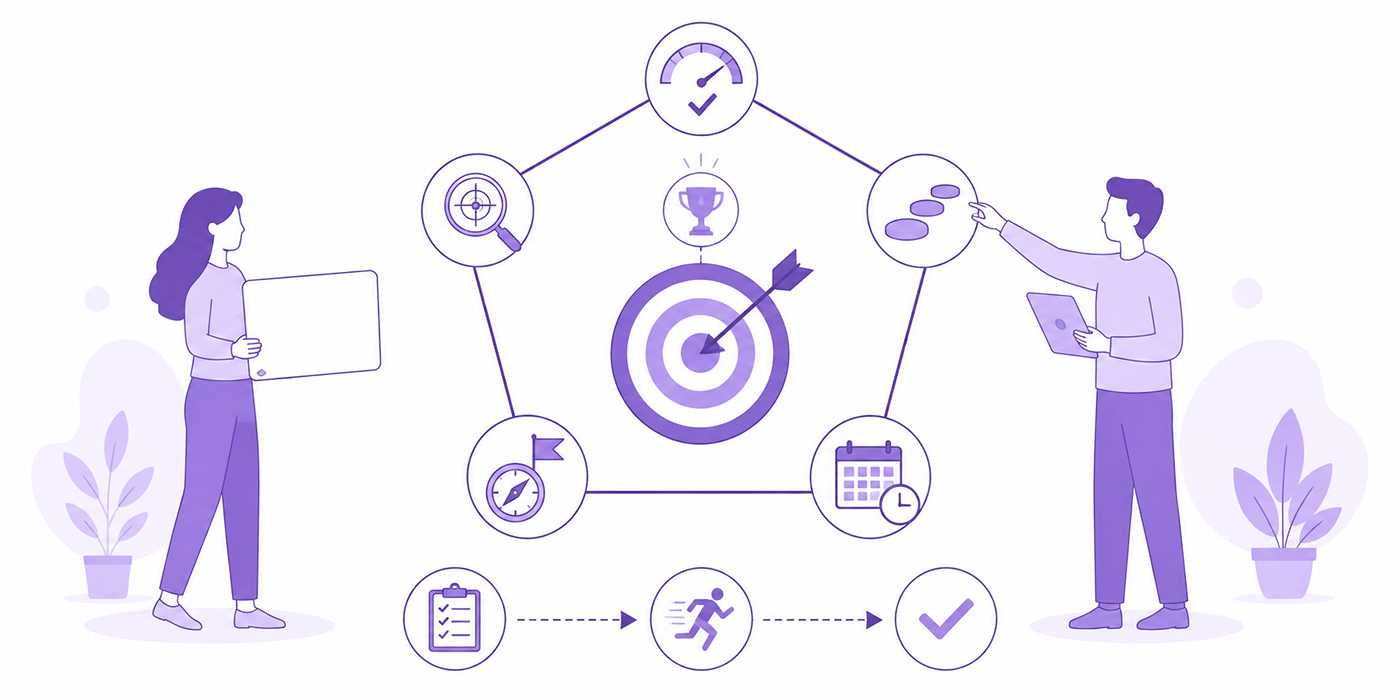
SMART stands for Specific, Measurable, Achievable, Relevant, and Time-bound. Each element answers a decision the client must make before meaningful action can begin. Specific defines the target. Measurable establishes evidence. Achievable tests feasibility. Relevant connects the goal to personal value. Time-bound creates a review horizon. Together, these elements give transformational coaching a practical execution system, support clearer constructive feedback, strengthen coach-client accountability, and generate clearer material for coaching case studies.
The model remains useful because clients frequently describe desired feelings rather than observable changes. “I want more balance,” “I need confidence,” and “I want to feel healthier” reveal important needs, yet they provide limited direction for the coming week. A coach can connect these aspirations to a life balance wheel, explore the client’s emotional agility, identify usable capabilities through strengths-based coaching, and convert the discussion into one behavior the client can recognize and repeat.
SMART goals also reduce the pressure created by oversized commitments. A client experiencing anxiety and stress may agree to an ambitious target during an emotionally intense session, then avoid it once ordinary demands return. Feasibility testing allows the coach to protect momentum, build client resilience, maintain a safe coaching environment, and apply emotional-intelligence coaching when guilt or perfectionism begins influencing the goal.
The strongest coaches use SMART as a decision framework throughout the engagement. The original goal guides session planning. Progress data shapes reflection. Barriers reveal where the support system needs adjustment. Review dates prevent goals from becoming permanent obligations after circumstances change. When connected to coaching automation, structured accountability systems, thoughtful client retention strategies, and carefully chosen coaching technology, SMART goals can organize an entire coaching program.
| Coaching Situation | Weak Goal | Stronger SMART Goal | Evidence to Track | Review Rhythm |
|---|---|---|---|---|
| Stress management | I want to feel calmer. | I will complete a 10-minute decompression routine after work on four weekdays for the next three weeks. | Completion log and stress rating before and after | Weekly |
| Anxiety regulation | I will stop overthinking. | I will use my three-question thought check during two identified worry episodes each week for one month. | Trigger, thought, response, and intensity score | Every seven days |
| Sleep routine | I need better sleep. | I will begin my wind-down routine by 10:30 p.m. on five nights per week for 21 days. | Start time and morning energy score | Twice weekly |
| Habit stacking | I will become more consistent. | After brushing my teeth each morning, I will complete two minutes of mobility work for 14 days. | Daily completion checkbox | Day 7 and Day 14 |
| Preventive health | I will take better care of myself. | I will schedule my overdue preventive appointment by Friday and prepare three questions before attending. | Appointment confirmation and question list | Friday |
| Metabolic health | I want more energy. | I will eat a protein-rich breakfast before 9 a.m. on four workdays weekly for four weeks. | Meal log and 2 p.m. energy rating | Weekly |
| Food awareness | I will figure out which foods affect me. | I will record meals, symptoms, timing, and context for 14 consecutive days before drawing conclusions. | Complete food-and-symptom record | Day 7 and Day 14 |
| Self-care | I need more time for myself. | I will protect one 30-minute recovery block on Tuesday, Thursday, and Sunday for the next month. | Calendar blocks completed | Sunday evening |
| Emotional intelligence | I want to communicate better. | I will pause, name my emotion, and ask one clarifying question during three difficult conversations this month. | Conversation notes and outcome reflection | After each conversation |
| Resilience | I want to recover faster. | Within 24 hours of a setback, I will document one lesson, one controllable action, and one source of support. | Recovery worksheet completion | After each setback |
| Emotional agility | I will manage difficult emotions. | I will label the emotion and choose a values-aligned response during four emotionally charged moments this month. | Emotion, value, choice, and result | Weekly |
| Life balance | I want a balanced life. | I will raise my connection score from 4 to 6 by scheduling one meaningful social activity weekly for six weeks. | Wheel score and completed activities | Every two weeks |
| Life visioning | I need clarity about my future. | I will draft a one-page three-year vision covering work, health, relationships, and environment by next Sunday. | Completed vision and clarity rating | Next Sunday |
| Life purpose | I want to find my purpose. | I will conduct four structured reflection interviews with trusted people within 30 days and identify recurring themes. | Interview notes and theme summary | After the fourth interview |
| Career burnout | I need work to feel manageable. | I will end work by 6:30 p.m. on four weekdays for three weeks and record any barriers. | Shutdown time and barrier log | Each Friday |
| Accountability | I will follow through. | I will send my coach a completion update by 5 p.m. every Friday for the next six weeks. | Six updates delivered on time | Weekly |
| Client engagement | I will engage more in the program. | I will complete the weekly reflection form before each of my next four coaching sessions. | Form completion rate | Before every session |
| Receiving feedback | I will become less defensive. | During my next three feedback conversations, I will summarize what I heard before responding. | Three summaries and reflection notes | After each conversation |
| Boundary setting | I will stop overcommitting. | I will use a prepared boundary statement in two situations this week where the request exceeds my capacity. | Requests, response used, and outcome | End of week |
| Psychological safety | I will speak honestly in coaching. | I will bring one avoided concern to each of my next three sessions and rate how safe the discussion felt. | Concern discussed and safety rating | Every session |
| Certification study | I will study more. | I will complete four 45-minute study blocks each week for the next six weeks. | Study blocks and practice scores | Sunday evening |
| ICF ethics preparation | I will understand the ethics code. | I will review two ethical scenarios every weekday and explain my reasoning in writing for three weeks. | Scenario accuracy and rationale quality | Every Friday |
| Scope-of-practice mastery | I will understand professional boundaries. | I will classify 25 practice scenarios and reach 90% accuracy by the end of the month. | Classification score | Weekly practice test |
| Professional networking | I will grow my network. | I will initiate two relevant professional conversations weekly for eight weeks and document follow-up actions. | Conversations and follow-ups | Friday afternoon |
| Case-study creation | I will improve my marketing. | I will complete one anonymized, consent-based client case study within 21 days. | Approved final case study | Day 7, 14, and 21 |
| Premium offer development | I will create a high-ticket package. | I will define the client, outcome, delivery model, price, and qualification criteria by the end of next week. | Completed offer brief | Next Friday |
| Income forecasting | I want more predictable income. | I will build a 90-day forecast using current clients, expected renewals, expenses, and three sales scenarios by Monday. | Completed forecast with assumptions | Monthly |
| Business automation | I will automate my business. | I will automate appointment reminders and intake-form delivery within 10 business days. | Two tested workflows | Day 5 and Day 10 |
| Client experience | I want clients to feel supported. | I will introduce a 48-hour post-session recap for every active client during the next four weeks. | Recaps sent and client responses | Weekly |
| Practice growth | I want to scale. | I will document and delegate one repeatable administrative workflow within 30 days. | Process document and successful handoff | Weekly milestone review |
2. How to Build Each SMART Element Without Weakening Client Ownership
Specific: A specific goal describes the behavior, context, and immediate target clearly enough that the client can recognize completion. “Improve confidence” becomes “contribute one prepared point during Monday’s team meeting.” The coach can use positive psychology coaching to identify existing capabilities, life visioning to clarify direction, constructive feedback to sharpen the language, and strengths-based coaching to design an action that feels authentic.
Specificity should answer five practical questions: What will the client do? Where will it happen? Under which conditions? With whom, when relevant? Which part deserves attention first? The coach should continue questioning until the client can picture the action in an ordinary week. This process becomes especially important during career burnout coaching, mental health coaching, holistic coaching, and life-purpose coaching, where the starting concern may feel broad or emotionally loaded.
Measurable: Measurement gives the client a way to observe change without relying on memory or mood. Useful measures include frequency, duration, completion, quality ratings, milestone achievement, response time, confidence scores, and observable outputs. A habit-formation plan may track repetition, while health behavior change may require symptom patterns, energy ratings, or adherence data. Coaching technology can collect this evidence, while micro-coaching can keep the feedback cycle short.
Coaches should select the lightest measurement system that still supports a useful conversation. Excessive tracking creates administrative friction and can intensify perfectionism. A single checkbox may be sufficient for a new habit. A leadership goal may require feedback from colleagues. A wellbeing goal may benefit from a one-to-ten energy scale. The measure should help the client notice patterns, refine decisions, and strengthen personal accountability, emotional agility, self-care consistency, and behavior-change awareness.
Achievable: Achievability examines capacity, resources, timing, skill, support, and competing obligations. The coach should ask what the goal requires and whether the client currently has access to those requirements. This prevents a highly motivated session from producing a plan that collapses under real-life pressure. The test is especially valuable during stress coaching, resilience coaching, economic uncertainty, and difficult client situations.
An achievable goal can still be demanding. The client needs a credible route from present capacity to desired action. Coaches can use scaling questions such as, “From one to ten, how confident are you that you can complete this?” A rating below seven often signals that the action needs adjustment. The coach can reduce frequency, simplify the first milestone, add support, remove a barrier, or use habit stacking. This preserves client motivation, supports lasting transformation, and improves follow-through accountability.
Relevant: Relevance connects the goal to the client’s values, identity, priorities, stage of change, and wider vision. A technically perfect goal can still generate weak commitment when the client selected it to satisfy a manager, partner, family member, or coach. Questions about personal significance protect client ownership. The coach may use self-actualization coaching, life-purpose exploration, a life balance assessment, or positive psychology to expose the deeper reason for change.
A relevance check should uncover the benefit the client expects, the cost of continued inaction, and the value expressed through completion. “I want to exercise three times weekly” becomes stronger when the client connects it to having enough energy for parenting, protecting long-term independence, or managing stress. This emotional and practical connection can strengthen preventive health coaching, lifestyle medicine coaching, metabolic health work, and holistic coaching programs.
Time-bound: A time boundary creates a moment for action, evaluation, and adjustment. Effective SMART goals usually need a start date, an execution period, and a review date. A deadline alone can encourage last-minute effort. A review rhythm helps the client study progress while the behavior is developing. Coaching automation can schedule reminders, weekly accountability can surface barriers, client feedback systems can capture experience, and client-retention processes can keep the goal visible between sessions.
The coach should distinguish between a completion date and a learning period. “Submit the application by August 30” has a clear completion point. “Practice a shutdown routine four evenings weekly for one month” creates a behavioral experiment. At the review, the coach and client decide whether to continue, expand, redesign, or replace the goal. This approach supports adaptive behavior change, realistic expectation management, responsive constructive feedback, and sustainable client transformation.
3. How to Run a SMART Goal Conversation That Creates Follow-Through
Begin by identifying the result the client wants from the session. Ask them to describe the situation, the pressure surrounding it, and the change they hope to experience. This protects the conversation from becoming a mechanical worksheet exercise. Coaches working with client anxiety, career burnout, emotional crises, or difficult circumstances should first establish enough emotional stability for useful planning.
Next, convert the desired result into one observable behavior. Ask, “What would I see you doing if progress were happening?” This question moves the discussion from abstraction into action. “Become a stronger leader” may produce behaviors such as holding weekly one-to-one meetings, delegating one recurring responsibility, or requesting structured team feedback. Each behavior can then be tested against emotional intelligence, strengths-based coaching, client-centered feedback, and behavior-change principles.
After choosing the behavior, define acceptable evidence. Ask the client how they will recognize completion and which data will help them learn. Completion evidence could include a submitted proposal, three scheduled conversations, four completed routines, a written decision, or a documented boundary. Learning evidence may include confidence ratings, emotional reactions, obstacles, and environmental triggers. These observations strengthen habit coaching, accountability coaching, emotional agility, and transformational coaching.
Run a confidence check before finalizing the goal. Ask the client to rate confidence from one to ten and explain the rating. Their explanation often reveals time pressure, missing skills, limited support, fear of failure, or competing priorities. Modify the action until the client can explain how they will complete it during a difficult week. This improves expectation management, protects the coaching environment, supports resilience development, and reduces avoidable client disengagement.
Finish by defining the support structure. Decide when the client will act, how reminders will work, what will happen after a missed action, and when the goal will be reviewed. A missed action should trigger curiosity and redesign rather than shame. Coaches can use micro-coaching prompts, business automation tools, structured client feedback, and exceptional client-experience systems to sustain momentum between sessions.
4. The SMART Goal Mistakes That Quietly Destroy Progress
The first mistake is treating every client aspiration as ready for immediate action. A client may need exploration before commitment, especially when identity, grief, conflict, exhaustion, or uncertainty shapes the situation. Premature goal setting can create artificial clarity and produce an action that the client feels little ownership over. Coaches can use life visioning, self-actualization coaching, emotional agility, and safe coaching practices before deciding whether a SMART goal belongs in the session.
The second mistake is allowing the coach’s preference to shape the action. Coaches often recognize an efficient path quickly, particularly after working with similar clients. Efficiency can reduce curiosity. The client may agree politely, then avoid the action because it conflicts with their values, capacity, culture, or readiness. Strong client expectation management, responsive constructive feedback, holistic coaching, and ethical scope-of-practice awareness help protect client ownership.
The third mistake is measuring only successful completion. Missed actions contain valuable information about friction, emotion, environment, competing rewards, and unrealistic design. Coaches should track attempts, barriers, recovery time, and lessons alongside completion. This produces richer conversations within habit coaching, health behavior change, accountability coaching, and resilience coaching. The client learns how their behavior system works rather than receiving a simple success-or-failure judgment.
The fourth mistake is confusing achievability with comfort. A SMART goal should respect capacity while still requiring meaningful effort. Goals that demand little attention can become irrelevant. Goals that require a sudden identity transformation create avoidance. The coach should locate the level where challenge and credibility coexist. A confidence score, barrier analysis, and staged progression can support habit stacking, positive psychology coaching, transformational coaching, and client motivation.
The fifth mistake is allowing the goal to disappear between sessions. Memory weakens, priorities shift, and immediate demands compete for attention. A concise recap, scheduled reminder, visual tracker, or weekly check-in keeps the commitment available at the point of action. Coaches can build this support through coaching automation, must-have coaching tools, technology-enabled coaching, and exceptional client experiences.
The sixth mistake is continuing a goal after its purpose has changed. A deadline may become unrealistic after illness, workload changes, financial pressure, or a shift in priorities. Review sessions should examine relevance, capacity, and learning rather than protecting the original wording. Coaches handling economic changes, emotional crises, client anxiety, or career burnout need explicit permission to revise the plan.

5. Advanced Ways Coaches Can Use SMART Goals Across Programs
SMART goals become more powerful when used at multiple levels. A coaching engagement can have one program outcome, several monthly milestones, and one or two weekly actions. The program outcome provides direction. Monthly milestones reveal whether the engagement is advancing. Weekly actions create immediate movement. This layered structure supports scalable coaching programs, stronger client retention, more useful case-study documentation, and more credible client transformation stories.
Coaches can also pair SMART with implementation intentions. The SMART goal defines the commitment, while an “if-then” plan prepares the response to a predictable barrier. A client might decide, “If my planned walk becomes impossible because of rain, I will complete a 15-minute indoor routine after dinner.” This approach strengthens habit formation, supports behavior-change science, improves habit stacking, and creates stronger accountability conversations.
Another useful pairing combines SMART goals with minimum, target, and stretch levels. The minimum preserves continuity during difficult weeks. The target represents the intended commitment. The stretch level offers additional effort when capacity is available. A client might set one strength workout as the minimum, three as the target, and four as the stretch. This structure supports resilience coaching, self-care coaching, metabolic health coaching, and preventive health coaching without encouraging all-or-nothing thinking.
SMART goals can further improve group and cohort coaching. Each participant may share a common program outcome while selecting an individual behavior, measure, and deadline. Group check-ins can focus on experiments, barriers, and learning rather than competitive performance. This design can strengthen micro-coaching delivery, support coaching automation, improve the client experience, and help coaches scale profitably.
For business coaching, SMART goals should connect activity metrics to commercial outcomes. “Increase revenue” offers little diagnostic value. A stronger design might involve conducting ten qualified sales conversations, sending five proposals, testing one revised offer, and reviewing conversion data within 30 days. This gives the coach useful evidence for high-ticket offer development, financial forecasting, joint ventures, and business-growth automation.
SMART goals can also support the coach’s own professional development. Certification preparation, ethical decision-making, portfolio creation, networking, and business systems all benefit from clear evidence and review dates. A coach could create a study schedule using ICF practice questions, strengthen ethical reasoning through the ICF Code of Ethics, avoid credentialing mistakes, and maintain long-term competence through CPD certification.
6. Frequently Asked Questions About the SMART Goals Model
-
Every session should end with clarity about the next step, although that step may involve reflection, observation, research, rest, or a decision rather than immediate behavioral execution. Sessions involving emotional crises, unresolved client anxiety, deeper life-purpose exploration, or self-actualization coaching may require space before a formal SMART commitment becomes useful.
A coach can still create a contained learning action. The client might observe one recurring pattern, journal after a particular trigger, gather information, or identify which decision feels most urgent. This action can be specific and time-bound while respecting the client’s stage of readiness. The goal should serve the coaching process and support client safety, emotional agility, and realistic expectation management.
-
Most clients gain more useful learning from one to three active goals. Each goal competes for attention, planning, emotional energy, and review time. A larger list can create the appearance of ambition while weakening execution. Coaches can use the life balance wheel to identify the highest-leverage area, apply strengths-based coaching to select a workable action, and use habit formation to establish consistency
Complex outcomes can be divided into milestones without activating every milestone simultaneously. A career-change client may first clarify role criteria, then update positioning materials, then begin outreach. This sequence supports career burnout recovery, resilience coaching, and accountability coaching while protecting cognitive capacity.
-
Begin with investigation. Ask what happened before, during, and after the intended action. Examine the trigger, environment, emotional response, competing demand, expected reward, and recovery plan. Repeated non-completion often points to weak goal design, limited relevance, excessive difficulty, or an unaddressed barrier. Behavior-change science, habit coaching, emotional-intelligence coaching, and constructive feedback can guide this conversation.
Redesign the smallest element likely to improve completion. Change the trigger, reduce the frequency, shorten the duration, add social support, or create a fallback action. The coach should also review whether the client chose the goal freely and whether the outcome remains valuable. This approach strengthens client trust, protects motivation, and transforms missed actions into usable coaching data.
-
SMART goals can support emotional and identity development when the coach measures behaviors and learning indicators connected to the desired change. Confidence itself fluctuates, while confidence-building behaviors can be observed. A client may prepare for one difficult conversation, speak once during each team meeting, document evidence of competence, or request feedback from two trusted colleagues. These actions support positive psychology coaching, emotional agility, resilience development, and self-actualization.
Identity-oriented coaching also benefits from reflection measures. Clients can record which values they expressed, which old patterns appeared, and which new choices felt authentic. The coach can combine these observations with life visioning, life-purpose coaching, and holistic coaching to create progress without reducing identity development to a superficial score.
-
Review frequency should reflect the action’s duration, difficulty, and risk of disengagement. A daily habit may benefit from a brief weekly review. A 90-day professional milestone may need weekly activity checks and a deeper monthly evaluation. A high-stress client may need shorter feedback cycles through micro-coaching, while a stable long-term goal may fit the standard session rhythm.
Each review should answer four questions: What happened? Which factors supported progress? Which barriers appeared? What should change next? Coaches can streamline this process using coaching automation, client feedback systems, accountability structures, and client-retention practices. A review should produce a decision rather than a simple progress report.
-
Present every goal as a structured experiment with a defined review point. The client commits to testing an action and studying the result. This language encourages curiosity and gives the coach permission to adapt the plan when new information emerges. Transformational coaching, emotional agility, resilience coaching, and behavior-change coaching all benefit from this experimental stance.
Flexibility should have a process. Decide in advance when the goal will be reviewed, which evidence will justify adjustment, and how the client will respond after disruption. This preserves structure while respecting changing circumstances. Coaches can then deliver stronger client experiences, manage difficult situations, maintain client motivation, and build coaching relationships grounded in learning, ownership, and practical progress.
