
CLEAR Coaching Model: Why It’s the Simplest Path to Client Transformation
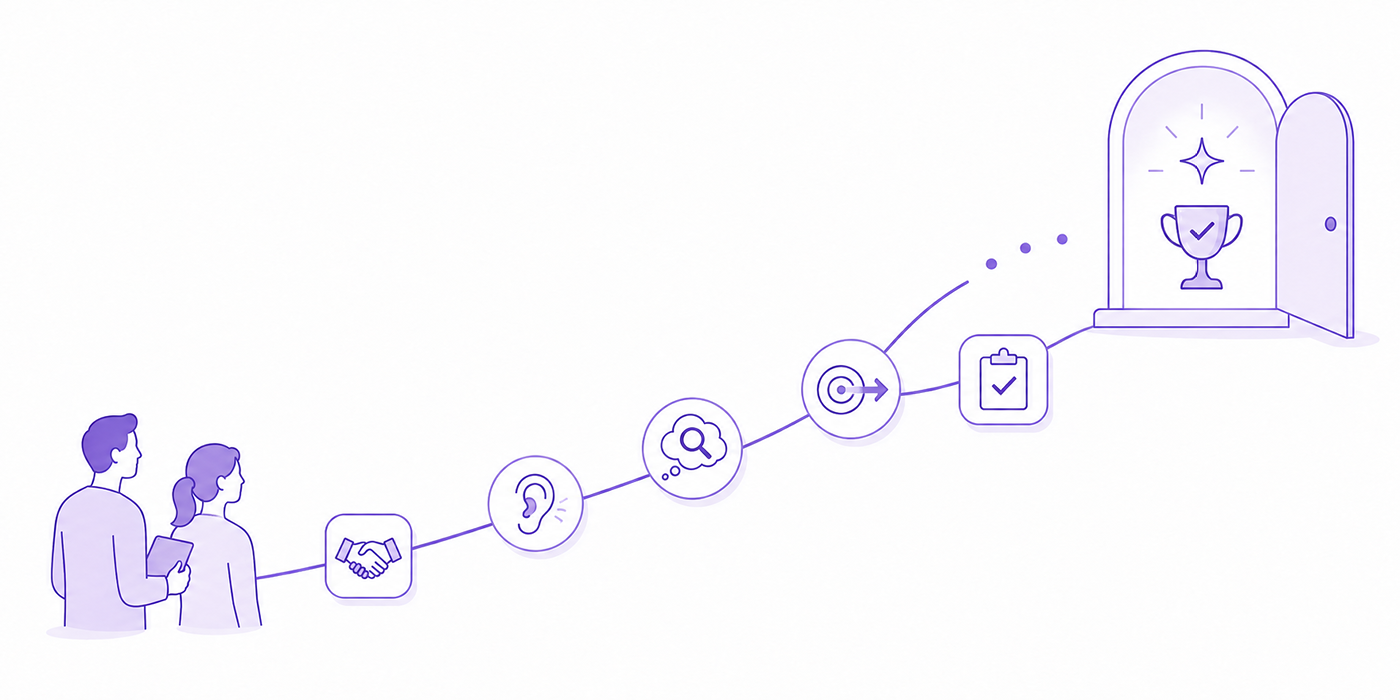
Coaching sessions lose value when clients speak in circles, coaches chase every emerging issue, and action plans appear before the real barrier has been understood. The CLEAR Coaching Model prevents that drift through five connected stages: Contracting, Listening, Exploring, Action, and Review. Developed by Peter Hawkins during the 1980s, the framework gives equal attention to the coaching relationship, the client’s thinking, and the movement from insight into action.
Its simplicity helps coaches combine psychological safety, emotional intelligence, behavior-change science, and accountability coaching inside one repeatable conversation.
1. Why the CLEAR Coaching Model Creates Faster Client Clarity
Many coaching conversations appear productive because the client talks extensively and leaves with several ideas. The weakness becomes visible a week later. The client cannot explain which insight mattered, which action deserved priority, or how success will be measured.
CLEAR gives each part of the conversation a defined purpose:
Contracting establishes the outcome, boundaries, expectations, and working agreement.
Listening allows the client’s complete experience to emerge.
Exploring investigates assumptions, emotions, patterns, choices, and wider consequences.
Action converts insight into a specific commitment.
Review captures learning, evaluates the session, and strengthens future execution.
The sequence supports the kind of deeper shifts associated with transformational coaching. Hawkins’ framework has also been presented as a way to examine facts, behaviors, feelings, and assumptions across the coaching process.
CLEAR gives structure without turning coaching into a script
Rigid scripts can make a coach sound mechanical. Unstructured conversations can become emotionally interesting while producing little usable movement. CLEAR creates a route through the session while preserving the freedom to ask questions that match the client’s language, context, and readiness.
A coach may spend five minutes contracting with a decisive client and fifteen minutes with someone who has several competing priorities. Listening may reveal that the original goal conceals a deeper concern. Exploration may send the conversation back toward the contract because the client now sees the situation differently.
That flexibility makes CLEAR useful alongside strengths-based coaching, positive psychology coaching, emotional agility, and holistic coaching.
The first stage prevents the most expensive coaching mistake
A weak contract allows the coach and client to pursue different outcomes.
The client may want to decide whether to leave a job. The coach may assume the session is about building confidence. The client may want space to think. The coach may rush toward a practical plan. The client may need to understand a recurring pattern. The coach may focus narrowly on solving today’s incident.
Contracting prevents these mismatches through questions such as:
What would make this conversation useful?
Which outcome deserves our attention today?
How will you know the session has helped?
What kind of support would serve you best?
Which topics sit outside today’s focus?
How directly would you like me to challenge your thinking?
Clear agreements strengthen client expectation management, improve exceptional client experiences, reduce difficult client situations, and support stronger client retention.
Listening reveals the problem beneath the client’s explanation
Clients often begin with a polished account of their difficulty. They may say they need better time management, stronger motivation, improved confidence, or clearer goals. Deep listening helps the coach hear contradictions, emotional shifts, repeated phrases, missing stakeholders, sudden changes in energy, and assumptions presented as facts.
A client complaining about time may struggle with boundaries. A client asking for confidence may lack adequate preparation. A client seeking motivation may feel disconnected from the goal. A client requesting accountability may already know that the chosen action conflicts with their values.
The Listening stage works especially well with anxiety-aware coaching, emotional crisis support, life-purpose coaching, and life visioning.
Exploration turns surface problems into transformable patterns
Exploration examines how the situation works.
The coach may investigate:
What triggers the behavior?
What meaning does the client assign to the event?
Which emotion follows?
What action or avoidance comes next?
Which short-term benefit keeps the pattern alive?
What long-term cost does the client pay?
Who else influences the situation?
Which assumption has never been tested?
What strength remains unused?
What changes when the client considers another perspective?
This creates the depth required for health behavior change, habit formation, resilience coaching, and self-actualization coaching.
Action and Review protect the transformation
Insight becomes commercially and personally valuable when the client behaves differently. Action defines that behavior. Review helps the client understand why the action worked, where resistance appeared, and which lesson should influence the next decision.
The review stage also gives the coach feedback about the relationship, pace, questioning, challenge level, and session design. The Association for Coaching’s supervision material describes CLEAR as moving through shared contracting, generative dialogue, action, and reflection on the value created for relevant stakeholders.
That final step strengthens constructive feedback, improves coaching case studies, supports client transformation evidence, and feeds coaching business growth.
| Client Situation | Priority CLEAR Stage | High-Value Coaching Question | Useful Session Output | Supporting ANHCO Resource |
|---|---|---|---|---|
| The client brings five competing goals | Contracting | Which outcome would make the greatest difference during the next seven days? | One agreed session priority | Manage client expectations |
| The client expects the coach to provide answers | Contracting | Which decisions remain yours to make, and what support would help you make them? | Clear responsibility boundaries | Build a safe coaching relationship |
| The coaching sponsor has different expectations | Contracting | What information can be shared, with whom, and for which purpose? | Explicit confidentiality agreement | Protect coaching boundaries |
| The client speaks without reaching a focus | Contracting | Which part of this situation requires a decision today? | Defined coaching outcome | Prioritize life domains |
| The client appears disengaged | Contracting | What would make this process feel relevant enough to deserve your effort? | Personally meaningful goal | Connect goals with purpose |
| The client repeats a familiar explanation | Listening | Which part of this story feels hardest to say aloud? | Deeper emotional information | Develop emotional agility |
| The client minimizes a serious concern | Listening | What did you notice in yourself as you described that event? | Greater emotional awareness | Recognize emotional distress |
| The client uses harsh self-criticism | Listening | Whose standard are you using to judge yourself? | Source of internal pressure | Apply positive psychology |
| The client describes constant stress | Listening | When does the stress rise, fall, or temporarily disappear? | Stress-pattern map | Understand client anxiety |
| The client gives intellectually polished answers | Listening | What are you feeling as you explain this so logically? | Connection between thought and emotion | Strengthen emotional intelligence |
| The same problem keeps returning | Exploring | What benefit do you receive from keeping the current pattern? | Hidden payoff identified | Map behavior change |
| The client blames external circumstances entirely | Exploring | Which part of this situation remains within your influence? | Realistic sphere of control | Build client resilience |
| The client cannot choose between two options | Exploring | Which value does each option protect, and which value does each compromise? | Values-based decision criteria | Use holistic decision-making |
| The client assumes failure is inevitable | Exploring | What evidence would cause you to revise that prediction? | Testable assumption | Create productive mindset shifts |
| The client avoids a difficult conversation | Exploring | What are you protecting through avoidance, and what is avoidance costing you? | Clear avoidance trade-off | Prepare difficult conversations |
| The client feels trapped in one perspective | Exploring | How might the other person describe the same situation? | Expanded relational perspective | Improve relationship awareness |
| The client overlooks existing capabilities | Exploring | When have you handled a comparable challenge effectively? | Transferable strength identified | Activate client strengths |
| The client has experienced repeated setbacks | Exploring | Which part of your approach has remained unchanged across every attempt? | Recurring strategy flaw | Turn feedback into growth |
| The client has insight without movement | Action | What will you do differently within the next 48 hours? | Immediate behavioral commitment | Create meaningful accountability |
| The proposed action feels overwhelming | Action | What is the smallest step that would still create useful evidence? | Minimum viable action | Use micro-coaching |
| The client relies on motivation | Action | Which existing routine can trigger this behavior automatically? | Habit-linked action cue | Apply habit stacking |
| The action lacks a deadline | Action | On which day, at what time, and in which setting will this happen? | Scheduled implementation | Strengthen habit execution |
| The client anticipates obstacles | Action | What will you do when the most likely obstacle appears? | Preplanned coping response | Create lasting behavioral change |
| The client has several possible actions | Action | Which action offers the highest learning value with acceptable risk? | One prioritized experiment | Improve follow-through |
| The client completed the action successfully | Review | Which behavior, decision, or condition contributed most to the result? | Repeatable success factor | Document client transformation |
| The client failed to complete the action | Review | At which exact point did the plan break down? | Specific execution bottleneck | Maintain productive motivation |
| The client reports mixed results | Review | What should be repeated, revised, removed, or tested again? | Improved second experiment | Refine behavior experiments |
| The session felt emotionally intense | Review | What support or recovery do you need after today’s work? | Post-session care plan | Integrate client self-care |
| The coach challenged the client strongly | Review | How did the level of challenge affect your thinking and engagement? | Feedback on coaching approach | Use constructive feedback |
| The engagement is reaching completion | Review | Which capabilities can you now use independently? | Evidence of coaching autonomy | Capture credible results |
2. How to Use the Five CLEAR Stages During a Real Coaching Session
CLEAR becomes useful when each stage has a visible outcome. Coaches who merely memorize the acronym may still rush the contract, interrupt the client, explore too broadly, assign vague actions, and skip the review.
C: Contracting
Contracting occurs at two levels.
Engagement-level contracting covers confidentiality, session frequency, roles, payment, cancellations, communication between sessions, sponsor involvement, data handling, and scope. Strong agreements reduce misunderstandings and support legal coaching requirements, coaching business setup, reliable payment systems, and stronger client retention.
Session-level contracting defines what today’s conversation must achieve. A useful contract contains:
One priority
One desired outcome
A reason the outcome matters
The type of support requested
A way to recognize progress
A coach might ask, “You have mentioned your manager, workload, confidence, and future career. Which area would create the greatest value if we clarified it today?”
That question prevents a 60-minute session from becoming four incomplete conversations.
L: Listening
Listening requires more than silence. The coach listens for content, emotion, contradiction, pace, emphasis, avoidance, body language, assumptions, and systemic influences.
Useful listening responses include:
“You became quieter when you mentioned the promotion.”
“You have used the word ‘trapped’ three times.”
“You described the project as important, yet your energy dropped when discussing it.”
“I hear two competing commitments.”
“You explained everyone else’s position. I have heard very little about what you want.”
These observations must be offered tentatively. The client retains authority over their meaning.
Deep listening supports safe coaching environments, emotional-intelligence coaching, anxiety-sensitive coaching, and emotional agility.
E: Exploring
Exploring helps the client understand the machinery of the problem.
A strong exploration moves across several levels:
Facts: What happened?
Behavior: What did the client do?
Emotion: What did the client feel?
Meaning: What interpretation did the client create?
Assumption: What did the client treat as unquestionably true?
System: Who, what, and which conditions influenced the situation?
Possibility: What alternatives become available when the assumption changes?
For example, a client may say, “My team ignores deadlines because they lack commitment.” Exploration might reveal unclear ownership, conflicting priorities, delayed feedback, unrealistic timelines, or a leader who rescues the team every time delivery slips.
That discovery can lead into accountability coaching, constructive feedback practices, handling difficult situations, and behavioral transformation.
A: Action
The Action stage should identify a behavior that generates progress or useful evidence.
A strong action answers six questions:
What exactly will the client do?
When will it happen?
Where will it happen?
Who else will be involved?
Which obstacle is most likely?
How will completion be verified?
“Work on my boundaries” creates no dependable execution.
“Before Friday at 3 p.m., I will send the client a revised scope showing the original deliverables, the new request, and the additional fee” gives the client a concrete test.
Actions become more reliable when coaches use habit stacking, behavior-change science, accountability systems, and coaching automation.
R: Review
Review happens at the end of the session and at the beginning of the next one.
An end-of-session review can ask:
What changed in your thinking?
Which insight deserves to be remembered?
What action have you committed to?
What could interfere with it?
Which part of today’s coaching helped most?
Where could the process have served you better?
How confident are you that you will complete the action?
The next session reviews execution:
What happened?
What did you learn?
Where did the plan hold?
Where did it break?
Which assumption changed?
What should happen next?
This creates a continuous learning loop through client feedback, case-study evidence, client expectation management, and lasting behavior change.
3. A 60-Minute CLEAR Coaching Session Coaches Can Use Immediately
The following structure gives coaches a practical starting point. The timing should respond to the client’s needs, emotional state, and session objective.
Minutes 0–8: Contract the session
Ask the client what has happened since the previous session, then choose one outcome for today.
Useful questions include:
What deserves attention most urgently?
What would you like to leave understanding?
Which decision or action should become easier?
How would you like me to support or challenge you?
What would make today’s session worth the time?
Capture the contract in one sentence. For example:
“Today we will identify why you keep delaying the conversation with your manager and leave with a realistic way to begin it.”
This focus complements life-balance coaching, life visioning, strengths-based coaching, and client expectation management.
Minutes 8–22: Listen for the complete experience
Invite the client to explain what is happening without immediately solving it.
Listen for:
Repeated words
Missing information
Emotional shifts
Assumptions
Conflicting goals
Unspoken fears
Relevant relationships
Physical responses
Previous attempts
Exceptions to the pattern
Summarize carefully: “You want greater responsibility, and you fear that asking for it will expose gaps in your experience. That fear keeps you quiet, which then prevents you from gaining the experience you need.”
This type of summary helps the client hear the pattern as a connected system. It draws on emotional intelligence, resilience coaching, positive psychology, and anxiety coaching strategies.
Minutes 22–43: Explore the pattern and alternatives
Choose questions based on the client’s situation:
When did this pattern begin?
What keeps it useful?
Which cost has become unacceptable?
What are you assuming about the other person?
Which evidence supports that assumption?
Which evidence challenges it?
What would you advise someone you respected?
Which value are you trying to protect?
What choice becomes possible when fear is allowed to remain present?
What outcome sits between your best-case and worst-case predictions?
The coach should resist the urge to ask every impressive question available. A single question deserves space when it changes the client’s perspective.
Effective exploration can integrate transformational coaching, mindset coaching, self-actualization coaching, and holistic coaching.
Minutes 43–54: Design and rehearse action
Ask the client to choose the next action. Test its clarity and difficulty.
A valuable action should be:
Specific
Within the client’s influence
Connected to the insight
Small enough to complete
Significant enough to create learning
Scheduled
Measurable
Rehearsal can increase readiness. The client might practice the opening sentence of a difficult conversation, role-play an objection, draft a boundary message, simulate a sales call, or visualize the first five minutes of a new routine.
These methods connect with micro-coaching, habit formation, accountability coaching, and constructive feedback.
Minutes 54–60: Review the learning and process
Ask the client to summarize the session in their own words. This reveals whether the coach’s interpretation matches the client’s learning.
End with:
The key realization
The selected action
The completion date
The anticipated obstacle
The response to that obstacle
The accountability method
Feedback about the session
A review produces the raw material for client transformation stories, credible coaching case studies, stronger client experiences, and higher client retention.
4. The Coaching Mistakes That Weaken the CLEAR Model
CLEAR is simple enough to remember during a live session. Its quality still depends on the coach’s judgment, emotional presence, questioning, boundaries, and willingness to let the client own the work.
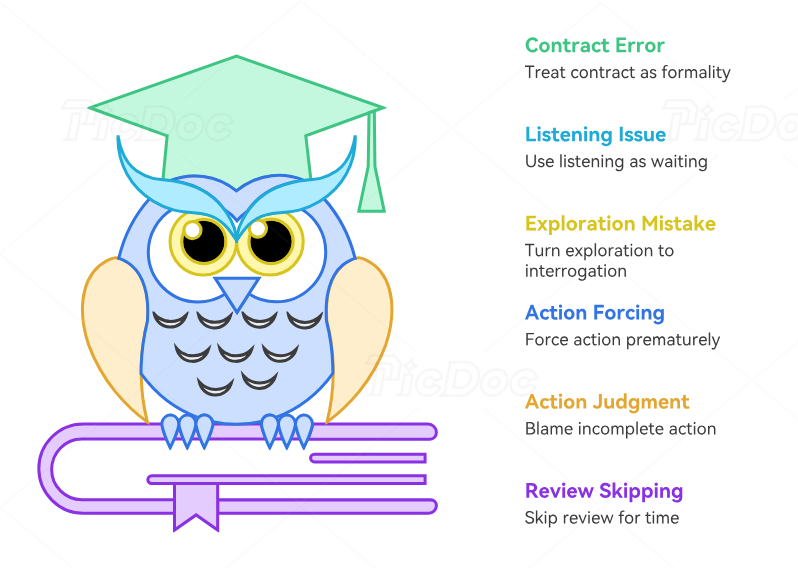
Mistake 1: Treating the contract as an administrative formality
A signed agreement covers the business relationship. It cannot replace a session-level contract.
When coaches skip this stage, clients may speak for 40 minutes and then ask, “So what should I do?” The coach may discover that the issue discussed was never the issue the client wanted resolved.
A strong contract protects time, reduces confusion, improves client motivation, supports professional coaching boundaries, strengthens client experiences, and prevents avoidable client conflict.
Mistake 2: Using listening as a waiting period
Some coaches appear attentive while mentally preparing the next question. Clients often detect this through premature interruptions, irrelevant questions, and summaries that miss the emotional core.
Active listening requires the coach to suspend diagnosis long enough for the client’s experience to become clearer. Reflecting a contradiction can produce more movement than asking five new questions.
This skill grows through emotional-intelligence coaching, safe coaching practices, constructive feedback, and ongoing coaching certification development.
Mistake 3: Turning exploration into interrogation
Rapid questioning can make the client feel examined. Valuable exploration has rhythm. The coach asks, listens, reflects, pauses, and follows the client’s emerging awareness.
Questions should earn their place. Coaches can ask:
What became clearer as you said that?
Which part of your answer surprised you?
What are you noticing now?
Where should we stay a little longer?
Which question are you avoiding?
This approach supports emotional agility, positive psychology coaching, holistic client work, and transformational change.
Mistake 4: Forcing action before the client reaches ownership
Coaches may feel pressure to prove value through a large action plan. Premature action frequently produces polite agreement and weak completion.
The coach should check:
Does the client believe the action is useful?
Did the client choose it?
Is the action emotionally realistic?
Does it address the actual constraint?
Can it be completed under current conditions?
Will it create evidence or movement?
One carefully chosen experiment often creates more value than a list of ten tasks. This principle aligns with micro-coaching, habit stacking, accountability coaching, and behavior-change coaching.
Mistake 5: Treating incomplete action as a character flaw
An incomplete action provides diagnostic information.
The task may have been too large. The cue may have been weak. The client may have faced a genuine barrier. The action may have conflicted with a value. The client may have agreed to please the coach. The anticipated reward may have felt too distant.
Review the precise failure point and redesign the action. This keeps accountability compatible with client resilience, self-care coaching, anxiety support, and constructive feedback.
Mistake 6: Skipping review when time runs short
Review is usually the first stage coaches sacrifice. Its absence weakens memory, learning, accountability, client feedback, and continuity between sessions.
Protect five to eight minutes for review. When exploration needs more time, acknowledge the trade-off and recontract. A disciplined ending improves client retention, strengthens coaching case studies, supports successful transformation evidence, and reveals opportunities for coaching business improvement.
5. How Coaches Can Package CLEAR Into a High-Value Service
CLEAR can become the operating system behind life coaching, leadership coaching, career coaching, health coaching, relationship coaching, and business coaching. Clients need a result-focused offer. The framework should guide delivery behind the scenes.
Build the offer around a defined transformation
A broad offer such as “CLEAR coaching sessions” describes the method. A stronger offer describes the client’s journey.
Examples include:
A six-week decision-clarity program for professionals facing a career transition
An eight-week leadership communication program for first-time managers
A 12-week accountability program for founders with inconsistent execution
A burnout-recovery program for professionals rebuilding sustainable performance
A behavior-change program for health clients struggling with follow-through
A relationship-pattern program for clients repeating unproductive conflict cycles
These programs can combine CLEAR with career-burnout coaching, life-purpose coaching, health behavior change, and emotional-intelligence coaching.
Create a CLEAR-based client journey
A structured program might include:
Session 1: Contracting the transformation
Clarify the client’s desired outcome, current reality, boundaries, success measures, and responsibilities.
Sessions 2–3: Listening for the complete system
Understand the client’s history, environment, strengths, relationships, emotional patterns, and previous attempts.
Sessions 4–6: Exploring leverage points
Identify beliefs, habits, assumptions, avoidance loops, conflicting values, and systemic constraints.
Sessions 7–9: Action experiments
Test new behaviors, conversations, routines, boundaries, and decisions.
Sessions 10–12: Review and independence
Consolidate learning, document evidence, strengthen relapse plans, and transfer responsibility fully to the client.
This journey supports transformational coaching, habit formation, client accountability, and self-actualization coaching.
Measure progress across all five stages
A CLEAR scorecard can track:
Contract clarity: Can the client state the current goal and success measure?
Self-awareness: Can the client identify emotions, triggers, assumptions, and needs?
Exploration depth: Can the client see multiple perspectives and recognize patterns?
Action quality: Are commitments specific, scheduled, realistic, and completed?
Review quality: Can the client extract learning and adjust future behavior?
Rate each category from 1 to 5 every four weeks. The score creates a coaching conversation about capability development. It should never be presented as a clinical or scientific assessment.
The evidence can support coaching certification portfolios, credible case-study creation, client feedback systems, and exceptional client experiences.
Scale CLEAR without weakening the relationship
Coaches can use CLEAR in:
One-to-one sessions
Group coaching
Team coaching
Leadership development
Peer-coaching programs
Manager-as-coach training
Short micro-coaching sessions
Coaching supervision
Digital reflection exercises
Automated check-ins
A digital form can collect the Contract before a session. Voice notes can support Listening between sessions. Worksheets can guide Exploration. Calendar triggers can support Action. Automated surveys can strengthen Review.
Technology should reduce administration and preserve the human relationship. Coaches can build this through coaching automation, technology-enabled coaching, must-have coaching tools, and profitable practice scaling.
Keep ethical scope visible throughout the model
Contracting should clarify scope. Listening should identify risk. Exploring should stay within competence. Action should remain safe and client-owned. Review should examine impact and determine whether referral is needed.
Coaches should refer appropriately when clients require diagnosis, psychotherapy, medical treatment, legal representation, regulated financial advice, or crisis intervention.
Ethical delivery depends on legal coaching requirements, safe coaching environments, emotional crisis protocols, and continuing CPD certification maintenance.
6. FAQs About the CLEAR Coaching Model
-
CLEAR stands for Contracting, Listening, Exploring, Action, and Review. Contracting establishes the purpose and working agreement. Listening helps the coach understand the client’s experience. Exploring examines assumptions, emotions, behaviors, and choices. Action creates a practical commitment. Review captures learning and evaluates progress. The model was developed by Peter Hawkins and places meaningful emphasis on the coaching relationship alongside the client’s goal.
Coaches can strengthen each stage through safe coaching practices, emotional agility, behavior-change methods, and accountability coaching.
-
CLEAR gives the conversation a complete learning cycle. The client defines the work, feels heard, examines the underlying pattern, chooses an action, and reviews the result. This prevents sessions from becoming advice-heavy, unfocused, or disconnected from execution.
Its value increases when coaches integrate transformational coaching, strengths-based coaching, constructive feedback, and habit formation.
-
CLEAR begins with explicit attention to the coaching relationship, expectations, boundaries, and purpose. Its Listening and Exploring stages encourage the coach to understand the client’s complete experience before designing action. Review examines the learning and the coaching process.
GROW commonly organizes conversations around Goal, Reality, Options, and Will or Way Forward. Both frameworks can support effective coaching. CLEAR may feel especially useful when relational dynamics, assumptions, emotions, or systemic pressures require careful attention.
Coaches can combine either framework with emotional-intelligence coaching, holistic coaching, accountability systems, and client expectation management.
-
CLEAR can guide a 15-minute micro-coaching conversation:
Two minutes for Contracting
Four minutes for Listening
Four minutes for Exploring
Three minutes for Action
Two minutes for Review
The scope must remain narrow. One immediate decision, behavior, or obstacle works better than a large life issue. Short sessions become more effective through micro-coaching, habit stacking, coaching automation, and behavior-change coaching.
-
CLEAR can support executive coaching, leadership coaching, career coaching, health coaching, life coaching, relationship coaching, business coaching, resilience coaching, and team coaching. The coach adapts the questions, metrics, and exercises to the client’s context while preserving the five-stage process.
It integrates naturally with career-burnout coaching, life-purpose coaching, resilience coaching, and positive psychology coaching.
