
Immunity to Change (ITC) Model: The Coaching Approach Clients Desperately Need
Clients often understand exactly what they should change and still repeat the behavior blocking their progress. The Immunity to Change Model helps coaches uncover the hidden commitments protecting that pattern. Developed by Robert Kegan and Lisa Lahey, the framework identifies competing commitments and “big assumptions” that keep sincere goals from becoming consistent action.
Through behavior-change coaching, emotional agility, psychological safety, and carefully designed experiments, ITC turns resistance into valuable information.
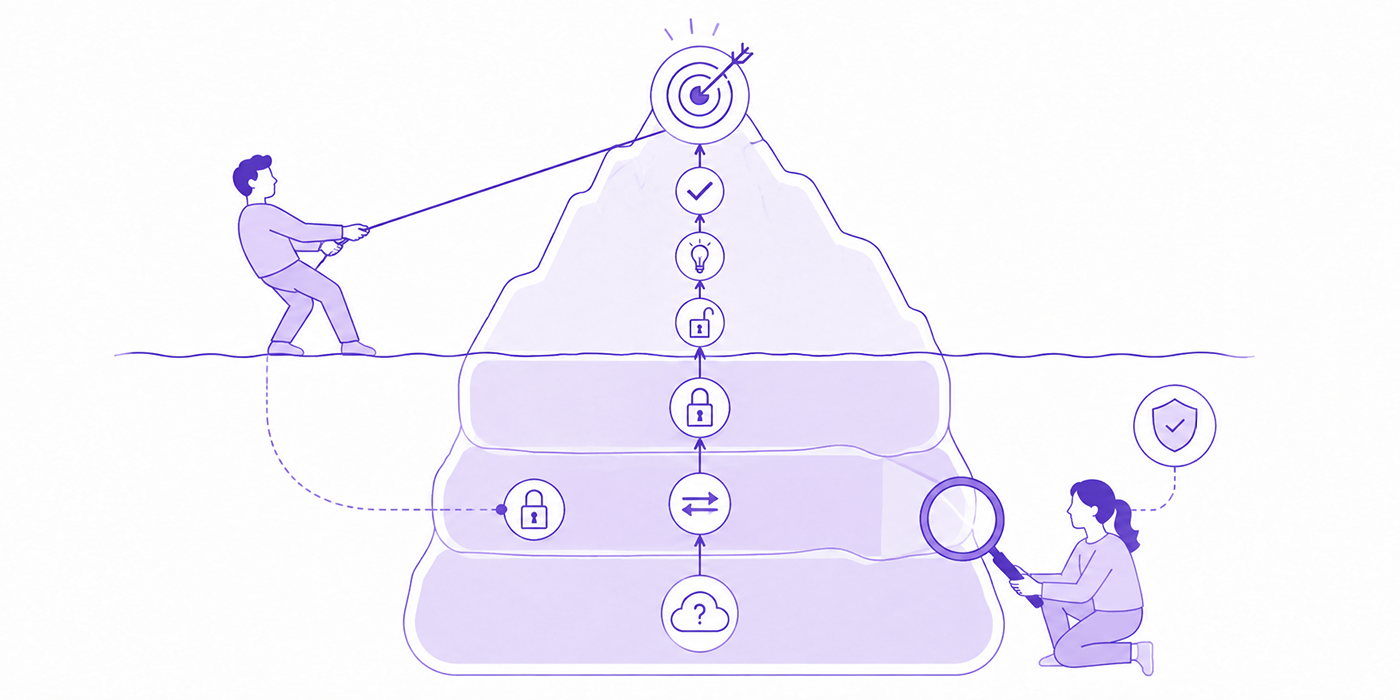
1. Why Clients Can Want Change and Still Protect the Status Quo
Most clients enter coaching with an improvement goal they genuinely care about. They want to delegate, set boundaries, exercise consistently, speak confidently, charge appropriately, manage stress, or become more decisive. They may understand the consequences of remaining stuck. They may have completed courses, downloaded trackers, created action plans, and promised themselves that the next attempt will be different.
The behavior often returns because it performs a protective function.
A manager avoids delegation because personally controlling the work protects them from being blamed for a team member’s mistake. A business owner undercharges because a lower price reduces the chance of rejection. A burned-out professional stays constantly available because responsiveness protects their identity as dependable. A health client abandons a routine because inconsistent effort protects them from discovering what happens after complete commitment.
Traditional goal setting may identify the required action while leaving that protection system intact. ITC gives coaches a way to examine the invisible agreement the client is already honoring. The framework aligns especially well with transformational coaching, health behavior change, habit formation, and accountability coaching.
Resistance often reflects successful self-protection
Consider a leader who says, “I need to stop micromanaging.”
The visible contradiction seems simple. The leader wants to delegate and continues checking every detail. A conventional intervention might involve task-allocation templates, project-management software, or weekly delegation targets. Those tools can help once the internal conflict becomes visible.
Deeper exploration may reveal a competing commitment:
“I am committed to avoiding any situation where another person’s mistake makes me appear incompetent.”
That commitment explains the micromanagement. The leader’s current behavior protects professional credibility as they understand it. Every request for delegation activates a perceived threat to reputation, control, or safety.
The coach can then explore the assumption organizing that protection:
“If I allow someone to complete important work independently and they make a mistake, senior leadership will decide that I cannot manage effectively.”
This assumption may contain truth, exaggeration, outdated experience, or an untested prediction. The coach does not immediately argue against it. The client designs a limited experiment that produces better evidence.
That process can draw on strengths-based coaching, constructive feedback, resilience coaching, and emotional-intelligence coaching.
The client may be serving two goals simultaneously
An ITC map reveals two commitments operating at once:
The stated improvement commitment
The hidden commitment protecting the client from a feared outcome
A client may want greater visibility while remaining committed to avoiding public criticism. Another may want healthier relationships while remaining committed to avoiding emotional vulnerability. A coach may want to grow their practice while remaining committed to never appearing commercially motivated. A professional may want a promotion while remaining committed to avoiding any assignment where performance could be judged publicly.
The second commitment often receives more behavioral support because the perceived threat feels immediate. The desired improvement offers future benefits. The protective commitment promises immediate safety.
Coaches can explore this tension through positive psychology coaching, life-purpose coaching, life visioning, and holistic coaching.
Why stronger motivation often fails
Motivation can increase pressure without changing the underlying assumption.
A client who believes disagreement leads to rejection may prepare harder for a boundary conversation and still cancel it. A professional who believes asking for help reveals incompetence may buy another productivity system and continue working alone. A founder who believes slowing down will cause collapse may add recovery activities to an already overloaded schedule.
The internal system interprets these changes as threats and restores the familiar pattern. This explains why clients often experience a burst of effort followed by retreat, guilt, and harsher self-judgment.
A valuable coach replaces shame with curiosity:
What danger does this behavior help you avoid?
Which identity does it protect?
What feels at risk when you imagine changing?
What outcome becomes possible when you stay exactly as you are?
Which feared consequence has remained untested?
When did this protection first become useful?
Does your current environment still require the same response?
These questions strengthen safe coaching conversations, support clients facing anxiety and stress, reduce harmful pressure during emotional crises, and improve client expectation management.
| Client Improvement Goal | Behavior Working Against It | Possible Competing Commitment | Possible Big Assumption | Low-Risk Test | ANHCO Resource |
|---|---|---|---|---|---|
| Delegate more effectively | Rechecks, rewrites and takes tasks back | Avoid appearing responsible for another person’s error | If someone I supervise fails, leaders will question my competence | Delegate one reversible task with agreed checkpoints | Build accountable delegation |
| Set healthier work boundaries | Answers messages late at night and accepts every request | Remain known as endlessly dependable | If I become less available, people will stop valuing me | Delay one nonurgent reply until the next work period | Address career burnout |
| Charge higher fees | Discounts before clients object | Avoid rejection and negative judgment | If I state my real price, people will see me as greedy | Quote the full price to three qualified prospects | Create premium offers |
| Speak with greater confidence | Stays silent, overprepares or reads every word | Avoid visible imperfection | If I make one mistake publicly, people will dismiss my expertise | Make one prepared contribution early in a low-risk meeting | Strengthen client confidence |
| Give direct feedback | Uses vague language and postpones conversations | Avoid conflict or being disliked | If I am direct, the relationship will become hostile | Deliver one specific observation and invite a response | Improve constructive feedback |
| Build a consistent health routine | Starts intensely and abandons the plan | Avoid complete commitment and possible disappointment | If I fully commit and struggle, it proves I cannot change | Complete a ten-minute minimum routine for seven days | Use habit stacking |
| Ask for a promotion | Waits to be recognized automatically | Avoid appearing entitled or being explicitly rejected | If I ask and hear no, my future prospects will be damaged | Ask a manager which evidence supports advancement | Document professional strengths |
| Become more decisive | Collects excessive information and delays choices | Avoid responsibility for an imperfect outcome | A capable person should always identify the correct decision | Make one reversible decision with 70% of the information | Develop decision resilience |
| Grow professional visibility | Avoids posting, networking and speaking opportunities | Remain protected from criticism | Visibility will attract attacks I cannot manage | Share one useful idea with a trusted professional group | Increase professional influence |
| Improve time management | Accepts every request and constantly changes priorities | Avoid disappointing other people | Saying no will make me appear selfish or uncooperative | Decline or renegotiate one low-priority request | Protect life balance |
| Build a coaching niche | Keeps services broad and messaging generic | Avoid excluding any potential client | Specializing will reduce my opportunities and income | Test one niche-specific message for two weeks | Study niche positioning |
| Follow up with prospects | Sends one message and waits indefinitely | Avoid appearing pushy | Professional buyers will resent any follow-up | Send one useful, low-pressure follow-up after two days | Systemize follow-up |
| Improve financial awareness | Avoids statements, reports and cash-flow reviews | Avoid feeling shame or helplessness | Looking at the numbers will confirm that I have failed | Review one account for 15 minutes with neutral labels | Build financial visibility |
| Request help sooner | Struggles privately until deadlines become urgent | Preserve an identity of self-sufficiency | Needing help proves I am unqualified | Ask one informed person for a limited form of support | Strengthen relational intelligence |
| Recover from burnout | Schedules recovery and fills the time with more work | Avoid losing status, momentum or control | If I slow down, everything I built will deteriorate | Protect one two-hour recovery period and observe the impact | Create sustainable self-care |
| Become a better listener | Interrupts, advises and redirects conversations | Avoid feeling unnecessary or uninformed | If I do not provide immediate answers, I offer no value | Ask three questions before offering any interpretation | Deepen psychological safety |
| Reduce perfectionism | Delays work, overedits and misses opportunities | Avoid exposing work that can be criticized | Any visible flaw will damage my credibility permanently | Submit one low-risk deliverable at an agreed quality threshold | Build emotional flexibility |
| Improve client retention | Avoids progress reviews and difficult feedback | Avoid hearing dissatisfaction | If I ask directly, clients will uncover reasons to leave | Conduct one structured client-value review | Strengthen client retention |
| Automate the coaching business | Manually controls every administrative task | Remain essential to every process | If the business can operate without me, my value will decrease | Automate one reversible reminder or intake process | Automate coaching operations |
| Build collaborative partnerships | Avoids outreach and protects ideas excessively | Avoid dependence or exploitation | Partners will take credit, clients or control from me | Explore one limited collaboration with written boundaries | Develop joint ventures |
| Handle disagreement calmly | Withdraws, becomes defensive or overexplains | Prevent rejection and loss of belonging | Disagreement means the relationship is becoming unsafe | State one different view while affirming the shared objective | Navigate difficult conversations |
| Develop stronger relationships | Conceals needs and expects others to infer them | Avoid vulnerability and possible disappointment | Expressing a need gives another person power over me | Communicate one modest, specific request | Improve relationship skills |
| Maintain accountability | Agrees to ambitious actions and reports little progress | Avoid revealing limited capacity or uncertainty | Reducing the goal will prove I lack discipline | Choose one smaller action the client can complete reliably | Redesign accountability |
| Change an unhealthy habit | Returns to the behavior during stress | Preserve a dependable form of relief | Without this habit, I will have no way to regulate myself | Test one alternative response during a mild trigger | Understand habit mechanics |
| Develop a clear life direction | Keeps researching possibilities without choosing | Avoid closing doors and grieving alternatives | Choosing one path means permanently losing every other future | Run a two-week experiment in one direction | Create a life vision |
| Change careers | Collects credentials without testing the new field | Preserve financial security and professional identity | Beginning again will erase the value of my past experience | Conduct three conversations with people in the target role | Clarify meaningful work |
| Lead through uncertainty | Withholds communication until every answer is available | Avoid appearing uncertain | Leaders lose credibility when they admit what they do not know | Share one update separating facts, decisions and unknowns | Coach through uncertainty |
| Stop rescuing team members | Takes over whenever someone struggles | Avoid being seen as unsupportive | Allowing struggle means I have failed as a leader | Ask the employee to propose two solutions before assisting | Develop capability through feedback |
| Use client feedback constructively | Defends decisions or avoids reviewing comments | Protect professional self-worth | Negative feedback proves the entire service lacks value | Classify feedback into useful data, preference and mismatch | Convert feedback into growth |
| Scale a coaching practice | Customizes every task and refuses standardization | Preserve quality and personal connection | Systems will make the service impersonal and ineffective | Standardize one administrative step while retaining human review | Scale coaching profitably |
2. How the Four-Column Immunity to Change Map Works
The core ITC process organizes the client’s change system into four columns: the improvement commitment, behaviors working against that commitment, hidden competing commitments, and the big assumptions supporting those commitments. The client can then test the assumptions through carefully designed experiments.
The value comes from precision. A vague map creates generic insights. A well-built map captures the exact conflict that makes the client’s behavior understandable.
Column 1: Define a genuinely important improvement goal
The first column states the change the client wants to make. A strong goal should be:
Personally meaningful
Within the client’s influence
Connected to a real cost or opportunity
Behavioral enough to observe
Important enough to activate resistance
Supported by credible feedback or evidence
Weak goals include “be better,” “feel confident,” “become successful,” or “fix my life.” These statements offer too little direction.
Stronger goals include:
Communicate disagreement directly and respectfully
Delegate meaningful work without taking it back
Protect two recovery periods each week
Ask for support before a project reaches crisis
Present my expertise without excessive self-disqualification
Review business finances every Monday
Give team members clear performance feedback
The coach can sharpen the goal through life-balance coaching, life-purpose exploration, strengths-based coaching, and client expectation management.
A useful quality test asks:
“Would people who know the client’s situation agree that progress on this goal would make a meaningful difference?”
Column 2: Identify the behaviors preventing improvement
The second column captures what the client does and fails to do that works against the goal.
A client seeking better boundaries may:
Reply immediately to nonurgent requests
Accept work without reviewing capacity
Avoid discussing scope
Apologize when declining
Complete tasks that belong to other people
Cancel personal commitments when work expands
The coach should insist on observable behaviors. “I sabotage myself” remains too abstract. “I delay sending invoices until the end of the month” provides something that can be examined and measured.
Ask:
What do you repeatedly do that undermines this goal?
Which necessary action do you avoid?
What would a camera record?
What happens immediately before the pattern?
What happens immediately afterward?
Which behavior has survived every previous solution?
This stage connects with behavior-change science, habit formation, micro-coaching, and coaching accountability.
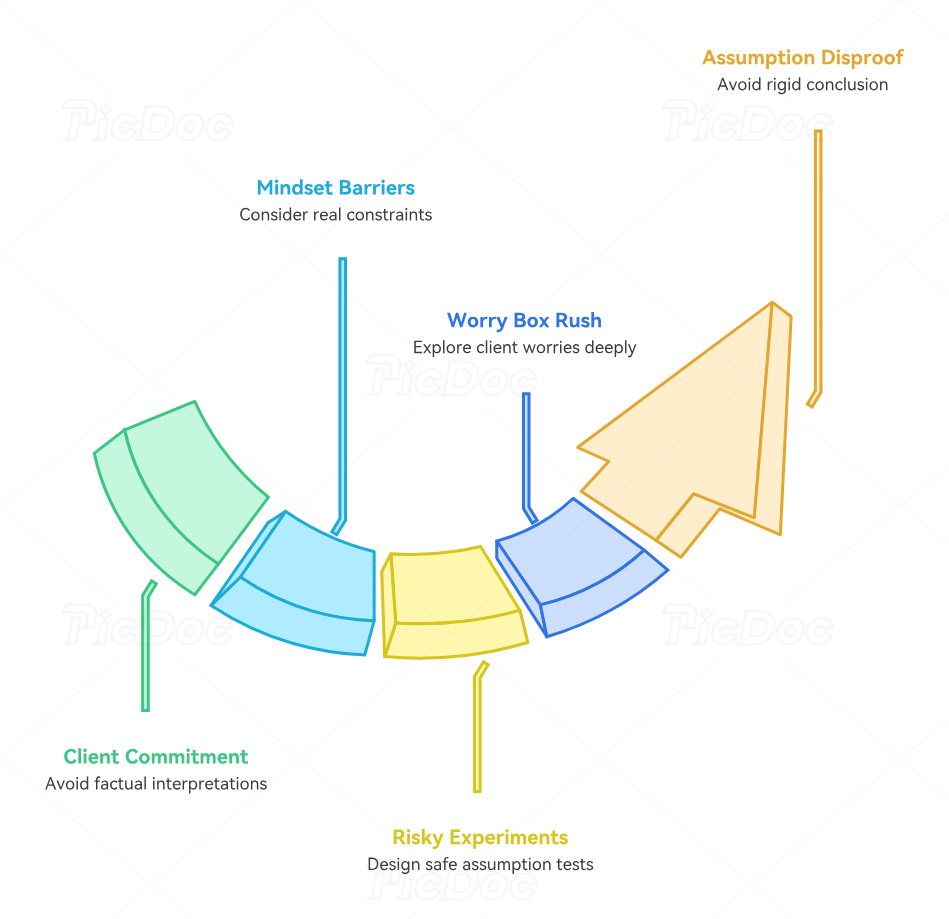
The worry box: Find the feared consequence of change
Before identifying the competing commitment, ask the client to imagine doing the opposite of every Column 2 behavior.
A coach might ask:
“Imagine you stopped responding to work messages after 7 p.m., declined tasks outside your capacity, and protected your personal commitments. What worries, fears, or uncomfortable possibilities appear?”
The client may respond:
People will think I have become difficult.
My manager will choose someone more available.
Colleagues will stop trusting me.
I will feel selfish.
Work will pile up and prove I was never capable.
I will lose control of how people perceive me.
The goal is to uncover the emotional stakes. Coaches should slow down here. The first answer may be socially acceptable, while the deeper fear appears after reflection.
This stage requires psychological safety, sensitivity to client anxiety, skill in emotional agility, and awareness of when emotional-crisis support or referral becomes appropriate.
Column 3: Convert fear into a competing commitment
A fear describes what the client hopes to avoid. A competing commitment identifies what the client is actively committed to protecting.
Fear:
“I worry that people will think I am unreliable.”
Competing commitment:
“I am committed to ensuring that nobody can question my reliability.”
This wording explains why the client continues overworking. They are successfully fulfilling the second commitment.
Other examples include:
I am committed to never appearing uninformed.
I am committed to avoiding situations where I could be rejected.
I am committed to preserving complete control over quality.
I am committed to ensuring that nobody experiences disappointment because of me.
I am committed to avoiding dependence on other people.
I am committed to remaining essential to the organization.
I am committed to protecting myself from public embarrassment.
The coach should use the client’s own language. This preserves emotional accuracy and reduces the risk of imposing an interpretation.
Competing commitments can be explored through transformational coaching, emotional-intelligence coaching, holistic coaching, and positive psychology coaching.
Column 4: Identify the big assumptions
A big assumption describes how the client believes the world works. It links the competing commitment with the behavior.
Common sentence structures include:
If I do X, then Y will happen.
I assume that people who X are always Y.
I assume that my value depends on X.
I assume that revealing X will cause Y.
I assume that losing X would mean Y about me.
Examples:
If I ask for help, competent people will lose respect for me.
If I set boundaries, clients will leave.
If I delegate, quality will collapse.
If I share unfinished thinking, people will discover I am unqualified.
If I rest, I will lose momentum permanently.
If someone disagrees with me, the relationship is damaged.
If I choose one path, every other opportunity disappears forever.
The assumption should feel emotionally consequential. A statement that produces no tension may sit too far from the real protection system.
Big assumptions become especially useful in mindset coaching, resilience development, self-actualization coaching, and career-burnout coaching.
3. How Coaches Turn an ITC Map Into Lasting Behavioral Change
Completing the four columns creates insight. The next phase turns that insight into learning. Coaches help clients collect evidence about their big assumptions through small, ethical, low-risk tests.
Step 1: Check the map for internal logic
Read the map horizontally.
The improvement goal should conflict with the Column 2 behaviors. Those behaviors should protect the Column 3 commitment. The Column 4 assumption should explain why that protection feels necessary.
Example:
Goal: Delegate more meaningful work.
Against-goal behavior: Recheck everything and take tasks back.
Competing commitment: Avoid responsibility for another person’s visible failure.
Big assumption: If someone I supervise makes a mistake, senior leaders will conclude that I lack management ability.
The full map should make the current behavior understandable. When the logic feels weak, return to the worry box and ask what feels genuinely dangerous about changing.
This disciplined review supports constructive coaching feedback, better client expectations, stronger coaching case studies, and more reliable transformation evidence.
Step 2: Examine the assumption’s history and current evidence
Ask the client:
When did this assumption begin to feel true?
Which experiences strengthened it?
Where has it protected you effectively?
Where does it remain accurate?
Where might it be exaggerated?
Which experiences do you dismiss because they conflict with it?
Who behaves differently without experiencing the feared consequence?
What does this assumption cost today?
This stage respects the intelligence of the protective system. Many assumptions formed in environments where they helped the client preserve safety, acceptance, control, or identity.
A former workplace may have punished visible mistakes. A family system may have rewarded compliance. A previous partnership may have exploited vulnerability. Coaching should recognize that history while examining whether the present context permits a broader response.
Such exploration benefits from safe coaching environments, emotional agility, anxiety-sensitive strategies, and careful crisis-support boundaries.
Step 3: Design a safe test of the assumption
An effective experiment should:
Test one specific assumption
Carry manageable risk
Produce observable information
Remain within the client’s control
Avoid proving bravery through excessive exposure
Preserve ethical and professional responsibilities
Include a clear observation plan
Suppose the assumption is:
“If I ask for help, colleagues will lose confidence in me.”
A dangerous experiment would involve requesting support during a critical emergency with no preparation. A useful experiment might involve asking a trusted colleague for input on one limited technical question.
The client can observe:
How the colleague responds
Whether respect appears to change
How quickly the client’s anxiety decreases
Whether the request improves the work
Which parts of the original prediction occur
What alternative explanation becomes available
The experiment generates data. It also builds the client’s capacity to hold uncertainty.
Coaches can support execution through micro-coaching exercises, habit-stacking techniques, accountability systems, and coaching automation.
Step 4: Create an assumption-testing worksheet
Before the experiment, record:
The big assumption being tested
The specific action
The predicted outcome
The predicted probability
The emotional risk level
The observable evidence
The date and setting
The support required
The boundaries protecting safety
The review date
Afterward, record:
What actually happened?
Which part of the prediction occurred?
Which part failed to occur?
What surprised the client?
How did other people respond?
What did the client learn about their own capacity?
How should the assumption be revised?
What would be an appropriate second experiment?
This process works well with behavior-change coaching, habit-formation systems, client accountability, and feedback-led improvement.
Step 5: Replace absolute assumptions with more accurate beliefs
One experiment rarely erases a deeply held assumption. Repeated evidence helps the client develop a more flexible interpretation.
Original assumption:
“If I set a boundary, people will reject me.”
Emerging assumption:
“Some people may dislike a boundary, while respectful relationships can usually tolerate clear limits.”
Original assumption:
“If I delegate, standards will collapse.”
Emerging assumption:
“Delegation requires clear expectations, appropriate support, and room for another person’s method.”
Original assumption:
“If I show uncertainty, I lose credibility.”
Emerging assumption:
“Credibility can increase when I distinguish known facts, informed judgment, and genuine uncertainty.”
These revised assumptions preserve discernment while expanding choice. The client gains more possible responses to the same trigger.
This deeper change supports resilience coaching, emotional-intelligence development, positive psychology coaching, and lasting behavioral transformation.
4. The Coaching Mistakes That Can Make ITC Unsafe or Ineffective
ITC can generate deep insight quickly. That depth requires careful contracting, pacing, consent, confidentiality, and scope management.
Mistake 1: Telling clients what their competing commitment is
The coach may recognize a likely pattern early. Presenting that interpretation as fact can create resistance, shame, or false agreement.
Use tentative language:
Could part of you be committed to avoiding that outcome?
How close does this wording feel?
Which word would make it more accurate?
What does this formulation miss?
Does the commitment feel strong enough to explain the behavior?
The client must recognize the commitment internally. Their ownership matters more than the coach producing a clever interpretation.
This approach supports constructive feedback, safe coaching practice, client expectation management, and ethical coaching relationships.
Mistake 2: Treating every barrier as a mindset problem
Clients face real constraints. Discrimination, unsafe workplaces, inadequate income, caregiving demands, disability, limited healthcare access, abusive relationships, unstable housing, and economic disruption can shape behavior.
A client may accurately predict retaliation after setting a workplace boundary. A business owner may face genuine cash-flow risk. A health client may lack safe access to appropriate support. The coach should examine the environment with the same care used to examine assumptions.
ITC becomes harmful when coaches encourage clients to reinterpret legitimate danger as personal resistance. Context-sensitive coaching can draw on holistic coaching, economic-change strategies, career-burnout coaching, and emotional-crisis awareness.
Mistake 3: Designing experiments that threaten the client
An assumption test should generate information at manageable risk. It should never pressure a client into confrontation, disclosure, financial exposure, medical decisions, or career consequences they have not freely chosen.
Before approving an experiment, ask:
What is the realistic worst-case outcome?
Can the client reverse the action?
Who could be affected?
Does the client have enough support?
Does this enter therapeutic, legal, medical, or financial territory?
Can the same assumption be tested more safely?
Is the client choosing the experiment freely?
Ethical design depends on legal coaching boundaries, safe coaching environments, appropriate client-anxiety support, and maintained CPD competence.
Mistake 4: Moving too quickly through the worry box
Clients may initially offer intellectual answers such as “I worry it will be difficult” or “I might fail.” These answers often require further exploration.
Useful follow-up questions include:
What would failure mean about you?
Who would see you differently?
Which consequence feels hardest to tolerate?
What are you working to ensure never happens?
What would become emotionally exposed?
Which fear feels uncomfortable to admit?
Silence can be productive here. The client may need time to encounter a belief they have organized their life around without naming directly.
Coaches can use emotional agility, positive psychology coaching, emotional-intelligence skills, and resilience coaching to maintain depth without forcing disclosure.
Mistake 5: Concluding that the assumption has been disproved
Big assumptions can contain partial truth. One positive interaction cannot prove that every future boundary will be welcomed. A strong experiment updates the client’s understanding of likelihood, severity, context, and coping ability.
Review the evidence through four categories:
Evidence supporting the assumption
Evidence challenging the assumption
Conditions that influence the outcome
Evidence that the client can handle the feared response
This produces a credible, flexible belief. It also avoids replacing one rigid certainty with another.
The review process strengthens behavior-change coaching, client accountability, feedback-led development, and lasting transformation.
5. How Coaches Can Package and Measure an ITC Program
The Immunity to Change Model works well as a focused intervention within leadership, career, health, life, relationship, and business coaching. Coaches should market the client outcome while using ITC as the methodology guiding the work.
Build an eight-session ITC coaching journey
Session 1: Contract the improvement goal
Clarify the desired change, evidence of importance, current consequences, boundaries, and success indicators.
Session 2: Map against-goal behavior
Identify repeated actions, avoidance patterns, triggers, previous solutions, and environmental influences.
Session 3: Complete the worry box
Explore feared consequences, emotional stakes, identity threats, and protective intentions.
Session 4: Define competing commitments
Convert fears into commitments the client is actively fulfilling.
Session 5: Surface big assumptions
Identify the beliefs linking the client’s protective commitment with current behavior.
Session 6: Design the first experiment
Create a safe test with predictions, boundaries, evidence criteria, and support.
Session 7: Review and refine
Examine what happened, update the assumption, and choose a second experiment.
Session 8: Consolidate the new operating system
Document revised beliefs, reliable behaviors, relapse triggers, support systems, and future experiments.
This journey integrates naturally with transformational coaching, accountability coaching, habit formation, and micro-coaching support.
Measure capabilities alongside goal completion
The final outcome matters, and ITC also develops transferable capabilities. Track:
Goal clarity: Can the client describe the desired behavior precisely?
Pattern recognition: Can the client identify triggers and against-goal behaviors?
Protective awareness: Can the client explain what the pattern protects?
Assumption visibility: Can the client recognize predictions previously treated as facts?
Experiment quality: Can the client design safe ways to test assumptions?
Emotional flexibility: Can the client act while discomfort remains present?
Evidence use: Can the client update beliefs using actual outcomes?
Behavioral consistency: Does the improved behavior continue across situations?
Recovery speed: How quickly does the client respond after returning to the old pattern?
Independent learning: Can the client apply the method without the coach?
Coaches can rate each capability from one to five at the start, midpoint, and conclusion. The scale supports reflection and program evaluation. It should be presented as a coaching measure rather than a clinical assessment.
The results can strengthen coaching case studies, certification portfolios, client transformation evidence, and client feedback systems.
Use ITC with teams and organizations
A team may publicly commit to collaboration while protecting individual authority. Leaders may encourage innovation while punishing failed experiments. An organization may promote open communication while rewarding people who conceal uncertainty.
A team-level map can explore:
The collective improvement goal
Behaviors the group repeatedly performs
Shared worries about changing those behaviors
Collective commitments protecting the current culture
Assumptions about status, trust, power, failure, and accountability
Small organizational experiments that generate evidence
The coach should establish confidentiality, sponsor expectations, information-sharing boundaries, and psychological safety before beginning. Team members may face different levels of power and risk.
This work can connect with exceptional client experiences, handling difficult situations, constructive feedback practices, and coaching through economic change.
Scale delivery while preserving depth
Coaches can support ITC engagements with:
Digital intake forms
Four-column mapping worksheets
Secure reflection journals
Experiment-planning templates
Weekly accountability check-ins
Prediction-versus-result scorecards
Peer-learning groups
Recorded educational modules
Progress-review surveys
Relapse and recovery plans
Automation can collect information and schedule reflection. The coach remains responsible for interpreting emotional complexity, protecting scope, and adjusting the process to the client.
A scalable ITC practice can use coaching automation, technology-enabled coaching, must-have business tools, and profitable scaling strategies.
6. FAQs About the Immunity to Change Model
-
The Immunity to Change Model is a framework developed by Robert Kegan and Lisa Lahey for understanding why people and organizations struggle to make changes they genuinely want. It maps an improvement goal, behaviors working against that goal, hidden competing commitments, and the big assumptions supporting those commitments. The process then uses small tests to examine whether those assumptions remain fully accurate.
Coaches can combine the model with behavior-change science, emotional agility, accountability coaching, and habit formation.
-
The four columns are:
The client’s improvement commitment
Behaviors that work against the commitment
Hidden competing commitments
Big assumptions supporting those commitments
Many practitioners then add an experiment-planning phase to test the big assumption. The four-column map makes the client’s internal conflict visible and provides a foundation for practical learning.
The map can support transformational coaching, strengths-based coaching, positive psychology, and client expectation management.
-
A competing commitment is a hidden protective priority that conflicts with the client’s stated improvement goal. Someone who wants to delegate may also be committed to avoiding responsibility for another person’s mistakes. Someone who wants stronger boundaries may be committed to ensuring that nobody sees them as selfish or unreliable.
The competing commitment explains why the current behavior remains emotionally logical. Coaches should help clients discover it through safe exploration, emotional-intelligence coaching, anxiety-sensitive questioning, and emotional agility.
-
A big assumption is a belief or prediction that makes the competing commitment feel necessary. It often takes an if-then form, such as, “If I set a boundary, clients will leave,” or “If I ask for help, people will decide I am incompetent.”
The client may have treated this assumption as a fact for years. Coaching helps them identify its origins, evaluate current evidence, and design safe experiments. Mindset coaching, resilience coaching, micro-coaching, and behavior experiments support this process.
-
A focused map may be developed across one to three sessions. Testing and revising the big assumptions usually requires several weeks because the client needs real-world evidence across more than one situation. An eight-session program provides room for goal selection, mapping, experiment design, review, and consolidation.
Progress depends on the complexity of the goal, emotional intensity, environmental risk, and frequency of relevant opportunities. Coaches can improve continuity through accountability systems, habit stacking, coaching automation, and constructive feedback.
-
ITC can help health and lifestyle clients examine why they repeatedly abandon plans, avoid monitoring, reject support, or return to coping behaviors during stress. The map may reveal commitments to emotional relief, autonomy, social belonging, or protection from disappointment.
Health coaches must remain within their professional scope and refer medical, nutritional, psychiatric, or therapeutic concerns appropriately. Ethical work can integrate health behavior change, habit formation, lifestyle medicine coaching, and the NBHWC scope of practice.
