
Transactional Analysis (TA): Why Modern Coaches Are Rediscovering This Method
Modern coaching clients rarely arrive with one clean problem. They bring recurring conflicts, approval-seeking, self-sabotage, weak boundaries, and goals they understand intellectually yet repeatedly avoid. Transactional Analysis gives coaches a practical language for examining these patterns through emotional intelligence coaching, behavior-change science, transformational coaching, and a carefully maintained safe coaching environment.
Developed by psychiatrist Eric Berne in the late 1950s, TA is described by professional associations as a theory of personality, social behavior, and communication with applications that include coaching, education, organizational development, counselling, and psychotherapy.
1. Why Transactional Analysis Fits Modern Coaching So Well
Transactional Analysis helps coaches study what happens between people, inside decisions, and across repeating behavioral patterns. Its language is accessible enough for clients to use between sessions, yet structured enough to support accountability coaching, constructive feedback, habit formation, and emotionally demanding client conversations.
The best-known TA framework describes three ego states:
Parent: Thoughts, emotions, attitudes, rules, and behaviors learned from authority figures or influential environments.
Adult: Present-focused information processing, reality testing, evaluation, and deliberate decision-making.
Child: Earlier emotional responses, adaptations, creativity, fears, needs, and spontaneous impulses that remain active in adulthood.
These labels should never become crude personality categories. A client does not permanently “belong” to one state. Each ego state represents a system of thoughts, feelings, and behaviors that may become active in particular situations. The International Transactional Analysis Association identifies Parent, Adult, and Child ego states, together with the exchanges between them, as foundational TA concepts.
A capable leader might use clear Adult thinking while reviewing performance data, move into a controlling Parent response when challenged, and experience an anxious Child reaction while presenting to senior executives. TA helps the coach identify these shifts without reducing the client to a fixed label. That precision strengthens leadership development, improves emotional agility, and makes client anxiety easier to explore behaviorally.
Modern coaches are returning to TA because it solves several problems common in contemporary practice.
It makes invisible communication patterns observable
A client may describe their manager as impossible, their partner as dismissive, or their team as unmotivated. Those descriptions communicate frustration while providing limited coaching data. TA directs attention toward the transaction:
What did the client say?
What response did they expect?
What response did they receive?
Which ego state appeared to initiate the exchange?
How did the client react when the exchange changed direction?
This approach supports stronger relationship coaching, more precise feedback conversations, and better strategies for managing difficult situations.
It exposes repetition without relying on vague self-awareness
Clients often recognize that a pattern exists and remain unable to interrupt it. Someone may know they seek approval, rescue colleagues, avoid confrontation, or abandon goals after criticism. TA examines how the pattern is repeatedly constructed through transactions, expectations, emotional rewards, and familiar roles.
That makes it highly compatible with transformational coaching, practical behavior-change coaching, resilience coaching, and structured client accountability.
It gives clients memorable language
Clients struggle to apply frameworks they cannot recall during a difficult conversation. “I moved from Adult into Critical Parent” is easier to remember than a complicated theoretical explanation. “I am inviting an Adult-to-Adult response” gives the client an immediate communication objective.
TA concepts such as ego states, transactions, strokes, scripts, games, and contracts can become part of a shared coaching vocabulary. The vocabulary makes micro-coaching, automated client check-ins, habit tracking, and progress reviews more efficient.
It connects personal patterns with systems
A communication difficulty may be reinforced by a company culture, family system, team hierarchy, or professional environment. TA can help a coach examine both the client’s choices and the transactional system surrounding them. This broader view complements holistic coaching, life visioning, career-burnout coaching, and coaching through economic or organizational change.
| Client Pattern | Possible TA Lens | High-Value Coaching Question | TA-Informed Coaching Move | Evidence of Progress |
|---|---|---|---|---|
| Automatically agrees with authority figures | Adapted Child responding to perceived Parent authority | “What would you say if disagreement felt professionally safe?” | Rehearse an Adult-to-Adult response using constructive-feedback language. | Client states a different opinion without apologizing. |
| Micromanages capable employees | Controlling Parent behavior | “Which responsibility genuinely requires your involvement?” | Separate oversight, support, and ownership. | Client delegates one decision with clear boundaries. |
| Waits to be rescued from difficult tasks | Dependent Child transaction | “Which part can you complete before asking for help?” | Create a staged action using accountability principles. | Client completes the first stage independently. |
| Rescues colleagues who avoid responsibility | Repetitive rescuing game | “What capability are you preventing them from developing?” | Replace rescuing with one coaching question. | Client returns ownership without hostility. |
| Becomes defensive during feedback | Child response to perceived Critical Parent | “Which part of the feedback contains usable information?” | Move toward Adult evaluation through emotional agility. | Client extracts one behavioral adjustment. |
| Gives advice nobody requested | Parent-to-Child communication | “What response has the other person actually asked for?” | Seek permission before offering guidance. | Client asks rather than assumes. |
| Cannot make a decision without reassurance | External stroke dependency | “What evidence would your Adult state evaluate?” | Create an independent decision scorecard. | Client makes one bounded decision independently. |
| Repeatedly misses commitments | Weak contract or hidden disagreement | “Which part of this commitment did you never fully accept?” | Renegotiate the agreement through clear expectation setting. | Client chooses a realistic deliverable and deadline. |
| Uses perfectionism to delay action | Internal Critical Parent and restrictive driver | “Whose standard are you trying to satisfy?” | Define an acceptable completion standard. | Client submits work before it feels flawless. |
| Overworks to prove personal worth | Conditional strokes and “try hard” pattern | “What do you believe achievement allows you to receive?” | Build sustainable success criteria using burnout-coaching strategies. | Client reduces one unnecessary workload commitment. |
| Turns every disagreement into a power struggle | Crossed transactions | “What response were you inviting through your tone?” | Rewrite the opening as an Adult request. | Client communicates the issue without escalation. |
| Feels ignored unless praised publicly | Recognition or stroke hunger | “Which forms of recognition genuinely sustain you?” | Create a healthier recognition plan. | Client requests specific feedback directly. |
| Regularly says, “Nobody helps me” | Possible repetitive game with an indirect request | “What direct request have you avoided making?” | Practice a specific request through emotionally intelligent communication. | Client asks for one defined form of support. |
| Changes goals after receiving criticism | Script reinforcement following disapproval | “What old conclusion did this criticism reactivate?” | Separate current evidence from historical meaning. | Client evaluates the goal using present information. |
| Assumes other people should know what they need | Ulterior or indirect transaction | “What would a direct Adult request sound like?” | Build a context–request–deadline statement. | Client communicates the need explicitly. |
| Becomes rebellious when given structure | Rebellious Child reaction | “Which part of the structure threatens your autonomy?” | Offer meaningful choice through mindset-focused coaching. | Client selects a self-directed route to the outcome. |
| Lectures a partner instead of expressing hurt | Critical Parent covering vulnerable Child feelings | “Which feeling is hidden underneath the correction?” | Translate criticism into feeling, need, and request. | Client expresses vulnerability without accusation. |
| Avoids asking for a promotion | Adapted script around visibility or authority | “What permission do you appear to be waiting for?” | Create internal permission supported by self-actualization coaching. | Client schedules or initiates the conversation. |
| Responds to questions as though being attacked | Contaminated Adult or historical threat response | “What evidence shows whether this question is hostile?” | Pause, test assumptions, and request clarification. | Client answers the present question directly. |
| Creates vague coaching goals | Unclear contract | “What observable result would make this work useful?” | Develop a behavioral coaching contract. | Coach and client agree on a measurable outcome. |
| Blames circumstances for every setback | Reduced Adult agency | “Which variable remains within your influence?” | Build a controllable-action plan using behavior-change science. | Client identifies and completes one controllable step. |
| Cannot accept positive feedback | Stroke filtering | “What happens internally when recognition contradicts your self-image?” | Practice receiving recognition without discounting it. | Client records the feedback accurately. |
| Frequently tells others what they “should” do | Critical or controlling Parent | “What outcome are you trying to create through instruction?” | Convert directives into collaborative questions. | Client invites ownership from the other person. |
| Feels guilty whenever setting a boundary | Internalized Parent rule | “What rule says protecting your capacity is unacceptable?” | Test the rule through resilience-oriented reflection. | Client communicates one respectful boundary. |
| Regularly provokes criticism | Familiar game or script confirmation | “What conclusion does criticism allow you to repeat?” | Identify an alternative route to recognition. | Client interrupts one provocative behavior. |
| Avoids networking because it feels performative | Conflict between Adapted Child and authentic Adult goals | “How could networking become a genuine exchange?” | Create curiosity-led openings using strategic networking principles. | Client initiates one value-based conversation. |
| Uses humor to escape serious conversations | Free Child strategy protecting vulnerability | “What becomes uncomfortable when the humor stops?” | Acknowledge the humor and return to the contract. | Client remains present with the central issue. |
| Feels responsible for everyone’s emotions | Rescuer position and conditional worth | “Which emotion belongs to you, and which belongs to them?” | Clarify emotional ownership through safe coaching exploration. | Client offers support without taking over. |
| Starts enthusiastically and disappears | Weak contract, novelty strokes, or avoidance pattern | “What changes once the work becomes repetitive?” | Introduce smaller commitments and habit stacking. | Client sustains the minimum behavior consistently. |
| Repeats the same conflict across workplaces | Life-script repetition or familiar transactional sequence | “At what exact moment does the familiar pattern begin?” | Map the sequence and rehearse a different response. | Client interrupts the pattern at its earliest stage. |
2. The TA Concepts Coaches Can Apply Without Turning Coaching Into Therapy
TA contains a large body of theory. Coaches gain more value by mastering a small number of concepts deeply than by introducing terminology indiscriminately. The most useful frameworks should improve client awareness, strengthen behavioral follow-through, clarify coaching expectations, and support ethically appropriate client experiences.
Ego states
Ego-state work asks the client to notice which system of thoughts, feelings, and behaviors becomes active in a particular situation.
Consider a client preparing for salary negotiation:
Their Parent state may repeat, “Grateful employees should never ask for more.”
Their Child state may anticipate rejection and embarrassment.
Their Adult state can examine market information, performance evidence, timing, and negotiation options.
The coaching objective is not permanent Adult behavior. Free Child creativity can support innovation, while Nurturing Parent qualities can support compassionate leadership. The objective is flexibility: helping the client access the state most useful for the present situation. This strengthens emotional agility, strengths-based coaching, leadership communication, and intentional mindset shifts.
Transactions
A transaction is a communication exchange. TA examines the message sent, the ego state from which it appears to originate, the ego state it addresses, and the response it receives. Professional TA materials describe practitioners as following transactional sequences so they can intervene in communication quality and effectiveness.
A manager may ask an Adult question: “When can the report be completed?” An employee may hear criticism and respond from defensive Child: “I am working as hard as I can.” The transaction becomes crossed because the psychological response does not match the practical question.
A coach can help the client redesign the exchange:
“The report requires two additional data sources. I can complete it by Thursday afternoon. Does that deadline meet the project requirement?”
This Adult response supplies information, ownership, and a negotiation point. It also supports difficult-client communication, stronger expectation management, effective feedback delivery, and healthier professional relationships.
Strokes
In TA, strokes refer to units of recognition. Attention, praise, criticism, acknowledgement, and even certain forms of conflict can function as recognition. Coaches can use this concept to investigate why clients repeatedly pursue attention that leaves them depleted.
A leader may create unnecessary crises because crisis resolution produces immediate recognition. A business owner may undercharge because gratitude feels safer than negotiation. A client may reject compliments while remaining highly responsive to criticism.
Useful questions include:
Which recognition are you seeking?
How do you usually obtain it?
Which forms of recognition do you reject?
What behavior continues because it reliably attracts attention?
How could you request healthier recognition directly?
Stroke analysis can support self-confidence coaching, client motivation, career-burnout recovery, and stronger relationship boundaries.
Games
TA uses “games” to describe repetitive, indirectly structured transactions that lead toward familiar emotional outcomes. Berne’s model does not refer to harmless playfulness. The pattern repeatedly produces frustration, confirms an existing belief, and prevents direct communication.
A client may repeatedly ask for advice, explain why every suggestion will fail, and finish by concluding that nobody understands their situation. Another may rescue overwhelmed colleagues, become resentful, and later accuse the team of taking advantage.
Coaches should avoid declaring, “You are playing a game.” That wording can sound accusatory and place the coach in a superior position. A more productive intervention is:
“I notice that several possible solutions have been dismissed. What result are you hoping our conversation will create?”
This preserves dignity while returning to the coaching contract, encouraging Adult responsibility, strengthening client accountability, and protecting a safe coaching relationship.
Scripts, drivers, and permissions
A life script is an organizing pattern shaped by early decisions, messages, experiences, and conclusions. Coaches may observe script-like themes such as:
I must work harder than everyone else.
I should never need help.
Being visible is dangerous.
Success makes people reject me.
I am valuable only when useful.
Mistakes prove that I do not belong.
The coach’s role is to examine how the belief functions in the client’s present life. Deep trauma processing, diagnosis, or treatment belongs outside ordinary coaching scope unless the practitioner has the relevant clinical qualifications.
Within coaching, clients can test present evidence, identify current choices, design new permissions, and perform behavioral experiments. “I must be perfect” may become “I have permission to complete valuable work at an appropriate standard.” This connects TA with resilience coaching, self-actualization, life-purpose coaching, and practical habit change.
Contracting
Contracting is one of TA’s greatest contributions to coaching. The coach and client agree on the purpose, responsibilities, boundaries, intended outcomes, and method of working.
Weak contracts produce sessions where the client speaks extensively, the coach works hard, and neither can define what changed. Strong contracts help prevent rescuing, dependence, hidden expectations, and endless exploration.
A useful session contract answers:
What does the client want from this conversation?
What observable difference would make the session valuable?
What responsibility belongs to the client?
What support will the coach provide?
What lies outside the agreed scope?
Strong contracting improves client retention, supports coaching case studies, protects legal and ethical practice, and makes coaching automation more purposeful.
3. Where Transactional Analysis Creates the Fastest Coaching Value
TA becomes especially useful when a client’s difficulty involves repetition. The content of each conflict may change while the transactional structure remains remarkably similar. Recognizing that structure helps the client move beyond surface-level problem-solving through transformational coaching, emotional intelligence, behavioral accountability, and targeted micro-coaching.
Leadership and workplace communication
Leadership clients frequently shift into controlling Parent behavior when pressure increases. They may overexplain, micromanage, correct people publicly, or assume that employees need constant instruction. Team members may then respond through compliance, rebellion, passivity, or covert resistance.
TA enables the coach to map this sequence without focusing exclusively on communication technique. The client can examine which behavior they invite from others, how authority affects their ego state, and how to establish Adult-to-Adult expectations.
A manager might replace:
“Why do I have to keep reminding everyone about deadlines?”
with:
“The deadline has been missed twice. What obstacle is affecting delivery, and what commitment can you make now?”
This shift supports clearer constructive feedback, better expectation management, improved client or employee accountability, and healthier emotional intelligence.
Confidence and visibility
Clients with low professional confidence may experience authority figures through an old Parent–Child lens. A senior executive’s question feels like judgment. A sales objection feels like rejection. Constructive criticism activates shame rather than curiosity.
TA allows clients to distinguish present authority from earlier experiences of authority. The client can return to current evidence, prepare an Adult response, and create internal permission to remain visible.
This approach works particularly well with positive psychology coaching, strengths-based development, emotional agility, and resilience coaching.
Boundaries and rescuing
Many coaches encounter clients who repeatedly take responsibility for other adults. They solve colleagues’ problems, absorb family conflict, work beyond capacity, and become resentful when others fail to reciprocate.
TA helps expose the transactions that maintain rescuing. The client may receive strokes for being indispensable, avoid guilt by saying yes, or reinforce a script that equates usefulness with worth.
The coaching intervention focuses on returning appropriate responsibility:
What belongs to you?
What belongs to the other person?
What support can you provide without taking ownership?
Which direct request or boundary is required?
What discomfort must you tolerate when you stop rescuing?
This work supports career-burnout coaching, safe emotional coaching, difficult-conversation skills, and realistic client expectations.
Repeated goal failure
Some clients appear committed during coaching sessions and fail to act afterward. The issue may involve a vague contract, an unspoken disagreement, a rebellious response to structure, or a hidden payoff from remaining stuck.
Instead of immediately adding reminders, the coach can examine the transaction:
Did the client choose the action or comply with the coach?
Did the coach become overly directive?
Was the commitment designed to please the coach?
What does non-completion allow the client to avoid?
How should the contract be renegotiated?
These questions prevent accountability from becoming surveillance. They strengthen habit formation, improve coaching automation, support micro-action design, and increase client retention.
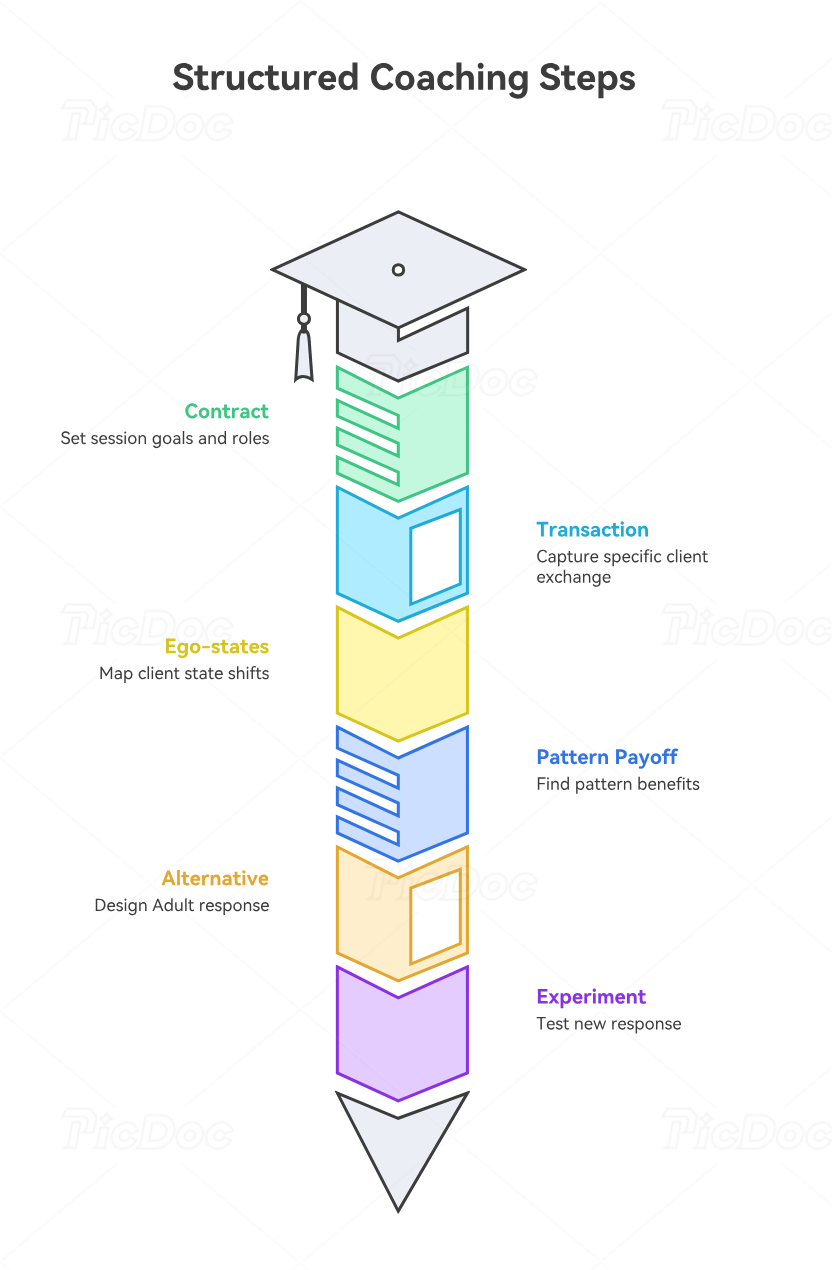
4. A Practical TA Protocol for a 60-Minute Coaching Session
TA works best when it produces a clearer choice rather than an impressive explanation. A structured session can combine micro-coaching, behavioral experimentation, emotional agility, and precise accountability planning.
Step 1: Create the contract
Ask what the client wants from the session and how both parties will recognize progress. “Understand why I struggle with my manager” remains broad. “Prepare an Adult response for tomorrow’s workload conversation” provides a useful contract.
Clarify the client’s responsibility, the coach’s role, the time available, and the intended outcome. This prevents the coach from drifting into rescuing, advice-giving, or unrestricted exploration. Strong contracting also improves client experiences, supports ethical practice, and strengthens coaching-business systems.
Step 2: Capture one real transaction
Ask the client to reconstruct a specific exchange as accurately as possible:
What was said first?
What did you say next?
What tone, expression, or assumption affected the exchange?
What did you want the other person to do?
What happened afterward?
Specific dialogue produces more insight than general descriptions. The coach can observe how the client’s communication style, stress response, emotional interpretation, and relationship expectations interacted.
Step 3: Map the ego-state shifts
Invite the client to identify the thoughts, emotions, behaviors, and assumptions operating at different moments. Avoid turning the analysis into a quiz with one correct label.
Ask:
Which rules or judgments appeared?
Which older emotional response became active?
What information was available in the present?
Which state would support the desired result?
What resource exists in another state?
A client may need Adult clarity, Nurturing Parent reassurance, and Free Child creativity in the same conversation. Flexible access is more valuable than rigid classification. This flexibility supports holistic coaching, positive psychology, strengths-based work, and practical confidence development.
Step 4: Identify the pattern’s payoff
Repeating patterns usually continue because they create some immediate benefit, even when the long-term result is costly. The client may avoid rejection, receive recognition, preserve familiarity, escape responsibility, maintain control, or confirm an existing belief.
Ask:
What does this pattern protect you from?
Which recognition does it produce?
What uncomfortable action does it postpone?
Which familiar conclusion does it confirm?
What would become necessary if the pattern stopped?
The purpose is to increase responsibility without shame. That balance is central to transformational coaching, resilience work, safe coaching, and effective client feedback.
Step 5: Design an Adult alternative
Help the client create a response grounded in current information, direct communication, clear ownership, and realistic consequences.
An Adult alternative may involve:
Asking for clarification
Stating an observable fact
Expressing a direct need
Negotiating a deadline
Refusing inappropriate responsibility
Requesting specific feedback
Pausing before reacting
Acknowledging uncertainty
Making a bounded decision
The alternative should fit the client’s voice. Scripted language that feels artificial will disappear under pressure. Rehearsal strengthens constructive communication, emotional intelligence, confidence under stress, and behavioral follow-through.
Step 6: Run the experiment
The client should test the new transaction within a specific context. Define:
The person involved
The likely trigger
The new response
The earliest interruption point
The minimum successful attempt
The recovery plan
The evidence to record
A useful experiment might be: “When my colleague asks me to repair work they own, I will ask which solution they have already attempted before offering help.”
This connects the session to habit formation, accountability coaching, automated follow-up, and stronger client retention.
5. How Coaches Can Use TA Responsibly and Build Greater Credibility
TA’s accessibility can tempt undertrained practitioners to use complex psychological language too confidently. Responsible coaching requires accurate representation of training, careful scope boundaries, informed consent, and referral pathways. These standards strengthen legal compliance, protect the coaching environment, improve client trust, and support sustainable practice growth.
Use models as hypotheses
A coach may notice a Parent–Child dynamic, restrictive script, or repetitive game. Present the observation as an invitation:
“One possible interpretation is that the conversation shifts into a Parent–Child pattern when your manager questions the timeline. How does that fit your experience?”
This allows the client to evaluate the model. Declaring a hidden motive as fact can create dependence, defensiveness, or false certainty. Collaborative interpretation aligns with constructive feedback, emotional intelligence coaching, safe coaching principles, and professional expectation management.
Remain within coaching scope
TA has applications across coaching, organizations, education, counselling, and psychotherapy. That broad reach does not erase the boundaries between those fields.
A coach can work with present behavior, goals, communication, decisions, professional relationships, accountability, and planned experiments. Clinical assessment, trauma treatment, severe psychological distress, self-harm risk, or major functional impairment may require a qualified mental-health professional.
Coaches should establish referral procedures and understand how to respond when clients experience emotional crises, severe anxiety or stress, destabilizing life events, or needs beyond the agreed coaching contract.
Pursue credible training
The European Association for Transactional Analysis describes TA 101 as its official introductory course. It covers core concepts through theory, practical exercises, and discussion, requires at least 12 hours, and leads to an EATA-recognized certificate upon completion.
An introductory course can strengthen conceptual accuracy while remaining only an introduction. Coaches planning to make TA central to their practice should pursue appropriate supervision, advanced training, ethical guidance, and continuing professional development.
Professional associations also regulate specific TA qualifications and titles within their certification systems. Coaches should represent their credentials precisely and avoid implying a professional status they have not earned. This accuracy supports a stronger certification portfolio, reduces credentialing mistakes, strengthens CPD development, and protects professional credibility.
Integrate TA into a defined coaching offer
TA becomes commercially useful when connected to a client problem rather than marketed as abstract theory. Potential offers include:
Adult-to-Adult leadership communication
Breaking approval-seeking patterns
Boundary coaching for chronic rescuers
Transactional conflict coaching for teams
Confidence coaching around authority figures
Burnout recovery for overresponsible professionals
Communication coaching for founders and executives
Each offer should include a behavioral assessment, clear contract, transactional mapping, live rehearsal, practical experiments, progress measures, and maintenance planning.
Results can be documented through carefully constructed coaching case studies, stronger client-feedback systems, structured retention strategies, and ethical high-ticket offer design.
6. Frequently Asked Questions About Transactional Analysis in Coaching
-
Transactional Analysis is a framework for understanding personality, communication, relationships, and repeating behavioral patterns. Coaches can use it to examine which ego states become active, how communication exchanges unfold, what recognition a client seeks, and which familiar patterns keep producing the same outcome.
Its practical language makes TA compatible with emotional intelligence coaching, behavior-change work, transformational coaching, and structured client accountability.
-
The Parent ego state contains learned rules, attitudes, judgments, and caring behaviors. The Adult state processes current information and makes reality-based decisions. The Child state contains earlier emotions, adaptations, impulses, fears, and creativity.
Every state can contain useful and limiting qualities. Effective coaching helps clients develop flexibility rather than trying to remain permanently “Adult.” That flexibility supports emotional agility, positive psychology, strengths-based coaching, and healthier professional relationships.
-
TA addresses several persistent coaching challenges: repeating conflicts, vague communication, approval-seeking, weak boundaries, hidden resistance, and commitments that collapse after the session. Its concepts are memorable, observable, and transferable to real conversations.
TA also integrates naturally with micro-coaching, habit formation, leadership development, and modern coaching automation.
-
Coaches can apply TA-informed questions to present behavior, communication, decision-making, accountability, professional relationships, and goal-directed experiments. They must maintain clear boundaries around clinical assessment, diagnosis, trauma treatment, and severe psychological distress.
Responsible application includes appropriate training, transparent credentials, informed contracting, supervision, and referral procedures. These practices align with legal requirements for coaches, safe coaching environments, support during emotional crises, and professional certification development.
-
An Adult-to-Adult transaction involves direct, present-focused communication that respects each person’s capacity to think, choose, negotiate, and accept responsibility. It commonly includes observable facts, specific requests, realistic options, and clear boundaries.
For example, “You never respect my time” can become, “The last two meetings started 20 minutes late. Can we agree that future meetings begin at the scheduled time?” This supports constructive feedback, expectation management, emotional intelligence, and healthier conflict resolution.
-
TA helps clients map the sequence that maintains the pattern: trigger, ego-state response, transaction, recognition sought, emotional outcome, and belief reinforced. The coach and client can then choose the earliest point where a different response becomes possible.
A client who repeatedly rescues colleagues may learn to notice the urge, ask what support was requested, return ownership, and tolerate the discomfort of stepping back. Repeated practice can be reinforced through accountability coaching, habit stacking, behavior-change planning, and resilience coaching.
